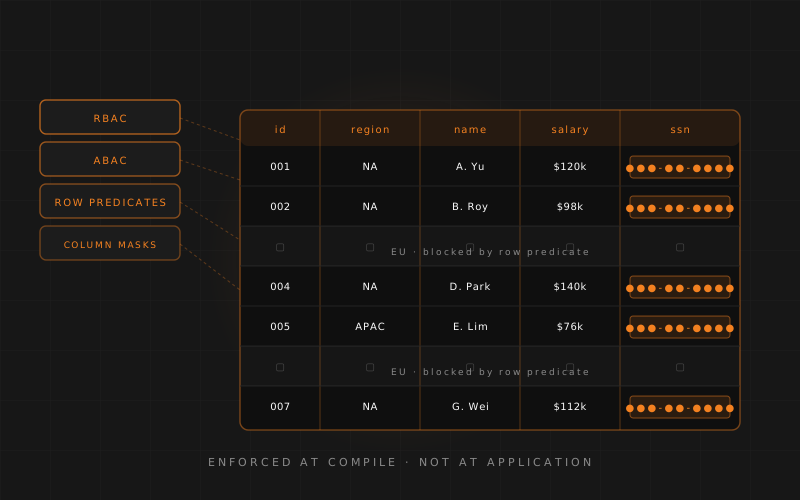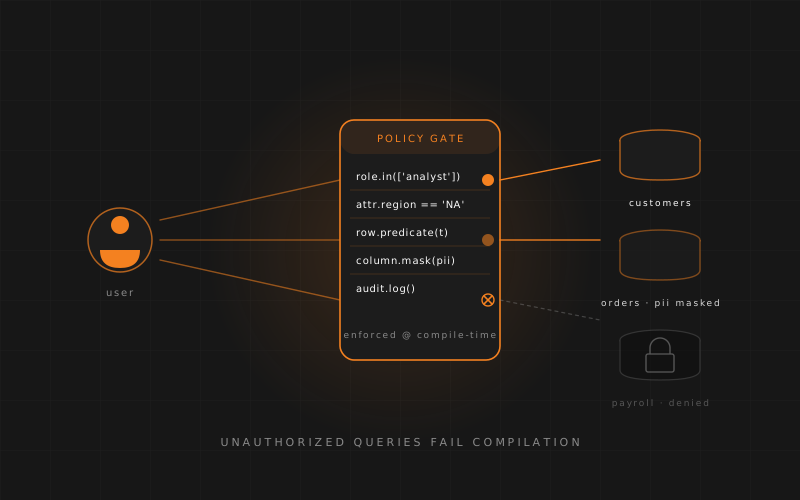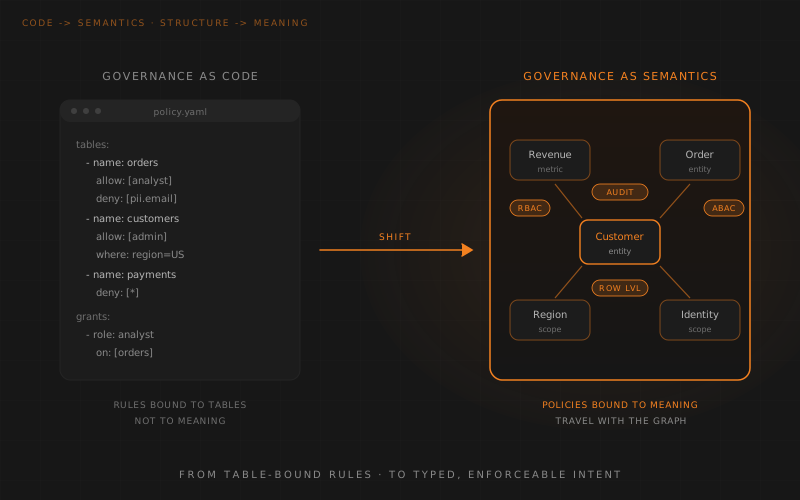
That gap, between what the data means and what the system actually enforces, is the story of governance over the last decade. We have moved from tagging by hand, to writing policy as code, and now to compiling policy into meaning. This post walks all three paradigms honestly: where the policy lives, where it is enforced, how each one fails, and why the semantic version is becoming the default for regulated enterprises and data mesh architectures. For how this applies to how semantic layers reframe data consumption, see the detailed comparison.
No buzzwords. Concrete examples. A clear view of where Colrows fits and where it does not.
The governance burden nobody budgeted for
Start with the cost, because it is larger than most teams admit. McKinsey's 2023 Master Data Management Survey of more than 80 global organizations found that 82% of respondents spend one or more days per week resolving master data quality issues, and 66% rely on manual review to do it. Monte Carlo's 2022 State of Data Quality survey of 300-plus data professionals put it bluntly: respondents reported spending, on average, 40% of their time evaluating or checking data quality. Gartner's July 2020 Magic Quadrant for Data Quality Solutions pegged the average cost of poor data quality at $12.9 million per organization per year.
This is not a tooling problem you can buy your way out of with another catalog. It is structural. When governance is a manual, after-the-fact activity, it decays at the same rate your data changes, which is to say constantly. Gartner went as far as predicting, in February 2024, that by 2027, 80% of data and analytics governance initiatives will fail due to a lack of a real or manufactured crisis.
Three failure patterns show up everywhere: manual tagging that cannot keep up, policy decay as definitions drift, and enforcement scattered across systems that do not talk to each other. Each paradigm below is an attempt to fix one of these. Only one fixes all three.
Paradigm 1: Manual governance (reactive tagging)
Where the policy lives: in a metadata catalog like Collibra or Alation. A human steward tags tables and columns with sensitivity, PII status, retention rules, and access classifications.
Where it is enforced: somewhere else entirely. The catalog documents intent; a separate system carries it out, usually database row-level security, dynamic data masking, or a quarterly access review.
The operational model: every new table is a ticket. A steward reviews it, tags it, and hopes the downstream enforcement picks up the tag.
This is documentation pretending to be control. The decoupling is the whole problem. The catalog and the enforcement engine have different owners and different lifecycles, so they drift apart the moment anything changes.
How it fails:
- Stale tags. Tagging is manual and does not update when the schema does. A column gets renamed, a new `ssn_backup` field gets added during a migration, and the catalog never hears about it.
- Silent enforcement failures. The tag says PII, but the masking rule that was supposed to act on it is missing, or points at the old column name. The tag is right and the data is still exposed. Nothing flags it.
- No audit trail. When did the tag change? Who approved it? In most catalogs you cannot reconstruct the answer.
- High toil. Snowflake's own documentation admits "a purely manual tagging process is difficult to sustain because new tables, columns and derived assets" arrive faster than humans can classify them.
Manual governance produces a binder of intentions. It cannot prove, on demand, that the intention was enforced. For a SOX or HIPAA auditor, the binder is not the point. The enforcement is.
Paradigm 2: Governance-as-code (proactive policy)
Where the policy lives: in version control. Access rules, row filters, and masking logic are written as code (Terraform, YAML, SQL), reviewed in pull requests, and tested like software.
Where it is enforced: still at runtime, in the warehouse engine, but now the rules are deployed deterministically from a reviewed source of truth.
This was a genuine leap, and the major platforms have built real machinery for it. (For an autonomous agent generating SQL, the rules here become critical. They prevent hallucinated definitions from producing wrong answers.)
Databricks Unity Catalog lets you write attribute-based policies directly:
CREATE POLICY mask_pii ON CATALOG prod COLUMN MASK prod.governance.mask_value TO `account users` EXCEPT `etl_service_principal` FOR TABLES MATCH COLUMNS has_tag_value('pii', 'ssn') AS ssn ON COLUMN ssn;
One policy, attached at the catalog level, applies automatically to every table carrying the `pii:ssn` governed tag. It is deployable via SQL, REST API, SDK, or Terraform, and every policy change is captured in the audit log.
Snowflake version-controls role hierarchies, dynamic masking, and row access policies through Terraform, with tag-based masking so you "tag once, govern everywhere."
dbt defines metrics, access controls, and business logic in YAML next to the models, so governance changes flow through the same pull-request-and-test workflow as transformations. MetricFlow compiles metric definitions into SQL.
What it fixes: version history, peer review, testability, consistency, shift-left enforcement. This is the floor every serious data team should already be standing on.
How it still fails:
- Policy-definition drift. An RLS rule references `region_code`. A refactor renames it to `region`. The policy now silently filters nothing, or everything.
- Silent runtime failures. A row filter UDF has a logic bug and returns zero rows. The dashboard looks empty, someone assumes "no data this week," and moves on.
- Test-coverage gaps. Policies are tested in isolation, not in integration with the metrics that depend on them.
- The structural gap. Policy logic lives separately from semantic meaning. When you change the definition of "active customer" in your metric layer, the row access policy that also references "active customer" does not change with it. You have two definitions of the same concept, governed by two systems, kept in sync by hope and code review.
Governance-as-code makes the rules trustworthy. It does not make the meaning and the rules inseparable. That is the next move.
Paradigm 3: Governance-as-semantics (semantic governance)
Where the policy lives: inside the typed definition itself. A metric carries its formula, its scope, and its access predicates as one object. A dimension carries the personas allowed to see it. An entity carries its RBAC.
Where it is enforced: at compile time, before any SQL is generated. When a query is compiled, the policy shapes the subgraph of allowed entities and join paths. An unauthorized resolution fails compilation. The data is never read. There is no post-query filter left to bypass. This compile-time enforcement is the same architectural line that separates a traditional runtime semantic layer from a semantic execution layer.
This is the difference between "structure" and "meaning." Code-based governance can confirm you are allowed to read the `orders` table. It cannot tell whether the number you computed used the finance team's definition of revenue or a stale one. An access-compliant query can still be a wrong query. The agent reads the right table, joins the right column, and returns a number calculated with the wrong definition. The audit log says everything is fine. The number is still wrong.
Semantic governance closes that gap by refusing to separate "what revenue is" from "who can see it."
You can see the industry converging here. Palantir Foundry binds "semantic elements (objects, properties, links) and kinetic elements (actions, functions, dynamic security)" into one ontology, with "granular policies ... dynamically computed at runtime for every interaction," governing human and AI access with the same controls; the N3C health research consortium governs access to data from thousands of hospitals via Purpose-Based Access Controls on that ontology. Databricks ABAC is a partial step in the same direction: it is "fail-closed," denying access when it cannot verify security, though it remains runtime row and column enforcement rather than compile-time graph shaping.
In the Colrows semantic graph, every entity, metric, and relationship is a typed first-class object, and policies attach to those objects with the same lifecycle. When metric stores evolve into knowledge machines, the policy travels with the concept:
- Entity-level RBAC. Read access to `Customer` applies to every metric, dashboard, and agent query that resolves through it.
- Metric-level masking. A definition declares which dimensions are visible per persona, and that masking travels with the metric into every consumer.
- Relationship-level row predicates. When the planner proves a join path, the policies on each edge contribute their predicates to the emitted SQL.
- Compile-time enforcement. Unauthorized resolutions fail compilation. The data is never read.
How it fails (honestly): the failure surface is smaller, but it is not zero. Policy is bound to versioned definitions, so failures are compile-time and loud: ambiguity raises an error instead of silently returning the wrong number. The real cost is up front. You have to build the semantic model. The payoff is that you were going to build that model anyway for analytics and AI agents, and governance comes along for free rather than as a separate maintenance loop.
The three paradigms side by side
| Dimension | Manual (tagging) | Governance-as-code | Governance-as-semantics |
|---|---|---|---|
| Where policy lives | Catalog metadata | Git (Terraform, YAML, SQL) | The typed definition itself |
| Where it is enforced | Separate downstream system | Runtime, warehouse engine | Compile time, before SQL |
| Coupled to meaning? | No | No | Yes |
| Version controlled? | Rarely | Yes | Yes (with the concept) |
| Typical failure | Stale tag, silent gap | Drift, silent wrong result | Loud compile-time error |
| Audit | Reconstruct across tools | Read the Git history | The runtime is the audit |
| Speed to deploy a change | Weeks (ticket + review) | Days to weeks (CI/CD) | Hours (recompile) |
| New table / domain | Manual review each time | New policy each time | Inherits from the graph |
Why this is becoming table stakes: the regulatory case
Every major control framework rewards the same thing: documented, tested, versioned, provable controls. That is precisely what compile-time semantics produces as a by-product.
- SOX 404 requires internal controls over financial reporting that are documented, tested, and certified, and auditors test IT change-management and access controls most heavily of all. A manual tag cannot show its test history. A compiled policy can.
- HIPAA 45 CFR 164.312(a) requires "Unique user identification" and "Emergency access procedure" as mandatory specifications, limiting access to authorized persons or software programs. Semantic policies that resolve under the requesting identity, persona, and scope satisfy this by construction.
- GDPR Article 32 requires "appropriate technical and organisational measures" plus "a process for regularly testing, assessing and evaluating the effectiveness" of them. When the policy is the definition, the test is automatic.
- PCI DSS Requirement 7 demands least privilege, role-based access, and default deny-all (7.2, 7.3), with bi-annual access reviews in v4.0. Manual governance cannot prove segregation of duties at scale; encoded policy can.
- EU AI Act Article 10 requires high-risk AI systems to apply "data governance and management practices appropriate for the intended purpose," with enforcement beginning 2 August 2026. Regulators increasingly want operational evidence, not documentation. Semantic governance makes the evidence the runtime.
This is the bridge between the technical property and the business requirement. The compile-time property (policy bound to definitions) directly produces the audit property (every query carries its graph version, resolved entities, proven join paths, and the policies that fired). A historical query can be replayed against the graph version in force at the moment the question was asked. The auditor stops chasing logs across five tools. The audit is the runtime.
Why this is becoming table stakes: data mesh
Data mesh makes the problem unavoidable. Its fourth principle, federated computational governance, asks you to balance local domain autonomy with global consistency, and to embed "computational policies in each and every domain and data product." That is a hard problem precisely because consistency across the mesh is hard.
- Manual tagging fails the moment two domain teams tag "customer" differently.
- Governance-as-code helps but leaves policy siloed inside each domain's repository, so the same concept is governed three different ways in three domains.
- Governance-as-semantics resolves it. A federated semantic layer defines the shared entity once. Policies resolve per context (persona, tenant, region), so the same "customer" is governed consistently everywhere while each domain keeps ownership of its own products.
That is the property a mesh actually needs: shared meaning, local autonomy, one consistent policy resolution.
Does this replace governance-as-code?
No. It absorbs it. Code-based rules become the structural floor. The policy engine still enforces "no PII to anonymous callers"; the semantic layer adds "no customer-acquisition cost metric to a finance persona using last quarter's definition." Both fire before data is read. Neither is optional.
And to be clear about scope: semantic governance only governs what you have modeled. Raw landing zones, un-modeled exploratory tables, and data outside the graph still need code-based or manual governance underneath. The honest pitch is not "semantics replaces everything." It is "semantics governs the meaning layer your analytics and agents already run on, deterministically, and the structural floor handles the rest."
Manual tagging and even code-based policy still bolt rules onto data after the fact; governance-as-semantics compiles meaning and policy into the same graph so both fire before data is read. Fix the Context, Not the Model.
Where Colrows fits
Colrows is a semantic execution layer. Policy compiles into the semantic graph rather than getting bolted on at runtime, so RBAC and ABAC predicates shape which entities and joins are reachable per identity, persona, and scope, and unauthorized resolutions fail at compile time. For regulated industries, that turns a compliance posture into compliance evidence: the runtime is the audit.
It is the evolved answer to governance-as-code, not a rejection of it. If you have already invested in dbt policies, Unity Catalog ABAC, or Snowflake row access policies, that work is the floor you build on. Semantic governance is the layer that finally makes meaning and policy inseparable.
Curators do not govern blind: every entity in the graph - metrics, business terms, relationships, table joins - is versioned, attributed, and reviewable in Entity Manager, so a policy or definition change is never a silent edit.
Frequently asked questions
What is the difference between governance as code and governance as semantics?
Governance as code stores access policies as version-controlled code that the warehouse enforces at runtime. Governance as semantics compiles the policy into the typed definition itself, so enforcement happens at compile time, before any SQL is generated.
What are the three data governance paradigms?
Manual tagging in a catalog, governance-as-code in version control, and governance-as-semantics compiled into the semantic model. Each moves enforcement closer to the definition and reduces silent failures.
Why does manual data tagging fail?
Tags are applied by humans and do not update when schemas change, enforcement lives in a separate system that drifts, there is no version history, and wrong tags fail silently. McKinsey found 82% of respondents spend one or more days per week resolving master data quality issues.
Is governance-as-code enough for compliance?
It satisfies SOX and similar frameworks' requirements for documented, tested, version-controlled policies, but enforcement is still runtime and policy stays separate from metric and entity definitions, so definition changes can desync from the policies that depend on them.
What is compile-time policy enforcement?
Policy shapes the allowed subgraph of entities and joins before SQL is generated, so an unauthorized resolution fails compilation and the data is never read, rather than being filtered after the fact.
How does semantic governance help with audits?
Every query carries the semantic graph version, resolved entities, proven join paths, and the policies that fired, so a historical query can be replayed against the graph version in force when it was asked. The runtime becomes the audit trail.
How does semantic governance solve data mesh consistency?
A federated semantic layer defines shared entities once and resolves ABAC policy per context, so the same concept is governed consistently across domains while owners keep local autonomy.
Does semantic governance replace existing tools like dbt or Unity Catalog?
No. Code-based rules remain the structural floor; semantic governance adds meaning-bound enforcement on top. Raw and un-modeled data still needs code-based or manual governance underneath.