The Security Tension Every CTO Is Living With
There are two pressures pulling in opposite directions. The business wants analysts, data scientists, and now AI agents to get to data faster. Compliance wants every access to be authorized, minimal, and provable after the fact. Most data platforms resolve this tension in the worst possible place: the presentation or BI layer, after the warehouse has already executed the query and read the data. The result is a system that feels fast until an auditor asks a question it cannot answer, or until a redaction bug means unauthorized data was read even though it was hidden on the way back.
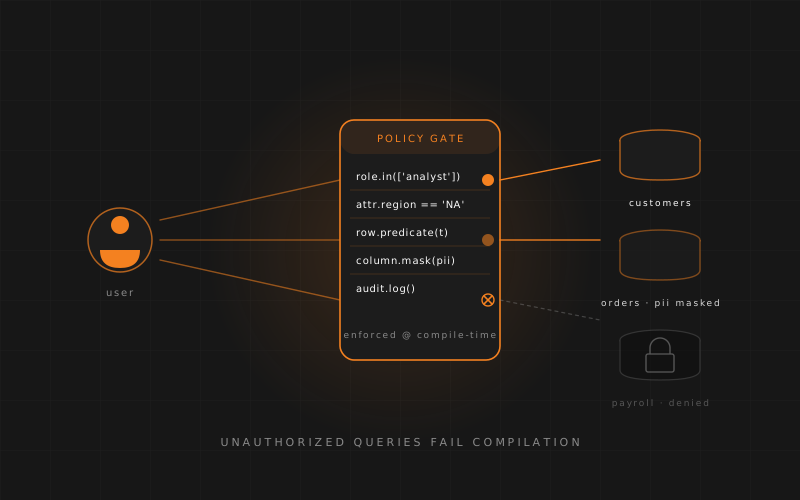
The thesis of this guide is that the tension dissolves when you move enforcement to compile time, when the layer that decides what SQL gets generated is also the layer that decides what is allowed. That is what Colrows does, and it is why the rest of this guide treats compile-time enforcement as the default architecture for regulated, multi-warehouse estates.
| Aspect | Post-Hoc BI-Layer Enforcement | Colrows Compile-Time Enforcement |
|---|---|---|
| Where policy applies | After the warehouse executes the query and reads the data | During query planning, before any data is read |
| Data exposure | Data read into memory, then filtered or redacted on return; one bug leaks it | Fails closed; unauthorized intent fails compilation, so the data is never read |
| Audit evidence | Log records that a query ran, not why rows were withheld | Reproducible record: graph version, identity, proven join paths, compiled SQL |
| Multi-warehouse policy | Separate policy stack per engine, prone to drift and missed revocations | One RBAC/ABAC policy set compiled across 16+ engines |
| Regulatory fit | Hard to answer "who accessed what, when" across the estate | Point-in-time reproducible for HIPAA, GDPR, SOX, and EU AI Act |
Section 1: The RBAC Trap, and Why It Still Dominates
Role-Based Access Control (RBAC) is intuitive: roles map to the org chart, and permissions attach to roles. It is easy to explain to a non-engineer, which is exactly why it persists. But RBAC encodes meaning statically. Every time a new dimension of access appears (a region, a department, a clearance level, a purpose), you multiply roles. N roles × M attributes becomes a combinatorial explosion: Manager_NY, Manager_CA, Manager_East, Manager_NY_PII, and so on.
GigaOm's independent benchmark, ABAC vs. RBAC: The Advantage of Attribute-Based Access Control over Role-Based Access Control (25 January 2023), put numbers on this. Across its basic and row-level scenarios, RBAC (tested with Apache Ranger) produced 745 policy changes; column-tagging RBAC (Satori) produced 401; attribute-based access control (Immuta) produced just 8, a 93x reduction, with an estimated ~$500,000 in operational savings. ABAC was the only approach that could satisfy advanced scenarios such as purpose-based restrictions and de-identification at all.
RBAC is the starting layer, not the destination. Colrows reads role assignments from your directory (Okta, Azure AD, etc.) and uses them as the first layer of policy evaluation, then layers ABAC on top, so a single policy ("user.department matches data.owner_dept") replaces dozens of role combinations.
Section 2: ABAC and Its Promise
Attribute-Based Access Control is formally defined in NIST Special Publication 800-162 (January 2014, with updates through August 2019), which describes ABAC as a logical access-control model that evaluates rules against attributes of the subject, the object, the requested operation, and environment conditions. The power of ABAC is expressiveness: one policy per access pattern instead of one role per combination. The cost is discipline: you must define and govern attributes, and the policies are harder to explain to non-engineers than "you're in the Managers group."
Colrows lets you express ABAC policies in plain, declarative terms ("Finance Analysts can read NetRevenue, but only for accounts in their region, only during business hours") and compiles them into SQL predicates. Policies are versioned, testable, and bound to a typed semantic graph. Colrows integrates with OPA (Open Policy Agent), so policy decisions can be externalized to a dedicated engine or identity provider and user entitlements can be pulled from external sources.
Section 3: The Multi-Warehouse Trap
Snowflake, Databricks, and BigQuery all ship capable native access control. The problem is that they are separate policy stacks. A "MarketingManager" entitled in Snowflake must be re-entitled in Databricks and again in BigQuery. Three consequences follow:
- Policy drift: the same logical rule diverges across three dialects and three admin consoles.
- Missed revocation: a termination is processed in one system and forgotten in another; the analyst keeps access where nobody looked. OCR's $1.19M penalty against Gulf Coast Pain Consultants (3 December 2024) cited exactly this failure mode: not terminating a former workforce member's access. That impermissible access affected 34,310 individuals.
- Unanswerable audit questions: when an auditor asks "who has access to customer data across the estate?", the answer lives in three places and reconciling them is a manual project.
Snowflake's own documentation underscores the boundedness: masking policies are schema-level objects scoped to an account, only one masking policy is allowed per column, and cross-account data sharing requires validating that policies remain attached in the consumer environment. The 2024 credential-based attacks on Snowflake customer environments (Ticketmaster, AT&T, Santander) showed that production data left fully intact and unmasked is exposed the moment credentials are compromised.
One RBAC/ABAC policy set, compiled to dialect-perfect SQL across 16+ engines (Snowflake, Databricks, BigQuery, Redshift, Postgres, MySQL, ClickHouse, Trino, and more), is the answer. Colrows sits between the policy and the warehouse; RBAC/ABAC/row/column predicates are injected into the generated SQL before it reaches each engine. A single revocation propagates everywhere, and any query traces back to the policy and the attribute that allowed it.
Section 4: The Compliance Drivers
Each major framework maps to a concrete technical control.
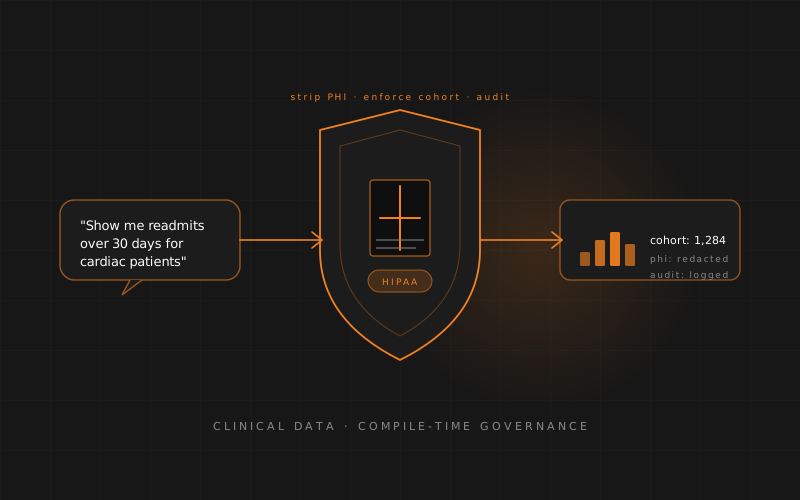
HIPAA (45 CFR §164.312, §164.502). The Security Rule's Access Control standard requires Unique User Identification and Audit Controls. The Privacy Rule's "minimum necessary" standard forces granular reasoning about who sees what. OCR enforcement in 2024 was heavy: OCR imposed 22 financial penalties and collected $9,944,612 across settlements. On 31 July 2025, Change Healthcare notified OCR that approximately 192.7 million individuals were impacted, the largest healthcare breach ever reported. Conversational analytics for clinical data requires compile-time enforcement to ensure every agent query is auditable.
GDPR (Articles 5, 32, 33, 83). Article 32 requires "state of the art" technical and organizational measures including appropriate access control; Article 5(1)(f) mandates "integrity and confidentiality"; Article 33 requires 72-hour breach notification. Article 83(5) caps the most serious fines at €20M or 4% of total worldwide annual turnover, whichever is higher. Fine-grained access is a documented mitigating measure.
SOX (Sections 302, 404, 906). Section 302/906 require CEO/CFO certification of financial-reporting controls. ITGCs require segregation of duties (SoD) and user-access controls, impossible to demonstrate without fine-grained, reviewable access. The PCAOB's amended AS 2201/AS 2101 take effect for audits of fiscal years beginning on or after 15 December 2026.
BCBS 239 / ECB RDARR (May 2024). The ECB's Guide on effective risk data aggregation and risk reporting prioritizes data quality, data lineage, governance ownership, and audit-trailing of manual workarounds, specifically "rigorous documentation and audit trailing of changes, data overrides and sign-offs" in an "audit-trailed IT-controlled environment." The relevant pressure for fine-grained control is traceability and reproducible audit trails. Citigroup's combined $135.6M penalty (10 July 2024) was for data-quality-management and governance deficiencies, not specifically access control.
EU AI Act (Regulation 2024/1689). Article 12 requires high-risk AI systems to automatically log events over their lifetime; Article 26(6) requires logs be retained for at least six months. High-risk obligations become enforceable 2 August 2026, with penalties up to €15M or 3% of global annual turnover. Annex III high-risk areas include credit, insurance, employment, and access to essential services, exactly the domains where analytics agents touch sensitive data.
The cost of getting it wrong. IBM's Cost of a Data Breach Report 2025 put the global average at $4.44M but the U.S. average at a record $10.22M. Healthcare led at $7.42M with a 279-day breach lifecycle. Of the 13% of organizations that reported breaches of AI models or applications, 97% reported not having AI access controls in place, a direct indictment of ungoverned data access.
Compile-time enforcement produces exactly the evidence these regimes ask for. Every Colrows query emits an audit record containing graph version, identity context, resolved entities, proven join paths, compiled SQL, and cardinality estimates, and it is point-in-time reproducible. Because enforcement happens before execution, data is never read without authorization.
Section 5: Compile-Time vs. Post-Hoc Enforcement
Post-hoc (traditional BI/database layer): the query executes, data is read into memory, then filtered or redacted at presentation. Three weaknesses: data is exposed in transit even when redacted on return; the audit log records that a query ran, not why rows were withheld; and if the filter logic has a bug, unauthorized data was still read.
Compile-time (Colrows): policy is applied during query planning. Colrows shapes the allowed subgraph for each persona before a plan is produced. If a metric depends on a node outside the persona's scope, resolution fails during compilation, not at the warehouse after a multi-minute scan. The security property is "fail closed": unauthorized intent fails compilation and the data is never read. The auditability property is a non-repudiable trace from intent → policy → compiled SQL → execution. There is, in Colrows' phrasing, "no way to smuggle a column past the planner."
Section 6: Row-Level and Column-Level Control in Practice
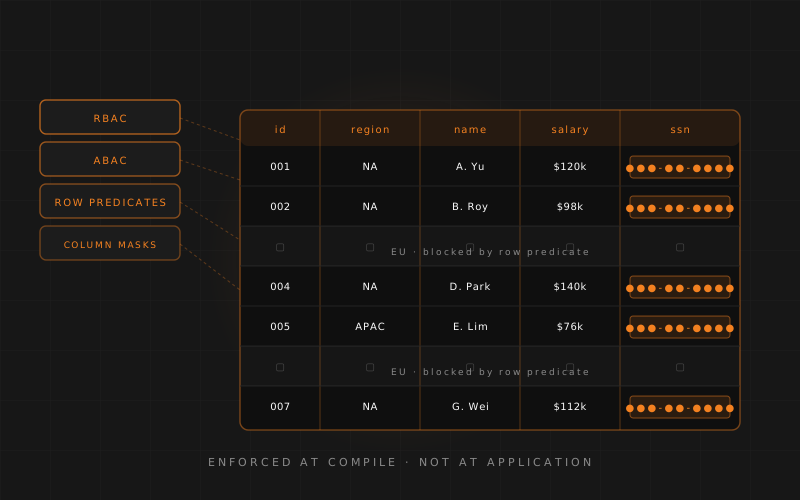
Fine-grained control spans four mechanisms: row-level (which records: "MarketingManager sees only their region"), column-level (which fields: "Sales sees customer name, not SSN"), dynamic masking (conditional redaction, hashing, tokenization), and aggregation (sums and averages but not individual rows). The utility-vs-privacy trade-off is real: some analyses survive masking, others don't.
Row and column predicates are authored once as policy and compiled into every query. A single policy ("user.region == data.region AND data.sensitivity <= user.clearance_level") can enforce row visibility, column visibility, and masking simultaneously across all queries and all engines, applied before data is read. Entitlement policies grant access at row and column level based on data attributes, with cluster-based control for consistency across sources. Self-serve analytics without losing control. That is the goal of fine-grained row and column enforcement.
Section 7: Audit Trails and the Compliance-Evidence Problem
Regulators ask a deceptively simple question: "Show me who accessed what data, when, and with what result." Post-hoc systems answer "query executed; X rows filtered afterward," which proves neither that the filter was intentional nor that it was correct. Compile-time systems answer "user requested X; policy evaluated to Y; SQL was compiled with predicates Z; the warehouse returned N rows." That is the difference between a log and evidence.
Colrows' reproducible audit record (replay any past query and get the same answer with the same audit trail) is the acceptance test regulators increasingly expect. It directly satisfies the spirit of EU AI Act Article 12 logging and HIPAA §164.312(b) audit controls. Data authorization at the policy layer, not the BI layer, is the structural answer.
Section 8: Implementation Roadmap
- Month 1: Inventory. Map current access patterns (who accesses what) and define RBAC base roles from your directory.
- Month 2: Author ABAC. Define user attributes, data attributes, and matching rules; version policies in Git.
- Month 3: Predicates and testing. Implement row/column predicates and dynamic masking; validate against a golden dataset in a sandbox so testing never exposes real data.
- Month 4+: Production and monitoring. Deploy, then monitor audit trails and policy coverage. Define a break-glass (emergency access) procedure that is itself fully audited.
Colrows accelerates this with pre-built industry templates and OPA integration, and its free tier ($0, unlimited datasources, users, and access policies) lets teams prototype policies before committing to enterprise rollout.
Section 9: CTO Decision Framework
Database-native is sufficient when: you run a single warehouse, team structure is stable, regulatory burden is light, and there is no federated or multi-tenant data.
Semantic-layer compile-time enforcement becomes necessary when: you run two or more warehouses, team membership changes rapidly, AI agents or APIs query data programmatically, or you face HIPAA/SOX/GDPR/BCBS 239/EU AI Act audit intensity.
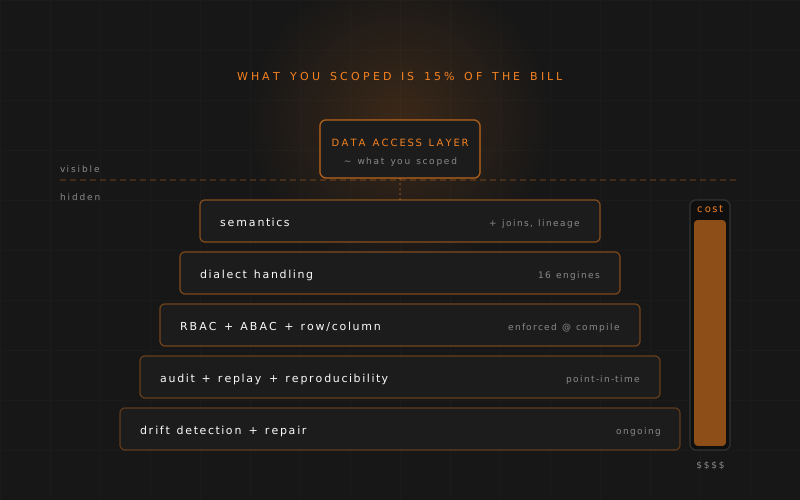
Build vs. buy: The hidden cost of building your own data access layer is a custom OPA + SQL-injection layer with multi-month build plus permanent maintenance, and it still leaves you to write the dialect translation and the audit record yourself. Colrows ships enforcement, multi-dialect compilation, and the reproducible audit trail as one layer.
Metrics to track: policy coverage (% of data-access paths covered by ABAC), time-to-audit-response, time-to-revoke (including emergency access), and incident-response time on unauthorized-access events. If policy coverage is below ~90% or audit-response time is measured in days, that is the threshold to move from native controls to a semantic enforcement layer.
The audit failures and breach costs in this guide trace back to where enforcement lives, not to smarter detection: move policy to compile time and unauthorized data is never read in the first place. Fix the Context, Not the Model.
Recommendations
- Now (0–30 days): Inventory your data estate and count your warehouses. If you run more than one analytical engine, treat unified policy as a priority. Stand up a Colrows free-tier instance and model your three riskiest access patterns as ABAC policies.
- Near-term (1–3 months): Externalize policy decisions to OPA where you already run a policy engine or IdP, and move row/column predicates into versioned, testable policy. Establish a golden-dataset sandbox so you can prove policies work without exposing data.
- Before your next audit: Adopt compile-time enforcement for any data subject to HIPAA, GDPR, SOX, BCBS 239/RDARR, or the EU AI Act, and validate that you can replay a historical query and reproduce its audit record. This is the single most decisive piece of evidence you can show.
- Triggers to escalate investment: add a second warehouse; deploy AI agents against production data; fail or barely pass a control audit; or measure time-to-revoke in days. Any one of these should move you off per-warehouse native controls.
Where a jurisdiction forbids the data leaving at all, this enforcement model becomes the deployment itself. See enterprise AI in the UAE.
Reconstructing who could see a row on a past date is covered in point-in-time query reproducibility.
For the measured evidence that guardrails and post-query filters are bypassable, and that the compile boundary is the only point reaching zero leakage, see how to secure AI agent database access.
Applied to tenancy, this is multi-tenant semantic isolation database design, where the cross-tenant query is made uncompilable rather than filtered out later.
Frequently asked questions
What is fine-grained data access control?
Fine-grained data access control manages permissions down to individual rows and specific columns within datasets. It spans four mechanisms: row-level control (which records), column-level control (which fields), dynamic masking (conditional redaction, hashing, tokenization), and aggregation-only access.
What is the difference between RBAC and ABAC?
RBAC attaches permissions to roles mapped to the org chart, which multiplies roles as new access dimensions appear. ABAC, defined in NIST SP 800-162, evaluates rules against attributes of the subject, object, operation, and environment. In GigaOm's January 2023 benchmark, RBAC produced 745 policy changes where ABAC needed just 8, a 93x reduction with roughly $500,000 in estimated operational savings.
Why enforce access control at compile time instead of the BI layer?
Compile-time enforcement applies policy during query planning, before any data is read. Unauthorized intent fails compilation, so the system fails closed and the warehouse never reads the data. Post-hoc filtering at the presentation layer exposes data in transit, and one redaction bug means unauthorized data was already read.
How does compile-time enforcement help with HIPAA, GDPR, and SOX audits?
It produces the evidence these regimes ask for. Every query emits an audit record containing graph version, identity context, resolved entities, proven join paths, compiled SQL, and cardinality estimates, and it is point-in-time reproducible. That answers HIPAA audit controls, EU AI Act Article 12 logging, and the SOX requirement for reviewable user-access controls.
When do database-native access controls stop being enough?
When you run two or more warehouses, team membership changes rapidly, AI agents or APIs query data programmatically, or you face HIPAA, SOX, GDPR, BCBS 239, or EU AI Act audit intensity. Separate per-warehouse policy stacks produce policy drift, missed revocations, and unanswerable audit questions.
What does a data breach cost without proper access controls?
IBM's Cost of a Data Breach Report 2025 put the global average at $4.44M and the U.S. average at a record $10.22M, with healthcare leading at $7.42M. Of the 13% of organizations that reported breaches of AI models or applications, 97% reported not having AI access controls in place.