HIPAA-Compliant Clinical Data Access: Comparison
| Capability | Standard RAG/LLM Pipeline | Colrows Deterministic Compiler |
|---|---|---|
| HIPAA Compliance | Difficult. Fragmented controls. | Native. Deterministic enforcement. |
| Data Masking | Runtime (hallucination risk). | Compile-time (guaranteed). |
| Auditability | Limited. Log-based only. | Full. Verifiable lineage. |
| Logic Consistency | Probabilistic. Hallucination risk. | Governed. Validated joins. |
| Access Control | Patchwork. Runtime filtering. | Integrated. RBAC/ABAC/RLS at compile. |
The hook: your EHR holds gold; ungoverned AI turns it into liability
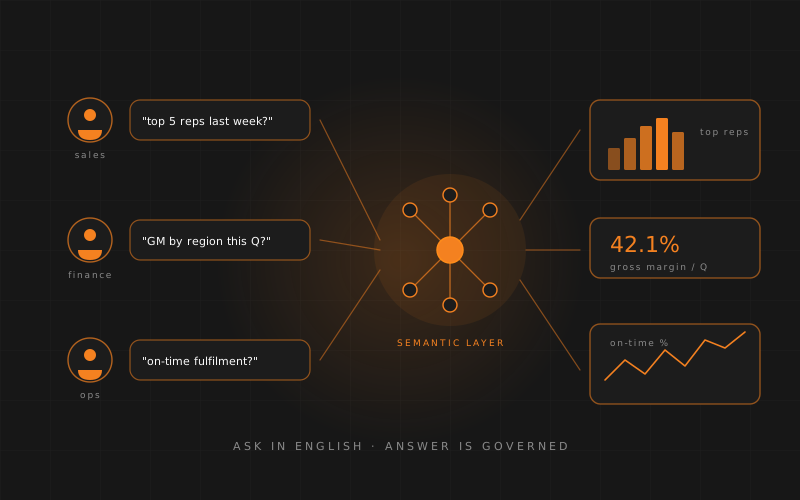
Walk into any health system in 2026 and you'll find the same tension. Clinical, operational, and financial data sits in Snowflake, Databricks, or a FHIR store, full of answers that could shorten length of stay, cut readmissions, and surface revenue leakage. Meanwhile clinicians and analysts wait days for a SQL-literate human to translate a question into a query. Conversational analytics ("ask your data in plain English") promises to close that gap.
But in healthcare, the naive version of that promise is dangerous. Point a general-purpose LLM at clinical tables and you inherit three liabilities at once: hallucinated joins that produce confidently wrong clinical numbers, PHI exposure when the model returns raw rows it should never have surfaced, and audit gaps your compliance officer cannot defend. IBM's 2025 report found that "shadow AI" (unauthorized AI tools) was a factor in 20% of breaches, adding $670,000 to average costs; and that of the 13% of organizations reporting an AI-model or AI-application breach, 97% lacked proper AI access controls. The healthcare breach now averages $7.42 million. The math is simple: the productivity upside of conversational analytics is real, but only if the governance is structural rather than aspirational.
The regulatory framework you can't skip
HIPAA Security Rule (45 CFR 164 Subpart C). The Security Rule requires access controls (§164.312(a)), audit controls that "record and examine activity in information systems that contain or use ePHI" (§164.312(b)), integrity controls, and transmission security. Every one of these maps directly onto what a conversational-analytics layer must enforce: who can ask what, what gets logged, and whether raw PHI ever leaves the warehouse.
The proposed Security Rule overhaul (January 6, 2025). HHS OCR published "HIPAA Security Rule To Strengthen the Cybersecurity of Electronic Protected Health Information" (90 FR 800), the first major update since 2013. It proposes to remove the "addressable vs. required" distinction and make implementation specifications mandatory; require encryption of ePHI at rest and in transit; mandate multi-factor authentication; require a technology asset inventory and network map maintained at least every 12 months; require annual compliance audits; require workforce-access termination within one hour of an employee's departure; and require business associates to verify their safeguards annually via written analysis by a subject-matter expert. Critically, the NPRM includes a Request for Information on AI, and HHS stated it expects AI software that interacts with ePHI to be listed in the technology asset inventory and included in risk analysis. The rule remains proposed (regulatory freeze and 4,700+ public comments have stalled it as of mid-2026); treat its requirements as the clear direction of travel.
HITECH Act. HITECH amplified HIPAA's penalties and breach-notification regime. Civil monetary penalties are tiered by culpability; effective January 28, 2026 (Federal Register inflation adjustment), they range from $145 per violation in Tier 1 to a maximum of $2,190,294 per violation in Tier 4, with annual caps. OCR continues to operate under its 2019 Notice of Enforcement Discretion, which lowered annual caps in three of four tiers ($25,000 / $100,000 / $250,000 for Tiers 1-3).
State laws. Washington's My Health My Data Act (effective March 31, 2024) regulates "consumer health data" beyond HIPAA's scope and, uniquely, provides a private right of action. Nevada's analogous law took effect March 31, 2024. CCPA/CPRA in California carve out HIPAA-covered PHI but reach other health-adjacent data. State breach-notification laws layer on top of HITECH's federal requirements.
International. GDPR treats health data as Article 9 "special category" data; 2024-2025 saw multimillion-euro healthcare fines. The Swedish DPA fined a healthcare provider €12 million in 2024 for inadequate consent mechanisms. A CMS Enforcement Tracker analysis found 265 healthcare GDPR fines totaling ~€32.3 million, with insufficient technical/organizational measures the most common cause. UK NHS suppliers must meet the Data Security and Protection Toolkit (DSPT); Canada's PIPEDA and Australia's Privacy Act add further regimes. GDPR's €20M / 4%-of-turnover cap is materially higher than HIPAA's per-violation structure.
Recent enforcement: the roadmap of what regulators punish
OCR's recent docket is a roadmap of what regulators are paying attention to. Montefiore Medical Center ($4.75M, February 2024): failed to conduct risk analysis, monitor system activity, and implement information-system-activity review. An insider stole 12,517 patients' ePHI over six months. PIH Health ($600,000, April 2025): phishing breach spanning Privacy, Security, and Breach Notification Rule violations. Solara Medical Supplies ($3M, January 2025). The trend is consistent: OCR is not (yet) issuing AI-specific fines, but its enforcement priorities (risk analysis, access control, audit logging) are precisely the controls an ungoverned AI analytics deployment undermines.
The cost-of-breach picture reinforces the stakes. The Change Healthcare ransomware attack (February 2024) hit 192.7 million individuals (HHS OCR breach portal) and cost UnitedHealth Group an estimated $3.09 billion "although that total could continue to rise", establishing that healthcare data risk is now a patient-safety and operational-continuity issue. IBM's 2025 Cost of a Data Breach Report puts the average healthcare breach at $7.42 million, still the costliest of any industry "for the past 14 years," with a 279-day average breach lifecycle, "five weeks longer than the global average breach lifecycle" of 241 days.
The conversational-analytics landscape in healthcare
What healthcare CIOs actually need from this category: HIPAA-readiness with a signed BAA, EHR/FHIR integration, complete audit trails, no PHI exposure in responses, and a deployment model that fits where their data already lives. Here's how the field maps:
- Microsoft Dragon Copilot (Nuance/DAX). The market leader in ambient clinical documentation, listening to patient encounters and drafting notes in Epic (general availability in Epic announced January 2024; merged with Dragon Medical One under the Dragon Copilot brand in March 2025). HITRUST CSF-certified, SOC 2 Type 2, BAA via Azure. Strength: documentation and EHR embedding; reported ~50% documentation-time reduction. It is not a cross-warehouse analytics layer.
- AWS HealthLake / HealthScribe. HIPAA-eligible, FHIR-native data lake with integrated medical NLP and zero-ETL SQL-on-FHIR; BAA via AWS Artifact. Strength: FHIR storage and API-first building blocks. You own the governance, UX, and safety layers yourself.
- Google Cloud Vertex AI / Vertex AI Search for Healthcare. FHIR/HL7 support, MedLM models, de-identification and DLP, BAA covering named services. Strength: infrastructure and search. The shared-responsibility model means compliance depends on your VPC-SC, IAM, CMEK, and logging configuration.
- Augmedix (acquired by Commure in 2024). Ambient documentation, EHR-integrated. Documentation-centric, not analytics governance.
- dbt Semantic Layer, Cube, Looker, ThoughtSpot. General-purpose semantic/BI layers; HIPAA-readiness depends on the surrounding warehouse and access configuration.
The "generic LLM problem" sits underneath all of these: a probabilistic model translating natural language to SQL can hallucinate joins, return non-reproducible answers, and surface PHI, none of which a compliance officer can attest to. The alternative is a compile-then-execute architecture that proves joins at graph-build time, not guess-time.
The Clinical Privacy Gap
Standard RAG/LLM implementations often leak PII during query generation because they lack fine-grained, compile-time access controls. Here is how the vulnerability emerges. An analyst asks "What is the average blood pressure for diabetic patients on medication X?" The LLM translates this to SQL. But during that translation, the model has already reasoned about the full dataset. It knows which tables contain patient identifiers. It knows which rows match the query criteria. When the runtime security filter fires afterward, the damage is done. The model has already computed outputs based on data the analyst should never see. The audit log shows "query executed" but cannot show "model reasoned over forbidden data." This is the compliance nightmare: governance-as-filter rather than governance-as-structure.
The Compiler Solution
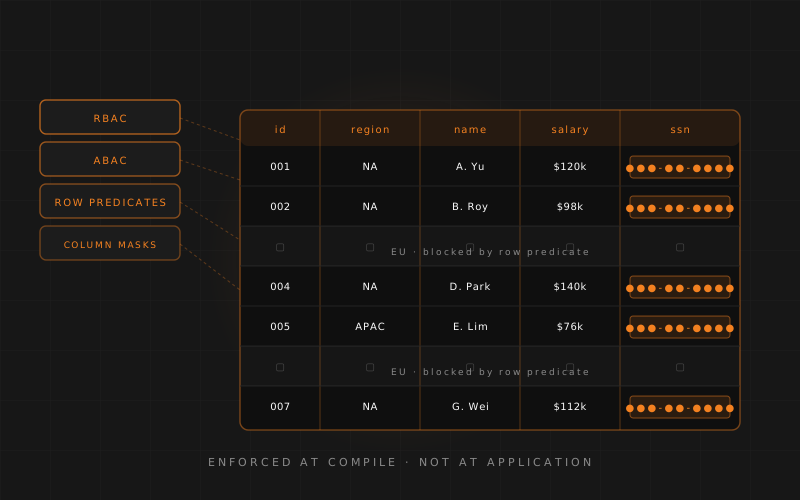
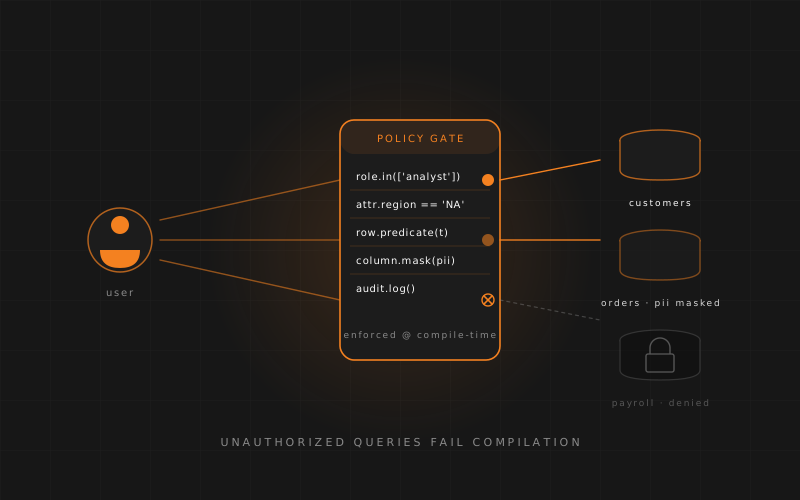
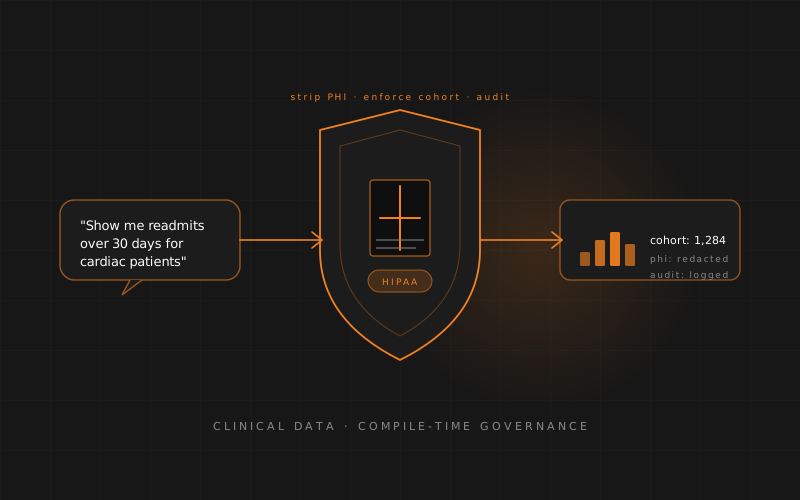
Colrows masks PII and enforces clinical governance before the SQL is ever generated. The AI agent only ever sees what it is explicitly authorized to access within the bounds of the semantic graph. When compile-time RBAC, ABAC, and row/column-level predicates are enforced, the query planner cannot even reason about unauthorized rows. The SQL that emerges already contains the security predicates. The authorization is baked into the query logic, not applied as an afterthought. A diabetologist asking for aggregate statistics across 10,000 patients gets policy-compliant aggregate results. A billing analyst gets the same query structure but filtered to their authorized cost centers. No raw PHI rows. No model hallucination on joins. No audit gaps. The compiler proves the query is safe before execution.
Core Principle: Compliance is not a hurdle. It is the foundation of clinical trust. Do not rely on models for privacy. Rely on the compiler. Fix the Context, Not the Model.
| Capability | Dragon Copilot | AWS HealthLake | Google Vertex AI | dbt SL / Cube / Looker | Colrows |
|---|---|---|---|---|---|
| Primary job | Ambient documentation | FHIR data lake + NLP | Infra + search | Presentation-time BI semantics | Compile-time agent/analytics runtime |
| BAA available | Yes (Azure) | Yes (AWS) | Yes (named services) | Depends on host | Confirm w/ Colrows |
| Compile-time policy (RBAC/ABAC/row-col) | n/a | Partial (IAM/Lake Formation) | Partial (IAM/VPC-SC) | Presentation-time only | Yes, before SQL leaves planner |
| Proven join paths / no hallucinated joins | n/a | n/a | No (LLM) | Modeled, human-authored | Yes (typed semantic graph) |
| Point-in-time audit of compiled query | Limited | CloudTrail | Audit Logs | Limited | Yes (graph version + identity + SQL) |
| Cross-warehouse (16+ engines) | No | FHIR-centric | GCP-centric | Varies | Yes |
How deterministic semantic layers solve healthcare's compliance problem
HIPAA-aligned conversational analytics requires four things: governed access, audit trails, no PHI exposure, and reproducibility. Colrows' architecture delivers each structurally rather than by policy promise. The full governance model is detailed in Company Brain Security & Privacy:
- Compile-time policy enforcement. RBAC, ABAC, and row/column-level predicates are enforced inside the compiler before any SQL leaves the planner. Unauthorized queries fail compilation; the data is never read. Governance is structural, not advisory.
- Proven join paths. Query planning searches only the typed semantic graph for valid join paths and cannot fabricate joins or invent entities, the structural antidote to LLM hallucination on clinical data. A cardiologist asking "compare 30-day readmission rates for heart failure vs. pneumonia in patients over 65" gets policy-compliant aggregate results, zero raw PHI rows, full audit trail.
- Point-in-time audit. Every query produces an audit record capturing graph version, identity context, resolved entities, proven join paths, and compiled SQL, enabling re-running a historical query with the exact definitions in force at that moment, exactly what a compliance officer needs during an OCR audit or breach investigation. Versioned definitions resist drift and maintain clinical truth over time.
- Cross-estate reach. One semantic graph compiles autonomously to dialect-perfect SQL across 16+ engines (Snowflake, Databricks, BigQuery, Redshift, Postgres, and more), fitting the reality that EHR-derived data lives in cloud warehouses, not just on-prem. See the SaaS Architecture documentation for deployment details.
Deployment flexibility and compliance attestation
Healthcare buyers need deployment flexibility and defensible attestations. Colrows supports:
- Deployment options: SaaS on AWS/Azure/GCP, private VPC, on-prem, and air-gapped, supporting data-residency requirements.
- BAA: State availability accurately (BAA available or standard). Confirm with legal.
- Encryption: In transit, at rest, and in compute.
- Audit logging: What compliance officers can see and export for SOC 2 / HIPAA audit readiness.
- Attestations: Reference SOC 2 / HIPAA-readiness posture only as confirmed by Colrows. Never claim certification. Use "HIPAA-ready," "designed for HIPAA," "BAA available."
- Timeline: Months 1-2 for semantic-graph build and policy setup; month 3+ for clinical/operational onboarding.
Building your business case: clinical and financial ROI
The ROI metrics healthcare buyers weigh: clinical-adoption speed, compliance audit-readiness, reduction in IT/analyst ticket backlog, and faster decision cycles. The downstream clinical and financial impacts that better-governed analytics enables are well documented:
- Readmissions and length of stay: A Kaiser Permanente Transitions Program study (BMJ-published, PMC8356037) found predictive-analytics-targeted intervention was associated with a ~2.7% absolute reduction in 30-day non-elective readmissions among medium-risk patients and a ~12.1-hour reduction in length of stay among medium/high-risk patients.
- Revenue cycle: The initial claim-denial rate rose to 11.81% of claims in 2024 (up 2.4% YoY), per Kodiak Solutions' data from 2,100+ hospitals and 300,000 physicians. Analytics-driven denial prevention is widely cited as recoverable net revenue. The Advisory Board estimates up to $10M per $1B in patient revenue.
- Documentation burden: Per Liu et al., NEJM Catalyst ("Ambient Artificial Intelligence Scribes: Learnings after 1 Year"), 7,260 Permanente Medical Group physicians saved an estimated 15,791 documentation hours ("equivalent to 1,794 working days") across 2,576,627 encounters over one year.
Frame implementation cost against breach/non-compliance risk: the cost of governance tooling is a small fraction of a $7.42M average breach or a multimillion-dollar OCR settlement. Start with a 3-month proof-of-value structured around one governed clinical-quality or revenue-cycle use case. Stop gambling with clinical data. Book a technical architecture review to see how our compiler enforces HIPAA-compliant, deterministic data access.
The general market view sits in our scorecard of conversational analytics tools.
Frequently asked questions
Can conversational analytics be HIPAA compliant?
Yes, but only if governance is structural. HIPAA-aligned conversational analytics requires governed access, audit trails, no PHI exposure, and reproducibility. A deterministic semantic compiler enforces RBAC, ABAC, and row/column-level predicates at compile time, before any SQL is generated.
Why do standard RAG and LLM pipelines leak PHI?
Standard RAG/LLM implementations lack fine-grained, compile-time access controls, so the model reasons over the full dataset while translating a question to SQL. By the time the runtime security filter fires, the model has already computed outputs based on data the analyst should never see. The audit log records that a query executed but cannot record that the model reasoned over forbidden data.
What does compile-time governance mean for clinical data?
RBAC, ABAC, and row/column-level predicates are enforced inside the compiler before any SQL leaves the planner. Unauthorized queries fail compilation and the data is never read. The SQL that emerges already contains the security predicates.
How much does a healthcare data breach cost?
IBM's 2025 Cost of a Data Breach Report puts the average healthcare breach at $7.42 million, the costliest of any industry for the past 14 years, with a 279-day average breach lifecycle. The Change Healthcare attack hit 192.7 million individuals and cost UnitedHealth Group an estimated $3.09 billion.
How does a deterministic semantic layer prevent hallucinated joins on clinical data?
Query planning searches only the typed semantic graph for valid join paths and cannot fabricate joins or invent entities. Every query also produces a point-in-time audit record capturing graph version, identity context, resolved entities, proven join paths, and compiled SQL.
How long does it take to deploy governed conversational analytics?
Months 1-2 cover the semantic-graph build and policy setup, and month 3+ covers clinical and operational onboarding. Start with a 3-month proof-of-value structured around one governed clinical-quality or revenue-cycle use case.