
Enterprise AI Governance
Secure and deterministic infrastructure for compliance and control. Governance that compiles, audits that verify, security that scales.
5 posts
Enterprise AI cannot scale on runtime filters and hope. True governance requires an architecture that enforces security at the compiler level. This hub maps the infrastructure required to secure autonomous AI across the entire data lifecycle.
Governance Benchmark
| Governance Domain | Traditional RAG/BI Approach | Colrows Autonomous Governance |
|---|---|---|
| Enforcement | Runtime. Patchwork. | Compile-time. Integrated. |
| Security | PII at risk in context window. | Masked at source/compiler. |
| Auditability | Manual log review. | Verifiable lineage/SQL logs. |
| Logic | Opaque. Hallucination-prone. | Transparent. Deterministic. |
The Three Governance Pillars
Compile-Time Security
Why runtime filtering is fundamentally broken for AI. Governance cannot be a filter applied after the model has already computed. RBAC, ABAC, and row/column-level predicates must be enforced before SQL is generated. When authorization is structural, the query planner cannot reason over forbidden data in the first place.
Deterministic Auditing
Ensuring every AI output has a verifiable SQL path. Point-in-time audit records capture the exact graph version, identity context, resolved entities, and proven join paths that produced the result. Compliance officers can re-run historical queries with the same definitions in force at that moment. Governance becomes auditable by design.
Governance at Scale
Moving from manual PII masking to autonomous compiler-enforced policies. One semantic graph. Every agent compiles through it. Joins proven, policies enforced, SQL emitted. Governance stops being a tax on innovation and becomes the infrastructure that enables it.
Core Principle: Security is not a layer on top. It is the compiler that defines the perimeter. Fix the Context, Not the Model.
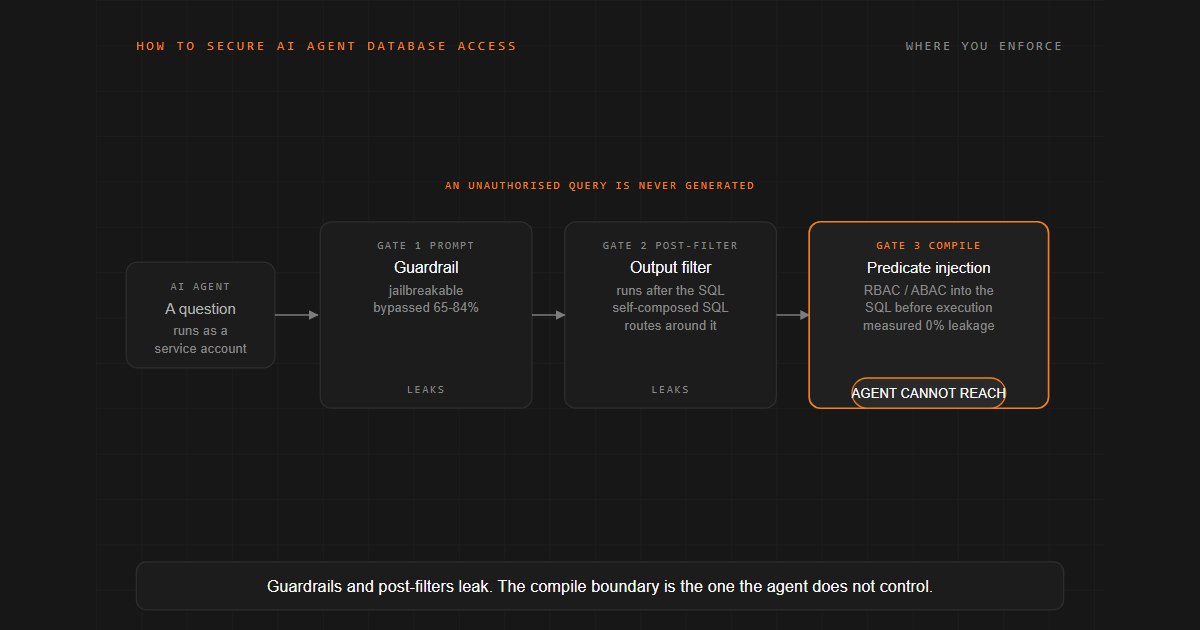
How to Secure AI Agent Database Access: Why Post-Hoc Guardrails Get Bypassed
Guardrails are bypassed 65 to 84 percent of the time, and text-to-SQL models violate access rules up to 76 percent even when handed the rules. The fix is compile-time enforcement.
Read more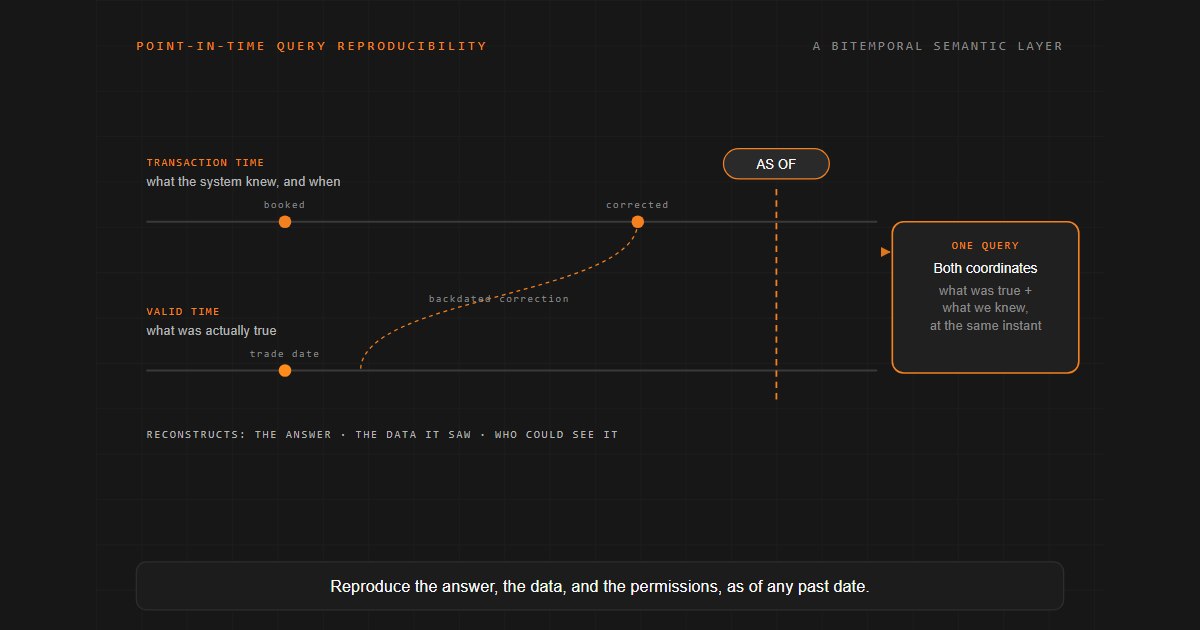
Point-in-Time Query Reproducibility: The Audit Gap Costing Banks Billions
SEC recordkeeping penalties passed $2 billion and MiFID II gives 72 hours to reconstruct a trade. Why point-in-time query reproducibility is the missing piece.
Read more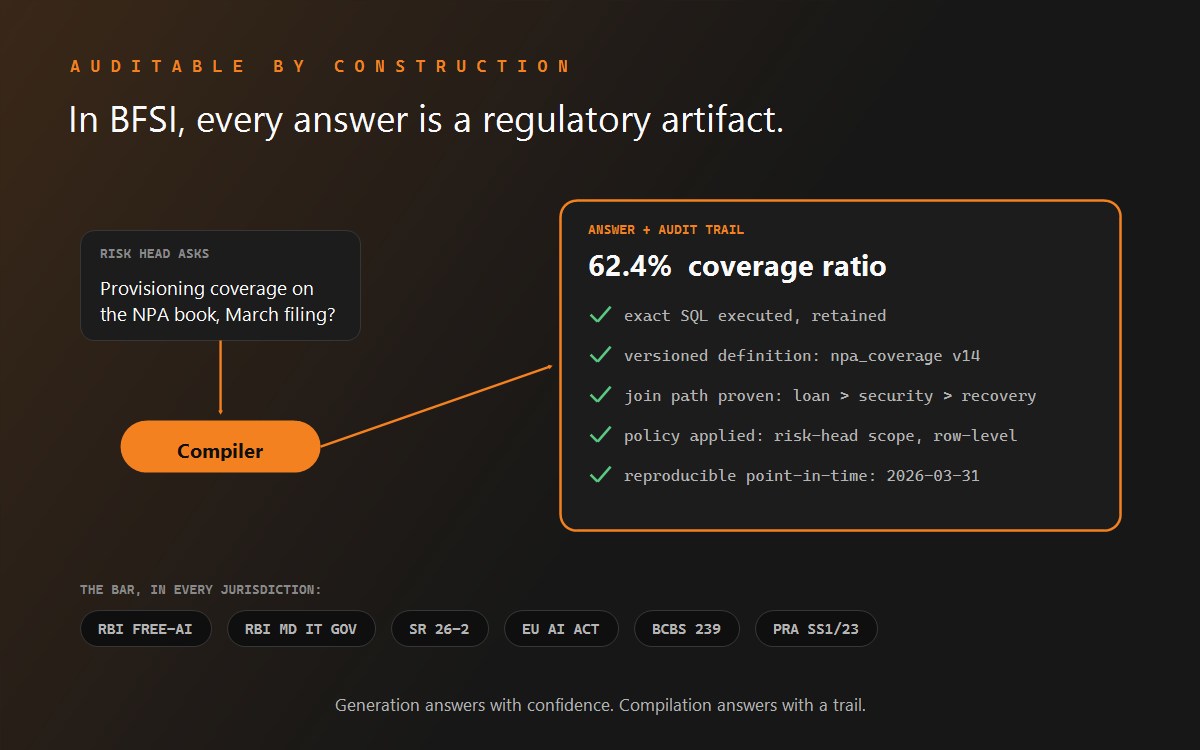
The Enterprise AI Brain: Engineering Auditable SQL for BFSI Conversational Analytics
What RBI FREE-AI, SR 26-2, the EU AI Act, and BCBS 239 require - and the architecture that clears the bar.
Read more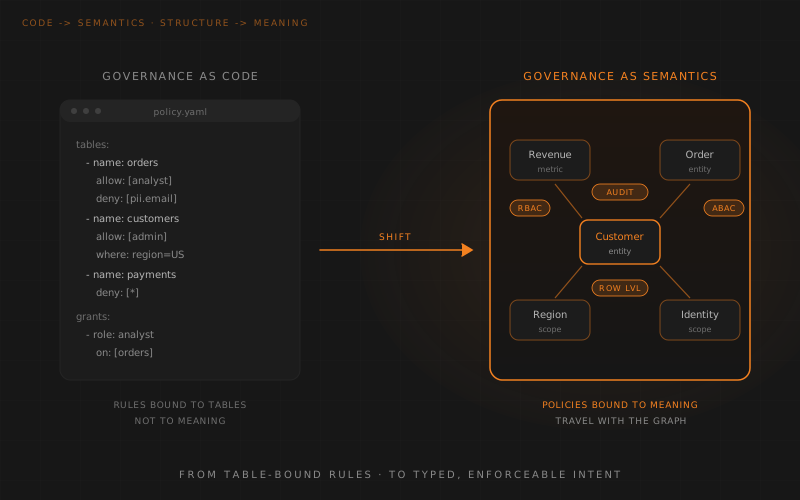
The Semantic Control Plane: Deterministic Governance for AI
Bound to meaning, applied at compile time, enforced before SQL runs. Why runtime guardrails are too late.
Read more
Governance as Code to Governance as Semantics
Code-based rules govern structure. Semantic governance attaches policy to meaning - and it is what AI agents actually need.
Read more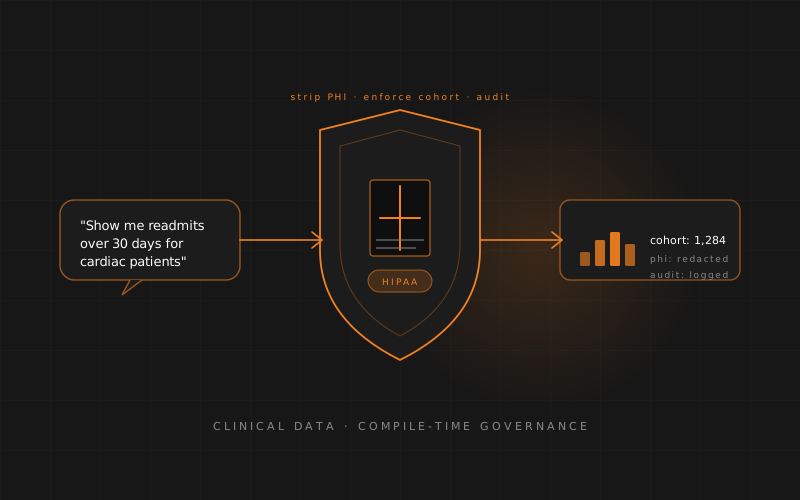
Conversational Analytics for Clinical Data: HIPAA-Compliant Architecture
Safely leveraging AI for data insights in a regulated, audit-heavy environment.
Read more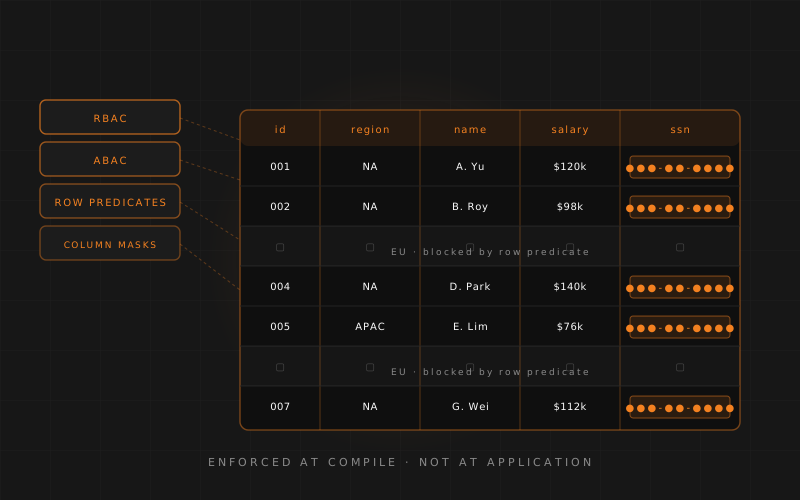
Fine-Grained Data Access Control: Precision & Security
RBAC + ABAC + row/column-level predicates - the layered model enterprise AI needs.
Read more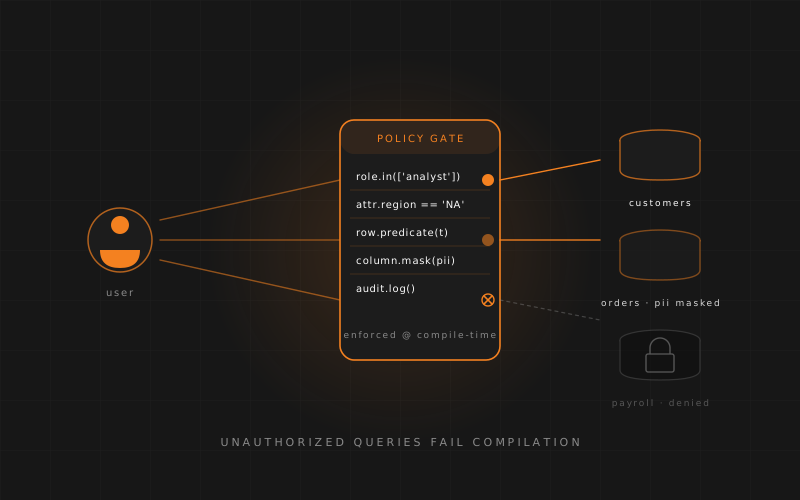
Data Authorization: Why Security Fails in the Semantic Layer
Why authorization at the BI layer is structurally too late - and where it should live.
Read more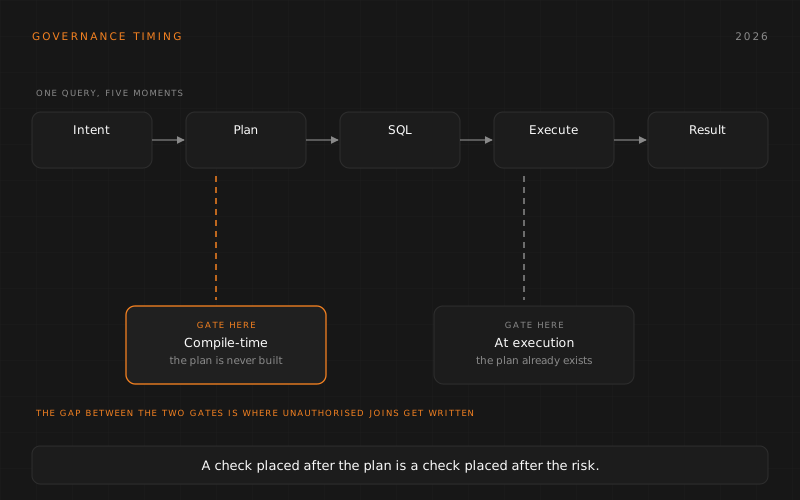
Data Governance Tools for AI Agents in 2026, Scored on Where the Policy Check Actually Runs
Every vendor markets agent control. As of August 2026 not one has shipped it generally.
Read more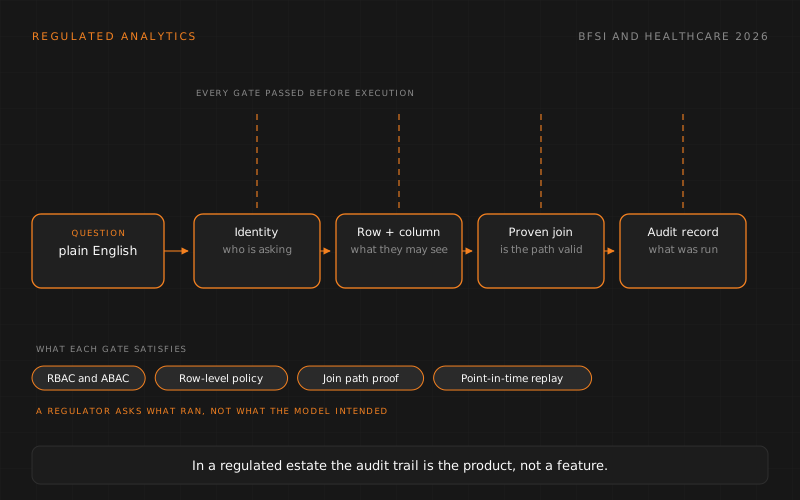
AI Analytics for Regulated Industries in 2026, and What Vendor Compliance Badges Do Not Cover
There is no HIPAA certification for software, and the EU AI Act high-risk deadline moved.
Read more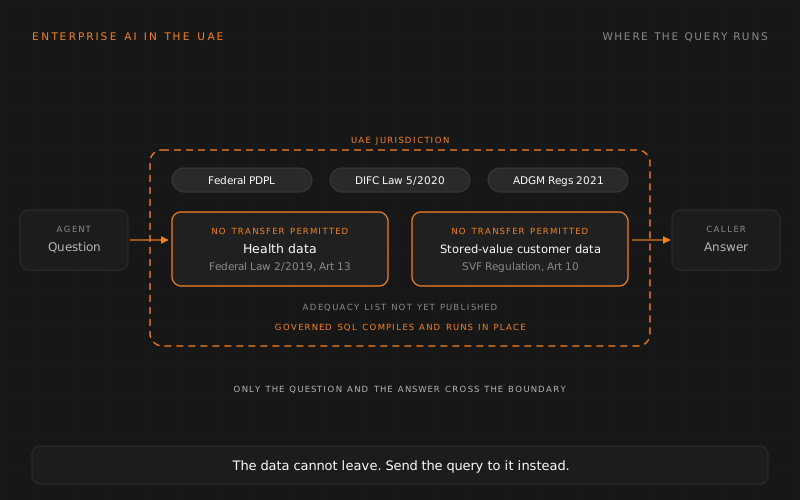
Enterprise AI in the UAE: What PDPL, DIFC, and ADGM Actually Require of Your Data Architecture
The UAE has no adequacy list yet, and two sectors cannot move data offshore at all. What that means for where your AI agents are allowed to run.
Read more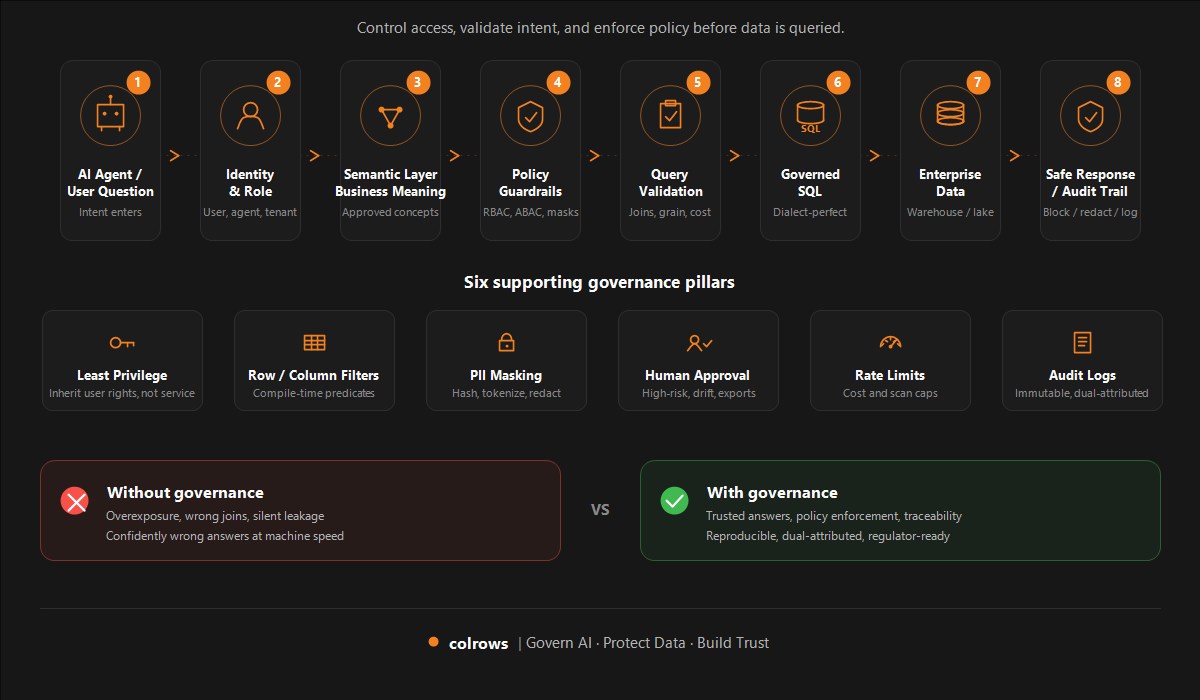
Governing AI Agents: Why Compile-Time Security is Mandatory
Governance must move from documentation to execution. A practical seven-layer model: identity, semantic resolution, policy enforcement, query validation, response guards, and audit trails.
Read more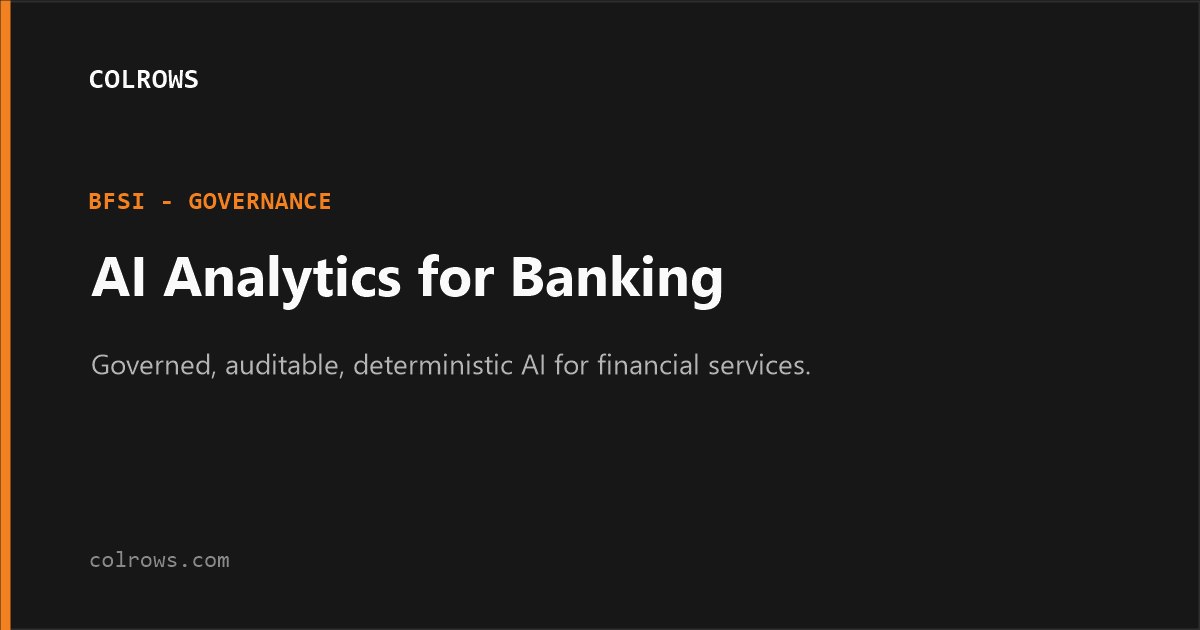
AI Analytics for Banking: Why BFSI Needs Governed, Auditable, Deterministic AI
In banking, a wrong answer is a compliance event. AI analytics for BFSI needs deterministic, auditable SQL with governance before execution. Proof from a >95% faster NPA deployment.
Read more
HIPAA-Compliant AI Analytics: Governing PHI Before the Query Runs
On healthcare data, masking output is not enough. Compile-time governance means PHI is never read without authorization, with deterministic, auditable SQL.
Read more
AI Analytics for Retail: Governed, Deterministic Self-Serve Across Every Store
Retail runs on fast decisions across thousands of locations. Governed, deterministic self-serve so every store sees one number. Proof from a 3,000-venue travel-retail deployment.
Read moreReady to implement enterprise-grade security?
Book a technical architecture review to see how our compiler enforces governance as a structural requirement.