| Capability | Metadata Management | Colrows Semantic Control Plane |
|---|---|---|
| Logic Authority | Passive. Documentation only. | Active. Deterministic compiler. |
| Governance Timing | Post-query. Runtime. | Pre-query. Compile-time. |
| Policy Enforcement | Fragmented. Manual. | Centralized. Automated. |
| AI Agent Fit | Low. Hallucination risk. | High. Guaranteed accuracy. |
| Data Lineage | Informational only. | Verifiable. Auditable traceability. |
What is the semantic control plane?
The semantic control plane is the policy half of the semantic execution layer. Where the execution side compiles intent into governed SQL, the control plane is the structured set of policies that compilation has to satisfy. This is the semantic operating system kernel - the layer that turns a collection of data assets into a coherent, governed whole. Two things make it distinct from every other governance pattern in the enterprise AI stack.
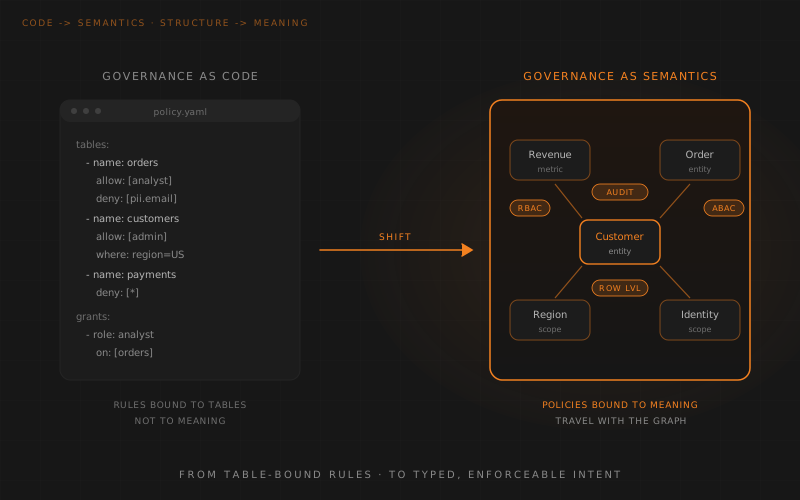
- Policies bind to semantic objects, not raw tables. "Finance can read net revenue" is not a row-filter on
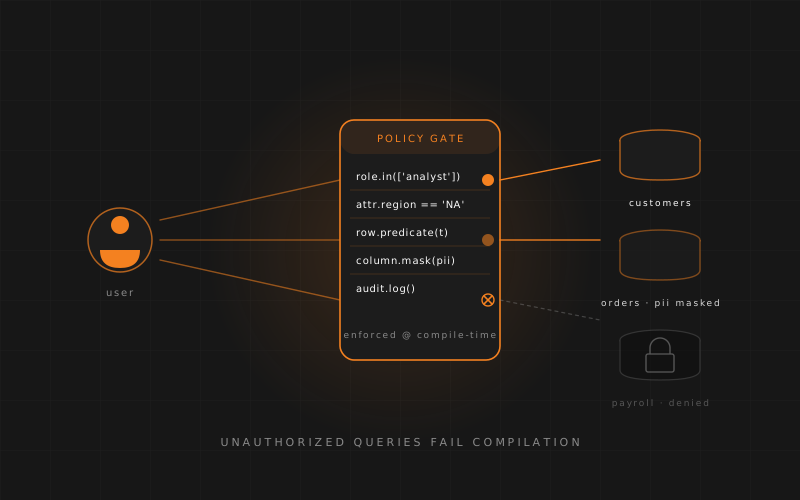
fact_orders. It is a policy attached to the metric concept "NetRevenue" inside the typed semantic graph. The policy travels with meaning, not with storage. - Enforcement happens at compile time. An unauthorised intent does not run, get filtered, and return a smaller result. It fails compilation. The agent receives a structured refusal; the warehouse is never queried.
This is what people mean when the phrase "shifting governance left" gets used in 2026 conversations about AI - except the formal name for the destination is the semantic control plane, and the shift is not a metaphor. It is a measurable change in where in the request lifecycle the policy gate lives.
Why runtime guardrails are too late
The current default for most agentic deployments is what you might call perimeter governance: the agent talks to the data freely, generates a response, and a downstream filter or classifier decides whether to surface it. Variations include LLM-as-judge guardrails, output classifiers tuned on harmful patterns, and SQL proxies that try to detect over-reach after the fact. This is fundamentally the wrong place in the stack - see why authorization at the BI layer is too late.
All of these share the same architectural defect: by the time the policy fires, the data has already been read. Three failure modes follow from that fact.
1. The "I saw it, I cannot un-see it" failure
If an agent reads PII it was not authorised to read, filtering the PII out of the response does not undo the read. The data left the warehouse. It transited the network. It sat in the model's context. Logs may capture it. Embeddings may have memorised it. From a compliance perspective, the breach happened the moment the SELECT ran. Runtime filters paper over the user-facing symptom; they do not solve the audit problem.
2. The "different agent, different result" failure
If an agent's allowed answers are determined by a downstream filter rather than a compile-time policy, two agents asking the same question will get two different answers - because two filter chains will catch different surface forms of the same data. This is the deterministic-reproducibility problem. Regulated industries cannot live with it. Auditors cannot certify against it.
3. The "the model learned the bypass" failure
Filters trained against patterns get gamed - sometimes by adversaries, often by the model itself, which generalises ways of phrasing answers that slip through. Treating an LLM as the thing that has to be guarded creates an arms race. Treating the data path as the thing that has to be guarded does not.
What gets enforced, where, and when
The control plane is doing four kinds of policy work in concert. Each one has a specific surface in the request lifecycle.
RBAC - role-based access control
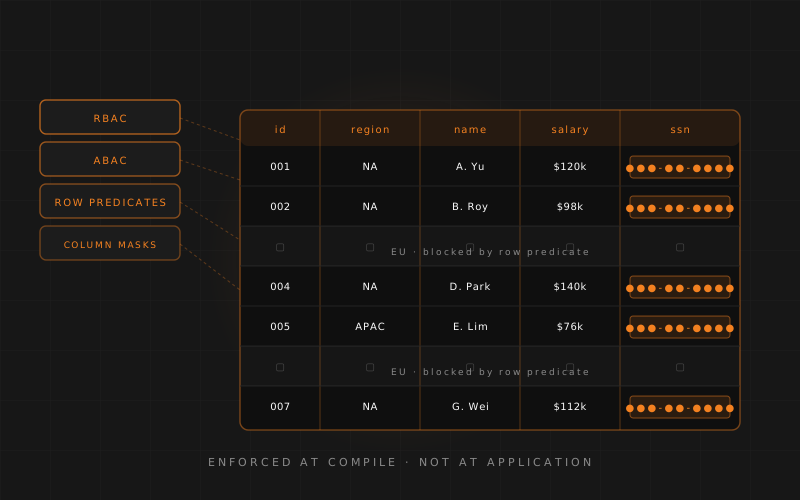
Who is asking? RBAC binds permissions to roles and roles to users. In a semantic control plane, RBAC operates at the entity level: the role "Finance Analyst" is permitted to resolve the entities NetRevenue, Refund, and Margin; the role "Customer Success Manager" is not. Compilation refuses to even bind the entity reference for an unauthorised role. The agent never gets a chance to compose SQL it has no rights to run.
ABAC - attribute-based access control
Under what conditions? ABAC layers in attributes of the user, the resource, the action, and the environment. "Finance Analysts can read NetRevenue, but only for accounts in their region, only during business hours, only for the current and prior fiscal year." All of those constraints are policy expressions evaluated against the typed semantic graph. The combinatorics of role-explosion that drove RBAC-only systems into the ground are dissolved by ABAC because attributes compose. See the journey from metric stores to knowledge machines for how governed metrics form the basis of this model.
Row- and column-level predicates
What slice? Even when the role and the attributes pass, the data is sometimes only readable in part. The semantic control plane carries predicates as part of the policy: region = user.region, tier in {standard, enterprise}, columns excluded: ssn, date_of_birth. These predicates are injected into the compiled SQL plan before emission. They are not stitched on by a SQL proxy. They are part of the plan.
Scope policies - the multi-scope semantic structure
Whose definition? This is the dimension most governance frameworks miss. The same concept can mean different things to different consumers, and the control plane has to encode that. Colrows' multi-scope structure (global -> datastore -> persona -> user) lets "active customer" mean one thing for finance, another for product, and a third for the regulator's quarterly filing - all from one graph, all consistent within scope, all auditable across scopes.
The compile-time pipeline, applied to a real intent
To make the abstraction concrete, consider what happens when a customer success agent issues an intent: "Show me churn risk for accounts in EMEA, last 90 days, broken down by tier." This is the SQL as a semantic compile target pattern in action.
- Identity binding. The intent is tagged with the agent's identity context: which user it is acting on behalf of, which role they hold, what tenant they belong to. Roles and attributes are resolved.
- Entity resolution under role. The control plane looks up "churn risk" in the typed graph and checks whether the bound role is permitted to resolve it. If not, compilation fails here. Nothing else runs.
- Scope selection. The customer-success scope is selected from the multi-scope structure. The version of "churn risk" applicable to that scope is bound. Different scope, different definition, different result - all by design.
- Constraint application. ABAC predicates are evaluated. The user's region, tenant, and time window constrain what is allowed. The plan is annotated.
- Join path proof under policy. The compiler tries to prove a path through the graph from "Account" to "ChurnRisk" via "Subscription" -> "Payment" -> "RefundEvent." If any of those edges is policy-blocked for the role, the path fails to prove. Compilation refuses.
- SQL emission with row/column predicates injected. If everything passes, dialect-perfect SQL is emitted with the row predicates and column projections already baked in. The warehouse never sees an unconstrained query.
- Audit record. Every step is recorded: graph version, scope used, role bound, attributes resolved, predicates applied, executed SQL, result fingerprint. The audit record is what makes the answer point-in-time reproducible.
Notice what is missing from this pipeline: a runtime classifier. A response filter. A guardrail that reads the model output. None of those are needed, because nothing left the warehouse that should not have.
The reproducibility property
Auditable AI analytics is one of the search terms regulated buyers use most often. What they actually want, most of the time, is a single property: given the same identity, the same scope, the same intent, and the same graph version, the system must return the same answer. Forever.
This is impossible in a runtime-guardrails architecture. The filter chain changes; the classifier is retrained; the LLM is upgraded; the response is different next quarter than it was this quarter for the same question. The audit log shows different numbers and there is no principled explanation of which is right. Knowledge drift and semantic decay are why this matters at scale.
The semantic control plane fixes this because the answer is determined by the compiler. The compiler is deterministic against the (graph version, scope, identity, intent) tuple. Replays are trivial: re-execute the audit-recorded query against a snapshot of the graph and warehouse at the prior point in time. Same answer. Always. This is what regulators mean by "explainable AI" in the analytics context - not natural-language rationales generated by another LLM, but a deterministic derivation that can be re-run.
Where industry terminology is converging
The phrase "semantic control plane" is one of several that ended up describing the same architectural shape. The rise of semantic gravity is how this becomes the control plane of the AI-native enterprise. Two adjacent ones worth recognising:
- Agent control plane. Used by IAM-leaning security vendors. Right idea, narrower scope - it focuses on agent identity, action authorisation, and runtime behaviour, but does not cover the semantic governance layer over data. The semantic control plane is what an agent control plane has to call into when the action is "read business data."
- Agentic enterprise control plane. Used by hyperscalers (Google, Snowflake, ServiceNow) describing their agent-orchestration platforms. Even broader - includes orchestration, deployment, observability. Again, the semantic control plane is the data-and-meaning sub-plane those broader platforms have to either build or integrate against. The limitation is that warehouse-native approaches, like Snowflake and Databricks governance, stop at the warehouse boundary.
One pattern that is not the same: AI gateways that filter LLM prompts and responses. Those are useful for some kinds of application-layer safety. They are not a control plane for data governance. They live in the wrong layer of the stack and fire at the wrong time.
Runtime guardrails ask "did the model say something bad?" Compile-time governance asks "should this query have been allowed to run?" The difference is the difference between cleaning up a breach and preventing one.
Core Principle: Do not rely on prompt engineering to fix data policy. The Colrows Semantic Control Plane enforces compliance at the compiler level. Fix the Context, Not the Model.
What enterprise architects should plan for
Three practical recommendations if you are designing the governance posture for your enterprise AI estate in 2026. The build vs buy decision will largely come down to whether you can afford the long tail of edge cases with a bespoke system or prefer the proven heuristics in a mature platform.
- Move policy attachment from tables to concepts. Whatever governance you have on tables today is fragile under refactor and invisible to AI agents. Re-attach it to typed entities and metrics in the semantic graph. The same policy will then automatically protect every query through every consumer.
- Push enforcement from runtime to compile time. If your only enforcement points are downstream filters, you are governing symptoms. Plan for compile-time gates - meaning: the layer that decides what SQL gets generated has to be the layer that decides what is allowed.
- Make audit reproducibility the acceptance test. Pick any past query. Replay it. If you cannot get the same answer with the same audit record, your control plane is not yet doing what regulators need it to do.
How Colrows fits
Colrows operationalises the semantic control plane as the policy half of the semantic execution layer. RBAC + ABAC + row/column-level predicates + multi-scope policies are bound to the typed semantic graph and applied at compile time. Every query produces a point-in-time-reproducible audit trail. For the philosophy behind this, see Governance as Code. Governance as Semantics and, on the access-control mechanics, Fine-Grained Data Access Control: Precision Security. Understand why authorization at the BI layer is structurally too late, and how the semantic control plane brings enforcement to compile time where it belongs. For regulated enterprises, see how auditable SQL for BFSI builds the governance foundation that regulators require.
Closing thought
Every enterprise AI architecture has a control plane. The question is whether yours is a structured policy graph applied at compile time, or a stack of runtime filters trying to catch what the agent has already done. The first scales with deployment count; the second collapses under it. The phrase "semantic control plane" is the name we are settling on for the kind that scales. The semantic layer buyer's guide for 2026 walks through how to evaluate different approaches.
The control plane sits on top of a semantic layer. If that foundation is new, what a semantic layer is covers it before this piece goes deeper.
Frequently asked questions
What is a semantic control plane?
It is the policy half of the semantic execution layer. The execution side compiles intent into governed SQL; the control plane is the structured set of policies that compilation has to satisfy. Policies bind to semantic objects, not raw tables, and enforcement happens at compile time.
Why are runtime guardrails too late for AI data governance?
By the time a runtime filter fires, the data has already been read. Filtering PII out of a response does not undo the SELECT, two filter chains give two agents different answers to the same question, and pattern-trained filters get gamed. Compile-time governance refuses the query before the warehouse is ever touched.
What is the difference between compile-time governance and runtime filtering?
Runtime guardrails ask whether the model said something bad. Compile-time governance asks whether the query should have been allowed to run at all. An unauthorised intent fails compilation and returns a structured refusal; the warehouse is never queried.
How do RBAC and ABAC work in a semantic control plane?
RBAC binds permissions to roles at the entity level, so an unauthorised role cannot even resolve a metric reference. ABAC layers in attributes of the user, resource, action, and environment, which compose and dissolve the role-explosion problem. Row and column predicates are then injected into the compiled SQL plan before emission.
What makes an AI query point-in-time reproducible?
The compiler is deterministic against the (graph version, scope, identity, intent) tuple. Every query records the graph version, scope, role, attributes, predicates, the join path proof, the executed SQL, and a result fingerprint, so replaying the audit-recorded query against a point-in-time snapshot returns the same answer.
Is a semantic control plane the same as an agent control plane or an AI gateway?
No. An agent control plane covers agent identity and action authorisation but not semantic governance over data, and it has to call into the semantic control plane when the action is reading business data. AI gateways filter LLM prompts and responses; they live in the wrong layer of the stack and fire at the wrong time.