
Compile enterprise intent into governed, deterministic SQL.
Colrows sits between users, AI agents, and your data systems. It resolves business meaning at compile time, proves every join, and runs dialect-perfect SQL inside a policy-shaped subgraph - so what executes is exactly what was authorized.
Start here
Introduction
Why enterprise AI needs a runtime layer below copilots. Read the thesis, the architecture, and what makes Colrows different.
Read the introduction →Quickstart
Sign up, connect a datasource, and compile your first governed query in under ten minutes.
Open quickstart →Core concepts
Compile-then-execute, the semantic graph, join path proof, multi-vector embeddings, and metrics-as-state.
Learn the concepts →System architecture
A technical deep dive into the four computational domains: parsing, semantic resolution, planning, and physical execution.
View architecture →The Colrows runtime
Every request follows the same compile-then-execute pipeline. Ambiguity is resolved at compile time, not at runtime - and policy shapes the plan before any database is touched.
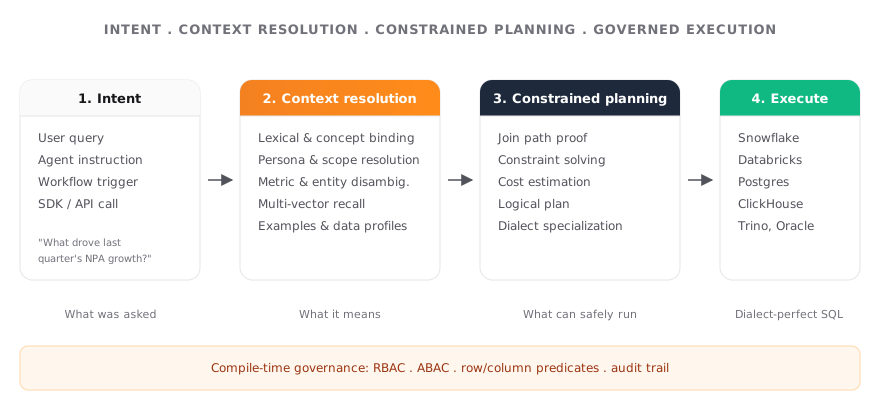
What Colrows does
- Versioned semantic graphEntities, metrics, events, concepts, constraints, policies and personas - modeled as typed nodes with point-in-time reproducibility.
- Compile-time governanceRBAC, ABAC, and row/column-level predicates shape the allowed subgraph. Unauthorized plans are never generated.
- Join path proofEvery multi-entity query is solved as a constrained graph traversal - ambiguous paths fail compilation rather than silently producing wrong numbers.
- Autonomous maintenanceDrift detection, conflict detection, and schema evolution run continuously. The graph keeps itself current as the enterprise changes.
- Multi-vector embeddingsEach concept carries definition, usage, and combined vectors - recall stays accurate as language and context evolve.
- Dialect-perfect SQLOne semantic plan, many backends. Snowflake, Databricks, Postgres, ClickHouse, Trino, Oracle, SQL Server, and more.
Build with Colrows
Consensus
The Consensus semantic layer - entities, metrics-as-state, autonomous agents, drift detection.
Catalog
Browse, edit, and govern every entity in the semantic graph - metrics, business terms, relationships - with full version history.
AI Data Analyst
Conversational analytics that grounds every answer in the governed semantic graph.
SQL Editor & Dashboards
Write and run governed SQL, bookmark queries, and save them as datasets for dashboards.
Datasources
Connect Snowflake, Databricks, Postgres, ClickHouse, Trino, Oracle, SQL Server and more.
Access Control
Compile-time RBAC + ABAC, fine-grained row/column predicates, and zero-trust data access.
APIs & SDKs
Embed the semantic execution layer in your applications and AI agents over REST, MCP, or the agent interface.
Agent Query API for Your Users
Compile, validate, and run governed SQL on behalf of each signed-in user, with that user's own access rules. Replaces the removed SQL API.
MCP Integration
Connect Claude Code, Cursor, Codex, and custom agents over the Model Context Protocol - with compile-time governance on every tool call.
Further reading
- Breaking the 20-year deadlock in data modeling - why traditional semantic layers fail under AI load.
- The rise of autonomous semantic systems - what self-maintaining semantics look like in practice.
- Multi-hop query understanding - how Colrows resolves intent across multiple hops without hallucination.
- Semantics for enterprise AI agents - building agents on a shared, governed business context.
- From metric stores to knowledge machines - why metrics belong in a graph, not a YAML file.
- The death of manual documentation - autonomous curation in the semantic layer.