
Introduction
Enterprise AI has advanced quickly at the interface layer. What remains unsolved is the harder problem underneath: turning what a user - or an agent - means into the right action, safely and reliably, inside a real enterprise. Colrows is the runtime layer that does that.
The missing layer in enterprise AI
It is now easy to build a copilot, agent, or chat interface on top of enterprise systems. Most of the market has crowded into context repositories - data catalogs, vector stores, semantic layers, metadata graphs, retrieval pipelines. These products store and retrieve relevant information. They do not resolve context at runtime.
That distinction is what separates a chat-on-top-of-data tool from infrastructure your auditors and your AI agents can both rely on.
A system can fetch table definitions, business glossaries, metric definitions, prior queries, and documentation through MCP or semantic search and still fail on the actual task. It may surface useful information but still not know which definition applies, which relationship is valid, which event matters, which filter is implied, which action is safe, or which execution path is allowed.
In enterprise environments, context is not a repository problem. It is a runtime resolution problem.
What Colrows is
Colrows is the semantic execution layer between enterprise intent and enterprise systems. It sits between a user or AI agent on one side, and databases, warehouses, applications, and operational workflows on the other. Its job is not to retrieve context - it is to resolve context at runtime and convert intent into governed execution.
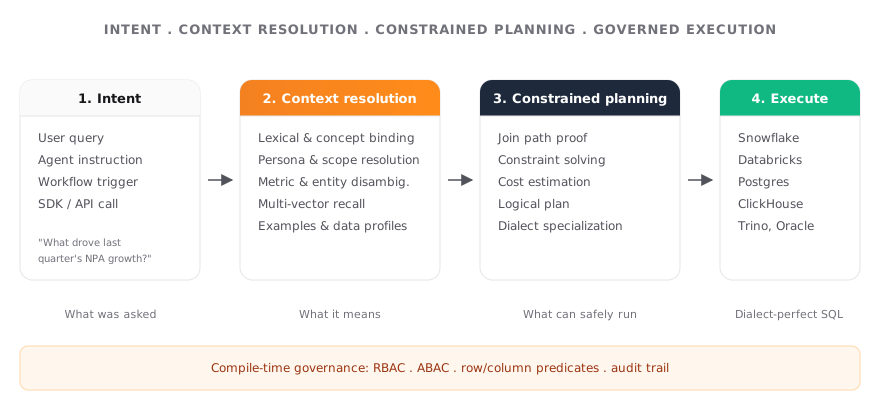
Three tightly linked capabilities sit inside the runtime:
- An autonomous semantic layer that captures not only entities and metrics, but examples, data profiles, relationships, events, triggers, causal patterns, policies, personas, and scopes.
- A compile-then-execute pipeline that lowers requests through parsing, semantic binding, join path proof, constraint solving, logical planning, physical planning, and dialect specialization.
- Governed execution control that applies policy, cost, and runtime constraints before a downstream system is touched.
Why this matters now
When AI moves beyond question-answering and into action, weak resolution stops being a quality problem and becomes a safety problem. Hallucinated joins, wrong filters, over-broad scans, and query explosion against operational databases are not edge cases - they are the predictable failure mode of probabilistic resolution at runtime.
Strong systems need guardrails before execution, not just after the response. Colrows is designed to be that layer:
- Semantic correctness, proven before executionNot inferred, not retrieved, not checked after the fact.
- Autonomous maintenanceThe graph keeps itself current as the enterprise changes - no team of engineers required.
- Governance, structural at compile timePolicy is enforced as part of planning, not layered on afterward.
- Built for AI agents from day oneThe same runtime serves humans in the SQL editor and agents over the API.
How Colrows compares
Colrows is not a feature improvement on existing tools. It occupies a layer none of them sit in.
| Category | What it does | What's missing for AI execution |
|---|---|---|
| Data catalogs Atlan · Alation · Collibra |
Document meaning for human readers. | Do not resolve meaning at execution time. No governed execution plan. |
| Static semantic layers dbt · LookML |
Developer-maintained, configuration-driven semantics. | No autonomous drift detection, no versioned graph, no compile-time join proof. |
| LLM + RAG copilots | Generate plausible answers from retrieved context. | Probabilistic by design. Governance is advisory; hallucinations are a feature, not a bug. |
| BI semantic layers Power BI · Tableau · MicroStrategy |
Resolve meaning at presentation time. | Vendor-locked, not warehouse-agnostic, not built for machine-driven planning. |
| Text-to-SQL tools | Generate SQL from natural language. | No proven join paths, no metric grain enforcement, no embedded governance. |
| Colrows | Resolves context at runtime. Compiles intent into governed SQL. | - |
Where to go next
The rest of the docs are organized to take you from the thesis to a running deployment.
Quickstart
Connect a datasource and run your first compiled query.
Core concepts
Compile-then-execute, the semantic graph, join path proof, metrics-as-state.
System architecture
Inside the engine: the four layers and how they scale independently.
Consensus
The Consensus semantic layer - primitives, autonomous agents, drift detection.