| Aspect | Manual Data Catalogs | Colrows Autonomous Compiler |
|---|---|---|
| Logic Authority | Human-authored definitions. Disconnect between doc and code grows daily. | Definitions ARE the code. Semantic graph is the source of truth executed at query time. |
| Maintenance | Manual. Teams spend 1+ days per week on documentation debt. | Autonomous drift detection and agents propose updates. Humans approve. Zero toil. |
| Accuracy | Decays immediately. No alerts when docs diverge from reality. | Always current. Fingerprint diffs detect changes in schema, lineage, transformations. |
| AI Utility | LLMs reason from stale definitions. Hallucination risk grows with age. | Deterministic. Agents query current graph. Governed, auditable results suitable for production. |
| Lineage | Drawn diagrams. Manual updates. Breaks when data changes. | Versioned dependency graph. Updates automatically because lineage IS the execution path. |
| Compliance Trail | Audit archaeology. "Where did this number come from?" takes days. | Query provenance at execution. Full audit trail. Timestamped, attributed, replayed. |
Nobody chose to abandon these documents. People stopped updating them because they were busy keeping the system running. And every data team eventually learns the same lesson: manual documentation loses the race against change.
This is not a motivation problem or a discipline problem. It is a structural one. As long as meaning lives in a document that sits outside the system it describes, a human has to be the synchronization layer between the two. Humans are bad synchronization layers. They forget, they leave, and they cannot keep pace with a data estate that changes daily across dozens of tools.
The good news: documentation does not have to be something you write. It can be something the system produces. This post explains why manual documentation fails, how automated documentation actually works (semantic graphs, lineage, drift detection, autonomous agents), what it is worth in money and compliance risk, and where a semantic compiler like Colrows fits, including what it does not do.
Why manual documentation fails structurally
Staleness: written once, wrong forever after
A document is a snapshot. The thing it describes is a movie. The moment a column is renamed, a join is removed, or a metric definition shifts, the document is wrong and nothing tells you. Worse, outdated documentation does not fail loudly. It fails politely. Because it still looks official, people trust a definition that no longer matches reality and copy logic that quietly drifted. By the time someone notices, the wrong number is already in a board deck.
This is exactly the gap that "active metadata" was invented to close. When Gartner replaced its Metadata Management Magic Quadrant with a Market Guide for Active Metadata Management in August 2021, it defined active metadata as "the continuous analysis of all available... reports... to determine the alignment and exception cases between data as designed versus actual experience." The point is simple: a definition that is not continuously compared against the system it defines will decay, and you will not get an alert when it does.
Toil: documentation work scales linearly with your data
Manual documentation costs roughly (number of tables) x (documents per table) x (rate of change). All three terms grow, so the work grows faster than any team can staff for. The result shows up in time studies. McKinsey's 2023 Master Data Management Survey found that 82% of organizations spend one or more days per week resolving master-data quality issues, and 66% still rely on manual review to monitor quality. McKinsey's broader transformation research found that roughly 30% of total enterprise time goes to non-value-added tasks driven by poor data quality and availability.
Documentation debt behaves like data-quality debt because it is the same debt seen from a different angle. Monte Carlo's 2023 State of Data Quality survey (200 professionals, fielded by Wakefield Research in March 2023) found that data downtime nearly doubled year over year (1.89x), driven by a 166% increase in average time to resolution, rising to an average of 15 hours per incident. A large share of those 15 hours is spent answering questions documentation was supposed to answer: where did this come from, who owns it, what does it mean.
Tribal knowledge: a productivity cliff and a compliance risk
When meaning is not in the system, it lives in a person's head. That is fine until the person leaves. Deloitte's 2023 Human Capital Trends research found 47% of organizations now identify key-person dependency (critical knowledge held by a single individual) as a significant operational risk, up from 34% in 2020. The cost also shows up in onboarding: a new data hire takes three to six months to reach full productivity, and research synthesized by Atlan suggests 40-60% of that time is spent reacquiring undocumented context that already existed somewhere in the company.
There is a concrete failure mode here. An agent or analyst builds a board report comparing revenue this quarter to two years ago. What nobody documented is that the revenue definition changed 18 months ago, so the two periods are not comparable without a normalization factor that lives in one finance analyst's spreadsheet. The report shows a trend that does not exist. That is not a broken model. It is a correct computation on an undocumented premise.
Inconsistency: documentation is descriptive, not prescriptive
Looker has its model of meaning. Power BI has another. dbt has YAML. The catalog has a glossary. Each describes "active customer" or "recurring revenue" slightly differently, and a wiki page cannot force them to agree because a document only describes; it does not govern. This is why "better discipline" advice ("make docs part of the process," "review docs quarterly") works at small scale and collapses at enterprise scale. You are asking documentation to do a job it was never built for: be the authoritative, enforced definition across every tool at once.
The architecture gap: Catalog Fallacy vs. Compiler Solution
The Catalog Fallacy: tracking yesterday, not today
Data catalogs were designed to be human-authored inventories. They are systems of record for metadata that someone enters, maintains, and updates. The assumption was sustainable: a team of stewards could keep pace with schema changes, business logic updates, and metric definitions. This assumption has not held since enterprises moved to continuous deployment and multi-source data estates.
The problem with catalogs is that they are always looking backward. A catalog entry describes what was true when it was written. By tomorrow, the schema may have evolved, the transformation logic changed, or the metric redefined. The catalog entry becomes a historical artifact instead of a current source of truth. And regulators do not care about historical artifacts. They care about proof that you can trace a reported figure to its source through verified transformations today.
The Compiler Solution: definitions that execute
The alternative is to embed meaning into the system itself, not alongside it. When business logic is compiled as part of query execution, the definition you read is the definition that runs. There is no drift because there is only one source of truth: the executable code.
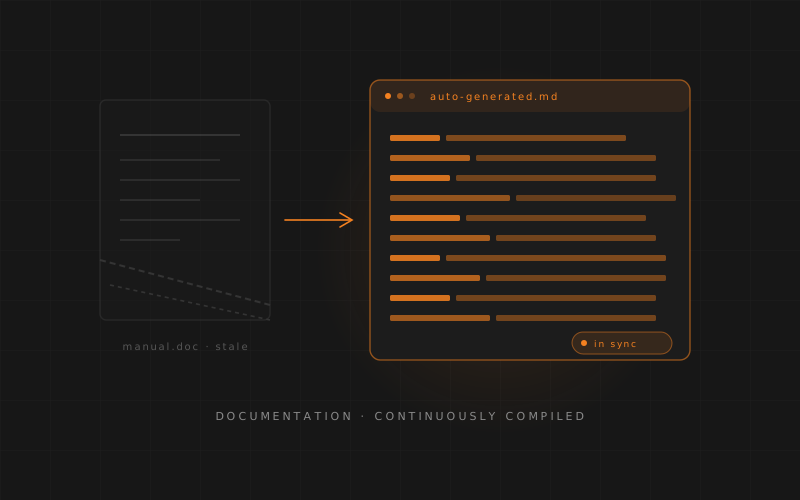
A semantic compiler works differently from a catalog. Instead of humans writing down how data flows, the compiler observes how data actually flows, builds a semantic model of that flow, and generates documentation as a runtime artifact. The documentation is not a separate thing you maintain. It is the byproduct of a system that governs data at compile time. Catalogs describe. Compilers define.
What replaces it: documentation as a runtime artifact
The alternative is not more writing. It is to make the system describe itself, so documentation becomes an output of how the data actually works rather than an input someone has to maintain.
Semantic graphs: every edge is documented intent
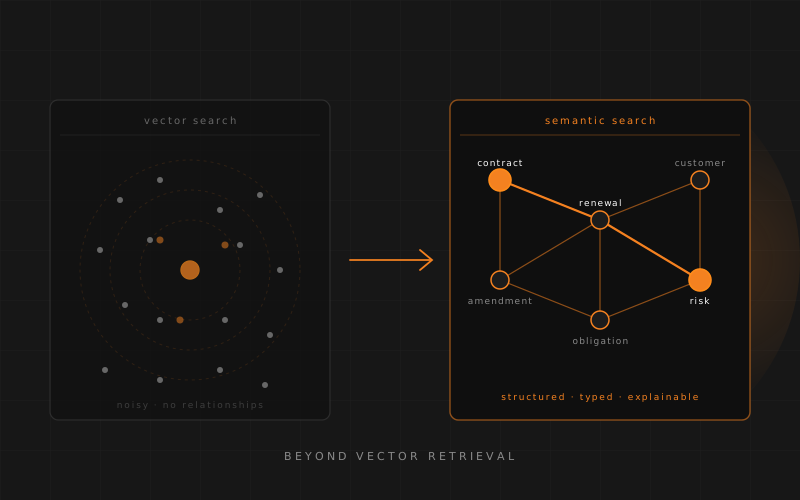
A typed semantic graph models entities, metrics, relationships, and policies as nodes and edges. That graph is documentation, by construction. When you declare that orders joins to customers on customer_id with a known cardinality, you have documented a relationship in a form a machine can enforce. When a metric carries an explicit formula, scope, and owner, you have documented its definition in a way no wiki can drift away from, because the same definition is what executes.
Colrows describes its product as "the semantic execution layer that autonomously builds and governs a typed semantic graph across your entire data estate," organized in three layers: a meaning layer (ontologies: concept, hierarchy, definition, synonym), a structure layer (the knowledge graph: entity, edge, join_path, cardinality), and a behavior layer (statistical profiles and usage). Documentation is what you read off those layers. It is not a separate document you maintain in parallel.
Lineage: the part of documentation that maintains itself
Instead of writing down "the revenue table comes from these three sources," the system records the path: source table to transformation to aggregation to published metric. Change a transformation and the lineage updates because the lineage is the dependency graph, not a drawing of it. Gartner places lineage at the catalog level of metadata maturity and projects that "by 2027, organizations that actively leverage metadata analytics results across their full data management environment will reduce the time to deliver new data assets by up to 70%." Lineage is also the single most valuable artifact for audits, which we will come back to.
Drift detection: the system notices change so you do not have to
This is the mechanical heart of self-maintaining documentation, and it is not exotic. The pattern, used by schema-management tools like Liquibase, Redgate, and Atlas and reproducible in any pipeline, is:
1. After each successful run, snapshot the source schema:
   { column_name, data_type, is_nullable, ordinal_position, table_name }
   and compute a fingerprint = hash(sorted(columns, types))

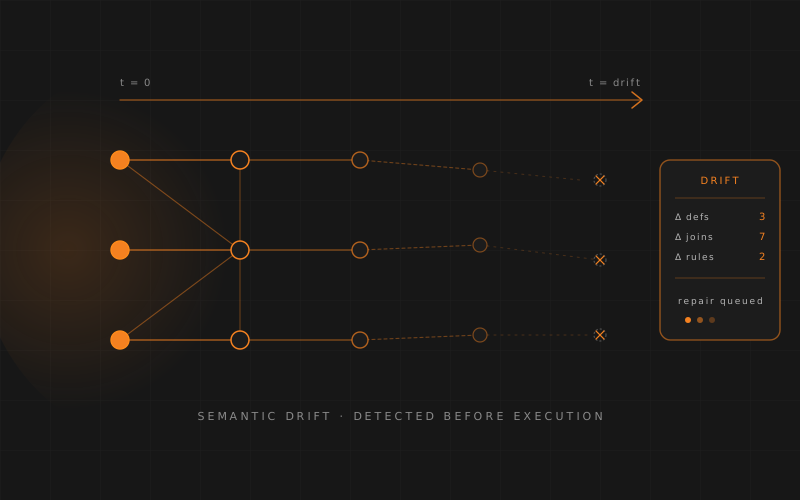
2. Before the next run, diff current schema vs. last snapshot:
   - NEW column        → propose a new node + draft description
   - REMOVED column    → flag dependent metrics/joins as at-risk
   - TYPE CHANGE       → flag downstream casts and tests
   - removed + similar new name → flag as LIKELY RENAME
   - ordinal reshuffle → low-severity note

3. Route the proposal to an owner for approval.
4. On approval, publish the updated docs + lineage, timestamped.
The fingerprint hash gives you cheap change detection; the field-level diff gives you the specific edit; the severity classification decides whether to halt a pipeline or just annotate. None of this requires anyone to remember to update a page.
Change tracking: a version-controlled document that never goes stale
Every change to the graph can be timestamped and attributed: who, when, what, and against which version. That turns documentation into an append-only history. As Colrows frames the audit benefit of a versioned graph, "a query carries the graph version it resolved against, so any decision can be replayed against the memory as it existed at that moment." A document that records its own history cannot silently drift, because the drift is the record.
The autonomous agent pattern (and the human in the loop)
"Self-documenting" does not mean "no humans." The realistic pattern is a small set of agents that propose, and humans who approve:
- Discovery agents watch sources and propose new nodes and lineage edges when tables, columns, or relationships appear.
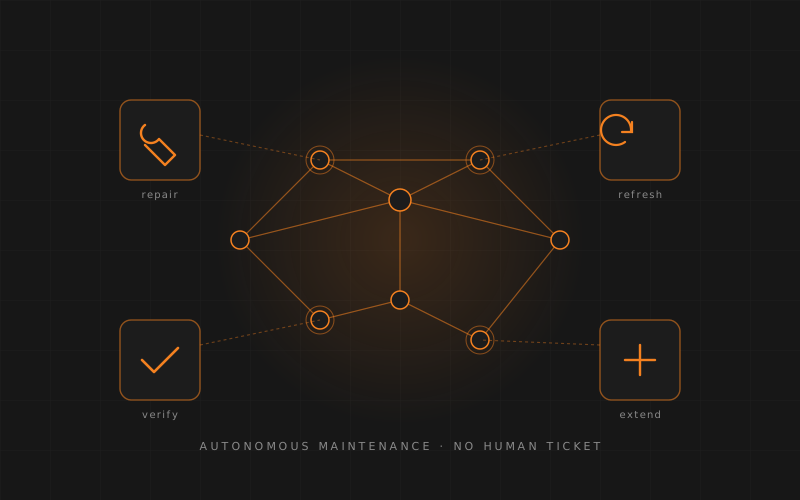
- Drift agents run the snapshot-diff above and propose updates for renames, type changes, and deletions.
- Quality agents check completeness: does every entity have an owner, every metric a formula, every relationship a description? They flag the gaps.
- Lineage agents track transformations, joins, and aggregations to keep the dependency graph current.
- A human approval loop reviews proposals and publishes. This is the control that keeps the system trustworthy.
This is exactly how Colrows positions its agents: they "monitor semantic drift, surface inconsistencies, and keep definitions aligned as data evolves," and they "detect drift and propose updates that humans approve. The kernel is bootstrapped, not handcrafted." The company is also explicit about what the agents do not do: "They don't make business decisions. They don't invent insights. They don't replace analysts." That boundary is the honest version of "the death of manual documentation." The toil dies. Human judgment does not.
What it is worth: the business case
The cost of undocumented data
Gartner estimates poor data quality costs organizations an average of $12.9 million per year. That figure comes from Gartner's Magic Quadrant for Data Quality Solutions (July 27, 2020, by Melody Chien and Ankush Jain), in which 154 reference customers were asked to estimate the annual cost. A meaningful slice of that is the documentation tax: the 82% of teams losing a day or more each week to data-quality firefighting (McKinsey MDM 2023), and the average of 15 hours to resolve each incident (Monte Carlo 2023), much of it spent rediscovering meaning that should have been recorded.
Governance velocity: weeks to minutes
This is the cleanest before/after. On undocumented data, a question like "who owns this table, what is the approval chain, is this column PII" requires manual investigation across silos. Atlan's research notes that manually tracing lineage across silos to answer "where is this customer name coming from" or "is this field subject to GDPR" can consume up to 80% of a data team's time. On documented data with active metadata, the same question is a query. Atlan reports that teams using active lineage see "50-70% faster incident resolution compared to manual investigation" and "40-50% time savings" on compliance processes, citing Gartner (2023).
Knowledge preservation and onboarding
Documented data survives turnover. When the analyst who knew "what revenue means" leaves, the definition stays in the graph instead of in their head. And onboarding compresses: instead of weeks of asking colleagues "what counts as an active customer," a new hire reads a governed definition with its lineage and owner. Given that 40-60% of a 3-6 month ramp is spent on tribal context, self-documenting data is one of the highest-impact onboarding investments a data org can make.
The bridge for buyers
The technical property and the business requirement are the same fact seen twice. Because documentation is generated from the semantic graph (technical), it is always current, queryable, and attributable, which is precisely what governance at scale, compliance readiness, and turnover-proof knowledge require (business). You do not buy automated documentation to save writing time. You buy it because governed scale is impossible without it.
Why this is becoming table stakes: the regulatory case
Regulators do not ask whether your documentation is tidy. They ask you to prove things about your data, fast, and manual documentation cannot keep up with the proof burden.
- GDPR and CCPA. Subject access requests (GDPR Art. 15) and the right to erasure (Art. 17) require you to know what data is personal and everywhere it flows. Without lineage you cannot confirm that deleting a record removed every copy across backups and downstream systems; deletion becomes guesswork. The 72-hour breach-notification window leaves no time for manual archaeology. Automated documentation makes "where does this PII live and flow" a query.
- SOX 404. Internal control over financial reporting requires documented, tested, auditable controls. End-to-end lineage is the evidence that a reported figure traces back to source systems through verified transformations, the kind of timestamped evidence PCAOB walkthroughs (AS 2201) and audit-evidence standards (AS 1215) expect. Manual documentation does not scale to a quarterly attestation across a changing estate.
- HIPAA. The Audit Controls standard, 45 CFR 164.312(b), requires mechanisms to record and examine activity in systems that contain ePHI, with logs typically retained for six years. Automated documentation of which fields are health data, plus an attributed change history, is auditable. A wiki is not.
The throughline: a versioned semantic graph that records every definition, owner, policy, and change turns audit preparation from a multi-week investigation into a query. Governance maturity is also widely associated with better operating performance; one frequently cited estimate puts the gain at 15-20% higher operational efficiency for organizations with mature governance, though the precise primary source for that figure is not firmly established and it should be read as a directional benchmark rather than a hard number.
The competitive landscape, honestly
No single category owns this, and each adjacent tool does something genuinely well.
| Approach | What it documents well | Where it falls short |
| Data catalogs (Collibra, Alation, Atlan) | System of record for human-authored metadata, glossaries, stewardship, governance workflows | Depend on humans to keep metadata fresh; historically batch ingestion |
| BI tools (Looker, Power BI) | Tight, well-modeled metadata for the dashboard being built | Single-tool view; do not reconcile meaning across tools |
| dbt / dbt Docs | Documentation as code from YAML + SQL: version-controlled, code-reviewed, introspects the warehouse | Scope: only covers assets managed within your dbt project |
| Semantic layers (Colrows, Cube, AtScale) | Documentation as a runtime artifact from the semantic graph: lineage, drift handling, API/MCP access | Require a semantic model; value depends on coverage of the estate |
The catalogs are not wrong; they are a system of record built for an era when manual curation was assumed to be sustainable. dbt Docs is excellent and genuinely automated, within dbt's boundaries. The semantic-layer approach differs in one respect: it treats documentation as a byproduct of execution. When every agent query and dashboard compiles through the same governed graph, the definition you read is the definition that runs.
Where Colrows fits, and where it does not
Colrows is a semantic execution layer that builds and maintains a typed, versioned semantic graph across the data estate, then compiles queries through it with compile-time governance (RBAC, ABAC, row- and column-level predicates) and a full audit trail. The SaaS Architecture deep dive explains how the compiler stages work together to produce documented, governed results. For documentation specifically, three properties matter:
- It bootstraps the graph from what you already have. Colrows says connecting a datasource and auto-building the initial graph "takes hours, not weeks" via an introspection pass that "proposes mappings you can edit before publishing," and that "existing dbt metric definitions can be ingested into the graph as a starting point." It also reads from warehouses, catalogs (Alation, Atlan, Collibra, Dataplex), BI and transformation tools (Power BI, dbt), and documentation sources (Confluence, wikis, PDFs), and "rebuilds the graph automatically as each source changes."
- It keeps the graph current with autonomous maintenance. Statistical drift detection, structural diffing, conflict and duplicate resolution, and schema-change handling "run continuously," with agents proposing updates that humans approve.
- It makes documentation queryable and replayable. Because the graph is versioned, lineage, definitions, owners, and policy decisions are all auditable at a point in time - curators inspect that history directly in Entity Manager, where every entity carries a version number, an actor, and a change-reason label.
Now the honest boundaries. Colrows requires a semantic model; the difference is that it bootstraps rather than hand-builds it, but the model still has to cover your estate to be useful. Its agents propose; humans approve. And Colrows is explicit that it is not your whole knowledge base: "Colrows governs data semantics. It is the foundational data pillar of enterprise memory, not the whole thing... it does not claim to be your company's entire brain." Documents, workflows, and org processes are adjacent systems. The accurate claim is narrower and stronger than "documentation is dead": for the data layer, documentation stops being a thing you maintain and becomes a thing the system produces, under human approval, from a graph that is always current.
Do not waste time documenting your data silos. Build a compiler that makes documentation redundant through deterministic execution. Fix the Context, Not the Model.
What to do about it
Manual documentation is not a habit to fix. It is an architecture to replace. Stop asking people to be the synchronization layer between your data and its meaning, and let the system hold the meaning. Start where the pain and the audit risk are highest, your regulated and most-queried domains, prove that lineage and drift detection turn investigations into queries, then expand. The teams that make this shift will spend their time deciding what data means. The teams that do not will keep maintaining infrastructure with sticky notes.
Why did we keep writing documentation anyway?
For a long time, documentation felt like the responsible thing to do. When systems were smaller and changed slowly, it worked well enough. A definition written once could stay relevant for months. A diagram could explain the whole flow. Knowledge moved at human speed.
So when problems showed up, the response was predictable. "Let's document it." "Let's add a page." "Let's update the wiki." But the systems changed. The habit didn't.
What is manual documentation really fighting against?
Modern data systems change constantly. Schemas evolve. Metrics get reused. Business logic shifts. New teams inherit old assumptions. AI systems consume data in ways humans never did. Documentation, meanwhile, is static. It depends on someone remembering to update it. It assumes people will read it. It assumes context stays stable long enough to write down.
None of those assumptions hold anymore. The result isn't bad documentation - it's outdated documentation. Which is worse.
When does documentation become a liability?
Outdated documentation creates false confidence. People trust a definition that no longer matches reality. They copy logic that quietly drifted. They assume relationships that no longer exist. By the time someone notices the mismatch, the damage is already done. Manual documentation doesn't fail loudly. It fails politely - and because it looks official, people rely on it longer than they should.
Is the documentation problem about effort?
Most teams don't fail at documentation because they're lazy. They fail because the work doesn't scale. Keeping documentation accurate requires constant vigilance across every schema change, every metric redefinition, every team handover. As long as meaning lives outside the system, humans are forced to be the synchronisation layer - and humans are not good synchronisation layers. That's not a writing problem. It's a systems problem.
Why won't 'better discipline' save documentation?
The usual advice is familiar: "Make documentation part of the process." "Hold teams accountable." "Review docs regularly." This helps at small scale. It collapses at enterprise scale. No amount of discipline can keep pace with a system that evolves daily across dozens of tools, teams, and consumers. The issue isn't that people aren't trying hard enough. It's that we're asking documentation to do a job it was never designed for.
What replaces manual documentation?
The alternative isn't more writing. It's systems that observe themselves. Instead of explaining how things should work, the system captures how they actually work. Instead of relying on static definitions, it tracks relationships, usage, and change over time. Instead of humans updating pages, agents maintain meaning as part of the system itself.
This is where semantic layers become essential. Platforms like Colrows approach documentation as an outcome, not an input. Meaning is modelled directly in the system - definitions, relationships, and context evolve automatically as data and usage change. Documentation becomes something generated from the system's understanding, not something humans struggle to keep in sync. Colrows' autonomous semantic layer captures how data is actually used - surfacing definitions, lineage, and business logic automatically. The system remembers so people don't have to.
What changes when documentation stops being manual?
When meaning lives inside the system, things feel different. People stop asking, "Is this doc still accurate?" Analysts stop reverse-engineering logic. New team members onboard faster. AI systems stop learning from outdated assumptions. Documentation doesn't disappear. It just stops being the source of truth. The system itself becomes the reference.
Manual documentation made sense when systems were simple. They aren't anymore. As data platforms grow more dynamic, the idea that humans can keep meaning up to date by writing things down becomes unrealistic - and risky. The future isn't document-driven. It's memory-driven. Systems that remember what they mean will quietly outperform those that rely on people to explain them after the fact. And once you experience that shift, going back to manual documentation feels like maintaining infrastructure with sticky notes.
Frequently asked questions
Why does manual data documentation always go out of date?
Documentation is a snapshot written once against a moving target. As schemas evolve, transformations change, and metrics shift, the document becomes outdated without any alert that it has drifted.
What is automated documentation for data?
Docs generated automatically from schema introspection, lineage graphs, and semantic models. The system produces documentation as an output of how data actually works, rather than as an input someone maintains manually.
What is a semantic graph and how is it documentation?
A typed semantic graph models entities, metrics, relationships, and policies as nodes and edges. Every edge is documented intent that machines can enforce. Joins have known cardinalities, metrics have formulas and owners, definitions are authoritative.
How does data lineage work as living documentation?
Lineage records the path from source table through transformation to published metric as a dependency graph. When transformations change, lineage updates automatically because lineage IS the dependency graph, not a drawing of it.
How do drift-detection agents keep documentation fresh?
After each successful run, the system snapshots schema (columns, types, nullability) and computes a fingerprint. Before the next run, it diffs against the last snapshot to detect NEW, REMOVED, or RENAMED columns, then proposes updates.
Does automated documentation remove humans entirely?
No. Agents propose changes; humans approve them. Discovery, drift, quality, and lineage agents surface what needs updating, but a human approval loop controls what gets published and keeps the system trustworthy.
How does automated documentation help with GDPR, SOX, and HIPAA?
PII flow becomes a query on the lineage graph. Lineage becomes audit evidence that reported figures trace through verified transformations. Attributed change history creates the compliance audit trail regulators require.
How is a semantic layer different from a data catalog for documentation?
A catalog is a human-authored system of record for metadata. A semantic layer produces documentation as a runtime artifact from the graph. Definitions that execute are the definitions that document.
What does Colrows automate vs. require humans for?
Colrows bootstraps the semantic graph from existing sources and maintains it with autonomous drift detection, conflict resolution, and schema-change handling. Humans approve proposed updates and decide what the definitions mean.