| Capability | Vector Search (Standard) | Colrows Semantic Layer |
|---|---|---|
| Accuracy | Probabilistic (>10% hallucination) | Deterministic (fails closed) |
| Data context | Requires fine-tuning per schema | Direct warehouse integration |
| Auditability | Low (black-box retrieval) | High (SQL-based lineage, compile trace) |
| Governance | Post-retrieval filtering | Compile-time (pre-query enforcement) |
The hidden tax on every knowledge worker
The McKinsey Global Institute's 2012 study The Social Economy found that the average interaction worker spends "nearly 20 percent" of the workweek "looking for internal information or tracking down colleagues who can help with specific tasks." IDC data, widely cited, puts the figure even higher: about 2.5 hours per day, or roughly 30% of the workday. At a $75,000 fully loaded average knowledge-worker salary, a 1,000-person organization losing two to three hours per employee per week is losing roughly 104,000–156,000 hours a year. On the order of $7.8M–$11.7M in salary spent searching rather than producing.
But the deeper problem is that fragmented search is a governance gap, not just a productivity gap. When employees can't find data through sanctioned channels, they make copies, spin up shadow datasets, and route around controls. IBM's 2024 Cost of a Data Breach Report found that 35% of breaches involved "shadow data" in unmanaged sources, raising average breach cost by 16%; its 2025 report found shadow AI involved in 20% of breaches, adding roughly $670K to the average cost, with 97% of those organizations lacking proper access controls.
Why enterprise search remains broken
Enterprise data does not live in one place. The average company runs 106 SaaS applications (down from a 2022 peak of 130, per BetterCloud's 2025 State of SaaS), and large enterprises with 5,000+ employees still average around 131. Each tool is its own knowledge silo with its own search box, its own permission model, and its own idea of what a "customer" or "account" is. A Harvard Business Review study (Aug 2022, Mark/Dadlani et al.) of 137 users across 20 teams at three Fortune 500 companies over five weeks found that workers "toggled roughly 1,200 times each day, which adds up to just under four hours each week reorienting themselves after toggling, roughly 9% of their time at work."
Three approaches to semantic search, and which one closes which gaps
Semantic search is an umbrella term hiding three very different architectures with very different risk profiles. IT leaders need to know which one a vendor is actually selling.
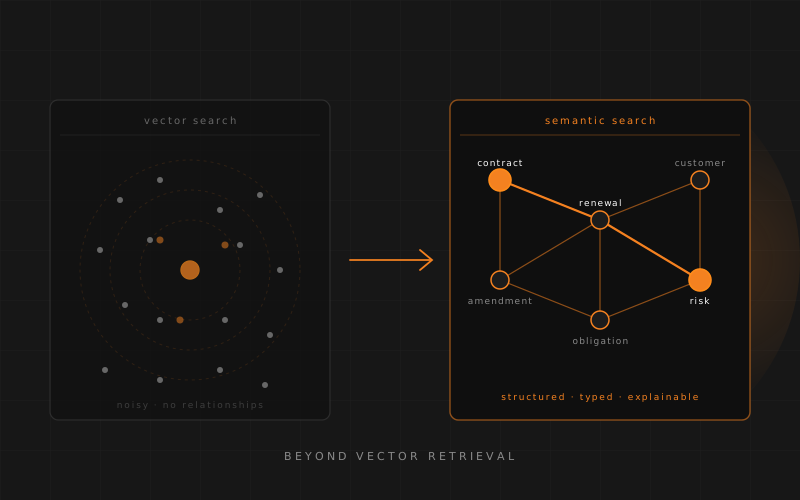
1. RAG + vector embeddings. Retrieval-Augmented Generation converts documents into numerical "embeddings," stores them in a vector database, retrieves the top-K most similar chunks to a query, and feeds them to an LLM that writes an answer. Pros: simple, scales to unstructured content (PDFs, tickets, wikis, Slack), and excellent for open-ended document discovery. Cons: it is probabilistic and non-deterministic: the same question can return different answers. And it hallucinates. Independent 2025–2026 benchmarks put enterprise RAG hallucination rates above 10% on real-world queries, with legal and medical domains cited well past 20%. RAG also cannot reason over joins: ask it a question that spans five entities and accuracy can collapse.
2. Knowledge graphs. Here entities, relationships, and attributes are modeled explicitly as a graph, and queries traverse those relationships. Pros: explicit semantics, explainable reasoning paths, and dramatically better accuracy on multi-entity questions. Diffbot's KG-LM benchmark found vanilla vector RAG scored zero accuracy on schema-intensive "Metrics & KPIs" and "Strategic Planning" questions, while graph-based retrieval handled them; Fluree's research reported zero-shot accuracy climbing from ~20% (traditional RAG) to 60–65% (GraphRAG) to 90–99% (decentralized knowledge graphs). Cons: graphs are historically expensive to build and maintain. LLM-based entity extraction "miss[es] 30–40% of entities or produce[s] incorrect relationships on typical enterprise corpora."
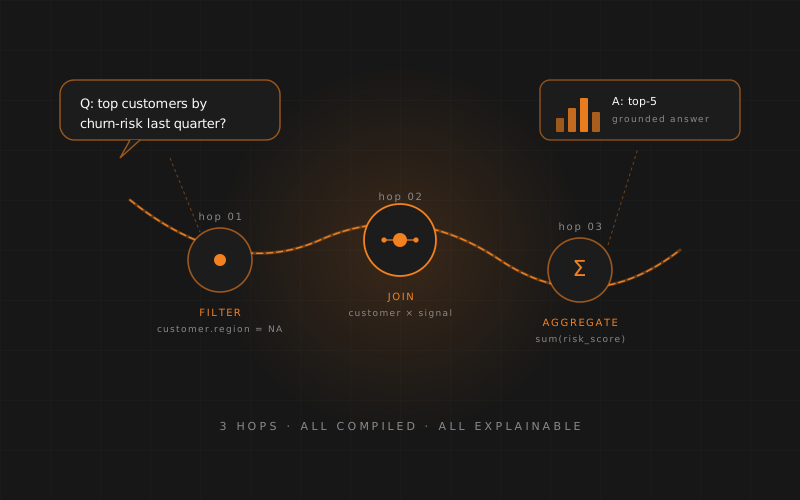
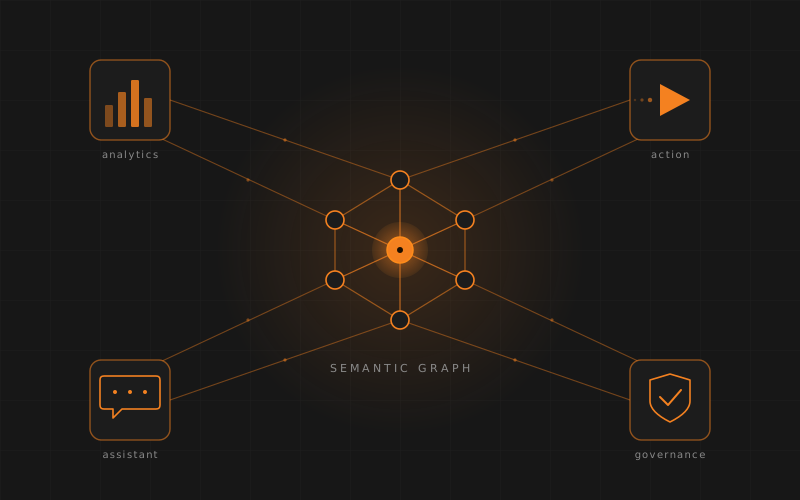
3. Deterministic semantic compilation. Instead of retrieving text and hoping, the system models the enterprise's concepts as a typed semantic graph and compiles a natural-language question into governed, executable SQL.proving every join path against the graph before execution. Pros: deterministic (same question → same answer), no hallucinated joins (a query either has a valid proven path or compilation fails), join-aware, auditable, and reproducible. Cons: it requires schema understanding and is built for structured/semi-structured data, not pure unstructured document discovery.
| Dimension | RAG + vectors | Knowledge graph | Deterministic compilation |
|---|---|---|---|
| Determinism | Low (probabilistic) | Medium | High (same Q = same A) |
| Hallucination risk | High (>10% typical) | Low–medium | Near-zero (fails closed) |
| Best data type | Unstructured docs | Connected entities | Structured / semi-structured |
| Join/multi-hop reasoning | Poor | Strong | Strong (proven joins) |
| Auditability | Low (black box) | Medium | High (compile trace) |
| Maintenance burden | Low to index | High (build/refresh) | Varies (autonomous if self-maintaining) |
When each wins: RAG for unstructured knowledge discovery ("what did we say about X?"); knowledge graphs for domain-specific relationship reasoning; deterministic compilation for cross-system metrics and insights ("what is true about X?"). RAG and the semantic layer are not competitors. They are "the two halves of how an enterprise AI agent reads and reasons."
The competitive landscape
Search infrastructure (Elasticsearch / OpenSearch / Vespa). Mature, dominant, and battle-tested. Elasticsearch added native kNN vector search in 8.0 and out-of-the-box semantic search (ELSER) in 8.8, with strong native RBAC, document- and field-level security, and on-prem/air-gapped deployment. Forrester's commissioned TEI study (June 2023) found a composite Elasticsearch organization realized 293% three-year ROI with payback in under six months. It is built for text/document search, requires significant engineering to tune, and is not designed for cross-system business semantics or proven joins.
Cloud managed search (AWS Kendra, Google Agent Search, Azure AI Search). Strong NLP, managed infrastructure, good connector libraries. Kendra's entry tiers run roughly $810–$1,008+/month for 10K–100K docs; Google Agent Search bills per query (~$1.50/1,000 queries). Each is happiest within its own cloud ecosystem, and reviewers consistently flag Kendra as "expensive and difficult to scale."
Enterprise knowledge search (Glean, Microsoft 365 Copilot). Glean connects 100+ tools with a permissions-aware knowledge graph; pricing starts around $50+/user/month with ~100-seat minimums and fully loaded TCO commonly cited at $300K–$480K+ for mid-to-large deployments. Microsoft 365 Copilot is $30/user/month on top of an existing M365 license. Gartner's June 2024 survey of 132 IT leaders found that 60% had started M365 Copilot pilots but "just 6% had finished their pilots... and were actively planning large-scale deployments."
Data catalogs + discovery (Atlan, Collibra, Alation). These help you find the asset (a table, a column, a dataset) and govern it, not the answer. Reviewers note that catalog search relies heavily on manual curation and that incumbents deliver "limited semantic understanding" and "difficulty retrieving context-rich results." Deployment commonly takes 3–9 months.
Vector databases (Pinecone, Weaviate, Qdrant, Milvus). The RAG infrastructure layer. Fast similarity search, increasingly enterprise-ready on certifications (SOC 2, HIPAA) and namespace/tenant RBAC. But, as Atlan bluntly puts it, "vector databases handle retrieval performance." They "do not govern what gets indexed, who owns the source data, whether it has been certified for AI use." Governance lives upstream, and hallucination risk lives downstream.
Colrows. Colrows positions itself as a semantic execution layer that autonomously builds a typed semantic graph across the data estate and compiles every query (natural-language, API, or agent intent) into governed, deterministic, dialect-perfect SQL across 16+ engines. Where the search incumbents return documents or links and the vector databases return similar chunks, Colrows returns the proven, governed answer with a reproducible audit trail. It is not a document-discovery tool; it is the structured-reasoning half of the stack.
Quantified ROI for IT leaders
Build the business case on four levers:
- Time savings. Even a conservative 10% reduction in search time across 1,000 knowledge workers reclaims thousands of hours. McKinsey found searchable, shared knowledge records can cut information-search time "by as much as 35 percent." Translate minutes saved per query × searches per week × fully loaded salary; most organizations modeling this find the annual cost of bad search exceeds $1M.
- IT ticket deflection. Better self-service search reduces the "help me find X" and "I need access to Y" ticket queue. Colrows' customer-facing claim for self-serve analytics is 80% fewer ad-hoc data requests, directionally consistent with broader enterprise-search literature.
- Compliance and audit efficiency. Faster location of records for DSARs, audits, and legal review directly cuts compliance and legal hours. GDPR exposure (fines up to 4% of global revenue) and HIPAA penalties make this a board-level number.
- Faster decisions / time-to-insight. Hardest to quantify, but the highest-ceiling lever: surfacing a relevant prior study, a duplicate R&D effort, or a regulatory gap "before it becomes an enforcement action" can save millions.
Build vs. buy: Rolling your own (Elasticsearch + RAG + LLM + governance + dialect handling) is real engineering. Colrows' own published estimate: 2 backend engineers for 12 months (~$300K+), $100K+ DevOps/infra, and ~$50K/year ongoing maintenance. Glean's per-user model scales linearly with headcount and is documented at $300K–$480K+ fully loaded TCO for mid-to-large deployments.
Implementation and governance: The differentiator
The critical architectural question is when access control is enforced. Most search and RAG systems filter results after retrieval, meaning unauthorized data was still read. Colrows enforces RBAC, ABAC, and row/column-level predicates at compile time: "Unauthorized plans are never generated" and the data is never read. Every query produces an audit record capturing graph version, identity context, resolved entities, proven join paths, and compiled SQL, enabling point-in-time reproducibility.
Timeline: Colrows states that connecting a data source and auto-building the initial semantic graph "takes hours, not weeks," with production rollouts in regulated environments running "in weeks, not months." A realistic POV scopes 3–5 data sources over a few weeks. By contrast, heavyweight catalog/governance suites commonly take 3–9 months.
Fix the context, not the model. Enterprise search fails not because the retrieval algorithm is wrong, but because the system has no context: no concept graph, no governance layer, no join proof. Adding more vectors to a contextless pipeline produces faster hallucinations. Adding a typed semantic graph produces deterministic answers.
Why semantic search fails (and how to avoid it)
- Failure mode 1: RAG hallucinations. The LLM invents an answer or a join that doesn't exist, presenting it with high confidence. Avoid it with deterministic compilation that fails closed: no proven join path, no answer.
- Failure mode 2: Governance gaps. Post-hoc result filtering surfaces data users shouldn't see. Avoid it with compile-time policy enforcement, where unauthorized queries never generate a plan.
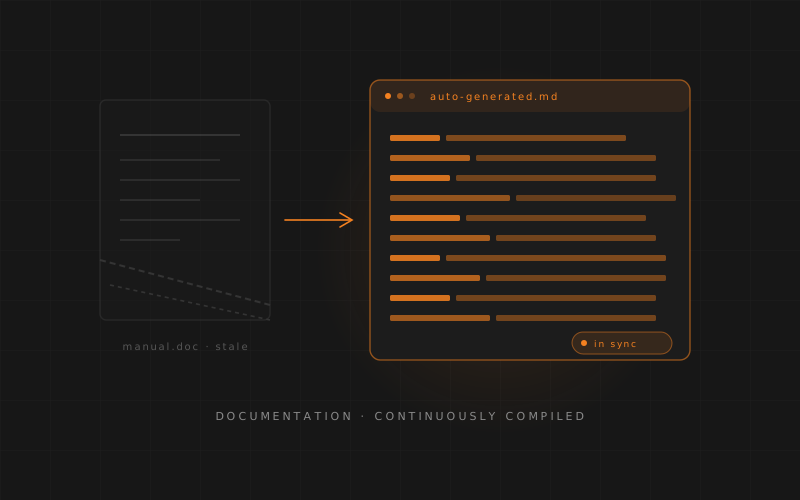
- Failure mode 3: Slow iteration / drift. Hand-built semantic models go stale the moment a schema changes. Avoid it with autonomous maintenance: drift detection and schema-evolution handling that keep the graph current.
Objection handling for IT buyers
- "We already have Elasticsearch / Kendra / Atlan. Why add this?" Those are document/asset search. They find the file or the table. They don't compile a governed, joined answer across your warehouses with proven correctness.
- "What's the hallucination rate?" Deterministic compilation has no probabilistic ranking step: a query either resolves to a proven plan or fails compilation. Compare that to RAG's 10%+ enterprise hallucination rates.
- "Can we enforce access control and integrate with our governance?" Yes. RBAC/ABAC and row/column predicates at compile time, with full reproducible audit trail.
- "How long to implement?" Hours to connect a source and auto-build the graph; weeks to a governed production rollout.
- "Will it work across cloud + on-prem?" 16+ engines, dialect-perfect SQL per backend, with shared, dedicated, and fully private VPC deployments across AWS, Azure, and GCP.
Getting started: The 4-stage roadmap
Stage 1 (Weeks 0–2): Decide which problem you actually have. If knowledge workers can't find documents, scope a permissions-aware enterprise search tool. If analysts and agents can't get trustworthy, governed answers from data across multiple warehouses, scope deterministic semantic compilation. Threshold to proceed: audit shows >2 hrs/week/employee lost to search or a multi-week ad-hoc data-request backlog.
Stage 2 (Months 1–2): Run a 4–8 week POV on 3–5 sources. Insist the vendor connect to your data, not a sandbox. Build a golden question set spanning single-system and cross-system queries. Measure: answer accuracy/reproducibility, latency, whether access control is enforced before retrieval, whether the same question reliably returns the same answer. Threshold to proceed: deterministic reproducibility on cross-system queries and zero unauthorized-data leakage in adversarial tests.
Stage 3 (Month 3): Decide on architecture, then negotiate commercials. For unstructured discovery, accept RAG's probabilistic nature but demand source ACL enforcement and a hallucination-rate SLA. For structured reasoning and anything audit- or agent-facing, require compile-time governance, proven joins, and reproducible audit trail. Model 3-year TCO against build-your-own engineering cost (~$450K+ first year, $50K+/year ongoing).
Stage 4 (Month 3+): Roll out by team, expand sources, and wire agents via MCP. Track ticket deflection, adoption (DAU/MAU, searches per user), and time-to-insight. Re-baseline at 90 days and tie renewal to demonstrated reduction in data-access tickets.
Frequently asked questions
Why do LLMs fail at corporate semantic search?
LLMs fail because they lack enterprise data context. They do not know your schema, your join paths, your access policies, or your business definitions. Without that context, they retrieve probabilistic matches and hallucinate joins that do not exist. Independent 2025–2026 benchmarks put enterprise RAG hallucination rates above 10%. The fix is not a better model. It is a typed semantic graph that gives the model the context it needs to compile deterministic, governed SQL.
How do you achieve deterministic retrieval in an enterprise environment?
Deterministic retrieval requires three things: a versioned semantic graph that maps every concept, relationship, and metric across your data estate; a compile-then-execute pipeline that proves every join path against the graph before execution; and compile-time governance (RBAC, ABAC, row/column-level predicates) that enforces access control before data is read. If the query cannot be proven, compilation fails. No hallucination. No unauthorized access.
What is the difference between vector search and semantic layer retrieval?
Vector search converts text into numerical embeddings and returns the top-K most similar chunks. It is probabilistic: the same question can return different results, and it cannot reason over joins or enforce governance at query time. Semantic layer retrieval compiles a natural-language question into governed, executable SQL through a typed concept graph. It is deterministic: same question, same answer, with a full audit trail. Vector search is best for unstructured document discovery. Semantic layer retrieval is best for trustworthy, governed answers from structured data.
Enterprise RAG hallucinates above 10% not because the model is weak but because it lacks your schema, join paths, and access policies; a typed semantic graph gives it that context and compiles governed, deterministic SQL. Fix the Context, Not the Model.
The bottom line for IT leaders: if your problem is finding documents across SaaS tools, a permissions-aware enterprise search tool (Glean, Kendra, Elasticsearch) is the right buy. If your problem is getting trustworthy, governed, reproducible answers from data spread across many warehouses and systems (the kind you'd put in front of an auditor or an autonomous agent), then deterministic semantic compilation closes the accuracy, governance, and cross-system gaps the incumbents leave open. Book a demo to model your specific search landscape and 3-year TCO.