"Let's just build a few endpoints to expose our data." It sounds cheap. It never is. Two senior backend engineers for twelve months is roughly $600,000 in fully-loaded salary alone, before you add DevOps, infrastructure, monitoring, on-call, and compliance work. And the moment your access layer touches regulated data (customer PII, financial records, health data), you have quietly signed up to build, document, and defend an audit-grade governance system. Per IBM's Cost of a Data Breach Report 2025, the average breach now costs $4.44M globally and a record $10.22M in the US, and 97% of organizations that suffered an AI-related breach lacked proper access controls. A hand-rolled access layer is precisely where those controls go missing.
This post breaks down the real cost of building a modern data access layer, names the specific alternatives you're actually choosing between, and shows why CTOs and data leaders increasingly buy this layer rather than build it.
| Aspect | Build your own (DIY) | Colrows (buy) |
|---|---|---|
| Year-one cost | ~$600,000–$1,000,000+ (two senior engineers for twelve months, plus DevOps, infra, and compliance work). | Starts at $0 on the Free tier; custom-priced Enterprise for regulated production. |
| Time to production | 6–12 months of senior-engineer work just to reach baseline parity. | Hours to connect a source and build the graph; weeks to production in regulated environments. |
| Cross-warehouse governance | Hand-rolled and single-platform; warehouse-native tools read only their own metadata. | Compile-time RBAC, ABAC, and row/column policies across 16+ engines before any SQL runs. |
| Audit and compliance | Often cannot answer who accessed what, under which policy, at what time (BCBS 239, HIPAA, EU AI Act exposure). | Built-in audit trails with graph version, identity context, and point-in-time reproducibility. |
| Maintenance | Connectors and hand-authored YAML drift as dialects, auth, and schemas change. | Autonomous semantic graph built and maintained by agents; resists schema drift. |
What you're really signing up to build
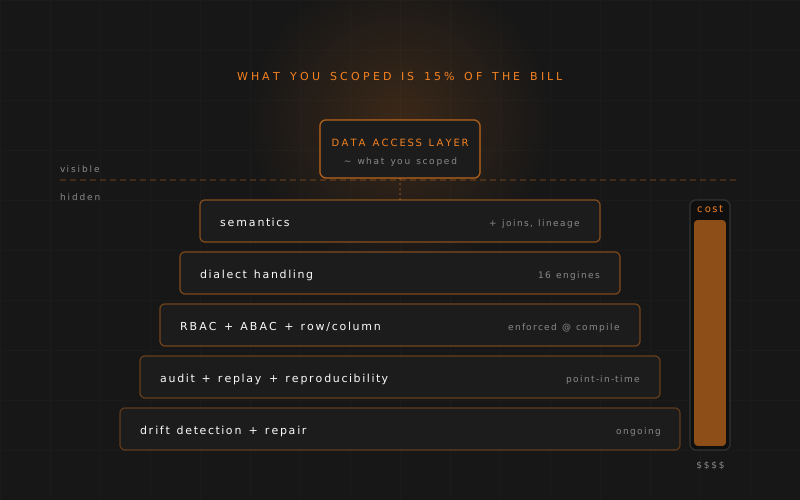
A "few endpoints" is the visible tip. Underneath sits a platform. To reach parity with a modern, secure, self-serve access layer you need:
- Connectors for 16+ engines:Snowflake, Databricks, BigQuery, Redshift, Postgres, MySQL, ClickHouse, Trino, MongoDB, plus REST/API sources. Each connector is a maintenance liability as dialects and auth methods drift.
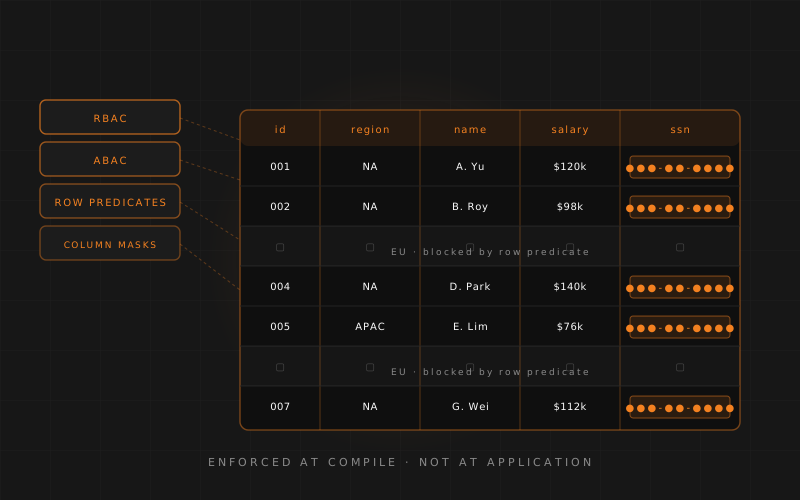
- Authentication and authorization:RBAC, ABAC, and row/column-level policies. Broken access control is the #1 risk on the OWASP Top 10, and several databases (MySQL, MariaDB) lack native fine-grained control entirely.
- Query governance and a SQL processing layer:parsing, validation, policy enforcement before execution, dialect translation.
- An AI layer that produces valid, context-aware SQL:metadata, join-path proof, confidence scoring, fallback strategies. The hard part isn't generating SQL; it's generating correct SQL.
- A metadata/semantic catalog:mapping tables, columns, relationships, and business definitions; usually requires a separate catalog or custom tooling.
- Operational plumbing:audit logging, caching, rate limiting, conflict resolution, version control, team collaboration, monitoring, multi-tenant isolation.
The total: easily 6–12 months of senior-engineer work to hit baseline parity, before scaling, onboarding, audits, or compliance demands.
The real TCO of building vs. buying
Engineering salaries (US total comp, 2025–2026 medians): backend SWE ~$193K; data engineer ~$156K; DevOps engineer ~$153K; data/database architect ~$167.5K–$178.8K. Senior roles at top firms routinely clear $250K–$300K+.
Itemized year-one build cost (illustrative, US):
- 2 senior backend engineers (12 mo): $300,000–$500,000
- DevOps + infrastructure support: $100,000+
- Cloud/compute, monitoring, on-call tooling: $50,000–$100,000
- Compliance/audit tooling & prep: 5–10% spike
- Year-one total: ~$600,000–$1,000,000+
3-year TCO: A custom build commonly exceeds $1M over three years once maintenance, scaling, and compliance are included. Per a McKinsey–Oxford study of 5,400+ IT projects, large IT projects run 45% over budget and deliver 56% less value than predicted. DreamFactory's published analysis of custom LLM data layers cites >$1.5M initial cost, 12–18 month timelines, and $610K–$710K/year in specialized staffing.
The buy side: Colrows starts at $0 (Free tier: unlimited datasources, unlimited users, unlimited access policies) and moves to custom-priced Enterprise for regulated production. Connecting a source and auto-building the initial semantic graph takes hours; production rollout in regulated environments runs in weeks, not months.
Named alternatives and why they fall short
You're not choosing "build vs. buy." You're choosing among specific options, each with a real gap:
Warehouse-native options (Databricks AI/BI Genie, Snowflake Cortex Analyst, BigQuery Gemini) are strong inside their own platform but structurally cannot deliver cross-warehouse, compile-time governance. Genie is capped (~25 tables per space); Cortex requires hand-authored YAML semantic views (~50–100 columns practical limit); Gemini works only against Google data.
Vendor bolt-ons carry abandonment risk: MongoDB's managed Atlas Data API and HTTPS Endpoints reached end-of-life September 30, 2025, forcing teams back to self-hosted Express/Azure Functions wrappers, concrete evidence that depending on a vendor's access API can strand you.
dbt Semantic Layer / MetricFlow is hand-authored YAML, resolved at presentation time, with a single global namespace (collision-prone). The team owns ongoing maintenance, caching, access control, and incident response. No cross-warehouse story.
Hand-rolled REST API wrapper (the most common build scenario) has no formal governance trail, ad-hoc auth, and becomes brittle as schemas drift. Lacks compile-time, row/column-level policy enforcement.
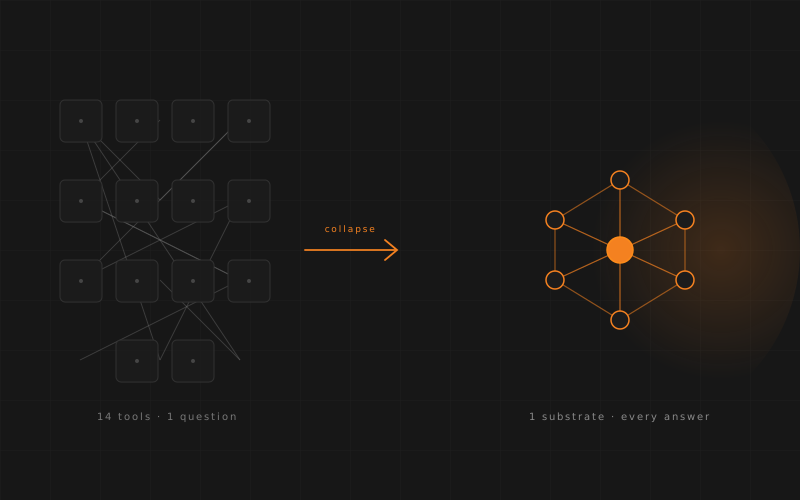
The shared blind spot: every warehouse-native option reads only its own platform's metadata. The questions executives actually ask ("margin by customer where billing is in Snowflake, telemetry in Databricks, reference data in Postgres") have no home in any single-vendor tool.
Compliance and audit risk
A hand-rolled access layer is a compliance liability the spreadsheet never captures.
BCBS 239 / RDARR: The ECB's Supervisory Priorities 2025–27 commits supervisors to "full use of the supervisory escalation toolkit (including sanctions)" for banks that miss deadlines. Only 2 of 31 G-SIBs are fully compliant (Basel Committee 7th progress report, Nov 2023). On July 10, 2024, the OCC and Federal Reserve fined Citigroup a combined $135.6M for unresolved data-quality and risk-control deficiencies. Without structured audit trails, formal RBAC/ABAC, and vendor SLAs, custom layers cannot answer: "who accessed what, under which policy, at what time?"
EU AI Act Article 10 mandates AI data governance; SOX, HIPAA, GDPR, CCPA require provable, auditable access controls. Breach economics (IBM 2025): $4.44M global / $10.22M US average; healthcare $7.42M; financial services $5.56M; shadow AI +$670K; 97% of AI-related breaches occurred where access controls were missing.
The Colrows alternative
Colrows delivers the full feature set without the engineering burden:
- Unified access across 16+ engines plus catalogs, Confluence, and documentation, no rip-and-replace.
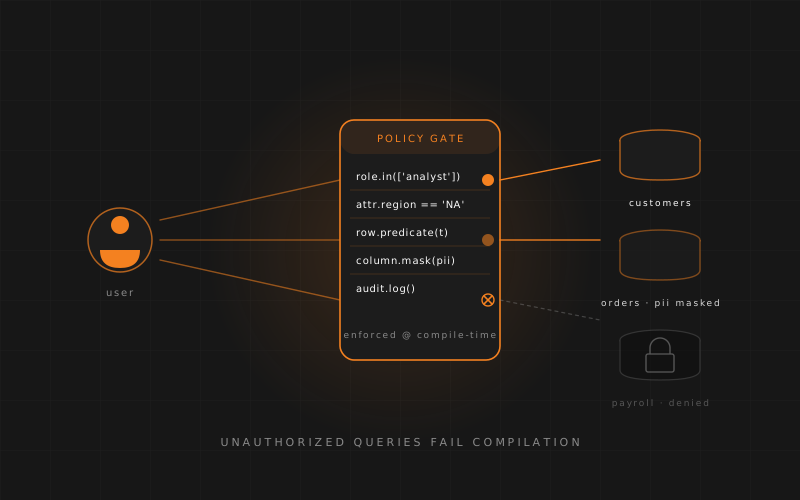
- Governance at compile time (RBAC, ABAC, row/column predicates) enforced before any SQL leaves the planner; unauthorized intent fails compilation.
- Deterministic, dialect-perfect SQL:every join proven at compile time; the same question returns the same answer.
- Autonomous semantic graph:built and maintained by agents, not hand-authored YAML; resists schema drift.
- Built-in audit trails:every query captures graph version, identity context, resolved entities, proven join paths, and compiled SQL, enabling point-in-time reproducibility.
- Python notebooks and REST APIs:pre-authenticated and governed by the same policies.
Customer proof
Cipla (pharma; 22,500+ field reps) deployed Colrows with a Trino federated engine and unified knowledge graph: 8× increase in data adoption, >90% reduction in decision latency (days → minutes), 80% drop in IT report requests, 18–24% sales productivity uplift, 30% reduction in stockouts. "What was once a fragmented, multi-day investigation became a single, explainable insight, surfaced before the morning meeting ended."
SSP Group (travel retail; ~49,000 employees across ~40 countries): 40% reduction in data-management overhead, 3× faster issue resolution, 80% improvement in team collaboration. Jayesh Pawar, Head of Analytics: "There isn't any comparable platform in the market; Colrows is the all-in-one solution… the pricing is incredibly reasonable."
Implementation roadmap
- Month 1: Connect data sources; Colrows auto-builds the semantic graph (hours per source).
- Month 2: Author RBAC/ABAC and row/column policies; wire SSO/SCIM; validate against existing definitions.
- Month 3+: Onboard AI agents, expand to new sources, stand up audit/compliance packs.
This beats a 12-month build because your team stays focused on insight, not infrastructure. Book a demo to model your specific TCO.
The visible endpoints are the cheap part; the real cost and risk live in the semantic, dialect, governance, and audit layers underneath, and those are a context problem rather than a model problem. Fix the Context, Not the Model.
Frequently asked questions
How much does it cost to build a custom data access layer?
Roughly $600,000-$1,000,000+ in year one for a US team. Two senior backend engineers for twelve months run $300,000-$500,000 in salary alone, before DevOps, infrastructure, monitoring, and compliance work.
Is it cheaper to build or buy a data access layer?
Buying usually wins on TCO. A custom build commonly exceeds $1M over three years, and a McKinsey-Oxford study of 5,400+ IT projects found large IT projects run 45% over budget and deliver 56% less value than predicted. Colrows starts at $0 on the Free tier and reaches production in regulated environments in weeks, not months.
What does a data access layer need beyond API endpoints?
Connectors for 16+ engines, RBAC, ABAC and row/column-level policies, a SQL processing layer with dialect translation, an AI layer that produces correct SQL, a semantic catalog, and operational plumbing like audit logging, caching, and monitoring. That is easily 6-12 months of senior-engineer work to hit baseline parity.
What are the compliance risks of a hand-rolled data access layer?
It typically cannot answer who accessed what, under which policy, at what time. That is exactly what BCBS 239, SOX, HIPAA, GDPR, and EU AI Act Article 10 demand. Only 2 of 31 G-SIBs are fully BCBS 239 compliant, and the OCC and Federal Reserve fined Citigroup a combined $135.6M for unresolved data-quality and risk-control deficiencies.
Why not just use Snowflake Cortex Analyst or Databricks Genie?
They are strong inside their own platform but structurally cannot deliver cross-warehouse, compile-time governance. Genie is capped near 25 tables per space, Cortex Analyst requires hand-authored YAML semantic views with a practical limit of 50-100 columns, and BigQuery Gemini works only against Google data.
How much does a data breach cost when access controls are missing?
Per IBM's Cost of a Data Breach Report 2025, the average breach costs $4.44M globally and a record $10.22M in the US. Healthcare averages $7.42M and financial services $5.56M, and 97% of organizations that suffered an AI-related breach lacked proper access controls.