The stack as a symptom of growth
No one sets out to build a complicated data stack. Each decision is reasonable in isolation. A new tool clears a bottleneck. A transformation framework adds structure. A metric layer, a catalog, an observability platform, a feature store, an access-control system. Each layer solves a real problem. The complexity does not come from any single tool. It comes from how the tools accumulate and how little shared understanding exists across them.
The result is a stack that is enormously powerful and yet cannot explain itself. Ask a simple question, why did this number change, and the system struggles. Logic is scattered. Definitions live in several places. Relationships are implicit. Context is assumed, not encoded. Understanding the system requires tribal knowledge, and new hires spend weeks reconstructing intent.
| Capability | Legacy "Best-of-Breed" Stack | Colrows Deterministic Architecture |
|---|---|---|
| Tool Count | High (Warehouse + BI + Metric Store) | Low (Unified Compiler) |
| Logic Location | Distributed / Siloed | Centralized / Compiled |
| Maintenance | Brittle / Manual updates | Self-healing / Automated |
| AI Integration | Complex / High Latency | Native / Deterministic |
| Complexity | Exponential with growth | Linear (Schema-driven) |
Brooks' distinction: essence versus accident
In 1986, Fred Brooks gave the industry the vocabulary for this. In "No Silver Bullet," he wrote: "Following Aristotle, I divide them into essence, the difficulties inherent in the nature of the software, and accidents, those difficulties that today attend its production but that are not inherent." Essential complexity is the problem itself. If users want a program to do thirty things, those thirty things are essential. Accidental complexity is everything we add through our tools, processes, and history that is not inherent to the problem.
Brooks' famous conclusion was sobering: "There is no single development, in either technology or management technique, which by itself promises even one order-of-magnitude improvement within a decade in productivity, in reliability, in simplicity." But he was also clear about where past wins came from. High-level languages freed a program "from much of its accidental complexity." That is the pattern: the biggest historical gains came from attacking accidental complexity, not essential complexity.
Twenty years later, Ben Moseley and Peter Marks pushed the argument further in "Out of the Tar Pit." They wrote: "Following Brooks we distinguish accidental from essential difficulty, but disagree with his premise that most complexity remaining in contemporary systems is essential." Their claim matters for data teams: if most of your complexity is accidental, most of it is removable. They defined essential complexity as "inherent in, and the essence of, the problem (as seen by the users)" and accidental complexity as "all the rest." For modern data stacks, "all the rest" is most of it.
The architecture gap: why the problem persists
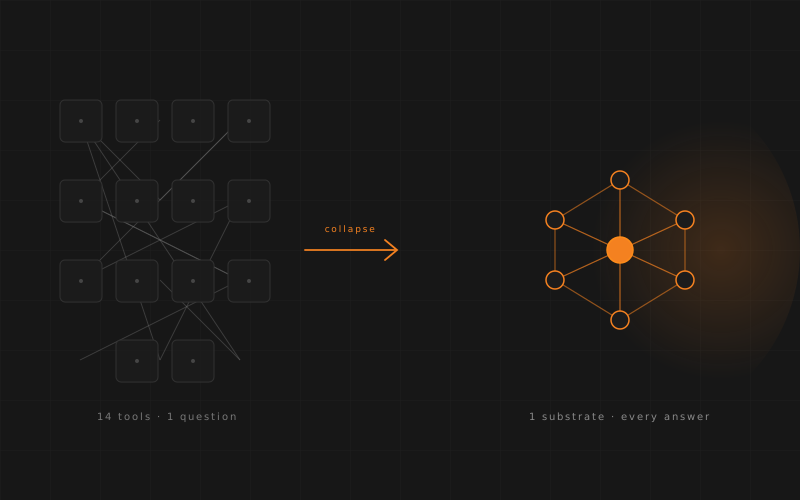
The glue code problem. Most modern stacks are just glue code holding together incompatible BI tools and warehouses. Colrows eliminates this by compiling logic directly from the data source. This removes the need for intermediate metric stores, view layers, and manual sync processes. See the SaaS Architecture to understand how the compiler physically replaces these fragmented layers.
The compiler advantage. Do not add another layer to your stack. Remove the complexity by consolidating your business logic into a single compiler. Fix the context, not the model.
Core Principle: Fix the Context, Not the Model. Do not add another layer to your stack. Remove the complexity by consolidating your business logic into a single compiler. A well-governed semantic layer that understands business context creates more reliable enterprise logic than stacking tools.
Where accidental complexity comes from in data stacks
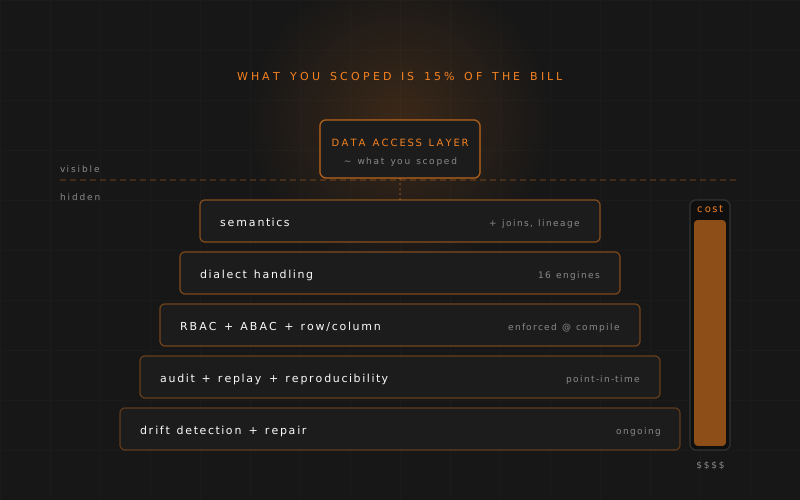
Tool proliferation. A typical stack now has separate tools for ingestion, storage, compute, transformation, orchestration, BI, observability, and governance. With eight tools at one tool per capability, you face 28 possible integration points. Every integration is a surface for drift, breakage, and maintenance. The 2024 industry data shows more than 70% of data teams rely on five to seven tools just to get through daily workflows, and per the Matillion/IDG MarketPulse survey, enterprises draw on an average of 400 data sources, with more than 20% of organizations reporting 1,000 or more.
Semantic inconsistency across tools. This is the deepest source. Finance defines revenue as cash collected. Sales defines it as signed contract value. Marketing counts only transactions above a threshold. Without a shared definition, three teams produce three numbers and the meeting becomes a debate about whose number is right. The same drift happens to "active customer," "churn," and every other core concept. Each tool reconstructs meaning on its own. Metric stores attempted to solve this but created a new layer to maintain.
Schema fragmentation and pipeline coupling. Business logic gets copied across models, dashboards, spreadsheets, and application code. A model excludes refunds, a BI tool applies its own filter, an analyst patches a spreadsheet before the executive pack goes out. Each step feels small; the combined effect is one metric with three meanings. Pipelines become tightly coupled, so a single upstream schema change cascades into downstream breakage that nobody can fully predict.
Tribal knowledge. The logic that decides whether a feature ships in two days or two weeks lives in Slack threads nobody can find, in senior engineers' heads, and in code comments that may not reflect reality. When that knowledge walks out the door, the system loses the ability to explain itself.
The cost of accidental complexity
The costs are concrete and quantifiable.
Hiring and onboarding. Data engineers commonly take several months to reach full productivity. One body of research puts engineer ramp-up at three to nine months. During that window the most senior engineers lose 20% to 40% of their time to mentoring and question-answering. The all-in cost of onboarding a single engineer is frequently estimated at 50% to 100% of annual salary.
Incident response. Roughly 80% of mean-time-to-repair is wasted on non-productive activities, primarily figuring out what changed, according to The Visible Ops Handbook. Almost 80% of outages are self-inflicted. When logic is scattered across tools, that identification phase balloons. Downtime is expensive: ITIC's 2024 Hourly Cost of Downtime Survey found the average cost of a single hour of downtime now exceeds $300,000 for over 90% of mid-size and large enterprises, with 41% to 44% saying it exceeds $1 million.
Cognitive load and decision paralysis. When teams cannot trust a number, they re-derive it, re-litigate it, or freeze. Documentation workflows try to keep up but fail. Gartner research from 2020 estimates poor data quality costs organizations at least $12.9 million a year on average, and Thomas C. Redman, writing in MIT Sloan Management Review, estimates "the cost of bad data to be 15% to 25% of revenue for most companies."
Essential complexity that cannot be eliminated
Not all complexity is the enemy. Some is essential and should be preserved.
Domain complexity. A bank genuinely must handle transactions, balances, interest, and fraud rules. Those are the thirty things the business needs. No architecture removes them.
Regulatory requirements. GDPR, CCPA, HIPAA, and the EU AI Act impose real obligations: data residency, right-to-erasure, audit trails, consent. These are inherent to operating in regulated markets. Governance must be encoded, not documented.
Federated domains. In a data mesh, domain teams own their data products because the people closest to the data understand its meaning best. Gartner's 2024 survey found 64% of organizations have spread data teams across business units. That federation is a deliberate, essential choice. The failure mode is not federation itself; it is federation without a shared semantic frame, where 20 teams each define "active customer" differently and cross-domain analysis breaks.
Why tool consolidation fails to solve it
The instinct when a stack feels complex is to consolidate vendors. Buy the suite. Reduce the logos. This reduces the number of systems but not the semantic coherence between them.
The reason is structural: each vendor ships its own model of meaning. A BI tool, a warehouse, and a transformation framework each have their own way of defining a metric. Bundling them under one corporate owner does not reconcile those models. Worse, consolidation trades one problem for another. As practitioners have noted about the wave of data-tool mergers, "the unified stack is not unification in the architectural sense; it is a lock-in ecosystem masquerading as freedom." Portability, flexibility, and independence erode. Switching costs rise. The semantic fragmentation remains because no one defined meaning in a place independent of the tools.
Adding more tooling has the same flaw. When logic is hard to track, teams add documentation. When definitions drift, they add governance workflows. When pipelines break, they add monitoring. These help at the margins but do not touch the root cause, which is the absence of shared, machine-readable meaning.
How semantic layers reduce accidental complexity
A semantic layer is the architectural answer because it attacks the root cause rather than the symptoms. It is a layer where business concepts are defined once, relationships are explicit, context is preserved, and changes are tracked over time.
It reduces accidental complexity along four axes:
1. Single source of truth for meaning. Revenue, active customer, and churn are defined once. Every BI tool, notebook, and AI agent reads the same definition. The reconciliation meeting disappears because there is nothing to reconcile. Meaning stays aligned over time.
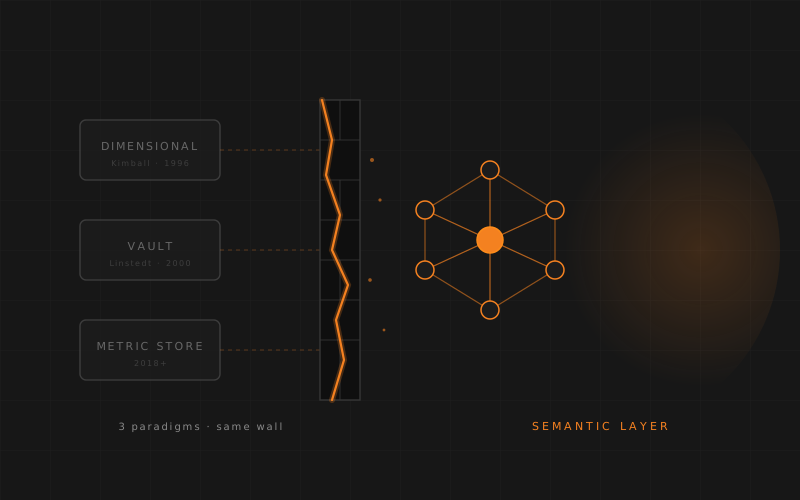
2. Decoupling definition from execution. Meaning lives independently of where data is stored or how queries run. A team can switch from one BI tool to another, or from one warehouse to another, and the business logic stays stable. Data becomes an implementation detail; meaning becomes the interface. A compiler target ensures this separation.
3. Enforcing governance once. Access policies, row and column-level security, and certification attach to concepts rather than being re-implemented per tool. Policy travels with the metric wherever it is consumed.
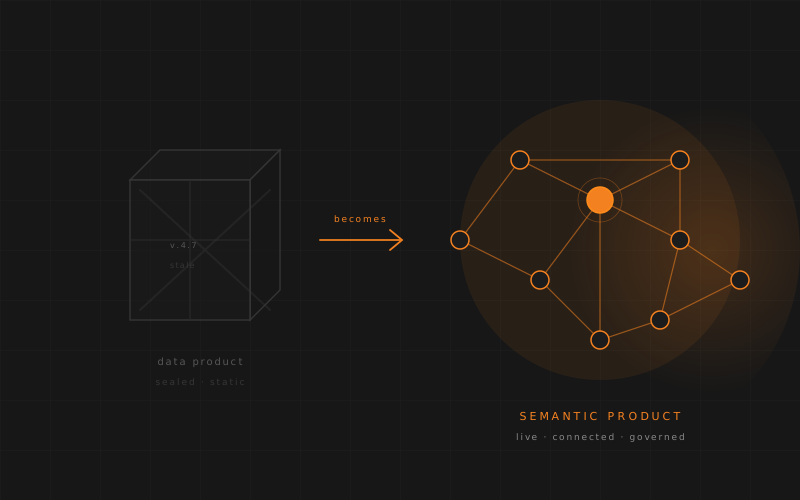
4. Eliminating manual reconciliation. Because definitions are centralized and machine-readable, the manual work of stitching meaning across tools, and the errors that work introduces, goes away. Semantic products replace static data products.
The market is moving this direction. Per MarketsandMarkets, the semantic-layer category is projected to grow from $2.71 billion in 2025 to $7.73 billion by 2030, a 23.3% compound annual growth rate, reflecting recognition that semantic consistency is foundational infrastructure, especially for trustworthy AI.
Where semantic layers fit against data fabric, data product, and data mesh
These approaches are complementary, not competing.
Data mesh is an organizational model: domains own data as products under federated governance. It answers who owns what. It does not guarantee a shared definition of a metric across domains.
Data fabric is a technology-centric integration layer that uses active metadata and automation to connect sources. Gartner frames fabric and mesh as complementary, not a choice: a data fabric is a technology-enabled implementation, while a data mesh is a solution architecture for building business-focused data products. A semantic control plane unifies these architectures.
Data products package and document datasets with owners and contracts. But documentation cannot keep pace, contracts do not explain nuance, and ownership does not prevent misinterpretation. What teams struggle with is alignment around meaning, not access to data.
A semantic layer sits above all three and supplies what they lack: an explicit, governed, machine-readable model of meaning that federated domains, fabric integrations, and data products can all anchor to. It preserves federation while eliminating the accidental coupling that federation without shared semantics produces.
Where Colrows fits
Colrows positions itself as a semantic execution layer for enterprise AI. The honest framing is the one Colrows itself uses: a semantic layer does not replace existing tools, it changes how they connect. Instead of each system interpreting data independently, they anchor to shared concepts modeled in a semantic graph that is kept aligned as data, schemas, and usage evolve.
Concretely, this maps to the four complexity-reduction axes: It decouples meaning from storage, so definitions are not trapped inside any one warehouse or BI tool. It centralizes governance, attaching policy to concepts rather than re-implementing access rules per tool. It reduces multi-tool semantic inconsistency by giving every consumer, human or AI agent, a single frame of reference. It preserves flexibility and federation, since domains keep their autonomy while sharing meaning.
A practical path forward
Stage 1, diagnose. Inventory how many tools touch a single critical metric end to end, and count how many places that metric is defined. If a board-level number can be produced four different ways by four teams, you have a semantic problem, not a tooling problem. Benchmark your current onboarding time-to-productivity and incident identification time. Threshold to act: if engineers spend most of a sprint wiring tools and fixing schema breaks rather than shipping, or if ramp-up exceeds three to four months, prioritize semantic consolidation over buying another tool.
Stage 2, define meaning before buying tools. Pick the five to ten most-contested metrics and define them once, with explicit logic, filters, and edge cases, in a tool-agnostic layer. Resist the urge to consolidate vendors first; reducing logos without defining meaning leaves the root cause intact and adds lock-in.
Stage 3, centralize governance and decouple. Attach access and certification policies to concepts, not tools. Expose governed definitions to BI tools, notebooks, and AI agents through a shared interface so meaning is consumed identically everywhere. Preserve domain ownership; federate execution, centralize semantics.
Stage 4, measure the reduction. Track the same benchmarks from Stage 1. Expect onboarding time, incident identification time, and the number of reconciliation meetings to fall. If they do not move within two quarters, your semantic layer is under-adopted, not wrong; invest in adoption and coverage.
What stays true even as the stack evolves
Modern data stacks did not become complex because we made bad choices. They became complex because we made many good choices without a shared layer of meaning to hold them together. The next generation of data platforms will not be defined by how much they store. They will be defined by how well they preserve understanding over time. Architectural simplicity is itself a competitive moat, as explored in The Semantic Divide. Because the accidental complexity that compounds silently is the kind that costs the most. The answer is not more tools. It is a deterministic compiler that removes the plumbing so your teams can focus on logic.
Frequently asked questions
What is accidental complexity in a data stack?
Accidental complexity is the difficulty that arises from how solutions evolved over time (through tool accumulation, semantic inconsistency, and fragmented logic) rather than from the problem itself. Fred Brooks distinguished this from essential complexity, which is inherent to the problem domain.
How much does poor data quality cost?
Gartner estimates poor data quality costs the average organization $12.9 million per year. Thomas Redman estimates the cost as 15% to 25% of revenue for most companies. ITIC's 2024 survey found the average hourly cost of downtime exceeds $300,000 for over 90% of mid-size and large enterprises.
Why does tool consolidation fail to reduce complexity?
Each vendor ships its own model of meaning. Consolidating tools under one owner does not reconcile their different definitions of the same metric. Semantic fragmentation persists because no one defined meaning in a place independent of the tools.
How do semantic layers reduce accidental complexity?
Semantic layers create a single source of truth for meaning, decouple definition from execution, enforce governance once across all tools, and eliminate manual reconciliation. They attack the root cause (absence of shared, machine-readable meaning) rather than symptoms.
What is essential complexity that cannot be eliminated?
Essential complexity includes domain rules (a bank handling transactions and fraud rules), regulatory requirements (GDPR, HIPAA, EU AI Act), and federated domain ownership (data mesh). These are inherent to the problem and should be preserved.
How long does it take to reach full productivity in data engineering?
Data engineers commonly take three to nine months to reach full productivity. During that window, the most senior engineers lose 20% to 40% of their time to mentoring, and the all-in onboarding cost is frequently 50% to 100% of annual salary.
How do data mesh and semantic layers work together?
Data mesh is an organizational model where domains own their data as products. A semantic layer sits above and supplies what mesh lacks: an explicit, governed, machine-readable model of meaning that all federated domains can anchor to, preserving federation while eliminating accidental coupling.