At a glance: legacy metadata tools vs. semantic compiler
| Capability | Legacy metadata tools | Colrows semantic compiler |
|---|---|---|
| Logic authority | Passive / documentation | Active / deterministic compiler |
| Governance timing | Runtime (post-query) | Compile time (pre-query) |
| Data lineage | Informational / manual | Verifiable / auditable SQL |
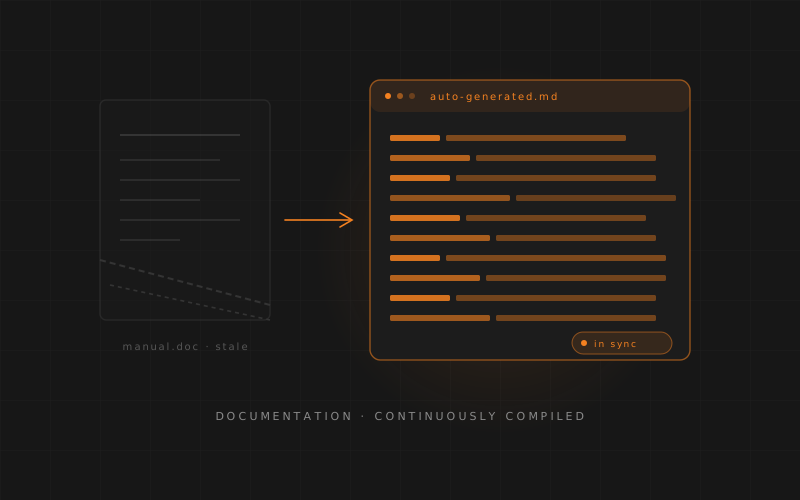
| Maintenance | High / drift-prone | Low / schema-driven |
| AI agent fit | Low (hallucination risk) | High / native / accurate |
The architecture gap
The catalog trap
Metadata tools tell you where data lives. They do not ensure your AI agent calculates "Revenue" correctly. A catalog documents that a column exists and who owns it. It does not compile that definition into the query. This creates a false sense of security: the governance looks complete on paper, but nothing in the execution path depends on it. The agent bypasses the catalog entirely and guesses from schema names.
The semantic compiler fix
Colrows compiles business metrics directly into SQL. It is the only way to guarantee that agents stay aligned with enterprise business logic. The semantic control plane makes governance structural, not advisory. The SaaS architecture shows the compile-time workflow end to end: intent resolves against the semantic graph, policy binds at compile time, and governed SQL is the only artifact that reaches the warehouse.
Do not waste resources cataloging data that is changing. Invest in a compiler that resolves your data reality in real time. Fix the context. Not the model.
Metadata tools did not fail because the idea was wrong. They failed because description does not pay the bills.
Start with the business fact, because it is the one buyers feel first. The standalone data catalog never became the large, durable software category its early valuations implied. Collibra peaked at a $5.25 billion valuation in November 2021 and has since rebranded away from "metadata" toward "data intelligence." Alation, the other category-definer, never went public, was last valued at $1.7 billion in November 2022, and has cut headcount since. Waterline Data, an early machine-learning catalog, was absorbed by Hitachi Vantara in 2020. The clearest signal of all came from Gartner: in August 2021 it scrapped its Magic Quadrant for Metadata Management Solutions entirely and replaced it with a Market Guide that opened on the line "Traditional metadata practices are insufficient."
That is the headline. The rest of this piece explains why it happened, where metadata tools still earn their keep, and why the operational center of the data stack has shifted to the semantic layer. We will be precise, because a "decline" narrative is easy to overstate. Metadata is not dead. The category that sold metadata as a standalone governance product is the thing under pressure.
What metadata tools were, and why they got funded
For roughly a decade, the enterprise answer to "we have too much data and nobody understands it" was to buy a catalog. Alation, Collibra, Waterline, Informatica, and later Atlan and data.world all sold variations of the same promise: discover what data exists, document where it came from, tag what is sensitive, define what terms mean, and make all of it searchable.
This was a real problem and these were real products. Gartner published a Magic Quadrant for Metadata Management Solutions annually through its final edition on 11 November 2020, and being named a Leader in it helped Collibra, Alation, and Informatica raise large rounds and win large enterprises. Billions of dollars in venture funding and enterprise spend flowed into the category between roughly 2015 and 2021.
The structural flaw: metadata describes, it does not enforce
Here is the technical reason the business model strained. A catalog is descriptive, not operational. It sits beside the data and tells you things about it. It does not participate in what happens to the data.
Consider a policy. In a catalog, a policy is a record: "this column is PII, restrict access." Whether that restriction is actually enforced depends on a completely separate system, the database or the warehouse, and on a human reading the tag and configuring the control correctly. The distance between the description in the catalog and the enforcement in the data platform is exactly where governance fails. Nothing in the catalog compiles into the query. Nothing breaks when reality drifts away from the documentation.
That gap produces a predictable decay pattern. Definitions are written once and go stale. Lineage graphs break as pipelines change. Glossaries diverge from how teams actually calculate revenue. Sensitivity tags lag behind new tables. Because nothing downstream depends on the metadata being correct, keeping it correct is pure cost with deferred benefit. The catalog becomes shelfware.
Why the ROI never closed
For an economic buyer, the failure mode is mundane and brutal: slow time to value plus low adoption equals weak renewal. Catalogs required heavy upfront modeling and ongoing manual curation by data stewards who often lacked the authority to enforce anything. Industry write-ups on governance failure converge on the same point: programs die not from bad technology but because the tooling lived outside the daily workflow, so people ignored it. A catalog that is not used cannot be renewed at the price it was sold at.
The market data reflects the squeeze. The standalone data catalog market sat somewhere between $1 billion and $2 billion in 2024, small for a category that absorbed so much capital, and analyst growth estimates diverge wildly, which itself signals an unsettled category. The vendor outcomes tell the rest of the story: no catalog-first company reached a large public exit. Several were absorbed into larger platforms.
The consolidation wave of 2025
The clearest evidence that standalone metadata struggled to stand alone is that, in 2025, much of the category got acquired into something bigger. ServiceNow bought data.world. Salesforce agreed to buy Informatica for roughly $8 billion. Collibra spent the year acquiring rather than being acquired, bolting on data-access governance (Raito) and unstructured-data capabilities (Deasy Labs) and leaning hard into the "data intelligence" and AI-governance narrative. Even Alation, the catalog archetype, spent 2025 buying an AI-agent startup, Numbers Station, to reposition around agentic workflows.
Detachability is the through-line. A catalog attaches to your metadata, and metadata can be re-pointed at a new tool. That makes catalogs replaceable, and replaceable products have weak pricing power and weak retention. This is the bridge between the technical story and the business story: the same property that makes metadata passive (it sits beside the data) makes the vendor detachable (it sits beside the stack). Enforcement equals stickiness. Description equals churn risk.
The turning point: LLMs made "query the data" everyone's job
The shift accelerated in 2023 and 2024 for a specific reason. Large language models turned "ask the data a question" from a task for trained BI analysts into a mainstream expectation. And LLMs exposed the catalog's core weakness instantly.
Point an LLM at raw warehouse tables and ask it a business question, and accuracy is poor: on the BIRD benchmark, text-to-SQL execution accuracy started around 40 percent in March 2023, and on the harder, enterprise-realistic Spider 2.0 benchmark the best model still reached only 31 percent as of April 2025. Ground that same model in a governed semantic layer, where revenue, churn, and active customer are precisely defined, and the picture changes completely. dbt Labs reran its own benchmark in 2026 and found that for questions within a well-modeled semantic layer's scope, leading models return correct results 100 percent of the time, while raw text-to-SQL on those same models hovered in the mid-60s and produced inconsistent results run to run.
A searchable glossary cannot fix this. An agent does not read your business glossary and absorb wisdom. It needs definitions it can compile through. That is the semantic layer's entire reason to exist.
What a semantic layer actually is, and why it wins
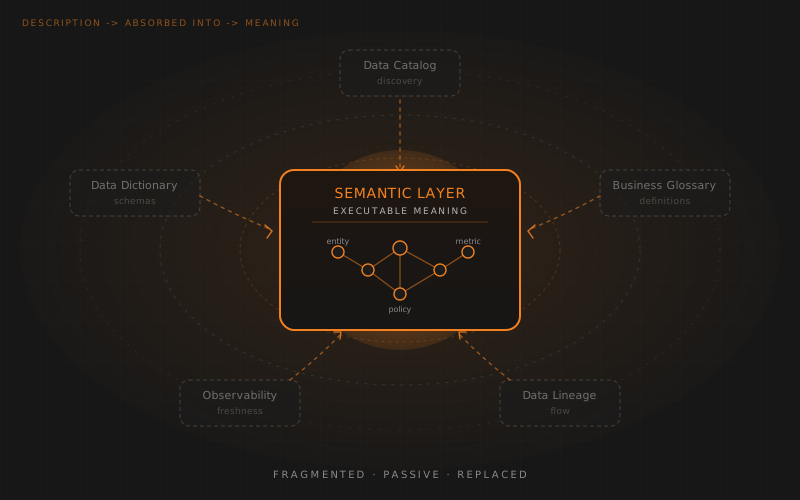
A semantic layer is a typed, versioned, executable definition of business meaning, entities, metrics, relationships, and constraints, that sits between data sources and anything that queries them. The difference from metadata is not cosmetic. It is architectural:
- Operational enforcement. The definition is compiled into every query. You cannot compute revenue a second way, because the only path to "revenue" runs through the definition.
- Continuous validation. A mismatch raises an error instead of silently returning a wrong number. Failures surface at compile time, not in a board deck three weeks later.
- Lower manual burden. Definitions evolve through code review in version control, not through a steward manually re-tagging assets in a separate UI.
That last point is the economic punchline. Metadata is governed by adding human effort over time. Semantics are governed by changing code, which teams already do. One scales with headcount. The other scales with engineering practice.
Catalog vs semantic layer at a glance
For readers who arrived here looking for a plain side-by-side rather than the market history, here is the distinction in scannable form. The point is not which is "better" - they answer different questions - but where each one is the load-bearing system.
| Aspect | Data catalog | Semantic layer |
|---|---|---|
| Primary question | What data exists, where is it, and who owns it? | What does the data mean, and how should it be used? |
| Main purpose | Discovery, inventory, metadata, lineage, stewardship. | Business meaning, metric consistency, governed query logic, execution. |
| Primary users | Stewards, governance teams, data engineers, architects, analysts. | BI tools, applications, AI agents, analysts, business users. |
| Core object | Data asset: table, column, file, pipeline, dashboard. | Business concept: customer, revenue, churn, margin, risk. |
| Typical output | Metadata page, lineage graph, owner, tags, glossary, certification status. | Metric API, governed SQL, semantic query plan, approved answer. |
| Governance role | Documents ownership, classification, sensitivity, policy metadata. | Applies policy during query planning or compilation. |
| AI readiness | Helps AI discover context but does not prevent wrong execution. | Grounds AI intent in approved definitions, relationships, and permissions. |
| Risk if missing | Teams cannot find or trust available data assets. | Teams and agents generate inconsistent or unsafe answers. |
Worked example: asking for customer revenue in West India last quarter
To make the distinction concrete, walk through one realistic enterprise question and notice which system answers which part of it.
"What was customer revenue in West India last quarter?"
What the catalog does. The analyst searches and finds that customer data lives in the CRM, order data lives in the ERP, invoice data lives in billing, region mapping lives in a reference table. The catalog shows who owns these assets, how fresh they are, whether they are certified, and how they flow into existing dashboards. That is genuinely useful - but the catalog stops here. It does not decide the correct business logic.
What the semantic layer does. It resolves what the question actually means before any SQL is generated:
- Does "customer revenue" mean booked, billed, collected, or recognized revenue?
- Are refunds, discounts, cancellations, taxes, or credit notes included?
- Which table is the approved source for revenue?
- Which customer-to-region relationship is the valid join path?
- Does "last quarter" mean fiscal quarter or calendar quarter?
- Is this user allowed to see customer-level revenue, or only aggregated regional revenue?
Discovery tells you where the data is. Semantics tells you what answer the data is allowed to produce. An LLM with only the catalog will pick a table and guess. An LLM with the semantic layer compiles the question through approved definitions and returns a number it can defend.
The vendor evidence: everyone is building semantic-layer-first
Follow where the building is happening. dbt rose from a transformation tool into a semantic layer by acquiring Transform and its MetricFlow engine in 2023, then re-open-sourced MetricFlow under Apache 2.0 in 2025 after concluding a closed semantic layer would not be trusted. In October 2025, Fivetran and dbt Labs agreed to merge into a roughly $600 million ARR entity explicitly positioned as "the data infrastructure for agents you trust." Snowflake shipped Cortex Analyst in August 2024 and native Semantic Views, treating the semantic model as a first-class, governed database object. Databricks open-sourced Unity Catalog in June 2024 and added governed Unity Catalog Metrics. Cube was built semantic-layer-first as an API-first headless layer; AtScale and Timbr launched as semantic platforms, not catalogs.
The tell is unmissable: new entrants launch as semantic layers, while incumbent catalogs scramble to bolt on "active metadata" and AI-readiness messaging. When the challengers and the incumbents are both running toward the same architecture, the architecture has won the argument.
The honest part: what metadata still does well
A fair analysis has to resist the temptation to declare metadata dead, because that claim is false and any buyer who has run a regulated data estate knows it. Several metadata functions remain genuinely valuable and are not replaced by a semantic layer:
- Sensitivity and PII classification. A human-curated, searchable, policy-bound classification of what is sensitive is a regulatory requirement under GDPR and CCPA. A metric object does not do this.
- Discovery and lineage. "What tables exist and where did they come from?" is a legitimate question, especially in data mesh estates with distributed ownership.
- Business glossary. A human-readable, version-controlled definition of what "customer" or "churn" means in plain language is a different artifact from a compiled metric, and useful for humans aligning on meaning.
- Access request workflows. "Who can access what" is a governance function that catalogs often hosted well as a user experience.
The honest frame is complementarity, not combat. Metadata describes. Semantics enforce. A mature estate needs both. What changed is which one sits at the center.
Where they overlap - and how each uses the shared inputs differently
Catalogs and semantic layers both touch glossaries, lineage, ownership, classification, and certification. The difference is not whether they hold the same information; it is what they do with it. The catalog publishes it for humans to read. The semantic layer compiles it into the execution path so that queries cannot route around it.
| Shared input | How a catalog uses it | How a semantic layer uses it |
|---|---|---|
| Business glossary | Documents terms and descriptions for human understanding. | Maps terms to executable concepts, metrics, and join paths. |
| Lineage | Shows how data moves from source to destination. | Uses lineage to validate trusted sources and explain answers. |
| Ownership | Identifies who owns or stewards a data asset. | Uses ownership to manage approval and change control for definitions. |
| Classification | Marks assets as sensitive, restricted, public, or regulated. | Compiles classification into query-time rules: masking, row filters, denial. |
| Certification | Shows whether an asset is trusted or approved. | Prefers certified sources when compiling governed queries. |
The architectural pattern that follows is simple to state and hard to skip: let the catalog stay the system of record for description, let the semantic layer stay the system of record for execution, and let metadata flow from the first into the second. A catalog that tries to also be the enforcement layer is the failure mode the last decade documented. A semantic layer that tries to also be the enterprise-wide asset inventory is the mirror failure waiting to happen.
Why this is now structural, not a fad
Three forces lock the shift in place. The LLM inflection made deterministic, policy-aware query interfaces a requirement rather than a nicety. The data mesh inflection pushed ownership outward, which means enforcement has to move from centralized human stewardship to compile-time rules that travel with the definition. And the regulatory inflection raised the stakes: the EU AI Act's Article 10 data-governance obligations for high-risk systems become enforceable on 2 August 2026, and they demand auditable, versioned governance, not tags in a search index.
Then there is the irony worth sitting with. In November 2025, Gartner revived the Magic Quadrant for Metadata Management Solutions after a four-year absence, describing the market as shifting "from augmented data catalogs to metadata 'anywhere' orchestration platforms," and naming Informatica, IBM, Alation, Atlan, and Collibra as Leaders. Metadata is not disappearing. It is being absorbed into operational systems and made active. The standalone catalog as the center of governance is what ended. Metadata as a capability inside a semantic and governance fabric is being reborn.
Do you need a catalog, a semantic layer, or both?
If you arrived at this piece evaluating an actual purchase, the answer is rarely "one and not the other." It is which one solves your current bottleneck. Most enterprises start with a catalog because visibility is the first pain. Once data is discovered, the question shifts: now that we can find it, how do we make sure every dashboard, agent, and API uses it correctly?
| If your problem is... | Prioritize |
|---|---|
| Teams cannot find where data is stored | Data catalog |
| No one knows who owns a given table or report | Data catalog |
| Lineage and sensitivity classification are unclear | Data catalog |
| Revenue, churn, or customer definitions differ across dashboards | Semantic layer |
| AI agents generate valid SQL but wrong answers | Semantic layer |
| Policies must be applied before the query runs, not after | Semantic layer |
| Trusted self-service analytics across many BI tools | Both - catalog for discovery, semantic layer for execution |
| Governed enterprise AI over structured data | Both - with the semantic layer as the execution control point |
If you are several years into a catalog and metric drift is still your loudest pain, you have proven the point of this piece: description was not enough. The next dollar belongs in the layer the queries cannot route around.
Where Colrows fits
Colrows is built for this world, and it is worth being precise about the claim. Colrows is a semantic layer, not a replacement for every metadata function. PII classification, discovery, and a human-readable glossary still matter, and often live best in dedicated tools. What Colrows provides is the operational core: entities, metrics, and relationships as first-class objects; definitions that are executable and versioned; governance enforced at compile time; lineage that is inherent in metric dependencies rather than reconstructed after the fact.
The one distinction that matters most for buyers: the warehouse-native semantic layers stop at their own boundary. Snowflake Semantic Views govern Snowflake. Databricks Unity Catalog Metrics govern the lakehouse. That is powerful inside one platform and silent outside it. Colrows is semantic-layer-first across the estate, built for multi-source, multi-warehouse environments where meaning has to stay consistent no matter where the data lives. That is the gap warehouse-native semantics leave open, and it is the gap that matters as estates get more federated, not less.
The bottom line
The center of the data stack moved from storage to compute to meaning. Metadata tools helped us describe data, and description was necessary but never sufficient. The market learned, expensively, that a system nothing depends on will be neglected, and a neglected system will not renew. Semantic layers win because they are depended upon: every query and every agent compiles through them. That technical fact (enforcement beats documentation) is the same as the economic fact (stickiness beats detachability). Buy metadata tools for what they are still good at. Build your governance on the layer that the queries cannot route around.
Metadata tools stalled not for lack of a smarter catalog but because description never became enforcement; the fix is a semantic layer that every query and agent has to compile through. Fix the Context, Not the Model.
Frequently asked questions
What is the difference between a data catalog and a semantic layer?
A catalog answers what data exists, where it lives, and who owns it. A semantic layer defines what the data means and compiles that meaning into every query. The catalog is descriptive; the semantic layer is the system of record for execution.
Why did standalone metadata tools decline?
Nothing downstream depends on catalog metadata being correct, so keeping it correct is pure cost with deferred benefit. Collibra peaked at a $5.25 billion valuation in November 2021, Alation never went public, and Gartner scrapped its Magic Quadrant for Metadata Management Solutions in August 2021.
Can AI agents answer questions accurately using only a data catalog?
No. An agent does not read a business glossary and absorb wisdom; it needs definitions it can compile through. Text-to-SQL on raw tables started around 40 percent on the BIRD benchmark, the best model reached only 31 percent on Spider 2.0 as of April 2025, and dbt Labs found models grounded in a well-modeled semantic layer returned correct results 100 percent of the time.
What is a semantic compiler?
A semantic compiler is an active enforcement engine that compiles business definitions into governed SQL. Intent resolves against the semantic graph, policy binds at compile time, and a mismatch raises an error instead of silently returning a wrong number.
Do I still need a data catalog if I have a semantic layer?
Yes, for description. PII classification, discovery, lineage, and a human-readable glossary remain genuinely valuable and are not replaced by a semantic layer. Let the catalog stay the system of record for description and the semantic layer stay the system of record for execution.
Is metadata management dead?
No. Gartner revived the Magic Quadrant for Metadata Management Solutions in November 2025 after a four-year absence. What ended is the standalone catalog as the center of governance; metadata as a capability inside operational systems is being made active.