The business stakes come first
Every enterprise is now wiring autonomous agents into the systems that move money, approve claims, and answer regulators. Those agents share one fatal weakness: they have no memory they can trust. Ask the same agent the same question twice and you can get two different numbers. Ask it for last quarter's revenue and it may join the wrong tables, drop a refund filter, or invent a column that does not exist. Semantics for enterprise AI agents is the foundation on which agents think, yet without a memory graph, those semantics are provisional.
This is not a model problem. It is a memory problem. Zylos Research reported in February 2026 that nearly 65% of enterprise AI failures in 2025 were attributed to context drift or memory loss during multi-step reasoning, not to raw context exhaustion or the underlying model being incapable. The model is usually fine. What is missing is a persistent, versioned, governed record of what the business has decided is true.
That record is the enterprise memory graph. It is the difference between an AI estate that operates and one that guesses. For a regulated enterprise, it is becoming the artifact that separates a passable audit from a failed one.
| Aspect | Knowledge Graph / RAG | Enterprise Memory Graph |
|---|---|---|
| What it answers | What is likely true about things in the world | What the company relies on as true about its business |
| Determinism | Embeddings drift; the same text yields different vectors over time and retrieval degrades with no error thrown | Query the same memory at the same version and you get the same answer, every time |
| Versioning and time | Read-optimized and unversioned, as with DBpedia or Freebase | Versioned and bitemporal: superseded facts are invalidated, not deleted |
| Joins | Joins on a plausible key and can miss a refund filter without throwing an error | The planner proves a join path exists before generating SQL and refuses when none does |
| Audit and governance | Rules scattered across sources that may never be retrieved | Every write, policy decision, version, and access recorded, so the runtime is the audit |
What an enterprise memory graph actually is
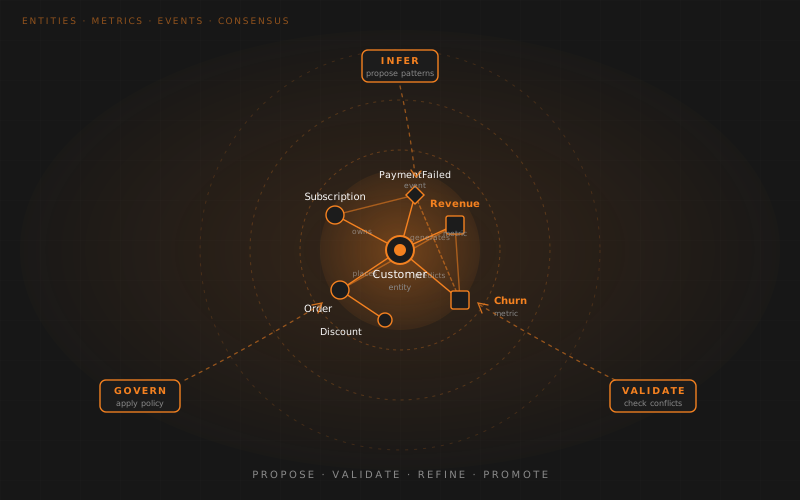
An enterprise memory graph is a persistent, versioned, semantically typed graph of the entities, relationships, attributes, metrics, and policies a company relies on to operate. It is the source of truth that every agent, dashboard, and decision compiles through.
The word that matters is memory, not knowledge. The distinction is sharp:
- Knowledge is probabilistic. It is what a model inferred might be true from patterns: an embedding, a similarity score, a generated answer.
- Memory is deterministic. It is what the enterprise decided is true: revenue is defined this way, a customer becomes inactive after this many days, this metric is board-approved.
A commodity knowledge graph answers "what is likely true about things in the world." An enterprise memory graph answers "what does our company rely on as true about our business." The first is built for breadth. The second is built for precision, governance, and proof.
Typed and constrained, not fuzzy
Enterprise memory is typed. A Customer is not a string that looks like a customer. It is an entity with declared attributes, constrained relationships, and foreign-key rules the system enforces. When an agent resolves "Customer," it resolves to that type, with that formula, under that policy.
A metric is not just a formula either. It carries its definition, dependencies, constraints, and scope as a first-class object:
{
  "metric": "NetRevenue",
  "definition": "SUM(order_amount - refunds)",
  "depends_on": ["Order", "Refund"],
  "constraints": ["exclude_refunds_for_finance"],
  "scope": ["finance"]
}
Compare this to a commodity knowledge graph like DBpedia, which held over 850 million semantic triples extracted from Wikipedia as of June 2021, or Freebase, which counted more than 3 billion facts about almost 50 million entities when Google turned it read-only on March 31, 2015. These are extraordinary feats of breadth. They are also built from scraped public data, linked by probabilistic entity matching, read-optimized, and unversioned. They were never designed to tell a bank which of its three "ACME CO" records is the legal entity that owes money. That is the job of entity resolution inside a governed memory graph, not a public knowledge graph. Colrows vs dbt's MetricFlow illustrates why: dbt versions metrics as YAML but stops at values, not entity graphs.
Determinism is the whole point
Here is the property that makes a memory graph worth building: query the same memory at the same version and you get the same answer. Every time.
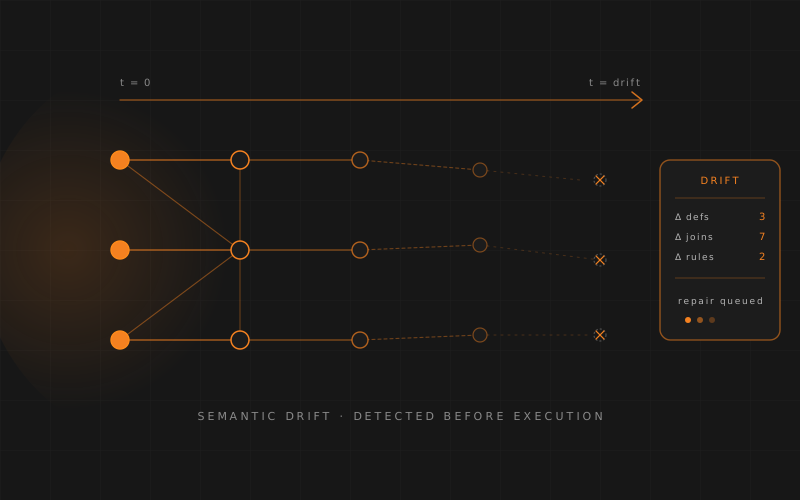
Embeddings cannot promise this. Embedding drift is well documented. The same text produces different vectors over time because of model updates, partial re-embedding, or changed preprocessing, and it degrades retrieval quality without throwing a single error. A study on the reproducibility limits of RAG systems showed that different state-of-the-art embedding models produce inconsistent retrieval results for the same query at the same point in time. Your vector index is a moving target. A memory graph pinned to a version is not.
This is why the hybrid pattern wins for many teams: use embeddings to find candidate entities in fuzzy language, then validate and join through the deterministic memory graph. Fast where speed matters, correct where correctness matters.
The temporal dimension: time travel and validity
A real memory graph is temporal. It does not overwrite; it versions. The mature form is bitemporal, a model formalized in the SQL:2011 standard, which tracks two timelines for every fact:
- Valid time: when the fact was true in the real world.
- Transaction time: when the system recorded it.
That separation lets you ask two very different questions. "What was this customer's profile on July 1?" is valid time. "What did our system believe this customer's profile was on July 1, as of the close we ran that day?" is transaction time. The answers can differ, because the database may have been corrected since. Open-source temporal graph tools like TerminusDB and agent-memory libraries like Graphiti are built on exactly this idea: superseded facts are invalidated, not deleted, so the graph can answer what is true now, what was true then, and why.
For a regulated enterprise, that is not a nice-to-have. It is the audit.
A concrete failure, and the memory-graph fix
Picture a finance agent answering "What was net revenue last quarter?"
The RAG path: the agent embeds the question, retrieves a few similar chunks of documentation and some table snippets, and writes SQL. It picks an orders table, joins to a discounts table on a plausible key, and sums order_amount. It misses the refunds exclusion that finance applies, because that rule lived in a Confluence page that did not get retrieved. The number looks right. It is wrong by the value of last quarter's refunds. No error is thrown.
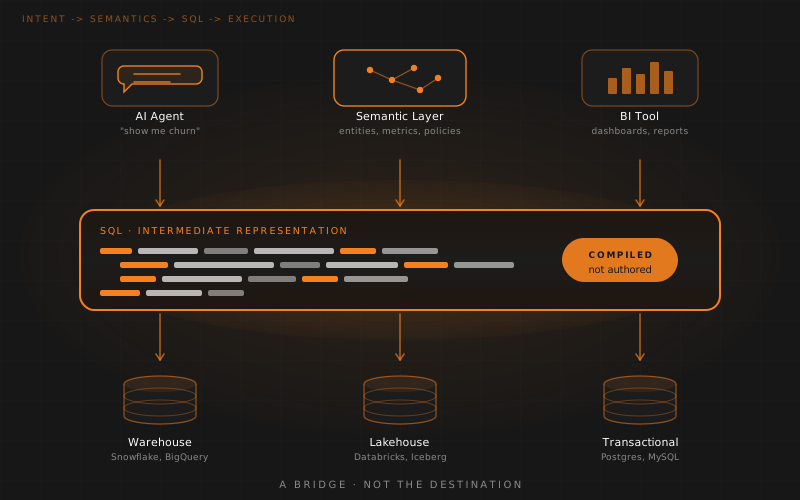
The memory-graph path: the agent resolves "net revenue" to the typed metric object above, whose definition is SUM(order_amount - refunds), whose dependencies are Order and Refund, whose constraint is exclude_refunds_for_finance, and whose scope is finance. The planner proves a join path exists in the graph before generating any SQL. Multi-hop query understanding means the system can trace complex dependencies and reject fabricated joins. If no proven path exists, it refuses rather than fabricating one. The query compiles to the same SQL every time, and the run records which version of the definition was used:
SELECT SUM(order_amount - refunds)
FROM orders
WHERE quarter = 'Q4'
The evidence that this gap is real and large: in a controlled benchmark by Sequeda and colleagues at data.world, GPT-4 writing zero-shot SQL against a raw enterprise database scored 16.7% accuracy, while the same model querying through a knowledge graph representation reached 54.2%, a 37.5 percentage-point jump. dbt Labs, replicating the approach with its Semantic Layer, reported an 83% accuracy rate for natural language questions on the addressable subset. Google reports that Looker's semantic layer reduces data errors in generative AI natural language queries by as much as two thirds. Different studies, same direction: structure beats prompting.
How it differs from the tools you already have
Several categories touch this problem. None of them is the whole thing.
- Commodity knowledge graphs (Wikidata, DBpedia, Freebase): web-scale breadth, probabilistic linking, no governance or versioning.
- Graph databases (Neo4j, TigerGraph, Amazon Neptune): excellent storage and traversal engines. They store your graph; they do not define your metrics, version your definitions, or enforce your policies for you.
- RDF triplestores (Virtuoso, Ontotext GraphDB): standards-based, SPARQL-queryable, strong for linked data, but the governance and temporal model is yours to build.
- Vector platforms (Pinecone, Weaviate, Vespa): retrieval, not memory. They find similar things; they do not hold what is decided.
- Semantic layers (dbt, Cube, Looker, Snowflake, Databricks): metric definitions and access. dbt's MetricFlow versions metrics as YAML in Git and compiles to SQL, which is genuinely valuable, but it stops at metric values and does not model entity identity and relationships as a graph.
- Data catalogs (Alation, Collibra): metadata about data. They document; they do not serve as the operational memory an agent compiles through.
The closest production example of a true memory graph is Palantir Foundry's Ontology. Foundry describes it as integrating "semantic elements (objects, properties, links) and kinetic elements (actions, functions, dynamic security)," with active lineage where every version of every dataset indicates which code, parent datasets, and runtime created it. It is the reference for what governance-native, typed, versioned operational memory looks like. It is also proprietary, platform-bound, and expensive to adopt wholesale.
Why this is becoming table stakes for regulated enterprises
Memory matters because regulators now require exactly what a versioned memory graph produces: traceability.
- SOX Section 404 demands an auditable record of data provenance, transformation logic, and processing controls feeding financial statements.
- HIPAA requires field-level logs of who accessed protected health information, when, and why.
- GDPR requires that you trace where personal data came from and prove it can be deleted.
- The EU AI Act, Article 12, requires high-risk AI systems to "technically allow for the automatic recording of events (logs) over the lifetime of the system," with logs retained for an appropriate period and at least six months. Full application for high-risk systems arrives on 2 August 2026.
A memory graph that records every write, every policy decision, every version, and every access turns audit preparation from a multi-week archaeology project into a query. When governance lives on the concept rather than the table, the runtime is the audit: a query carries the graph version it resolved against, so any decision can be replayed against the memory as it existed at that moment.
The strategic picture: the memory layer as a moat
The broader pattern is clear. The AI-native enterprise stack is becoming lakehouse plus semantic memory plus agents. The lakehouse stores. The agents act. The memory graph is the layer in between that makes the agents reliable and the actions auditable.
In 2026, persistent memory moved from research to production across the agent ecosystem, with dedicated layers like Letta, Mem0, Zep, and Cognee, and memory now treated as a first-class architectural component with its own benchmarks. Gartner projects that 40% of enterprise applications will be integrated with task-specific AI agents by 2026, up from less than 5% today. Most of those memory tools focus on per-user conversational memory. The enterprise memory graph is the organizational equivalent: shared, typed, governed memory of the business itself.
The competitive logic follows. The semantic divide will separate enterprises that run deterministic memory graphs from those that don't. The first movers to put a deterministic memory graph under their data estate will run their agents at higher accuracy and lower risk than competitors still stitching together embeddings and ad-hoc SQL definitions. When every agent queries the same memory and gets the same answer, you can trust automation at scale. When they do not, every new agent is a new liability.
Where Colrows fits, honestly
Colrows is the semantic memory engine for the data estate. It builds and maintains a typed, versioned semantic graph of entities, metrics, relationships, and policies, with compile-time governance and deterministic query paths. Every query flows through a seven-step compile-then-execute pipeline: resolve intent against the graph in context, prove the join path, compile to dialect-perfect SQL with policy injected, execute, and audit. The planner refuses to fabricate a join the graph does not support. Historical queries can resolve against the definitions that were in force at that moment.
Be clear about scope. Colrows governs data semantics. It is the foundational data pillar of enterprise memory, not the whole thing. The broader enterprise memory also includes documents, workflows, processes, and organizational structure, and those are adjacent systems. Colrows does not claim to be your company's entire brain. It claims to be the part of that memory that decides, deterministically and auditably, what your data means. For an AI-native enterprise, that is the pillar everything else compiles through.
As this post argues, most agent failures trace to context drift and memory loss during multi-step reasoning, not to an incapable model; a persistent, versioned, typed memory graph is what makes answers reproducible and auditable. Fix the Context, Not the Model.
The bottom line
An enterprise memory graph turns meaning into something structured, typed, versioned, validated, and executable. For the builder, that means determinism, reproducible queries, and auditable joins instead of drifting embeddings and hallucinated schema. For the buyer, that same mechanism is the strategic advantage: reproducible decisions, regulatory proof, and agents you can actually put in production. The mechanism is the moat. Companies that build it first will operate on understanding. The rest will keep querying data and hoping.
The recall side connects to the broader picture in AI knowledge management, which scores retrieval against governed execution.
Frequently asked questions
What is an enterprise memory graph?
An enterprise memory graph is a persistent, versioned, semantically typed graph of the entities, relationships, attributes, metrics, and policies a company relies on to operate. It is the source of truth that every agent, dashboard, and decision compiles through.
What is the difference between knowledge and memory in enterprise AI?
Knowledge is probabilistic: what a model inferred might be true from patterns, such as an embedding or a similarity score. Memory is deterministic: what the enterprise decided is true, such as a board-approved revenue definition. A memory graph stores the second, not the first.
Why can't embeddings serve as enterprise memory?
Embedding drift. The same text produces different vectors over time because of model updates, partial re-embedding, or changed preprocessing, and retrieval quality degrades without throwing a single error. A memory graph pinned to a version returns the same answer every time.
How much more accurate are AI agents with a memory graph?
In a controlled benchmark by Sequeda and colleagues at data.world, GPT-4 writing zero-shot SQL against a raw enterprise database scored 16.7% accuracy, while the same model querying through a knowledge graph representation reached 54.2%. dbt Labs reported an 83% accuracy rate on the addressable subset with its Semantic Layer, and Google reports Looker's semantic layer reduces data errors in generative AI natural language queries by as much as two thirds.
What is a bitemporal memory graph?
A bitemporal graph, formalized in the SQL:2011 standard, tracks two timelines for every fact: valid time (when the fact was true in the real world) and transaction time (when the system recorded it). Superseded facts are invalidated, not deleted, so the graph can answer what is true now, what was true then, and why.
Why do regulated enterprises need a memory graph?
Regulators require exactly what a versioned memory graph produces: traceability. SOX Section 404 demands an auditable record of data provenance, HIPAA requires field-level access logs, GDPR requires tracing where personal data came from, and EU AI Act Article 12 requires automatic event logging for high-risk systems, with full application arriving on 2 August 2026.