Manual Maintenance vs. Colrows Autonomous Compiler at a Glance
| Capability | Manual Maintenance | Colrows Autonomous Compiler |
|---|---|---|
| Logic Sync | Drift-prone / Periodic | Self-healing / Continuous |
| Error Detection | Post-failure (Runtime) | Pre-failure (Compile-time) |
| AI Reliability | Degrades over time | Guaranteed accuracy |
| Governance | Reactive log analysis | Proactive semantic tracing |
| Scalability | High overhead | Zero-maintenance scaling |
The architecture gap: static documentation vs. autonomous semantic resolution
Knowledge drift is not a documentation problem and it cannot be fixed by writing better Confluence pages. It is an architecture problem. The systems that catch drift are the systems that compile through the meaning, not the systems that describe it on the side.
The drift problem
Documented metadata becomes obsolete the moment a schema changes. A column gets renamed, a join condition gets refined, a metric absorbs a new business rule, and every downstream artifact - dashboards, prompts, vector stores, fine-tuned models - inherits the gap. The wiki stays cheerful while the warehouse moves on. Manual reconciliation runs on the cadence of the team that owns the doc, which is to say: never on time.
The autonomous fix
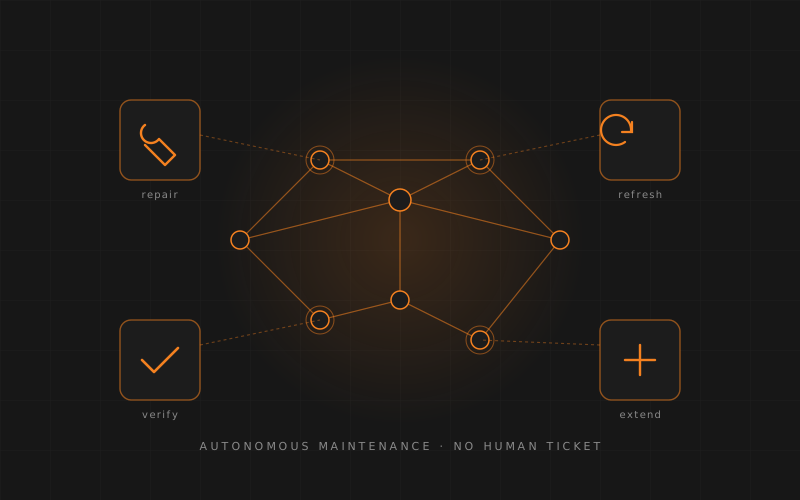
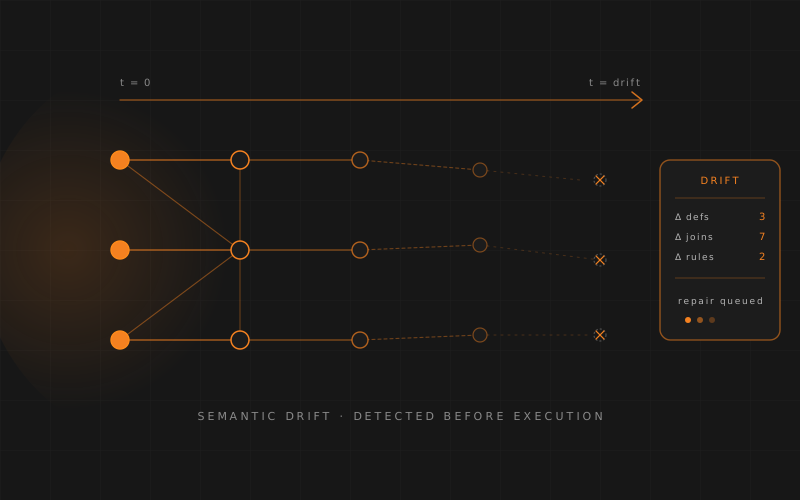
Colrows does not rely on static documents. The Colrows semantic compiler dynamically resolves metrics at compile time - the same compile-time resolution explained in semantic layer vs. semantic execution layer. If the underlying data structure shifts, the semantic graph catches the drift before the AI generates a faulty query, via statistical fingerprinting of column distributions, structural diffing of dataset nodes, and conflict-resolution against governed definitions. Compile-time governance also keeps row-/column-level data authorization policies aligned with the live graph, so policy decay does not lag schema drift. Curators review and approve these proposed updates in Entity Manager, where every change is versioned with a timestamp, actor, and change-reason label.
Do not let semantic decay ruin your AI investments. An autonomous semantic layer ensures your data context evolves perfectly with your schema. Fix the context. Not the model.
Knowledge drift has quietly become one of the most expensive problems in the modern data stack. Gartner estimates that poor data quality costs organizations an average of $12.9 million every year. The more uncomfortable finding from Gartner's surveys is that 59 percent of organizations do not measure data quality at all, which means most teams cannot see the bill they are already paying.
What does knowledge drift actually look like?
Knowledge drift is dangerous precisely because it is not obvious. Revenue still looks like revenue. Churn still looks like churn. Dashboards still load and queries still run. What changes is the meaning behind the numbers. Sometimes the change is intentional, because a definition evolves with the business. Sometimes it is accidental, because logic was copied, modified, and reused. Sometimes it is contextual, because the same metric means one thing to finance and another to growth. Over time the organization stops having a single source of truth and instead has several versions of truth, each of which looks correct in isolation.
Why this is not a data quality problem
We usually file this under data quality, or governance, or documentation. Often the data is accurate, the pipelines are correct, and the schemas are valid. Semantic decay is what happens when systems keep storing data faithfully but lose track of what that data is supposed to represent. A broken pipeline announces itself with an error. Semantic decay does not. A field can keep the exact same name and data type while its business definition changes underneath it, and no schema validation, null check, or freshness test will ever catch that.
This is why semantic debt is worse than ordinary technical debt. Technical debt is visible; you can see messy code and know it needs refactoring. Semantic debt is invisible, and it shows up as second-order symptoms: repeated clarification meetings before any decision can be made, analysts rewriting the same logic because no one trusts the original, dashboards people reference but quietly distrust, and AI systems producing answers that are almost right. The cost compounds not in compute but in confidence. As one industry writer put it, once a catalog is wrong twice it is ignored forever, and the real definitions move into Slack and into three senior engineers' heads, where they are invisible, unauditable, and impossible to transfer when those people leave.
Why the problem is getting worse
Knowledge drift used to be manageable because systems changed slowly. That is no longer true. Schema drift, the most common trigger, is now constant: in event-driven and microservice architectures, upstream services change fields, types, and structures on their own schedules, and downstream consumers find out only when something breaks. Fivetran's 2026 benchmark of 500 enterprise data and technology leaders found that 53 percent of engineering capacity now goes to maintaining and troubleshooting pipelines rather than building anything new. Meanwhile Monte Carlo's 2022 survey found data teams spend 40 percent of their time on data quality, that 75 percent of teams take four or more hours just to detect an incident, and that bad data already touches 26 percent of company revenue. The faster the business moves, the faster meaning drifts behind it, and the wider the gap between when something changes and when a human finally notices.
Why documentation cannot fix it
Most organizations respond to semantic decay by writing more documentation. It feels logical and it rarely works, because documentation is static and meaning is not. By the time something is written down it is already outdated somewhere else, and no document can keep up with how data is actually used across tools, teams, and workflows. This is not a discipline problem. It is a mismatch between how fast systems change and how slowly humans can maintain shared understanding. The same logic explains why machine-learning models decay through concept drift: the world moves, and a definition fixed at one moment slowly diverges from reality unless something actively keeps it current.
What it actually takes to stop drift
To stop semantic decay, meaning has to become part of the system itself, not a note on the side. That requires four concrete capabilities, and each one already exists in mature form somewhere in the data ecosystem.
First, detection. The cheap primitive is a fingerprint. A schema fingerprint or content hash is a fixed-length signature of a structure; comparing two hashes is a near-instant check that tells you whether anything changed, and only then do you compute the expensive diff. Practitioners snapshot schema state from system catalogs, store the history, and use a full outer join to find added, removed, and retyped columns. For meaning rather than structure, statistical fingerprinting of column distributions, using tests such as Kolmogorov-Smirnov or the Population Stability Index, catches drift even when the schema is unchanged.
Second, classification. Not every change matters equally. Schema registries enforce backward, forward, and full compatibility at registration time, and data contracts borrow semantic versioning so that a breaking change forces a major version bump, an additive change a minor one, and a fix a patch. The point, as one practitioner put it, is to never hide a meaning change inside stable syntax.
Third, continuous monitoring instead of quarterly review. Observability platforms learn a baseline and alert on deviation, but the hard-won lesson is to rank changes by business impact rather than statistical size, because static threshold alerts produce fatigue and the real failures get lost in the noise.
Fourth, versioning and rollback. Liquibase brought this to database schemas, giving every change a checksum and a rollback path. Knowledge-graph research brings it to meaning, storing either full snapshots or change layers so the system can answer "what did we believe about this entity on this date" and revert a bad change.
How Colrows approaches it, and what it does not do
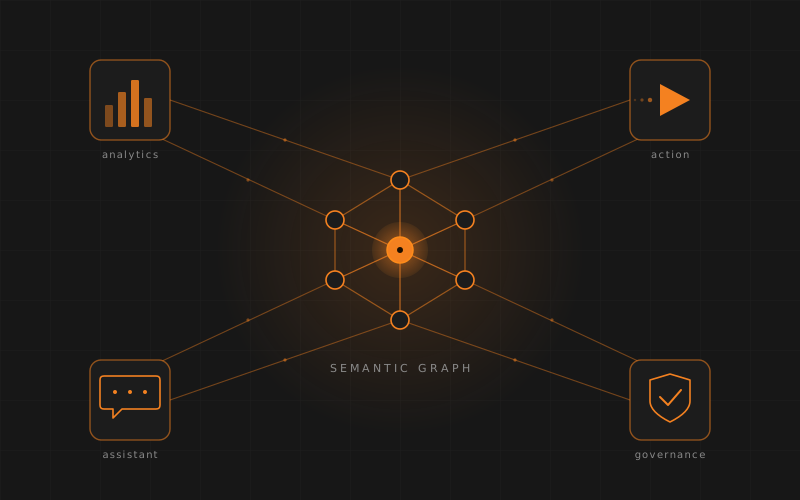
Colrows treats meaning as a versioned, governed runtime rather than a wiki page. Its Consensus layer models entities, metrics-as-state, events, concepts, constraints, and policies as typed nodes in a semantic graph, and every node carries point-in-time reproducibility. Metrics are modeled as state, not as a stored SQL string, so the system knows not just how a number is computed but what it means, at what grain it is valid, and which dashboards and agents depend on it.
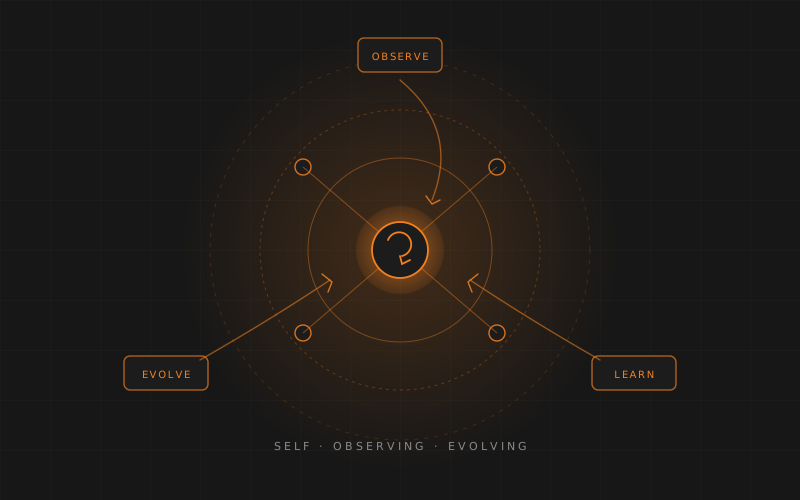
Detection runs continuously and uses exactly the mechanics described above: statistical fingerprinting of column distributions to catch data drift, structural diffing of dataset nodes to catch schema evolution, and a hybrid of vector similarity and structural checks to catch duplicate or conflicting metric definitions. A set of agents does the work that humans do today, badly and intermittently: Discovery agents ingest schemas and documentation, Architecture agents refuse to publish definitions that violate business logic, Learning agents refine definitions from real usage, and Monitoring agents watch for drift and broken assumptions. The refusal-to-publish step is the important one. It is a proposed-versus-published model, where a change is staged and validated before it becomes the live definition, so drift is made visible and manageable before it turns into debt.
Two capabilities matter most for the strategic and compliance reader. Every change to a node is versioned, attributed to a human or an agent, and timestamped. And any historical query can be re-executed against the exact semantic state that was active at the time, which means you can reconstruct and prove what a number meant on the day a decision was made, then roll forward or back.
It is worth being precise about scope. Colrows is a semantic execution layer. It is not a data-movement tool like Fivetran, not a pipeline observability tool like Monte Carlo, and not a database change tool like Liquibase. It governs and versions meaning, and it works alongside those systems rather than replacing them. Where dbt versions the metric definitions a team remembers to write in YAML, and a catalog describes assets, Consensus treats the entire web of meaning as an executable graph that agents must traverse and pass before any query runs.
Why preventing drift is cheaper than recovering from it
The strategic case is the oldest one in engineering: it is far cheaper to prevent a defect than to recover from it once it has propagated. The widely cited claim that a defect costs up to 100 times more to fix in production than in design is, in honesty, an industry heuristic whose original study has never been located, so treat the exact multiple with caution. The direction, though, is not in doubt and it is sharper for meaning than for code, because a drifted definition does not just cost engineering hours; it corrupts every decision and every model trained on it in the interval before anyone notices, and trust, once lost, is slow to rebuild.
Compliance turns this from prudent to mandatory. BCBS 239 requires banks to trace every risk number from source to report with a defensible audit trail. The EU AI Act's Article 10 requires that the data behind high-risk systems be relevant, representative, and "to the best extent possible, free of errors," maintained across the system's lifecycle. GDPR's Article 5(1)(d) requires that personal data be "accurate and, where necessary, kept up to date." Every one of these assumes you can show what your data meant over time, not just what it means today. A versioned semantic graph with replay is, in effect, the evidence layer those regimes ask for.
Technical debt slows systems down. Semantic debt makes them untrustworthy, and trust is the hardest thing to win back. The next generation of data platforms will not be judged by how much they store. They will be judged by how well they preserve understanding over time. Because data does not rot on its own. Meaning does.
A more capable model will still return a confidently wrong number when the definition behind it has quietly drifted; drift is a problem of decaying meaning, not model quality. The cure is a versioned semantic graph that keeps definitions aligned with the warehouse over time. Fix the Context, Not the Model.
Frequently asked questions
What is knowledge drift?
A gradual divergence between what data actually means and what teams believe it means, caused by schema changes, business logic updates, and untracked usage shifts.
How is knowledge drift different from data quality?
Data quality is about accuracy and completeness; knowledge drift is about meaning. Pipelines can be correct and numbers accurate while definitions silently diverge.
Why is semantic decay expensive?
Because it is silent. Drifted definitions corrupt decisions and AI models trained on them before anyone notices, and trust takes years to rebuild.
What are the four capabilities needed to stop semantic decay?
Detection (fingerprinting and diffing), classification (semantic versioning), continuous monitoring (impact-ranked alerting), and version control with rollback.
How does schema fingerprinting work?
A content hash is a fixed-length signature of a schema. Comparing hashes is instant; only on change do you compute the expensive full diff.
Why does documentation fail to prevent semantic decay?
Documentation is static; meaning is not. By the time something is written it is outdated elsewhere, and no document can keep pace.
What is the proposed-versus-published model?
Changes are staged and validated before they become live definitions, making drift visible and manageable before it becomes debt.
Can historical queries be replayed against old semantic states?
Yes. A versioned semantic graph lets you re-execute any query against the exact meaning that was active at the time, enabling audit and rollback.