This is the condition most enterprises are in right now. Meaning is local. Consistency is tribal knowledge and a spreadsheet someone maintains by hand. And it is exactly the condition personal computing was in before the operating system.
Before the OS, every application talked straight to the hardware: its own drivers, its own memory map, its own scheduling. The OS ended that. It gave every program one filesystem, one memory model, one set of system calls, one security model. Application authors stopped reimplementing the substrate and started building on it. The same unification is now happening to enterprise meaning. The thing doing the unifying is the semantic operating system.
This is not a metaphor for a slide. It is a precise architectural claim, and the rest of this piece maps it part for part: what the kernel is, what the system calls are, what the drivers are, and why the execution model is the security model.
| Aspect | Fragmented Data Stack | Semantic Operating System |
|---|---|---|
| Where meaning lives | Each tool holds its own definition: Power BI, dbt, the catalog, the agent prompt | One typed, versioned semantic graph resolved for every consumer |
| Consistency | Tribal knowledge and a hand-maintained spreadsheet; definitions drift and go stale | Declared once, resolves to the same value for every consumer |
| Security model | Execute the query, then filter rows or mask columns (reactive) | Compile-then-execute; unauthorized requests fail at compile time, data never read |
| Changing engines | Every tool reimplements schema understanding per backend | Dialect adapters; swap Snowflake for Databricks without changing the apps above |
| AI accuracy | Agents become confidently wrong when definitions disagree | The kernel returns a governed plan or a structured refusal |
The fragmentation tax is now measurable
Fragmentation used to be an annoyance. With AI in production, it is a liability with a price tag.
Gartner puts the average annual cost of poor data quality at $12.9 million per organization, a figure drawn from its Magic Quadrant for Data Quality Solutions, which surveyed 154 reference customers across 16 vendors. McKinsey's Master Data Management Survey found that 82 percent of respondents spend one or more days every week just resolving data quality issues, and that roughly 30 percent of total enterprise time goes to non-value-add work caused by poor data quality and availability. That is not a tooling problem. That is a meaning problem wearing a tooling costume.
It shows up in four predictable ways: (1) every tool reimplements schema understanding; (2) governance scatters across systems; (3) meaning drifts between teams; (4) agents become confidently wrong when definitions disagree. Gartner's verdict is blunt: by 2027, organizations that prioritize semantics in AI-ready data will increase agentic AI accuracy by up to 80 percent and cut costs by up to 60 percent.
How a semantic operating system works: the architecture, mapped to a real OS
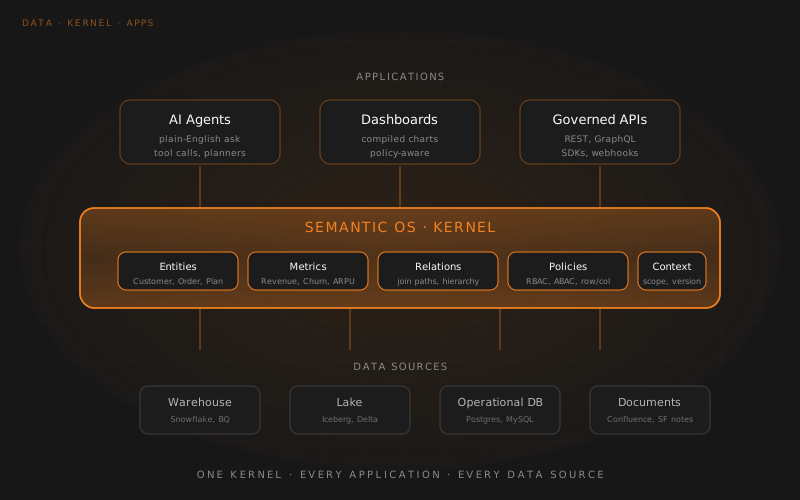
Here is the stack. Read it top to bottom the way you would read a classical OS diagram:
USER SPACE      Agents · BI tools · Notebooks · Metric APIs · Apps
------------------------------------------------------------------
SYSCALLS        MCP · HTTP/REST · JDBC · GraphQL · Arrow Flight
------------------------------------------------------------------
KERNEL          Semantic graph: entities, metrics, relationships,
                  policies, context  +  compile-then-execute planner
------------------------------------------------------------------
DRIVERS         Dialect adapters / connectors per engine
------------------------------------------------------------------
HARDWARE        Snowflake · Databricks · BigQuery · Redshift ·
                  Postgres · ClickHouse · Trino · Oracle · SQL Server
The kernel is the semantic graph. In a classical OS the kernel owns memory management, process scheduling, and I/O, and it enforces protection so no process can corrupt another. The semantic kernel owns the typed, versioned definitions of your business: entities (Customer, Order, Plan, Region), metrics with explicit formulas and ownership, typed relationships the planner can walk, and policies (RBAC, ABAC, row- and column-level predicates) compiled into the definition itself as first-class attributes. Definitions are declared once and resolve to the same value for every consumer.
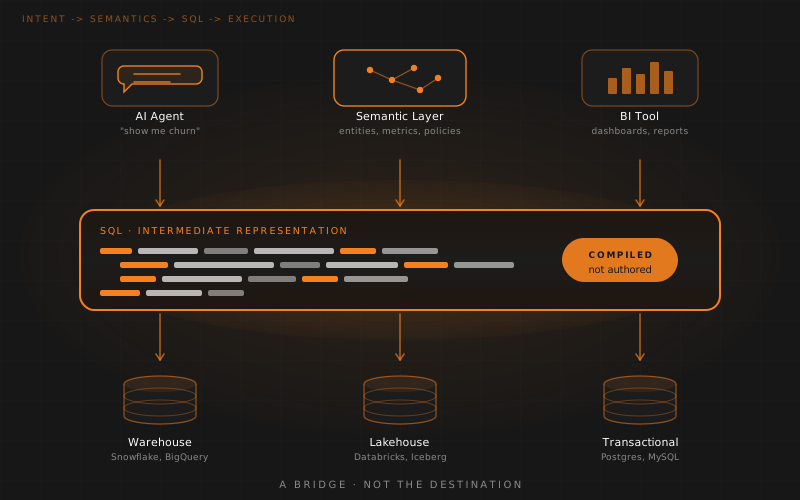
The system calls are MCP, HTTP, JDBC, GraphQL, and Arrow Flight. Applications do not write SQL against raw tables any more than a modern program pokes at disk controllers. They make a request through a stable interface. An agent calls a semantic-intent tool over MCP, and the kernel returns a plan or a structured refusal.
The drivers are dialect adapters. A classical OS abstracts disks, NICs, and GPUs behind driver interfaces so applications never see the hardware. The semantic kernel abstracts data engines the same way: one semantic plan, many backends, dialect-perfect SQL per engine. Swap Snowflake for Databricks and the agents, dashboards, and notebooks above do not change.
User space is everything that consumes meaning: agents, BI tools, notebooks, metric APIs, internal apps. They inherit resolution, planning, and governance from the kernel instead of reimplementing each one.
The principle behind it is worth stating plainly: storage is a fast-moving, plural, optimized substrate, while meaning needs to be slow-changing, singular, and authoritative. The warehouse stays the system of record for state. The lake stays the system of record for raw events. Neither is asked to also be the system of record for what the rows mean. That job moves up to the kernel.
Compile-then-execute: why the execution model is the security model
A semantic OS is firmly in the compile-then-run camp, and the choice is not stylistic. It is what makes the system both deterministic and secure. During compilation: every term resolves against the graph, every join path is proven (an impossible path fails compilation rather than silently returning a wrong number), and every policy is applied before any SQL exists. The output is auditable, reproducible, cacheable, and portable.
This is the difference between guessing and knowing, and it shows in the benchmarks. Snowflake reports Cortex Analyst hits 90%+ accuracy on its internal 150-question text-to-SQL benchmark, while single-shot GPT-4o "plummeted to 51%" on the same set, making the semantic-model approach close to twice as accurate.
Now the security half. Most data platforms execute the query and then filter rows or mask columns: run the attack, then block it. That is reactive. A semantic OS shapes the allowed subgraph for each persona before any plan is produced, so an unauthorized request fails at compile time and the data is never read. The kernel returns a plan or a structured refusal. The attack cannot be expressed in the query surface the user is given. That is the kernel model, applied to data.
The interface that makes it an OS, not a one-off: MCP
A semantic layer that only one tool can call is a private library. A semantic layer that any tool can call through a standard interface is a kernel. The thing that turned the second into reality, fast, is the Model Context Protocol.
MCP launched in November 2024. By March 2026 it had crossed 97 million monthly SDK downloads (Python and TypeScript combined), with more than 10,000 active public servers and first-class client support across ChatGPT, Claude, Cursor, Gemini, Microsoft Copilot, and Visual Studio Code. In December 2025 Anthropic donated MCP to the Agentic AI Foundation, a directed fund under the Linux Foundation co-founded by Anthropic, Block, and OpenAI with AWS, Google, Microsoft, Cloudflare, and Bloomberg behind it. The governance question that had stalled enterprise procurement closed: no single vendor controls the standard.
MCP is to a semantic kernel what the syscall table is to Unix: the standardized boundary where user-space programs request kernel services. dbt's MCP server already exposes its Semantic Layer through tools like `list_metrics`, `get_dimensions`, `get_entities`, and `query_metrics`. Colrows exposes a semantic-intent tool over MCP backed by its compiler, plus a signed JDBC driver so Tableau, Power BI, dbt, and DBeaver inherit governed compilation without changing their workflow.
This is the convergence event. Without it, your semantic layer is bespoke plumbing. With it, it is an OS any agent can boot against.
Backward compatibility: the Torvalds rule for data
The most underrated property of an operating system is that it does not break the programs running on it. Linus Torvalds' first rule of the Linux kernel is "we never, ever, break userspace." A semantic OS makes the same promise on the data side. The contract your agents, dashboards, and notebooks depend on (MCP, JDBC, HTTP) stays stable while the engine underneath changes. Migrate from Snowflake to Databricks, add Trino for a workload, fold in a Postgres source, and the semantic layer absorbs the dialect change. Nothing in user space breaks.
How the kernel gets built without a three-year committee
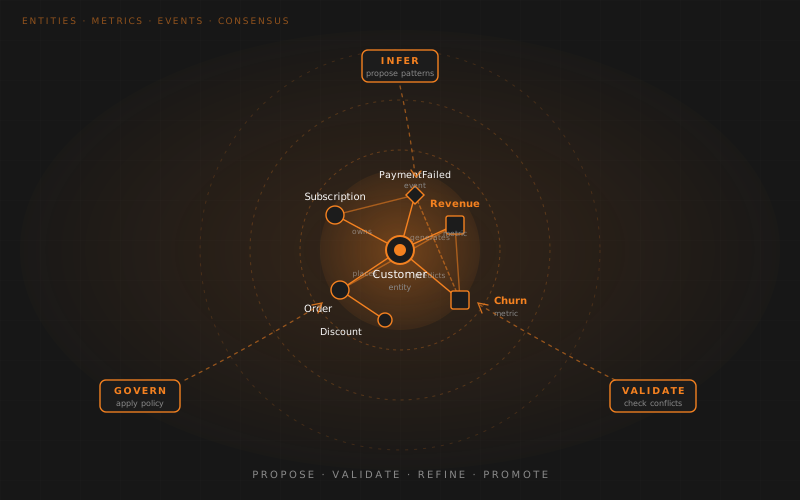
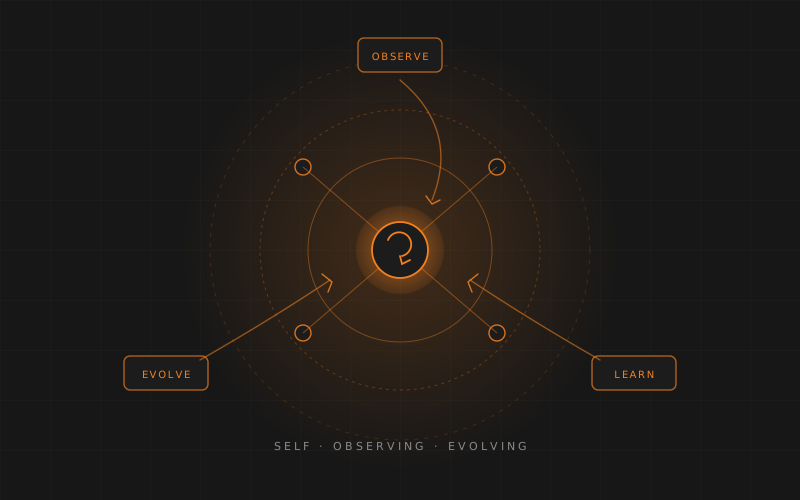
The standard objection is that defining all this meaning is a governance death march. It is, if you hand-author every node. The way through is to bootstrap, not handcraft. Schemas, primary and foreign keys, and existing metric definitions are ingested directly. Embeddings ground each concept against the language the business actually uses. Autonomous maintenance agents then watch every connected source: discovery agents propose candidate entities and metrics, architecture agents reject definitions that violate grain or dependency rules, monitoring agents detect drift through statistical fingerprinting of column distributions and structural diffs, and humans approve the changes in-product. The graph keeps itself current as columns are renamed and tables appear.
The strategic case: why this is becoming table stakes
Total cost of ownership. A multi-tool stack pays the meaning tax repeatedly. Enterprise integration tooling alone runs into six figures annually, with real TCO commonly three to five times the sticker price once implementation and maintenance are counted. A semantic OS makes meaning a one-time cost per concept rather than a recurring cost per tool.
Speed to production. Raw LLM agents pointed at a schema take months to tune. Agents on a semantic OS become reliable consumers because the definitions are deterministic, the governance is prebuilt, and compilation is safe by construction. Zendesk's data engineering lead described the shift in exactly those terms: what used to take months now happens in weeks. The ROI case is concrete too; Strategy reports its Mosaic semantic layer delivered an average 551% ROI with a two-month payback across interviewed customers, about $279K in value per month.
Governance de-duplication. When governance is scattered across the warehouse, a masking tool, and a catalog, it is a per-query cost paid forever. When governance is compiled into the definition and enforced before SQL is generated, it is enforced everywhere, identically, deterministically. One set of policies, applied at the kernel, inherited by every tool.
Where the lines are: warehouse-native vs independent
Warehouse-native layers (Snowflake Semantic Views and Cortex Analyst, Databricks Metric Views with Unity Catalog, BigQuery) are powerful and convenient inside their own walls. But their definitions are tied to that platform; the moment a second warehouse, an embedded use case, or a cross-engine agent appears, the definitions do not travel. They are excellent device drivers. They are not an OS.
Independent, engine-agnostic layers (dbt Semantic Layer / MetricFlow, Cube, AtScale, Colrows) sit above the warehouse and can be cross-tool, cross-engine, and policy-embedded. The Open Semantic Interchange, launched September 2025 by Snowflake, Salesforce, dbt Labs, and over 40 partners, is building a vendor-neutral YAML semantic spec. The whole field is converging on the OS thesis.
Colrows' specific bet is to be the kernel, not the dashboard. It resolves meaning at compile time rather than presentation time; it autonomously builds and maintains the typed graph, declared once and resolve to the same value; it formally proves join paths; and it enforces RBAC, ABAC, and row/column policy before any SQL leaves the planner. In its own framing: tools like Cube and the dbt Semantic Layer "resolve meaning at presentation time, primarily for human consumers," while Colrows "resolves meaning at compile time, across any warehouse, for AI agents."
Honest boundaries
A semantic OS is the operating system for the scoped, governed data layer: the entities, metrics, relationships, and policies your enterprise has decided are authoritative. It is not a replacement for exploratory or raw work. Data scientists hunting an unmodeled hypothesis, engineers profiling a brand-new source, analysts spelunking through raw event logs: that work still belongs in notebooks and direct warehouse access. The semantic OS governs what is known and shared. It does not pretend to govern what has not been modeled yet.
Agents hallucinate not because the model is weak but because four tools hold four theories of what your business means; a semantic kernel that resolves one definition for every consumer removes that ambiguity at its source. Fix the Context, Not the Model.
The era before the OS
Once a real OS exists, the world before it looks primitive: every application reinventing drivers, every program its own island. Enterprise data is about to feel the same way about the era of n tools talking to m schemas, each guessing at meaning. The kernel is the semantic graph. The system calls are MCP, JDBC, and HTTP. The drivers are the dialect adapters. User space is every agent, dashboard, and notebook you will ever connect. Build the kernel once, and the unstructured world below it stops feeling like a system you fight and starts feeling like hardware you stand on.
One graph. Every consumer.
Frequently asked questions
What is a semantic operating system?
A unified meaning layer that acts like an OS kernel for enterprise data: a typed, versioned semantic graph of entities, metrics, relationships, and policies that every consumer (agents, BI, notebooks) queries through standard interfaces instead of reimplementing meaning per tool.
How does a semantic layer map to operating-system concepts?
Kernel = semantic graph; system calls = MCP/HTTP/JDBC/GraphQL; drivers = warehouse dialect adapters; user space = agents, dashboards, and notebooks; kernel security = compile-time RBAC/ABAC/row-column policy.
What is compile-then-execute?
An execution model where user or agent intent is compiled to SQL once, deterministically, with join paths proven and policy applied at compile time, so results are auditable, reproducible, and secure by construction rather than filtered after the fact.
What role does MCP play?
MCP (Model Context Protocol) is the standardized interface, like Unix syscalls, through which agents request kernel services. With 97M+ monthly SDK downloads and Linux Foundation governance, it is the convergence point that turns a bespoke semantic layer into an OS any agent can consume.
Why is fragmentation expensive?
Gartner estimates poor data quality costs $12.9M per organization per year, and McKinsey found 82% of teams lose a day or more each week to data-quality issues. Every tool holding its own definitions multiplies that cost.
How is a semantic OS more secure than row-level security?
Traditional RLS executes the query then filters; a semantic OS shapes the allowed subgraph per persona and refuses unauthorized intent at compile time, so the data is never read and the query cannot be expressed.
Can a warehouse-native semantic layer be the OS?
Within a single warehouse, yes; across an enterprise, no. Warehouse-native definitions are tied to that platform. Only engine-agnostic independent layers solve fragmentation across multi-cloud, multi-vendor stacks.
What are the limits of a semantic OS?
It governs the modeled, scoped data layer. Raw, exploratory, and unmodeled work still belongs in notebooks and direct warehouse access.
How is the semantic graph built without years of work?
By bootstrapping: ingest schemas, keys, and existing metrics; ground concepts with embeddings; and use autonomous agents to detect drift and propose updates that humans approve.