The number your CFO can't reconcile is costing more than you think. In its Magic Quadrant for Data Quality Solutions, Gartner found that poor data quality costs organizations an average of $12.9 million a year, and most of that loss doesn't come from spectacular failures. It comes from the quiet tax of inconsistency: the analyst who rebuilds a metric because no one trusts the original, the week of "metric wrangling" before every planning cycle, the executive meeting that opens with data validation instead of decisions. When sales says revenue is $18M and finance says $17.2M, that $800K gap isn't a data-quality bug. Both numbers are "correct." They're just maintained by different humans using different definitions, and human-maintained meaning no longer keeps pace with a living enterprise.
This is the problem autonomous semantic systems exist to solve. Not "systems of understanding," that's the vision. The economics are simpler and harder: the semantic layer has remained a fragile, hand-curated artifact while everything around it automated. Version control replaced shared folders. CI/CD replaced manual deployment. The definitions, relationships, and governance that give your data meaning are the last manually maintained layer in the stack, and the cost of that manual maintenance is now compounding.
| Aspect | Manual Semantic Layer | Autonomous Semantic System (Colrows) |
|---|---|---|
| How the model is built | A fragile, hand-curated artifact maintained by people | Builds the typed graph itself from schemas, query logs, dbt models, and catalog metadata |
| Drift | Documentation is static, so drift wins anyway | Detects and repairs drift as schemas and usage evolve |
| Governance | A catalog describes governance, checked after the fact | Enforces RBAC, ABAC, and row/column predicates at compile time |
| Auditability | By the time meaning is written down, it is already outdated | Every answer is point-in-time reproducible against its exact semantic state |
| Maintenance cost | Growing steward and metadata headcount just to keep definitions from drifting | Maintains the semantic graph autonomously without a human ticket |
The maintenance bottleneck is a line item, not a philosophy
Look at where data teams actually spend time. Sigma Computing reports that BI teams in organizations with significant dashboard sprawl dedicate up to 80% of their working hours to maintaining, fixing, and updating existing dashboards, not net-new analysis. Every schema change ripples downstream into every dashboard and every metric definition that references it; multiply that across hundreds of assets and the maintenance tax becomes unsustainable.
Now price the people doing that maintenance. A data steward in the US runs roughly $79K–$108K; a data analytics engineer averages around $130K–$145K; a senior data engineer tops $170K. A "semantic wall" arrives when an organization is hiring its third or fourth metadata/steward role just to keep definitions from drifting, and the drift wins anyway, because documentation is static and meaning is not. As data doesn't rot on its own; meaning does. By the time something is written down, it's already outdated somewhere else.
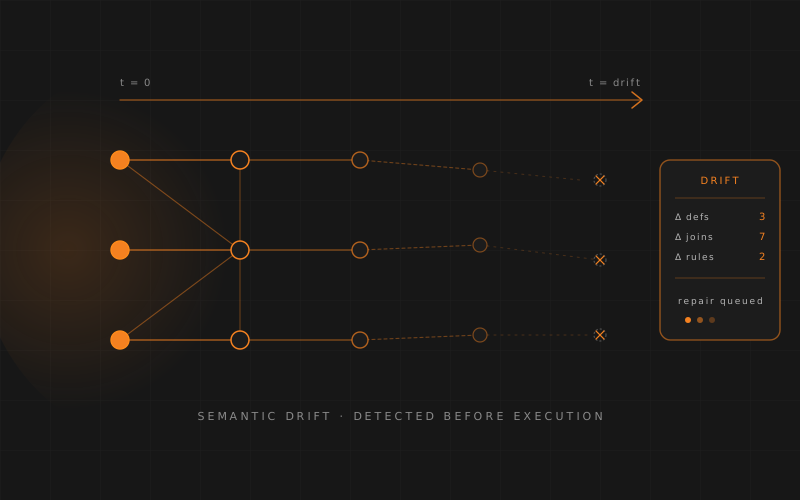
The breakage is invisible until it isn't. A renamed column doesn't throw an error. It silently changes the interpretation of a metric three systems downstream. Industry analyses put a typical enterprise at roughly 400 data incidents per year, totaling about 2,400 hours of downtime and well over $2.6 million in operational inefficiency, much of it traceable to inconsistent definitions and silent schema drift.
Why now: three forces converged
Autonomous semantics became possible (and necessary) because three things happened at once.
1. Agentic AI matured, and then got ahead of itself. Gartner's 2026 Hype Cycle for Agentic AI places the category at the Peak of Inflated Expectations: only 17% of organizations have deployed AI agents, yet more than 60% expect to within two years. Gartner also predicts that "over 40% of agentic AI projects will be canceled by the end of 2027, due to escalating costs, unclear business value or inadequate risk controls." The projects that survive will be the ones grounded in governed semantics. Gartner's blunter prediction: through 2026, 60% of AI projects will be abandoned for lack of AI-ready data, and only 37% of organizations are confident in their data practices today.
2. The industry agreed semantics is the bottleneck. On September 23, 2025, Snowflake, Salesforce, dbt Labs, BlackRock and RelationalAI launched the Open Semantic Interchange (OSI), a vendor-neutral standard for semantic definitions. The coalition now includes Alation, Atlan, Cube, Hex, Honeydew, Mistral, Omni, Select Star, Sigma, ThoughtSpot, Google and AWS, with dbt Labs open-sourcing MetricFlow under Apache 2.0 at Coalesce on October 14, 2025. When the entire industry forms a consortium to fix "semantic fragmentation," the category has been validated.
3. Regulation made auditable meaning mandatory. BCBS 239/RDARR, SOX, and the EU AI Act (full enforcement August 2, 2026) are making semantic transparency and auditable lineage mandatory, not optional. And the penalties are board-level.
What an autonomous semantic system actually is
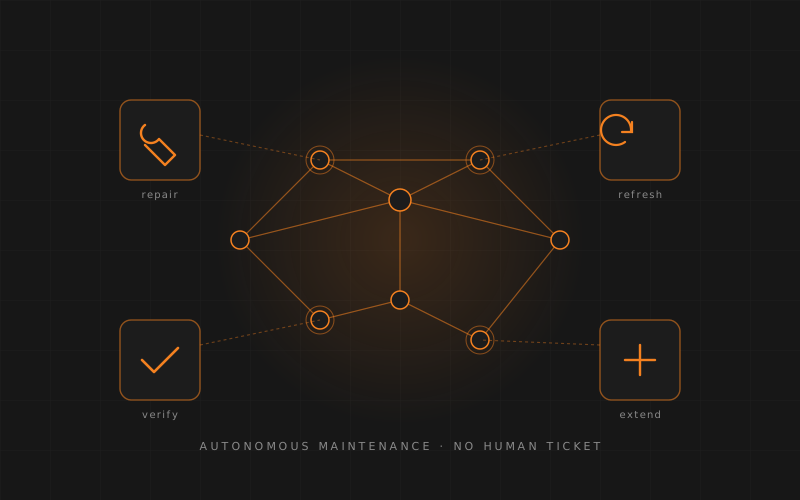
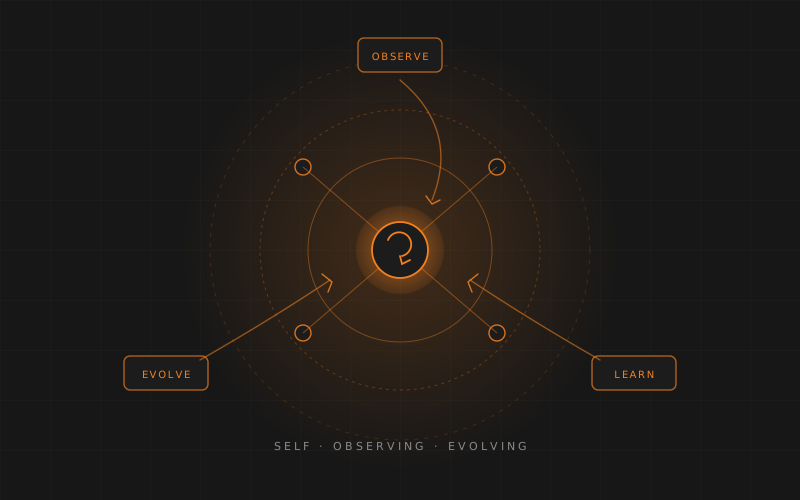
Strip away the abstraction. An autonomous semantic system is infrastructure that does four concrete jobs without a human ticket:
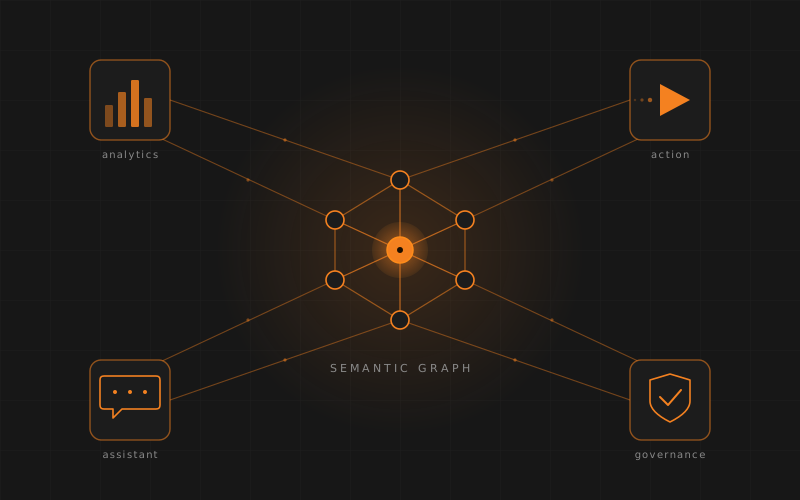
Builds the graph itself. It ingests schemas, query logs, dbt models, BI definitions, catalog metadata, and documentation, and constructs a typed graph of entities, metrics, events, relationships, and policies. Colrows' agents (Discovery, Architecture, Learning, and Monitoring) do exactly this.
Detects and repairs drift. Statistical fingerprinting of column distributions, structural diffing of datasets, and conflict/duplicate resolution flag and reconcile divergence as schemas and usage evolve.
Enforces governance at compile time. RBAC, ABAC, and row/column-level predicates are injected into generated SQL before the warehouse is touched, not checked after the fact.
Stays auditable. Every answer is point-in-time reproducible: a historical query can be re-executed against the exact semantic state active when it ran.
That last property is what separates a category from a feature. Most "autonomous" claims in the market stop at one of these.
The competitive landscape: who means what by "autonomous"
Be honest about competitors. Position on architecture, not feature checklists. The market splits into three camps.
Camp 1. Governance catalogs automating documentation. Atlan is the strongest here, with Context Agents that auto-write descriptions and active metadata; one customer reports 40% efficiency savings. But Atlan's first-generation AI descriptions hit only ~75% accuracy, and, critically, a catalog describes governance; it doesn't enforce it inside the query an agent runs. Select Star, Collibra, and Alation sit in the same camp: excellent at lineage and documentation; not a deterministic execution layer.
Camp 2. BI and semantic layers automating the interface. ThoughtSpot Spotter is genuinely agentic at the interface, but that model is still hand-built and maintained. Looker rebuilt itself around "agentic BI" with Gemini and LookML agents; Google's own data shows the LookML semantic layer "reduces data errors in gen AI natural language queries by as much as two thirds," but Google also states plainly in its own developer codelab that "Agents are not deterministic," and LookML still scales only with modeling effort your team can sustain. Cube is the closest architectural cousin: an open-source semantic layer with deterministic SQL compilation; Brex chose Cube over dbt SL and Looker. But Cube's model is code-first and human-maintained. dbt Semantic Layer / MetricFlow is hand-authored YAML that compiles metric requests to SQL, complementary, not autonomous.
Camp 3. Activation agents. Hightouch deploys reinforcement-learning agents for downstream activation, valuable, but it ties semantics to marketing activation, not governed, cross-domain reasoning.
Where Colrows wins. The wedge is the intersection no one else occupies: autonomy + determinism. Autonomy without determinism produces confident hallucinations. Determinism without autonomy reproduces the human maintenance burden that's breaking teams today. Colrows builds and maintains the semantic graph autonomously and compiles every agent intent into governed, deterministic, dialect-perfect SQL across 16+ engines, with join paths formally proven and policy injected at compile time.
Customer proof, quantified
Cipla (pharmaceuticals). With 22,500+ field representatives and data siloed across Cirrius CRM, Oracle, and ERP, Colrows deployed its semantic execution layer over a federated query engine and unified knowledge graph. Reported outcomes: an 8× increase in data adoption among business teams, a greater-than-90% reduction in decision latency (days to minutes), an 80% drop in IT report requests, and an 18–24% sales productivity uplift, with a 30% reduction in stockouts. As the Cipla commercial team put it: "What was once a fragmented, multi-day investigation became a single, explainable insight, surfaced before the morning meeting ended."
SSP Group plc (travel retail; ~49,000 employees). Reported outcomes: 40% reduction in data-management overhead, 3× faster issue resolution for front-line staff, and 80% improvement in team collaboration. Jayesh Pawar, Head of Analytics at SSP Group: "Colrows is a complete solution for a firm like SSP Group. There are no tools currently available on the market that compare, and the pricing is incredibly reasonable."
A leading Indian asset reconstruction company (BFSI). Colrows compressed non-performing-asset portfolio evaluation from months to hours, a greater-than-95% cycle-time reduction, with RBI SARFAESI and DRT frameworks modeled directly in the graph for 100% regulatory coverage. The reflection captures the thesis exactly: "The investment committee didn't ask us to justify the number. For the first time, the number came with its own justification, traceable to regulation, to precedent, to the account itself."
The regulatory case for deterministic autonomy
Regulators are now explicitly demanding what deterministic semantics provide.
BCBS 239 / RDARR. The ECB made remediation of risk-data-aggregation deficiencies a top supervisory priority for 2025–2027, and BCBS 239 Principle 3 states that "Data should be aggregated on a largely automated basis so as to minimize the probability of errors," with full data lineage to attribute level. Enforcement has teeth: Citigroup paid a combined $135.6 million on July 10, 2024, a $75M OCC penalty plus a $60.6M Federal Reserve penalty, for ongoing data-quality-management deficiencies.
SOX. Public companies spend $1–2M a year on SOX, roughly 70% of it administrative. Continuous, automated control monitoring compresses audit timelines 30–40% and cuts manual control-testing effort 70–85%. Deterministic, versioned metric definitions with full audit trails are exactly the evidence auditors want.
EU AI Act. Full enforcement of the high-risk regime begins August 2, 2026, mandating data lineage, traceability, reproducibility, and explainability. Probabilistic LLM-to-SQL "guessing" cannot produce that; compile-time, point-in-time-reproducible semantics can.
The pattern is consistent: every regime rewards systems where the answer carries its own provenance. That is a deterministic property, not a probabilistic one.
Objection handling
"How reliable is LLM-based semantic autonomy?" It depends on the architecture. Pure LLM-to-SQL guesses; Colrows uses embeddings only to resolve intent, then compiles through a typed graph where invalid joins and incorrect aggregations are blocked before execution.
"Can I trust agents with my definitions?" Every change is versioned, every historical query is point-in-time reproducible, and Architecture agents refuse to publish definitions that violate grain, cardinality, or policy constraints. Reversibility and audit trails are built in.
"What's the ROI / payback?" Benchmark against the costs above: the headcount you stop adding to fight drift, the 30–40% audit-cycle compression, the days-to-minutes decision latency Cipla saw. Initial graph build takes hours; regulated production rollouts run in weeks.
"Won't IT resist autonomous changes?" The governance model is human-in-the-loop where it matters: agents propose, constraints gate, and high-impact changes route to people, the same pattern Atlan and Acceldata have validated, but enforced at compile time.
Implementation roadmap
- Pick 20 high-stakes metrics that drive board reporting, pricing, and operational decisions.
- Connect a data source and auto-build the initial graph, hours, not weeks.
- Implement join-path proof and grain validation as compile-time checks, and expose them through MCP so you're not locked in.
- Track one metric: the percentage of agent/BI queries that resolve through the governed layer versus ad hoc SQL. Drive it up.
- Expand to regulated workloads (risk, finance close, audit prep) where deterministic provenance pays for itself fastest.
Models are already smart enough; the projects that survive are the ones whose semantic context is governed, deterministic, and auditable by construction. Fix the Context, Not the Model.
The companies that get this right in the next twenty-four months won't just have cleaner dashboards. They'll have AI they can put in production because the answers are governed, deterministic, and auditable by construction. Book a demo and pilot autonomous semantic maintenance on your 20 most contested metrics.
Frequently asked questions
What is an autonomous semantic system?
Infrastructure that does four jobs without a human ticket: it builds the semantic graph itself from schemas, query logs, and BI definitions, detects and repairs drift, enforces governance at compile time (RBAC, ABAC, and row/column-level predicates), and stays auditable. Every answer is point-in-time reproducible against the exact semantic state active when it ran.
How much does manually maintained semantics cost an enterprise?
Gartner puts the cost of poor data quality at an average of $12.9 million a year. Sigma Computing reports BI teams with significant dashboard sprawl spend up to 80% of their working hours on maintenance, and a typical enterprise sees roughly 400 data incidents per year, about 2,400 hours of downtime, and well over $2.6 million in operational inefficiency.
Why are autonomous semantic systems emerging now?
Three forces converged. Agentic AI matured (Gartner predicts over 40% of agentic AI projects will be canceled by the end of 2027), the industry validated the category with the Open Semantic Interchange launched September 23, 2025, and regulation (BCBS 239, SOX, and the EU AI Act with full enforcement August 2, 2026) made auditable meaning mandatory.
How is an autonomous semantic system different from a data catalog like Atlan or Collibra?
A catalog describes governance; it does not enforce it inside the query an agent runs. Catalogs are strong at lineage and documentation (Atlan's first-generation AI descriptions hit roughly 75% accuracy), but they are not a deterministic execution layer that compiles intent into governed SQL.
Can enterprises trust AI agents to maintain metric definitions?
Yes, when the architecture constrains them. Every change is versioned, every historical query is point-in-time reproducible, and Architecture agents refuse to publish definitions that violate grain, cardinality, or policy constraints. High-impact changes route to humans.
What results have companies seen from autonomous semantics?
Cipla reported an 8x increase in data adoption, a greater-than-90% reduction in decision latency, an 80% drop in IT report requests, and an 18-24% sales productivity uplift. SSP Group cut data-management overhead 40% with 3x faster issue resolution, and an Indian asset reconstruction company compressed NPA evaluation from months to hours, a greater-than-95% cycle-time reduction.