The silent assumption that shaped 50 years of modeling
For more than two decades, enterprise data modeling has followed one playbook: tables designed, schemas normalized, facts and dimensions arranged, star and snowflake models treated as doctrine. Tools evolved and storage got cheaper, but the mental model barely moved. That model rests on a quiet assumption: model the data correctly and the questions will naturally follow. It traces to E. F. Codd's 1970 paper on relational data, operationalized by Bill Inmon's Building the Data Warehouse (1992) and Ralph Kimball's The Data Warehouse Toolkit (1996). The assumption was correct for its era. Business questions were known in advance, reporting ran in weeks or months, and analysis was retrospective. For thirty years, that worked. It no longer does, not because the founders were wrong, but because the world their tools served has been replaced. Tables store facts well; they represent meaning poorly. That mismatch is the deadlock.
The four schools of table-first modeling, all individually correct, collectively incomplete
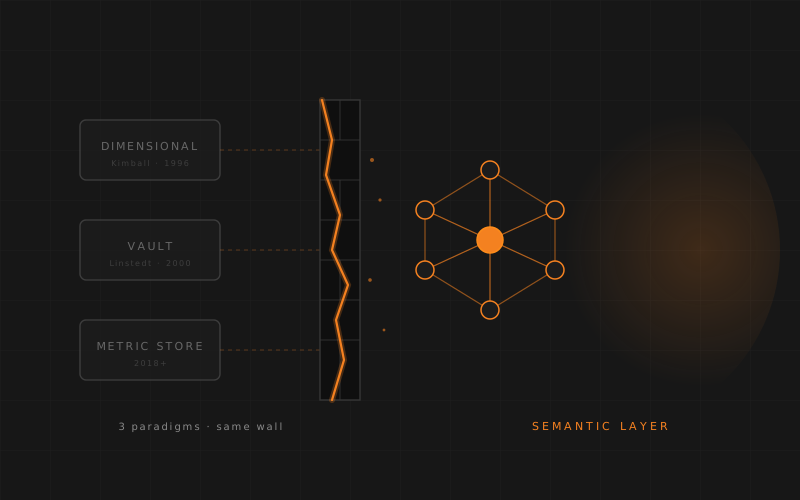
Kimball (dimensional, 1996): Star and snowflake schemas surround fact tables with dimension tables, joined through conformed dimensions. Strengths: fast OLAP queries, intuitive for analysts. Limitations: assumes you know business questions up front; conformed dimensions become bottlenecks; struggles with enterprise-wide reporting.
Inmon (enterprise data warehouse, 1992): Top-down, normalized, hub-and-spoke model builds an integrated corporate core first, then feeds dependent marts. Strengths: single source of truth, adaptable. Limitations: slower queries, complex to navigate, long initial delivery.
Data Vault (hub-link-satellite, 2000): Separates identity (hubs), relationships (links), and context (satellites), with full auditability and parallel-loadable design. Strengths: highly flexible to source change, fully auditable. Limitations: high complexity; typically still resolves to a Kimball star for BI. It remains table-centric.
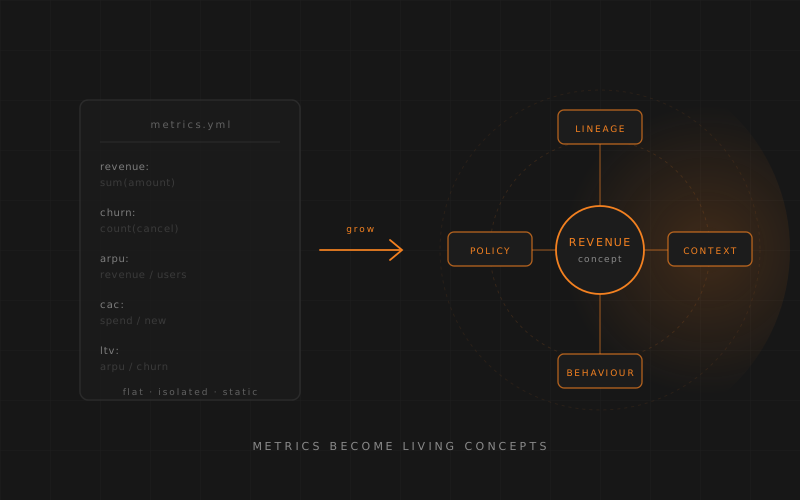
dbt (analytics engineering, 2020+): Brought software discipline (version control, modular SQL, DAG transparency) to analytics. Its Semantic Layer, powered by MetricFlow, lets teams define metrics in YAML. Strengths: democratizes SQL, code discipline, metric consistency. Limitations: metrics are still formulas attached to tables, not concepts in a graph; the table-centric mental model persists.
Semantic-first (2024+): A semantic layer models meaning explicitly (entities, relationships, metrics, constraints and policies) as a typed graph above storage, separate from the schemas that hold the data. Strengths: AI-native, cross-source, governance built in, change-resistant, auditable. Limitations: requires schema understanding to map to it; the category is emerging.
| Dimension | Kimball | Inmon | Data Vault | dbt/Analytics Eng | Semantic-First |
|---|---|---|---|---|---|
| Schema flexibility | Low (rigid stars) | Medium | High (insert-only) | Medium | High (decoupled) |
| Meaning expressiveness | Low–medium | Low | Low | Medium (metrics) | High (concepts, policy) |
| Governance model | Conformed dims | Centralized, top-down | Audit by design | CI tests, code review | Compile-time, cross-model |
| Maintenance burden | High under change | High | High (complex) | Medium | Centralized (one model) |
| AI-readiness | Low | Low | Low | Medium | High |
Why table-first is hitting a wall: Five forcing functions
The cost of the deadlock is semantic debt, the invisible, compounding cost of reinterpreting definitions, rebuilding models, and reconciling conflicting logic. The data is accurate and pipelines run, yet meaning forks. The 2024–25 Modern Data Report found that 68% of data professionals spend the majority of their time just understanding business requirements, and ~40% lose more than 30% of their time wrangling tools to agree on definitions.
- AI requires grounded reasoning. On Spider 2.0, the best LLMs solve only 21% of real warehouse tasks versus 87% on academic benchmarks, the gap between clean schemas and actual ones. Models improvise joins and hallucinate filters when meaning is implicit.
- Business velocity. Definitions change faster than schemas; metric churn is the norm. A semantic layer decouples metric change from schema change.
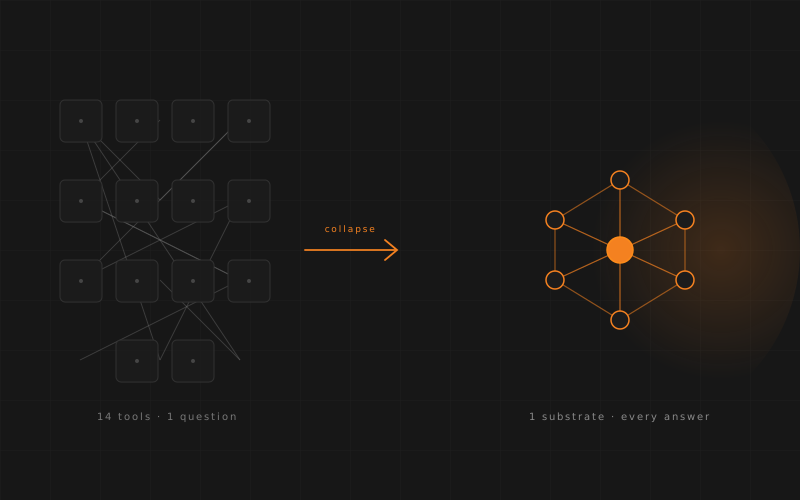
- Data sprawl. Meaning no longer lives in one warehouse. It spans Snowflake, Databricks, BigQuery, operational databases, SaaS, and event streams.
- Governance pressure. From August 2, 2026, the EU AI Act's high-risk obligations require auditable data lineage and explainability. Table-first models scatter logic across SQL, docs, and people's heads.
- Worker expectations. SQL-first access is no longer acceptable; semantic, natural-language access is expected.
The semantic-first paradigm
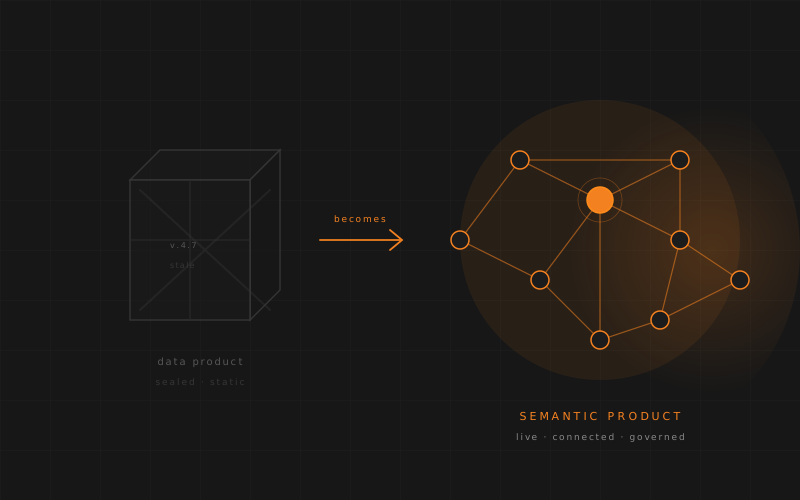
Semantic-first modeling is a meaning layer that sits above storage, with five defining properties: explicitly typed (relationships declared, not implied), decoupled from schema (one model spans heterogeneous sources), AI-native (agents reason without hallucinating), auditable (every answer carries lineage), and evolvable (extend instead of rewrite). This is an overlay, not a migration. It does not replace warehouses or dbt; it compiles through them. Metrics become concepts rather than formulas; entities become participants in relationships rather than row collections; context becomes explicit rather than inferred.
Why now: The industry consensus has arrived
Gartner (March 11, 2026): Distinguished VP Analyst Rita Sallam framed universal semantic layers as a "nonnegotiable foundation": "By 2030, universal semantic layers will be treated as critical infrastructure, alongside data platforms and cybersecurity."
Fivetran (May 5, 2026): 2026 Agentic AI Readiness Index found that nearly 60% of enterprises invest millions in agentic AI, yet only 15% are fully prepared, meaning 85% lack the data foundation to support agentic AI at scale; the top blocker was data quality and lineage (42%).
Standards (September 23, 2025): The Open Semantic Interchange launched, led by Snowflake with Salesforce, dbt Labs, BlackRock, and others, to create a vendor-neutral semantic model specification.
Market consolidation (June 1, 2026): Fivetran and dbt Labs completed their merger explicitly to build "the data foundation for trusted AI agents," launching an Agents Schema standard treating a warehouse schema as a shared semantic context layer.
Implementation: Four stages for CDOs and CTOs
Stage 0 (this quarter): Audit analyst-hours lost to reconciliation and tool-wrangling. If it exceeds ~30% of time, you are already paying the semantic-debt tax. Inventory every place your top 10 KPIs are defined.
Stage 1 (next 1–2 quarters): Pilot one cross-functional use case (revenue recognition, churn, compliance) and model it semantically as an overlay while table-first models keep running. Measure time-to-answer and reconciliation cycles eliminated.
Stage 2: Decide build vs. buy. Custom metadata plus governance is a multi-month build with drift risk. Platforms deliver managed evolution in weeks. The question is who maintains the model: hand-authored YAML versus autonomously built-and-maintained.
Stage 3: Scale across the estate, prioritizing domains feeding AI agents and EU AI Act high-risk systems first.
Thresholds to escalate: AI/agent pilots stalling on data quality (the 85%-not-ready cohort); >30% of analyst time lost to reconciliation; EU AI Act high-risk systems that cannot produce lineage on demand before August 2, 2026; more than one BI platform or cloud warehouse in production.
Objection handling for the boardroom
- "Kimball has worked for 30 years. Why change?" It worked for human-driven BI on known questions. It does not serve AI agents, cross-source reasoning, or governance at scale. Keep it; layer meaning above it.
- "Won't this add overhead?" It reduces overhead by centralizing meaning maintenance instead of re-encoding it in every dashboard, pipeline, and query.
- "How do we transition?" You don't. The layer sits on top; existing dashboards and queries keep working. No migration, no rip-and-replace.
- "What's the ROI?" Faster time-to-insight, fewer reconciliation cycles, AI-ready governance, and lower semantic debt, with downside risk of not acting quantified by Gartner's "60% of MCP-only agentic projects fail by 2028."
The 20-year deadlock persists because teams keep re-engineering table schemas when the real gap is meaning: a semantic layer above your existing warehouses and dbt models resolves it without a migration. Fix the Context, Not the Model.
The bottom line for data leaders: The 20-year deadlock is real, the cost is compounding, and the fix is not a new table schema. It is a meaning layer that sits above them. Book a demo to model your semantic debt and 3-year roadmap to AI readiness.
Frequently asked questions
What is semantic debt?
Semantic debt is the invisible, compounding cost of reinterpreting definitions, rebuilding models, and reconciling conflicting logic. The data is accurate and pipelines run, yet meaning forks. The 2024-25 Modern Data Report found 68% of data professionals spend the majority of their time just understanding business requirements.
What is semantic-first data modeling?
Semantic-first modeling represents meaning explicitly (entities, relationships, metrics, constraints, and policies) as a typed graph above storage, separate from the schemas that hold the data. Its five defining properties: explicitly typed, decoupled from schema, AI-native, auditable, and evolvable.
Do we have to replace Kimball, Data Vault, or dbt to adopt semantic-first modeling?
No. A semantic layer is an overlay, not a migration. It sits above existing warehouses and dbt models and compiles through them, so current dashboards and queries keep working.
Why do LLMs fail on table-first data models?
On Spider 2.0, the best LLMs solve only 21% of real warehouse tasks versus 87% on academic benchmarks. When meaning is implicit, models improvise joins and hallucinate filters. An explicitly typed semantic graph gives agents declared relationships to reason over.
When will semantic layers become critical infrastructure?
Gartner predicts that by 2030, universal semantic layers will be treated as critical infrastructure, alongside data platforms and cybersecurity. Fivetran's 2026 Agentic AI Readiness Index found 85% of enterprises still lack the data foundation to support agentic AI at scale.
When should a CDO move to semantic-first modeling?
Escalate when AI or agent pilots stall on data quality, when more than 30% of analyst time goes to reconciliation, when EU AI Act high-risk systems cannot produce lineage on demand before August 2, 2026, or when more than one BI platform or cloud warehouse runs in production.