
Enterprise Data Architecture: The Shift to Autonomous Infrastructure
Modern data architecture is no longer about moving data. It is about governing meaning. The Colrows framework bridges the gap between raw warehouse storage and autonomous AI agents through a unified semantic compiler.
9 posts
| Data Stack Strategy | Dependency | Governance Method | AI Readiness |
|---|---|---|---|
| Traditional BI | Manual Logic | Runtime | Low |
| Modern Data Stack | Fragmented Tools | Patchwork | Medium |
| Colrows Autonomous | Deterministic Compiler | Compile-time | High |
Three Architectural Stages
Stage 1: The Legacy Trap
Fragmented stacks with scattered definitions, manual documentation, metric drift, and conflicting definitions across teams. Every tool encodes meaning independently. The result: organizations lose $12.9M annually to poor data quality.
Stage 2: The Modern Response
Semantic layers, data mesh architectures, centralized governance. Better than Stage 1, but still hand-authored, slow to evolve, and unable to scale autonomously. 40-60% of Looker investment goes to maintenance. The stack still breaks when you connect an AI agent.
Stage 3: The Autonomous Future
Compiler-driven architecture where meaning is built autonomously, not hand-authored. Deterministic agents reason over a typed semantic graph. Policies are enforced at compile time, not after-the-fact. Change is detected and versioned. The infrastructure maintains itself.
Core Principle: Fix the Context, Not the Model. Do not build for the next dashboard. Build for the next agent. Move the logic out of the prompt and into the compiler.
Re-architecting for Autonomy
Why the stack must shrink to scale. Modern data infrastructure has accumulated layers. Catalogs, glossaries, dictionaries, metric stores, lineage tools, observability platforms. Each models a slice of meaning in its own format. The result is fragmentation that breaks the moment you connect an AI agent: every layer disagrees on what "active customer" means.
The Semantic Compiler Core
Replacing manual catalogs with deterministic logic. Instead of storing definitions passively, a semantic compiler reasons over them. It understands that "revenue" means something different before refunds versus after, gross versus net, booked versus recognized. It encodes cardinality so joins do not silently fan-trap. It proves every path before execution.
Governed AI at Scale
How compile-time security beats runtime filtering. RBAC, ABAC, and row- and column-level predicates are injected into the SQL before any byte is fetched. Unauthorized plans are never generated, rather than being filtered after the fact. The difference is structural: a denied request at compile time costs nothing. A denied request at runtime wastes warehouse compute and erodes trust.
This collection rethinks data modeling for the AI era. Posts examine how the typed semantic graph collapses scattered metadata into a single, versioned source of truth. Why the 20-year deadlock between dimensional models, data vaults, and lakehouse formats is broken not by another modeling philosophy but by elevating semantics above the physical layer. And how accidental complexity in the modern data stack compounds when every tool encodes meaning independently.
You'll also find architectural deep dives on the enterprise memory graph, the autonomous patterns that maintain it, and the cost equations behind building your own semantic execution layer versus consuming one as governed infrastructure. The thesis across these pieces: the next generation of data architecture is semantic-first. Meaning is modeled once, in a typed and reasoning-friendly form, and every downstream consumer compiles through it rather than rebuilding it.
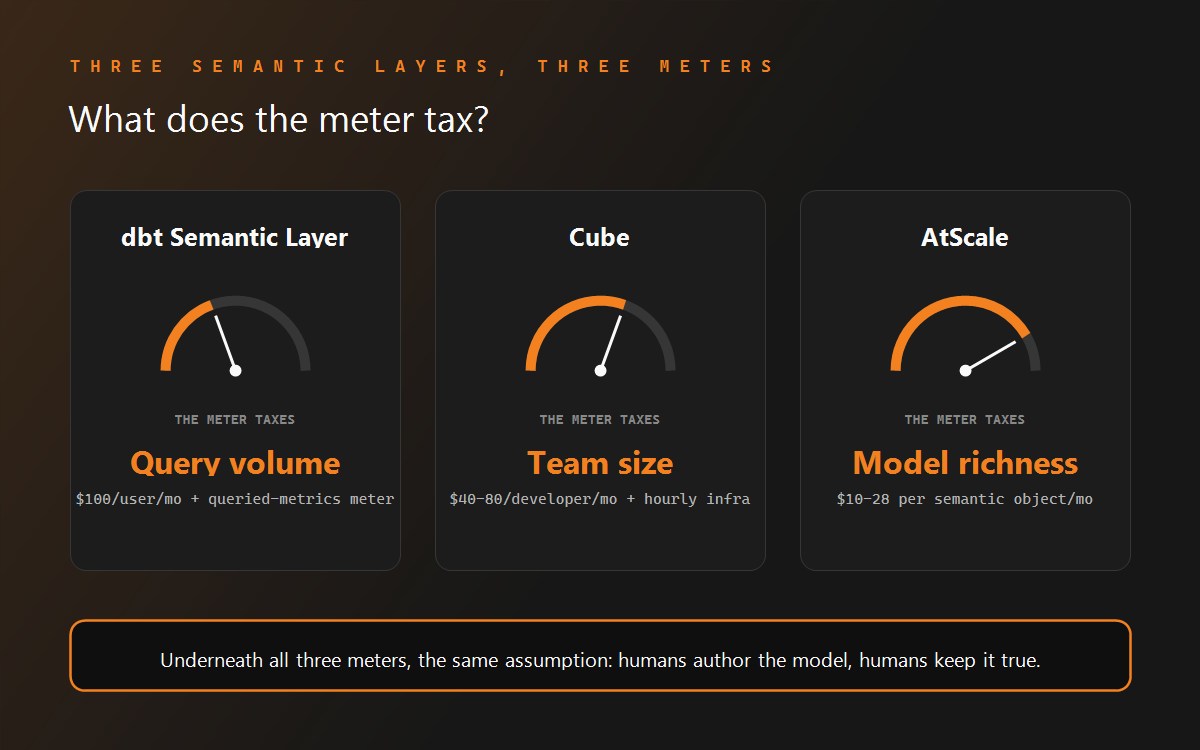
dbt Semantic Layer vs Cube vs AtScale: Choosing an Enterprise Semantic Layer
Three credible semantic layers, three different meters. And the assumption all three share.
Read more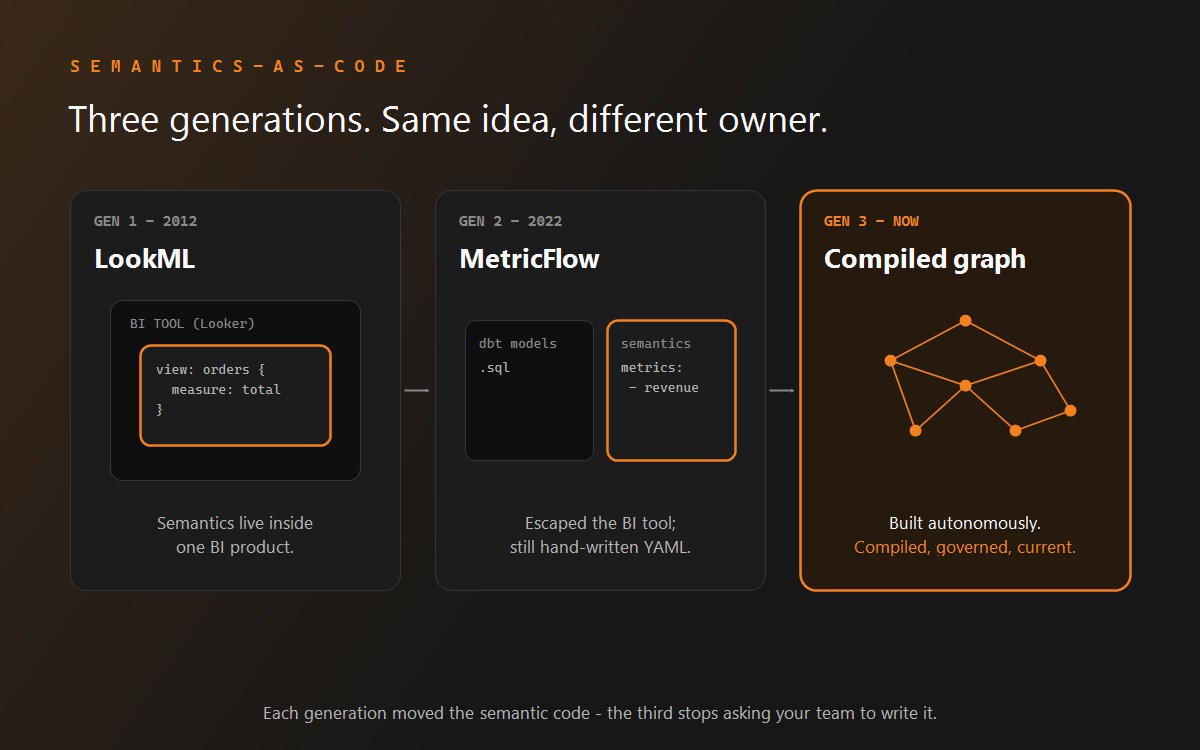
LookML vs dbt Semantic Layer vs a Compiled Semantic Layer
Three generations of semantics-as-code, compared on the axis that decides it: who maintains the model.
Read more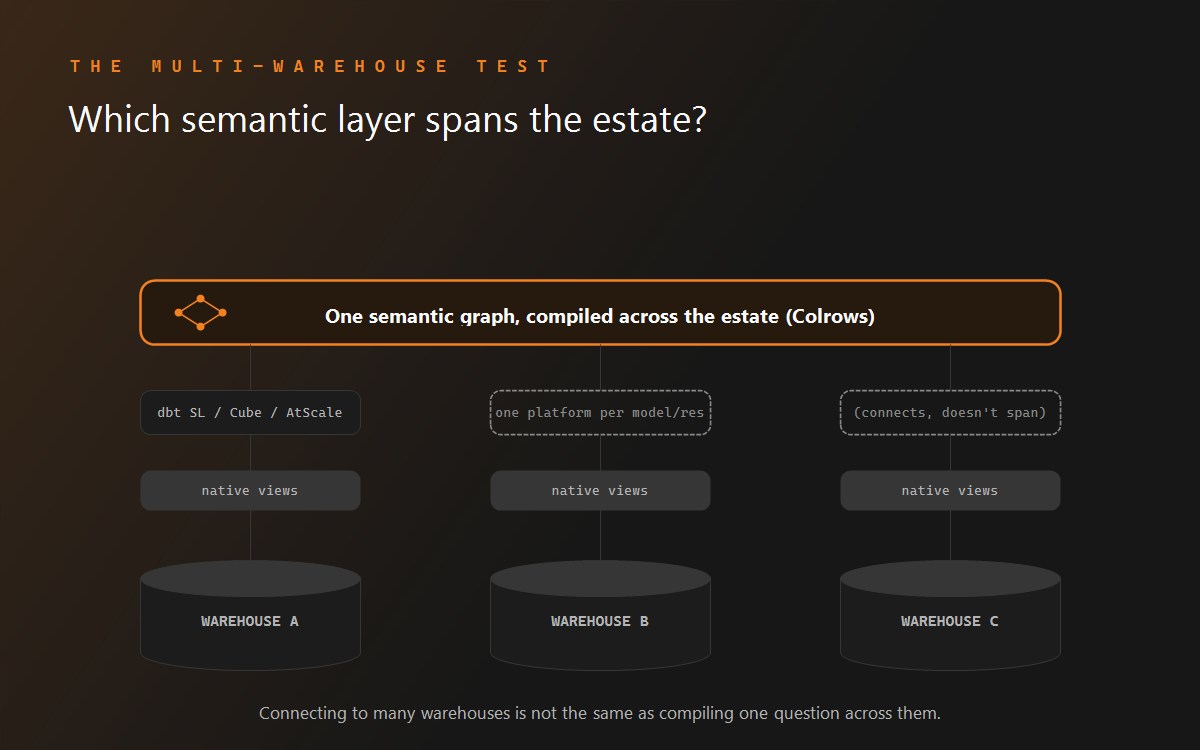
dbt Semantic Layer Alternatives for Multi-Warehouse Estates (2026)
Six credible options, post-merger. With the constraints each carries.
Read more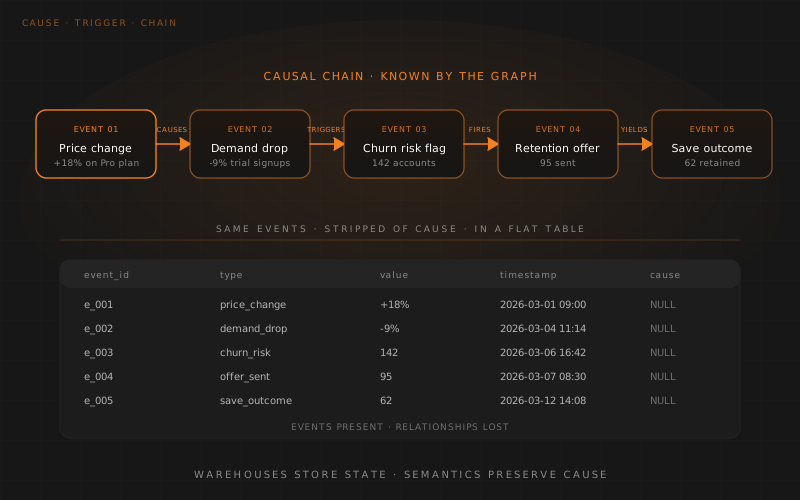
Events, Triggers, and Causal Chains: The Hidden Logic in the Enterprise
Warehouses store events; they lose the arrows. Why typed causal edges in the semantic graph make the hidden logic queryable.
Read more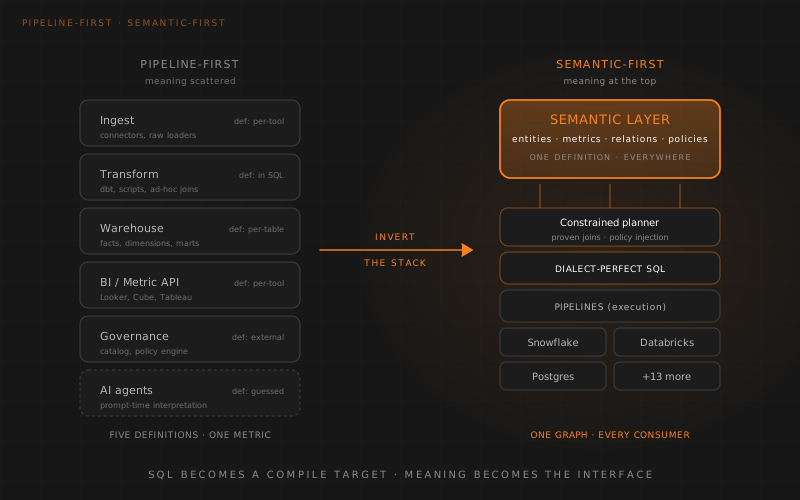
Why the Future of Data Engineering Is Semantic-First
Pipeline-first ships data, not meaning. Semantic-first inverts the stack. SQL becomes the compile target.
Read more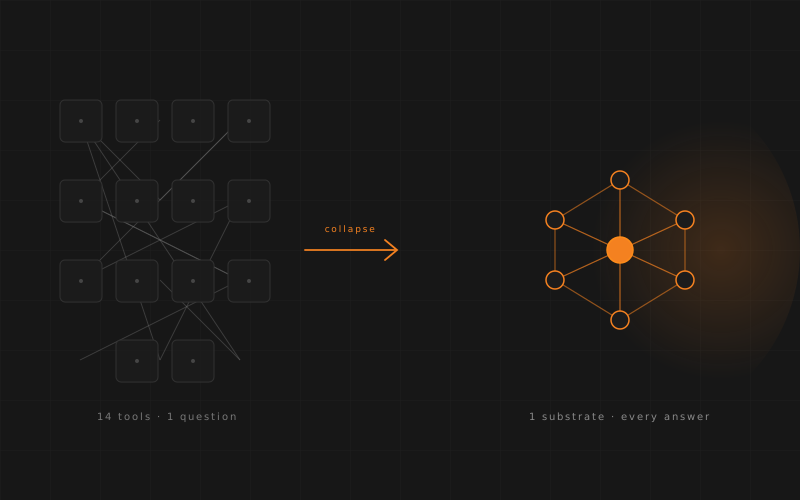
The Accidental Complexity in Modern Data Stacks
How we ended up with 14 tools to answer one question. And what consolidation looks like.
Read more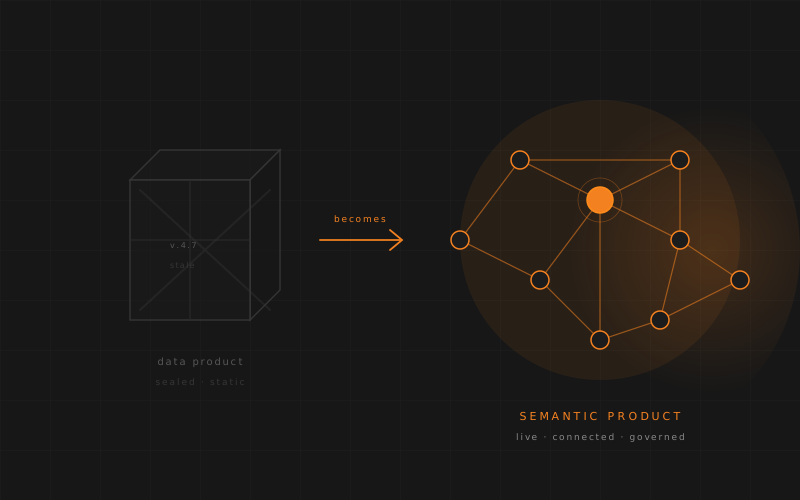
Data Products Are Dead: The Era of Semantic Products
The data-mesh era is closing. The semantic-product era is opening.
Read more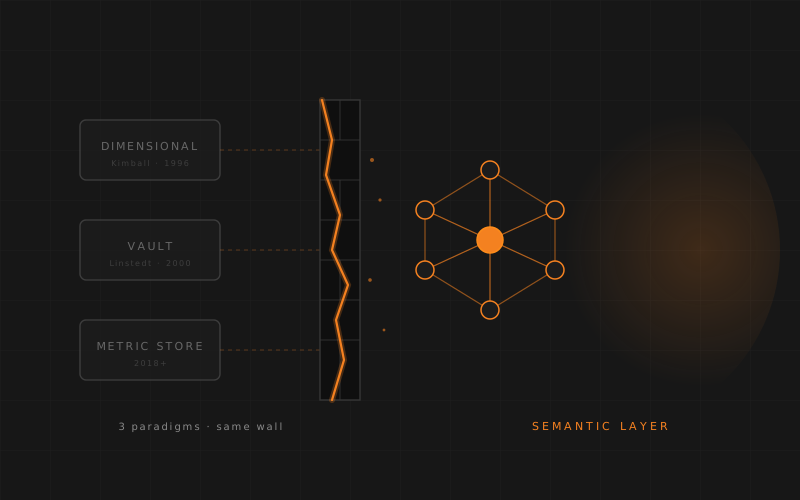
Breaking the 20-Year Deadlock in Data Modeling: From Tables to Meaning
Why dimensional, vault, and metric-store paradigms all hit the same wall. And what comes next.
Read more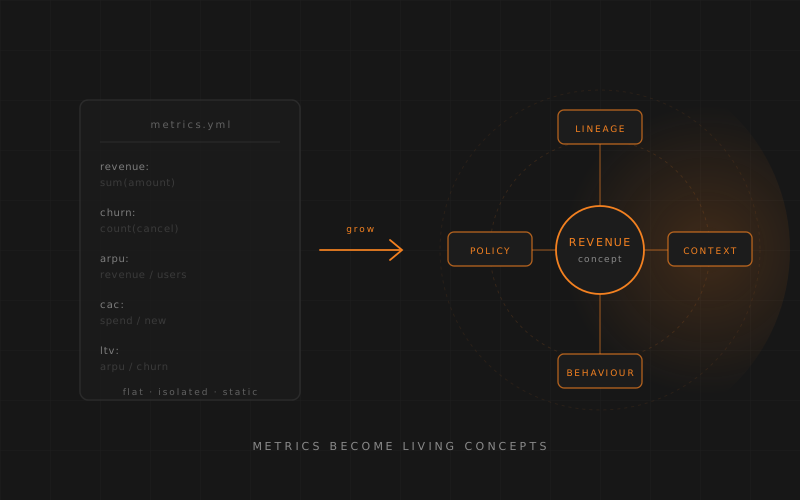
Metric Stores to Knowledge Machines: The Evolution of Semantic AI
Why static metric definitions can't scale to AI. And what replaces them.
Read moreReady to build for the next agent, not the next dashboard?
The Colrows SaaS Architecture is the implementation blueprint for autonomous, governed, deterministic AI infrastructure.