"dbt alternatives" or "dbt Semantic Layer alternatives"? They are different questions
Two searches look alike and want opposite answers. It is worth separating them before you shortlist anything.
dbt alternatives, unqualified, almost always means replacing dbt Core or dbt Cloud as a transformation tool. That shortlist is SQLMesh, Coalesce, Dataform, Matillion, and Dagster. Those tools build and orchestrate models. They are not metric layers, and this page does not rank them.
dbt Semantic Layer alternatives means replacing the metrics layer specifically: the MetricFlow definitions and the governed interface that serves them to BI tools and agents. That is a different product and a different shortlist, and it is what this page compares.
If you are evaluating dbt Labs competitors after the Fivetran merger, you may need both lists. Retiring the transformation tool and retiring the metric layer are separate decisions, and most teams do them at different times.
Why teams go looking
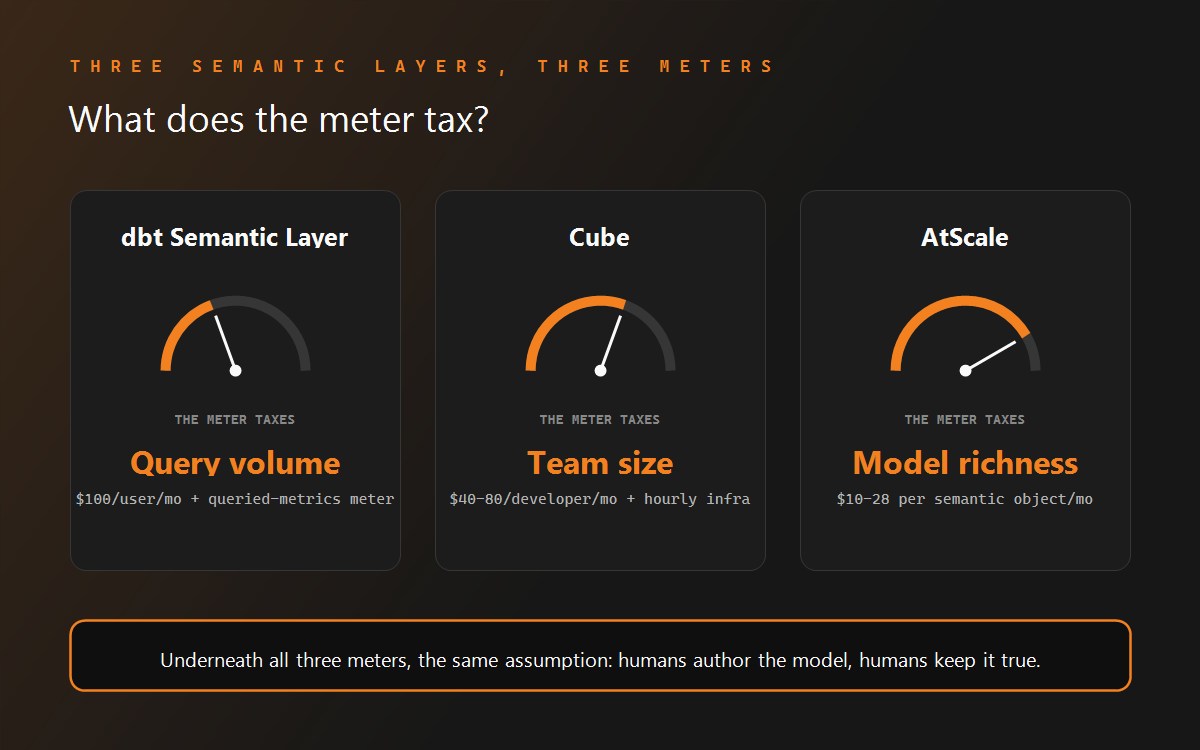
Three documented frictions drive this search. The platform gate: per dbt's docs, querying metrics through the Semantic Layer APIs requires a paid platform plan - Starter at $100/user/month with 5,000 queried metrics included - while dbt Core users can author MetricFlow YAML but not query it. Analyst David Jayatillake put the consequence plainly in his semantic-layer buyer's guide: "dbt Labs is aiming very clearly at enterprise now... making buying dbt Cloud to use the dbt Semantic Layer impractical for many" (a 2024 critique that the enterprise repositioning since has only sharpened). The authoring burden: dbt's own product manager for the spec wrote in January 2026 that "defining metrics was just plain hard" - and the mandatory time spine and single global namespace are real constraints we detail in our comprehensive comparison. And corporate motion: the Fivetran-dbt merger completed 1 June 2026 (Fivetran's George Fraser as CEO, Tristan Handy as President). Nothing about Semantic Layer pricing changed at close - but evaluators committing multi-year semantic infrastructure to a company mid-integration are entitled to a look around.
Fairness first: MetricFlow's spec is thoughtful, the dbt 2026 benchmark showing 98-100% accuracy through deterministic compilation is the best public evidence for the whole category, and if your estate is one warehouse with dbt at its center, staying is a defensible default. Disclosure: Colrows is our product, listed first; the rest are factual and sourced.
1. Colrows - the cross-estate graph that builds itself (our product)
The multi-warehouse answer: one semantic graph across all engines, built autonomously.
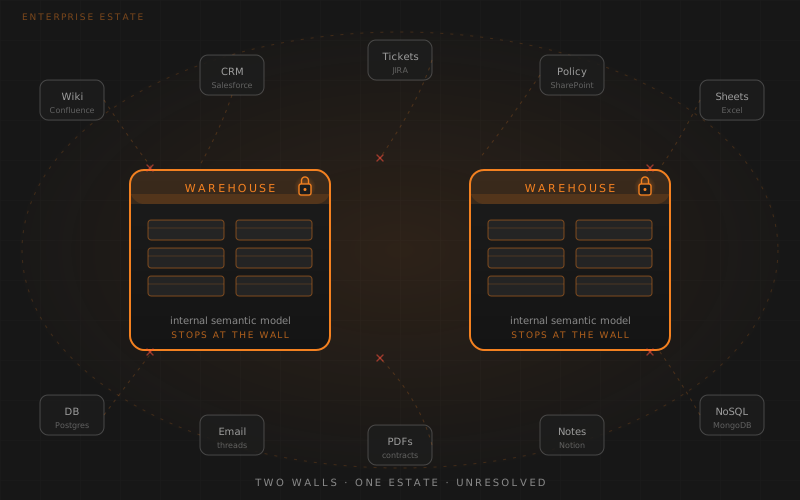
The dbt Semantic Layer's two structural limits for multi-warehouse estates - hand-authored YAML and one-platform-at-a-time resolution - are exactly what Colrows removes. The semantic graph (versioned, typed, multi-scope) is constructed autonomously across Snowflake, Databricks, BigQuery, Postgres, and 12+ more engines, ingesting existing MetricFlow semantic_models YAML as a seed rather than demanding a rewrite. Questions compile through it - intent → context resolution → constrained planning → governed execution - with join paths proven across warehouses, compile-time governance, and dialect-perfect SQL per engine. Where the metric-shaped spec hits its ceiling (dbt's own benchmark scored 0% on questions with too many entity hops), the graph keeps traversing. Trade-offs: a younger vendor than everything below, and BI-tool integration breadth narrower than dbt SL's native list. Pricing: free tier, Enterprise custom. The head-to-head detail lives in Colrows vs dbt Semantic Layer - written by us, so weigh the disclosure - and for what regulated buyers should demand from any platform on this list, see Auditable SQL for Conversational Analytics in BFSI.
2. Cube - the practitioners' technical favorite
The open-core answer: a standalone semantic layer with APIs, caching, and no dbt-platform dependency.
When practitioners rank these tools on architecture, Cube usually wins: Jayatillake's buyer's guide concluded "for all other companies, Cube is probably the best choice. It's superior from a technical POV" - open source down to SQL compilation, exposed via REST/GraphQL/SQL APIs, with a serious pre-aggregation engine and the D3 agentic layer added in 2025. Published pricing is per-developer ($40-80/month) plus hourly infrastructure, with Vendr reporting a $37,200/year median. Key considerations: data models are still hand-authored YAML/JS, pre-aggregation tuning is an ongoing discipline, and Cube has cycled through three pricing models. Multi-warehouse note: Cube connects to many engines, but a given data model resolves against one source - cross-warehouse joins are not the design.
3. AtScale - published pricing, BI-scale consumption
The enterprise-BI answer: OLAP-shaped models with unlimited users and per-object pricing.
AtScale's pitch to dbt-SL evaluators is the inverse meter: instead of seats plus queried-metrics consumption, published per-object pricing ($10-28 per deployed semantic object/month, floors at $2,500-7,000/month) with unlimited users, queries, and data sizes - friendly to large BI populations that would run a queried-metrics meter hot. Its SML modeling language is open-sourced (Apache, September 2024) with converters for Snowflake Cortex, Databricks UC Metrics, and Power BI - genuine portability progress. Key considerations: models are hand-authored by specialists, Gartner reviewers call setup "complex to set up and configure," and a model virtualizes one underlying source at a time.
4. Lightdash - keep dbt, skip the gate
The stay-close answer: your dbt project as the semantic layer, queried without the platform-plan gate.
If your complaint is the API gating rather than dbt itself, Lightdash is the shortest move: metrics defined in YAML beside your dbt models, consumed through Lightdash's UI, Slack, and AI agents - self-hosted free (open source), or Cloud Pro at $3,000/month flat with unlimited users. The honest constraints: the dbt dependency is absolute (no dbt project, no value), and the historical lock-in cuts the other way - as Jayatillake noted of the dbt-metrics ecosystem, "you end up only being able to use Lightdash with it." It is a BI tool with a semantic layer, not a headless metrics API for arbitrary consumers.
5. Warehouse-native: Snowflake Semantic Views & Databricks Metric Views
The zero-infrastructure answer: free, native - and bounded.
Both platforms now ship first-class semantic objects: Snowflake Semantic Views (the recommended grounding for Cortex Analyst) and Databricks Metric Views, which - as data engineer Daniel Beach wrote in February 2026 - "are first-class semantic-layer objects that live in the Unity Catalog." His framing of the moment is the honest one: "No one fully agrees on what [a semantic layer] is - but everyone seems to be selling one." For single-platform estates these are hard to argue with: no extra vendor, no extra infrastructure, native AI integration. The structural caveat is the one the typedef.ai architecture comparison states flatly: warehouse-native is "Snowflake-only: can't use metrics on data in BigQuery, Databricks, etc." Mirror-image for Databricks. A multi-warehouse estate that goes this route maintains one semantic dialect per platform - re-creating the inconsistency a semantic layer exists to end. The full argument is in Why Snowflake and Databricks Can't Be Your Enterprise Semantic Layer.
6. Looker (LookML) - the original, with caveats
The incumbent answer: mature governed semantics, inside one BI platform.
LookML predates MetricFlow by a decade and still does centrally governed metrics well - with the costs documented in our Looker alternatives guide: a developer bottleneck reviewers consistently report, quote-only pricing (~$150K/year average contracts per marketplace reports), Google Cloud coupling, and semantics that serve Looker consumers first. Moving from dbt SL to LookML solves the platform-gate complaint by replacing it with a bigger one; it appears here because evaluators keep asking, not because the trade usually makes sense.
The honest option 7: stay, and re-evaluate at renewal
If your estate is effectively single-warehouse, your consumers are the natively integrated BI tools, and your query volume is dashboard-shaped, the dbt Semantic Layer remains a reasonable home - and the post-merger engineering signals (Fusion GA on Snowflake, dbt Core v2.0 alpha under Apache 2.0) suggest investment, not neglect. Do two things at renewal: model the queried-metrics meter against any AI-agent plans (agents query continuously; the meter counts every successful API request), and watch the Open Semantic Interchange initiative - 60+ members including Databricks, Cube, AtScale, Lightdash, and dbt Labs itself, first spec released January 2026 - which is steadily lowering the cost of changing your mind later.
At a glance
| Option | Multi-warehouse? | Who authors the semantics | Entry price (published?) |
|---|---|---|---|
| Colrows | Yes - one graph, cross-engine compilation | Autonomous + drift detection | Free POC; custom annual |
| Cube | Many engines; one source per model | Developers (YAML/JS) | $40-80/dev/mo + infra (~$37K/yr median) |
| AtScale | Many engines; one source per model | BI modeling specialists (SML) | $10-28/object/mo; $30K/yr floor |
| Lightdash | Wherever dbt runs; dbt-bound | Analytics engineers (dbt YAML) | $0 self-hosted; $3,000/mo Cloud |
| Warehouse-native views | No - one platform each | Data engineers, per platform | Free with the platform |
| Looker (LookML) | Many engines; Looker consumers | LookML developers | Quote-only (~$150K/yr reported) |
| dbt SL (stay) | Many engines; one platform per resolution | Analytics engineers (MetricFlow YAML) | $100/user/mo + queried-metrics meter |
The question under the question
Run your eye down the middle column. Every row except one answers "who authors the semantics" with a human team - the alternatives mostly relocate the YAML rather than retire it, and the warehouse-native options multiply it per platform. For BI consistency, relocation can be enough. For multi-warehouse estates serving AI agents - consumers that ask long-tail questions across platform boundaries on day one - the two properties to buy are cross-estate compilation and autonomous maintenance, because those are the two no amount of YAML discipline provides. The evaluation framework is in Deterministic vs Probabilistic Text-to-SQL; the three-way incumbent comparison with full pricing detail is in dbt Semantic Layer vs Cube vs AtScale.
Most of these alternatives just relocate the YAML instead of retiring it; the property worth buying is a semantic layer that compiles across your whole estate and maintains itself, not another human-authored model bolted onto the same tables. Fix the Context, Not the Model.
Frequently asked questions
What is the best dbt Semantic Layer alternative?
By driver: platform gate or meter → Cube (practitioners' technical favorite) or AtScale (unlimited-user economics); keep dbt, skip the gate → Lightdash; single-warehouse estate → that warehouse's native semantic views; multi-warehouse with AI agents → Colrows' autonomous cross-estate graph. For a deeper comparison of dbt vs LookML and other coded semantic layers, see LookML vs dbt Semantic Layer.
Do I need the dbt platform for the Semantic Layer?
Yes - APIs require a paid plan ($100/user/month Starter with a 5,000 queried-metrics allowance); dbt Core authors locally but cannot query. This gate is the most-cited reason for the search you just ran.
Did the Fivetran-dbt merger change anything?
It closed 1 June 2026 with no Semantic Layer pricing changes announced; Fusion is GA on Snowflake (other warehouses in preview) and dbt Core v2.0 is alpha. Treat the commercial roadmap as in motion and re-check at renewal.
Are warehouse-native semantic views a real alternative?
Within one platform, yes - free, native, AI-integrated. Across platforms, no: each view describes only its own warehouse's data, so multi-warehouse estates maintain one dialect per platform.
A note on the claims
Pricing and plan facts were checked on vendor pages on 12 June 2026 (dbt, Cube, AtScale, Lightdash); the merger and Fusion status come from the Fivetran-dbt press release and dbt's availability docs of the same date; practitioner quotes are attributed and dated (Jayatillake's is from 2024 - we frame it as a critique that has aged toward true). Colrows is our product; the alternatives' genuine strengths are stated, and the sources let you audit ours. This page is reviewed quarterly.