Why teams go looking
Three themes recur in public Looker reviews and procurement data. The modeling bottleneck: G2 reviewers describe a steep learning curve "especially when working with LookML," and Gartner Peer Insights reviewers report that data requests "still bottleneck with the engineering team" - governed self-service, rationed by a developer queue. Opaque cost: Google's pricing page lists no figures - Standard, Enterprise, and Embed are all "Call sales" on annual commitment - while marketplace data attributed to Vendr reports average contracts around $150,000/year. And a new meter: the same page publishes Gemini Data Token allowances per edition, with overage pricing of $3 per million input tokens and $20 per million output tokens effective 1 October 2026 - AI usage is becoming a metered line item on top of the quote. Fairness requires saying the other side: LookML-style central governance is a genuinely good idea, Gemini-powered Conversational Analytics went GA in 2025, and for Google-stack estates Looker remains a defensible default. The alternatives below are organized by what they offer instead of LookML.
One disclosure up front: Colrows is our product. It leads the list because this is our site; the other seven entries are factual, sourced, and useful without ours.
1. Colrows - the modeling layer that builds itself (our product)
Replaces LookML with: an autonomous semantic graph.
Colrows attacks the bottleneck directly: instead of a team authoring and maintaining semantic code, the semantic graph - versioned, typed, multi-scope - is built autonomously from the estate and kept current with drift detection. Existing LookML (views, explores, access grants) seeds the graph rather than being rewritten. Every question then compiles through it - intent → context resolution → constrained planning → governed execution - into deterministic, auditable SQL with compile-time governance (RBAC + ABAC + row/column predicates), serving chat-to-chart, dashboards, and AI agents through one pipeline. The honest trade-offs: Colrows is a young vendor, and if your need is pixel-perfect dashboard craftsmanship, the incumbent BI tools below are deeper there. Pricing: free tier (unlimited datasources, users, policies; metered compute), Enterprise custom. The head-to-head detail lives in Colrows vs Looker - written by us, so read it with the disclosure above in mind - and the platform comparison matrix puts both alongside the rest of the category.
2. Lightdash - the open-source heir
Replaces LookML with: your existing dbt project.
Lightdash is the most literal answer to "Looker without LookML": an open-source BI tool (5.9k GitHub stars) whose semantic layer is your dbt project - metrics declared "in yaml alongside your dbt project," per its README, now repositioned around "Agentic BI" with AI agents that answer questions through the governed layer in the UI or Slack. Pricing is refreshingly published: self-hosted free, Cloud Pro at $3,000/month flat with explicitly no per-seat pricing and unlimited users (a lower Starter tier has circulated via third parties but is no longer on the published page). The constraint is the mirror of the strength: reviewers note the dbt dependency is absolute - without a dbt project, Lightdash provides no value - and visualization breadth trails the incumbents.
3. Omni - Looker rebuilt by its own people
Replaces LookML with: a shared semantic model that tolerates spreadsheet-style freedom.
Founded by ex-Looker leadership (CEO Colin Zima was Looker's chief analytics officer), Omni is the "what we'd do differently" product: a governed semantic model underneath, spreadsheet-and-SQL workbook freedom on top, and an AI layer that carries business logic and permissions into Claude, ChatGPT, Cursor, and VS Code via agentic integrations. The market is voting: a $120M Series C at a $1.5B valuation (April 2026), with customers including dbt Labs itself. Trade-offs: no published pricing (custom quotes only), and as the youngest well-funded entrant its enterprise governance track record is still being written.
4. Holistics - as-code modeling, team-based pricing
Replaces LookML with: AML, a Git-versioned modeling language - at a published price.
Holistics keeps Looker's central thesis (model once, as code, with version control) and changes the commercial shape: published, team-based pricing from $960/month (10 users included, $15/month per extra user), Standard at $1,200/month, and a Security Compliance Suite at $2,400/month with SAML/SCIM and records-based access control. Its AI layer is notable for the right reason - Holistics AI generates queries against the governed semantic layer rather than raw SQL against schemas - but is currently beta/request-access, so do not buy on it. Reviewer caveats: an AML learning curve that keeps modeling with a central data team, and isolated reports of performance issues on some warehouses.
5. Metabase - the pragmatic open-source default
Replaces LookML with: lightweight models and metadata - less governance, far less ceremony.
Covered fully in our ThoughtSpot alternatives guide, Metabase earns its place here too: $0 open source self-hosted, published cloud tiers from $100/month, Metabot AI at a flat $3.75 per million tokens. The honest framing for ex-Looker evaluators: you are trading LookML's governance depth for speed and transparency. Teams that needed Looker's access grants and metric rigor will feel the gap; teams that mostly needed dashboards will not miss the ceremony.
6. Preset (Apache Superset) - open-source scale, governance gated
Replaces LookML with: dataset-level metrics on Apache Superset.
Preset is managed Superset with published pricing: free for up to 5 users, Professional at $20/user/month, Enterprise custom. The catch for governance-minded ex-Looker teams is where features sit: RBAC arrives at the paid Professional tier, while SSO/SCIM, audit logs, and even dbt integration are Enterprise-gated - and the "semantic layer" is Superset's dataset-level metrics, not a standalone queryable layer. Strong choice for engineering-led dashboarding at scale; weak swap for LookML's governance role.
7. Sigma - the spreadsheet route
Replaces LookML with: live warehouse computation and Excel-native UX.
Sigma's wager is that much of what LookML governed can instead be computed live against the cloud warehouse through a spreadsheet interface business users already know - with Ask Sigma showing its reasoning steps for inspection. Pricing is unpublished (Vendr reports a $62,000/year median across recorded purchases), and the recurring reviewer caveat is cost predictability under heavy usage. It is less a governance replacement than a governance relocation - your warehouse's permissions and your workbook discipline carry the load.
8. Microsoft Power BI - the gravity option
Replaces LookML with: semantic models in the Microsoft ecosystem.
At $14/user/month for Pro, Power BI is the price-anchored default for Microsoft estates, and its semantic models are a real (if differently shaped) modeling layer. Two eyes-open caveats from our deeper coverage: Copilot requires paid Fabric capacity (F2+, from $262.80/month - "a Pro license alone isn't sufficient"), and Microsoft's own docs warn that unprepared models produce "inaccurate or even misleading outputs" - the modeling tax again, relocated. Details in Why Power BI Copilot Gives Confidently Wrong Answers.
At a glance
| Tool | What replaces LookML | Entry price (published?) | Watch for |
|---|---|---|---|
| Colrows | Autonomous semantic graph | Free POC; custom annual | Young vendor; agent-first focus |
| Lightdash | Your dbt project | $0 self-hosted; $3,000/mo Cloud Pro (unlimited users) | No dbt, no value; viz breadth |
| Omni | Shared model + workbook freedom | Quote-only | Young enterprise track record |
| Holistics | AML (as-code, Git) | $960/mo (10 users incl.) | AML learning curve; AI in beta |
| Metabase | Lightweight models | $0 OSS; $100/mo cloud | Governance depth |
| Preset (Superset) | Dataset-level metrics | $0 to 5 users; $20/user/mo Pro | RBAC/SSO/dbt gated to paid tiers |
| Sigma | Live warehouse + spreadsheet UX | Quote-only (~$62K/yr median, Vendr) | Usage cost predictability |
| Power BI | Semantic models (MS stack) | $14/user/mo (+ Fabric for Copilot) | Prep burden; capacity gating |
Looker itself, for reference: quote-only platform pricing ("Call sales" on all editions), ~$150K/year average contracts per marketplace data attributed to Vendr, Gemini Data Token overage metering from 1 October 2026.
The question under the question
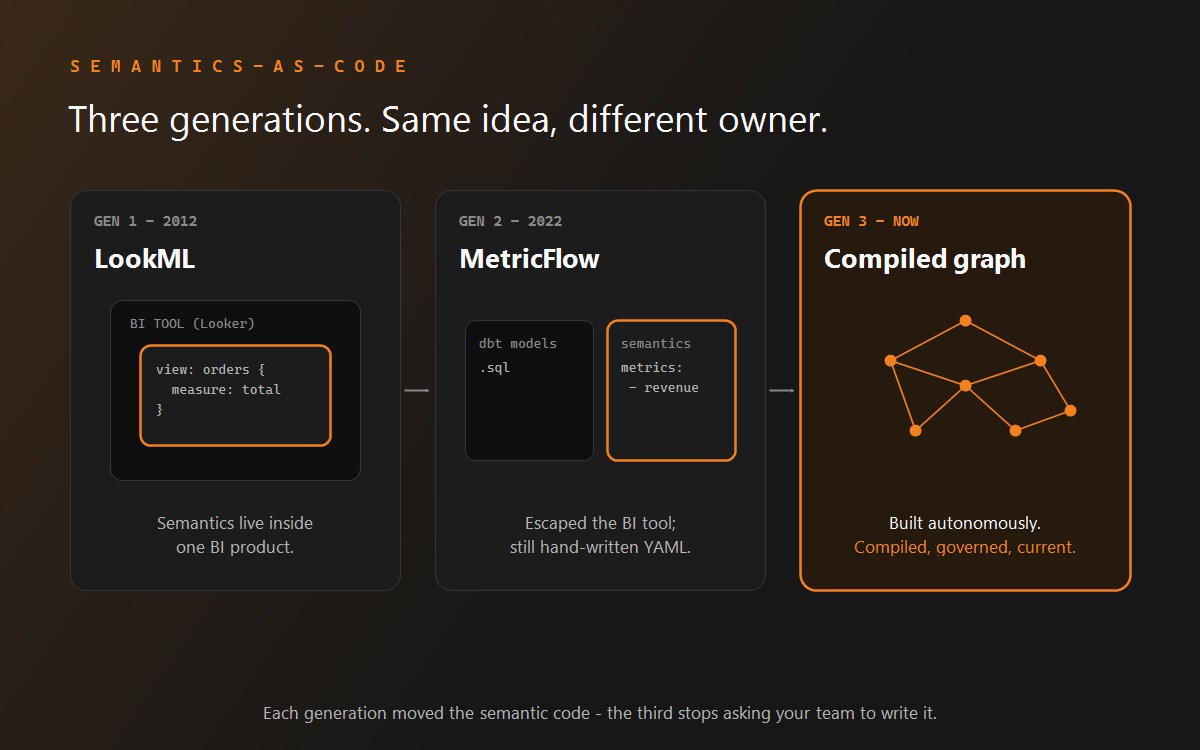
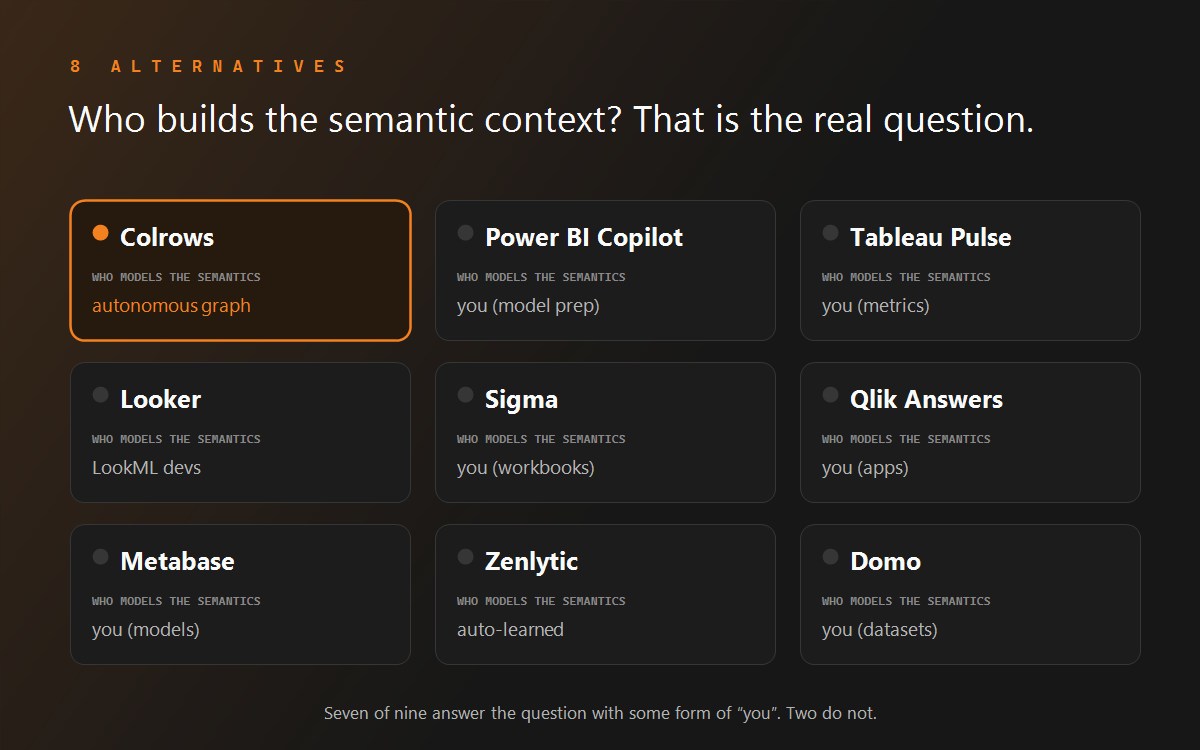
Notice what the column "what replaces LookML" actually varies on: who writes and maintains the semantic model. Lightdash and Holistics move the code (to dbt YAML, to AML); Omni softens its edges; Metabase, Preset, and Sigma thin it out; Power BI relocates it into Microsoft's prep checklist. Only one entry removes the human authorship assumption entirely - which matters most when the consumers are AI agents asking long-tail questions no backlog anticipated. Portability is also finally improving: the Open Semantic Interchange initiative (60+ members including Lightdash, Omni, Preset, Cube, AtScale, Databricks - with its first spec released January 2026) is building a vendor-neutral YAML standard for metrics and joins, so the semantics you author next should be less captive than your LookML was. The deeper architecture argument is in LookML vs dbt Semantic Layer vs a Compiled Semantic Layer.
As every entry in this comparison shows, swapping one BI front-end for another does not remove the modeling backlog; what decides whether agents and analysts get the right answer is who authors and governs the semantic model behind the tool. Fix the Context, Not the Model.
Frequently asked questions
What is the best Looker alternative?
Match it to what LookML did for you: governance-as-code without the proprietary language → Lightdash or Holistics; the Looker experience modernized with AI → Omni; cost transparency → Metabase or Preset; autonomous modeling for conversational analytics and agents → Colrows.
Is there an open-source Looker alternative?
Lightdash (self-hosted free, dbt-native, $3,000/month cloud flat for unlimited users) is the closest; Metabase and Superset/Preset are broader open-source BI with lighter governance.
Why do teams leave Looker?
The LookML developer bottleneck, quote-only pricing (~$150K/year average per marketplace reports), Google Cloud coupling - and from October 2026, metered Gemini Data Token overages on AI usage.
Can I keep my LookML if I switch?
Definitions translate with effort (to MetricFlow or Lightdash YAML); Omni eases migration culturally; Colrows ingests LookML to seed its graph. Explores, Liquid templating, and drill configs generally do not port. For a deeper comparison of dbt Semantic Layer and other coded alternatives, see dbt Semantic Layer Alternatives.
A note on the claims
Published prices were checked on vendor pricing pages on 12 June 2026 (Lightdash, Holistics, Metabase, Preset, Power BI); quote-only vendors are marked as such, with marketplace medians attributed. Review sentiments are attributed to G2 and Gartner Peer Insights. Vendors ship changes monthly; this page is reviewed quarterly. And once more: Colrows is our product - check the sources on the rest.