ThoughtSpot vs. Colrows at a Glance
| Capability | ThoughtSpot | Colrows |
|---|---|---|
| Logic | Search-based / Heuristic | Deterministic Semantic Compiler |
| Governance | Runtime / Patchwork | Compile-time / Integrated |
| SQL Output | Generated via Natural Language | Generated via Semantic Graph |
| AI Agent Fit | Low (Hallucination risk) | Native / Production-Ready |
| Metric Definition | Decentralized / Search | Centralized / Auditable |
The architecture gap: search-based BI vs. deterministic compilation
ThoughtSpot and Colrows both promise "ask your data questions," but they answer through different machines. The difference matters the moment an autonomous agent, not a human, is the consumer.
The limits of search-BI
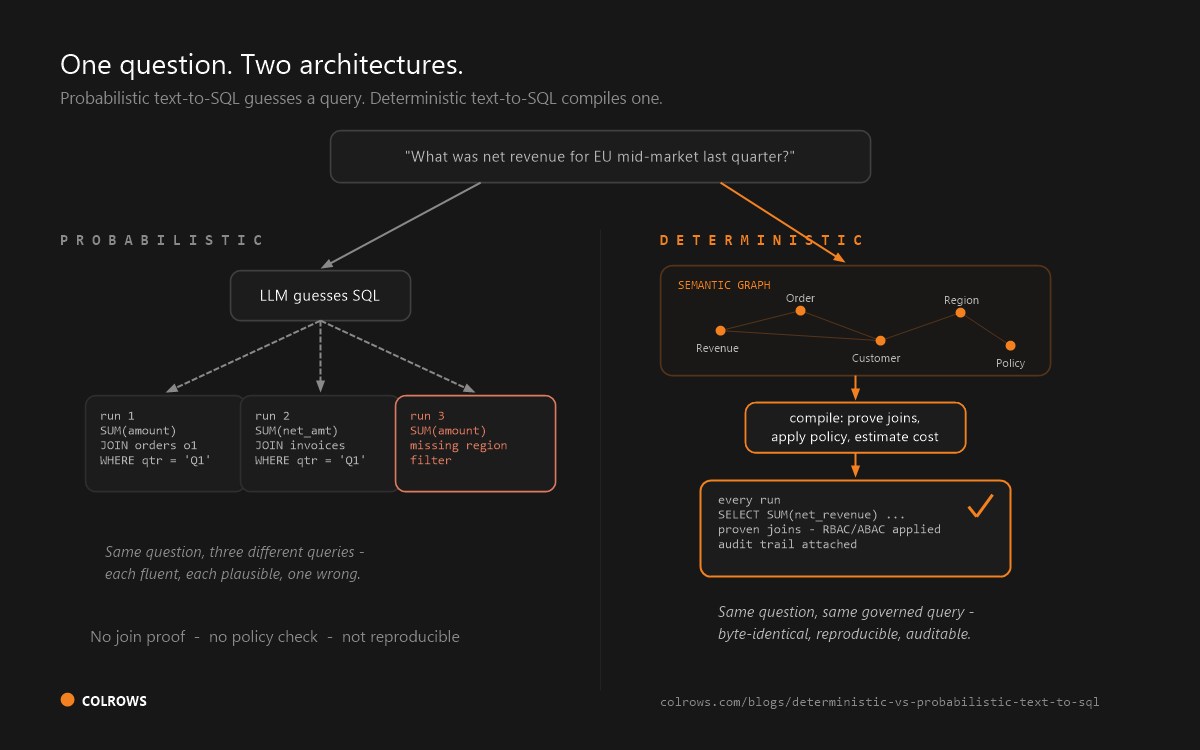
Search-based BI matches strings against a worksheet or model. It works when the question is short, the schema is small, and a human is in the loop to spot a wrong answer. It runs out of room when the question is multi-step, the schema is large, or the consumer is an agent that cannot eyeball the result. The hallucination cliff is real: as questions get complex, the system silently picks the wrong column or join because it has no formal contract to enforce.
The semantic compiler fix
Colrows resolves business definitions before any SQL is formed. The Colrows semantic compiler ingests warehouse schemas, dbt models, catalog metadata, and usage signals, builds a typed semantic graph autonomously, and emits dialect-perfect SQL with RBAC, ABAC, and row-/column-level predicates injected at compile time. Unauthorized or ambiguous intent fails compilation with an explainable error. There is no path to a confidently wrong answer because the system refuses to produce one. For the empirical evidence on how raw generation collapses on real enterprise schemas, see The Text-to-SQL Accuracy Cliff.
Do not trade AI precision for search-box convenience. Build your data foundation on a deterministic semantic layer. Fix the context, not the model.
Why teams go looking
Public reviews of ThoughtSpot converge on two themes, and neither is really about the brand. The first is the modeling tax: one Gartner Peer Insights reviewer called natural-language search "impossible without the data team doing a huge amount of up-front data modelling work and defining all the business logic and semantics"; a Reddit commenter described hitting a wall "at 70% of what I want to do." The second is cost: procurement marketplace Vendr reports a median annual contract of $92,521 across 30 recorded purchases (February 2026, range $36,736-$231,060), with implementation typically adding 15-40% of first-year subscription value.
Hold that first complaint in mind as you read the list, because it is the secret theme of the entire category: every tool below either makes you build the semantic context by hand, or competes on how that context gets built and enforced. A search box is the cheap part.
How we evaluated
Four questions, applied to each tool: How close is it to the conversational, search-driven use case ThoughtSpot owns? Who does the modeling work, and how much of it is there? What enforces governance and correctness - especially for regulated workloads? And what does it actually cost, preferring published prices and attributed marketplace data over "contact sales" mystique. One disclosure up front: Colrows is our product. We put it first because this is our list; we have kept the descriptions of the other eight factual and sourced so the comparison stays useful even if you discount ours.
1. Colrows - autonomous semantic layer, compiled answers (our product)
Best for: regulated enterprises (BFSI, healthcare, retail) that want conversational analytics and AI agents without a manual modeling program.
Colrows attacks the modeling tax directly: it is a semantic execution layer that builds and maintains its semantic graph autonomously - versioned, typed, multi-scope - across the warehouse estate, then compiles every question through it: intent → context resolution → constrained planning → governed execution. The differences evaluators notice against search-driven BI: answers are compiled, not generated, so the SQL is deterministic, dialect-perfect, and auditable; governance is compile-time (RBAC + ABAC + row/column-level predicates) rather than per-worksheet configuration; and drift detection keeps the graph current without a curation team. It does chat-to-chart, dashboards, and governed self-service for humans - and the same compiled pipeline serves AI agents, which is where search-based architectures stop. Pricing: a free tier (unlimited datasources, users, and access policies, metered compute) and custom Enterprise. The trade-off to weigh: Colrows is a young vendor relative to the platforms below, and the head-to-head detail lives in Colrows vs ThoughtSpot - written by us, so read it with this paragraph's disclosure in mind.
2. Microsoft Power BI + Copilot - the price floor, with a capacity catch
Best for: Microsoft-stack organizations that want mainstream BI cheaply and can fund Fabric capacity for AI.
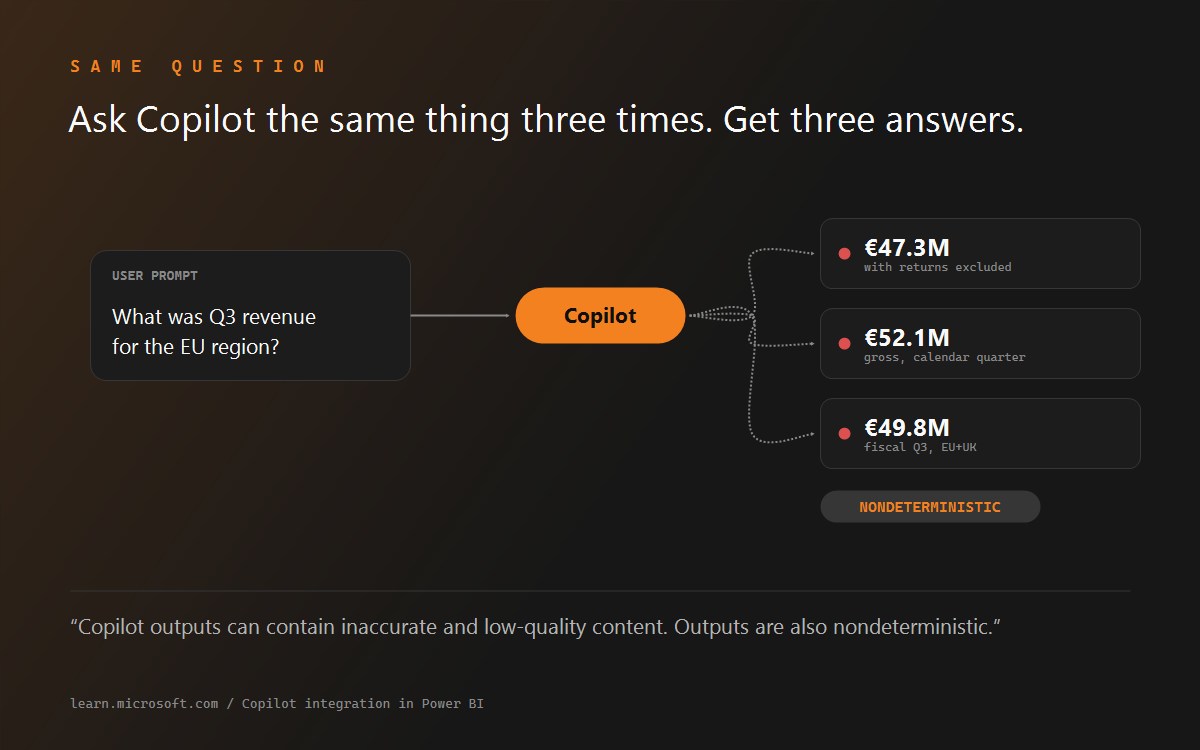
Power BI remains the cheapest credible entry in enterprise BI - $14/user/month Pro, $24 PPU - with the deepest Office integration in the market. The conversational layer is Copilot, and it carries two caveats straight from Microsoft. First, the gate: Copilot "requires organizational capacity" - a paid Fabric capacity (F2+, from $262.80/month) or Premium P1+; a Pro license alone is not enough. Second, the accuracy contract: Microsoft's documentation warns that without serious data preparation, "Copilot can struggle to interpret data correctly - leading to generic, inaccurate, or even misleading outputs," and that outputs are nondeterministic. The modeling tax did not disappear. It moved into "Prepare your data for AI." We unpack that fully in Why Power BI Copilot Gives Confidently Wrong Answers.
3. Tableau + Pulse - the visualization standard, AI behind a bundle
Best for: organizations that prize best-in-class visual analytics and live in Tableau Cloud.
Tableau is still the reference for visual exploration, with 88% satisfaction across roughly 11,000 G2 reviews - in which, notably, "expensive" surfaces in 217 review mentions and large-dataset performance in 225. Its ThoughtSpot-adjacent play is Tableau Pulse, a metrics-feed-plus-NL-Q&A experience that is Cloud-only - Tableau's own API reference confirms Pulse is "not available for Tableau Server," so on-prem estates are excluded - and metric-centric rather than free-form. Deeper agentic features sit in the sales-negotiated Tableau+ bundle. Pricing as reported across multiple 2026 sources: Cloud Standard around $75 Creator / $42 Explorer / $15 Viewer per user/month, roughly $115/$70/$35 on Enterprise edition (Tableau's pricing page does not render publicly; treat as reported figures).
4. Looker + Conversational Analytics - strongest governance, steepest modeling
Best for: Google Cloud estates that want centrally governed metrics and accept a LookML practice to get them.
Looker is the governance benchmark among BI incumbents: every metric is defined once in LookML and reused everywhere - which is exactly why its bottleneck is famous. G2 reviewers describe a "steep learning curve, especially when working with LookML," and Gartner Peer Insights reviewers note that data requests "still bottleneck with the engineering team." Its conversational layer, Gemini-powered Conversational Analytics, went GA in 2025 and is a direct ThoughtSpot competitor - grounded, again, in the LookML you hand-author. Pricing is quote-based: Google's pricing page lists no figures ("Call sales"), though it does publish Gemini Data Token allowances per edition with overage pricing of $3/1M input and $20/1M output tokens effective 1 October 2026. Third parties citing Vendr report average contracts around $150,000/year - attribute accordingly.
5. Sigma Computing - spreadsheet UI, warehouse-native
Best for: Excel-fluent business teams on Snowflake, Databricks, or BigQuery.
Sigma's bet is the interface: a spreadsheet-style canvas that computes live against the cloud warehouse - no extracts, no cubes. Its conversational layer, Ask Sigma, takes a notably transparent approach, showing every step of its reasoning for users to inspect and edit. Pricing is unpublished; Vendr reports a median of $62,000/year (range $17,390-$132,507). The recurring G2 caveat is cost predictability on heavy usage - "costs can feel unpredictable at times... limited visibility into detailed compute usage" - and, by design, Sigma requires a cloud warehouse underneath it.
6. Qlik - the associative veteran, mid-AI-transition
Best for: teams that value Qlik's associative exploration model and a published entry price.
Qlik's associative engine remains genuinely differentiated - surfacing relationships "users didn't think to look for" is the long-standing reviewer praise - and Qlik Cloud Analytics Standard has a published price: $825/month for 25 GB of analyzed data, annual billing. Its ThoughtSpot answer is mid-transition: Insight Advisor is giving way to the agentic Qlik Answers, and per Qlik's own FAQ, "you will use either Qlik Answers or Insight Advisor, not both," and Qlik Answers "is cloud only," with "no plans to bring Qlik Answers to on-premises environments." Reviewers also note learning-curve and license add-on complexity. Evaluate against where Qlik's AI will be, not where the brochure is.
7. Metabase + Metabot - the open-source pragmatist
Best for: teams that want transparent pricing, self-hosting, and fast pragmatic dashboards.
Metabase publishes everything the enterprise vendors hide: open source self-hosted for $0, Starter at $100/month + $6/user, Pro at $575/month + $12/user, Enterprise from $20K/year, and AI usage at a flat $3.75 per million tokens (or bring your own key). Its assistant, Metabot, generates charts and SQL and fixes query errors, with refreshingly honest documented limits (no SQL variables, no goal lines, no visualization-settings changes yet). The honest ceiling: Metabase is dashboard-first, its governance depth is lighter than the enterprise platforms here, and third-party testing notes that "if your data models are messy... Metabot's output degrades sharply" - the modeling tax again, unbudgeted.
8. Zenlytic - the AI-native challenger
Best for: teams that want the most ThoughtSpot-like conversational experience from an AI-native architecture, and can accept startup risk.
Zenlytic is the closest architectural kin to the conversational use case on this list: its entire product is an AI analyst ("Zoë") whose answers validate against a Git-versioned semantic layer before they render - the right instinct, shared with Colrows, that the model must be grounded in governed semantics. Its May 2026 "Zoë Self-Learning" release claims warehouse-connected self-built semantic layers with deployment "in 59 minutes or less" (vendor claim; attribute accordingly). The risk axis is vendor scale: a $9M raise as of late 2024, no published pricing (a self-serve tier now exists for teams up to 10), and too thin a public review base to cite sentiment honestly.
9. Domo - the all-in-one platform
Best for: organizations that want connectors, ETL, dashboards, and data apps in one cloud platform.
Domo's strength is breadth - 1,000+ connectors and pipeline-to-dashboard in a single product - and its AI story is moving fast, with AI Chat plus an AI Agent Builder and MCP server launched in March 2026. Pricing is consumption "credits," quote-only; Vendr reports a median of $50,000/year across 91 purchases (range $10,920-$175,245). The caveat to diligence carefully is renewal economics under the credit model: third-party guides and Reddit threads report multi-fold renewal increases in some accounts - reported claims, but consistent enough to ask the question in procurement.
ThoughtSpot competitors and alternatives at a glance
| Tool | Conversational fit | Who models the semantics | Entry price (published?) |
|---|---|---|---|
| Colrows | Purpose-built (chat, dashboards, agents) | Autonomous graph + drift detection | Free POC; custom annual |
| Power BI + Copilot | Strong, capacity-gated | You ("Prepare your data for AI") | $14/user/mo + Fabric F2 from $262.80/mo |
| Tableau + Pulse | Metric-feed first, Cloud-only | You (metric definitions) | ~$75/Creator/mo (reported) |
| Looker + Conv. Analytics | Strong, LookML-grounded | LookML developers | Quote-only (~$150K/yr avg, per Vendr via third parties) |
| Sigma (Ask Sigma) | Good, exploration-first | You (warehouse + workbook logic) | Quote-only (~$62K/yr median, Vendr) |
| Qlik (Qlik Answers) | Good, cloud-only, in transition | You (apps + curation) | $825/mo (Standard, 25 GB) |
| Metabase + Metabot | Basic, dashboard-first | You (models/metadata) | $0 open source; $100/mo cloud |
| Zenlytic (Zoë) | Purpose-built | Git-versioned semantic layer (self-learning claimed) | Quote-only; small-team self-serve |
| Domo (AI Chat) | Good, platform-first | You (datasets + curation) | Quote-only (~$50K/yr median, Vendr) |
ThoughtSpot itself, for reference: published Essentials at $25/user/month; Vendr median $92,521/year across 30 purchases (February 2026).
The question under the question
Read the third column of that table again. Seven of nine entries say some version of "you." That is the industry's quiet consensus: natural-language analytics is only as good as the semantic context behind it, and almost everyone bills you - in licenses, services, or staff time - to build and maintain that context by hand. The idea worth abandoning is not ThoughtSpot; it is the assumption that months of manual modeling are the unavoidable price of asking questions in English. The two structural escapes are autonomous semantic-layer construction (build the context once, by machine, keep it current with drift detection) and deterministic compilation (so what the context says is what the SQL does, provably). Our full evidence for that argument - benchmarks, not vibes - is in Deterministic vs Probabilistic Text-to-SQL and The Text-to-SQL Accuracy Cliff.
Spotter reaches level 3 on the autonomy ladder in agentic BI tools, which is the widest warehouse reach among the platform vendors.
Cost is usually the reason teams start looking. We broke the real numbers down in ThoughtSpot pricing, where list price and median contract value diverge sharply.
The escape from months of manual modeling is not a smarter search engine; it is a semantic layer that builds and keeps the context current by machine and compiles it into provable SQL. Fix the Context, Not the Model.
Frequently asked questions
What is the best ThoughtSpot alternative?
Match the tool to your reason for leaving. Modeling burden → autonomous-semantics platforms (Colrows) or AI-native challengers (Zenlytic). Cost → Power BI or Metabase, with eyes open about Copilot's capacity gate and Metabase's governance depth (compare Power BI options at Power BI Copilot Alternatives). Ecosystem alignment → Looker (Google), Sigma (warehouse-native), Qlik.
Is there a free or open-source ThoughtSpot alternative?
Metabase (open source, $0 self-hosted; Metabot AI on paid tiers) and the Colrows free tier (unlimited datasources, users, and policies, metered compute). Neither is a UX clone of search-driven BI - Metabase is dashboard-first; Colrows is conversational and agent-first.
Why do teams leave ThoughtSpot?
The public record points at the upfront modeling burden (the Gartner reviewer's "huge amount of up-front data modelling work") and enterprise cost ($92,521 Vendr median plus 15-40% implementation). Both are properties of hand-curated search architectures generally, not of one vendor.
How much does ThoughtSpot cost compared to alternatives?
ThoughtSpot: $25/user/month published entry, $92,521/year Vendr median in practice. Published alternatives: Power BI $14/user/month (+ Fabric capacity for Copilot), Qlik $825/month, Metabase free-to-$575/month tiers. Quote-based: Sigma ~$62K, Domo ~$50K, Looker ~$150K/year per marketplace data, attributed above.
A note on the claims
Published prices were checked on vendor pricing pages on 12 June 2026; where a vendor does not publish pricing, we cite Vendr marketplace medians or clearly labelled third-party reports. Review quotes are attributed to Gartner Peer Insights and G2. Vendors ship changes monthly and several figures (Tableau, Looker contract values, Domo renewals) are reported rather than list - treat them as claims with sources, which is how we have written them. This page is reviewed quarterly. And once more: Colrows is our product; discount our entry as you see fit and check the sources on the rest.