This post is for two readers at once. If you build the stack (data engineer, platform architect, analytics engineer), you will see what changed architecturally and why. If you fund the stack (CTO, data platform leader, enterprise architect), you will see why semantic-first is becoming table stakes, what it costs to defer it, and how fast it pays back.
The old stack put meaning last
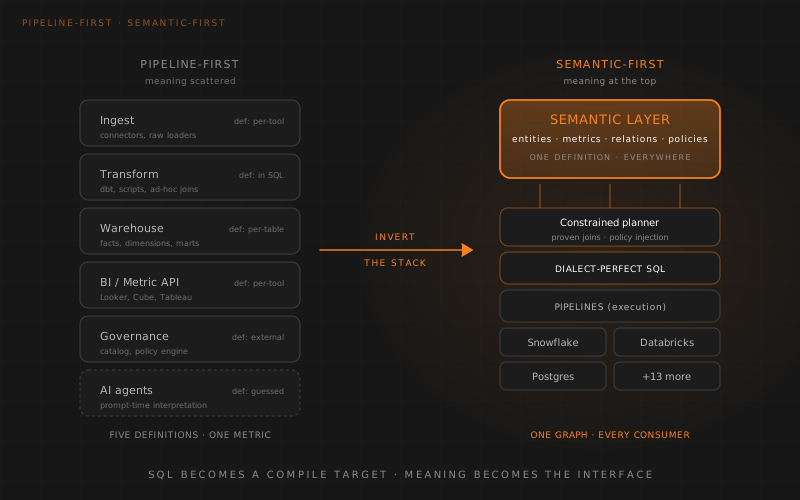
The pipeline-first stack we all built is everywhere because each layer solved a real problem. Ingestion tools handled volume. Transformation frameworks handled logic. Warehouses handled storage and scale. Metric APIs handled standardization. Catalogs handled discovery. Governance engines handled access. Each one shipped. Each one helped.
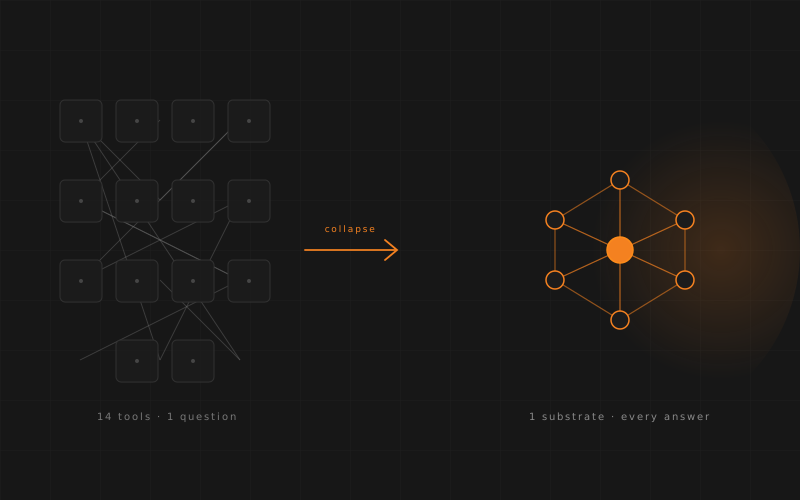
What none of them did was unify meaning. The same metric gets defined three or four different ways across the stack: once in the dbt model that builds the table, once in the LookML that exposes the column, once in the Cube definition the agent calls, and a fourth time, implicitly, in whatever a support team's spreadsheet says. Some are roughly equal. None is authoritative. None is enforced. The system functions; the meaning does not.
The reason is architectural. The warehouse is the source of truth for data, never for meaning. Snowflake, BigQuery, and Databricks store rows, enforce ACID, and scale compute brilliantly. They do not store what "revenue" means, who is allowed to see it, or what caused it. Those are meaning concerns, and for twenty years they lived in human memory, in tribal knowledge, and in the head of whichever analyst joined in week three and slowly absorbed what "active customer" means in this business.
The new stack puts meaning first
Semantic-first inverts the order. Raw data still lands in a lake or warehouse. But before any consumer (a dashboard, a notebook, an app, an agent) touches it, the data resolves through a semantic layer: typed entities, governed metrics, proven relationships, and policies. A metric like "active customer" is defined once, in a versioned, typed semantic graph, with its formula, its scope, its policies, and its provenance. The dashboard resolves the concept and renders. The agent asks the planner to compile a query for that concept under the requesting identity. The data engineer authors it once and the system propagates.
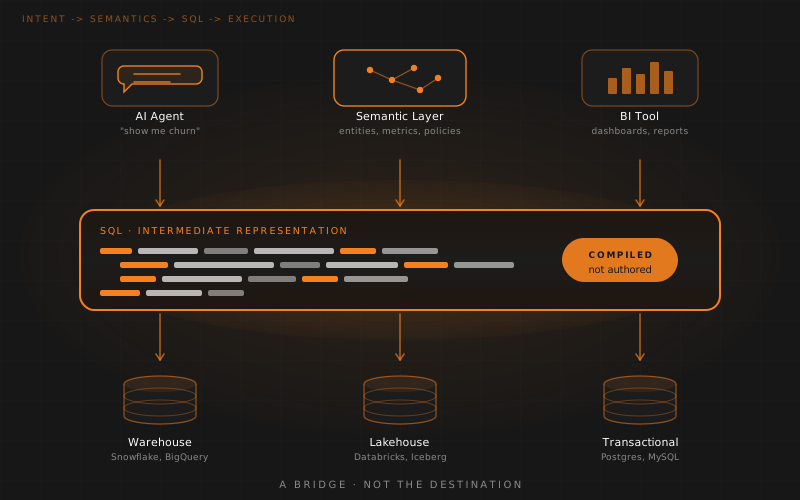
SQL does not die in this world. It moves down the stack. The semantic layer becomes the authoring surface; SQL becomes the intermediate representation the platform emits. The same intent against Snowflake, Databricks, or Postgres compiles to a dialect-perfect output with the same logical guarantees: same joins (proven against the graph's typed relationships), same predicates (RBAC, ABAC, row-level), same provenance. SQL has just been carrying too much weight. It has been the source of business logic, the storage abstraction, the governance hook, the join recipe, and the metric definition all at once. Semantic-first gives SQL its right job back.
Pipelines change too. They become execution plans the platform derives from the graph: what to materialize, when, and where. The data engineer's job shifts from writing the pipeline to declaring the meaning the pipeline serves. The work does not disappear. It gets harder and more valuable, because it demands precision about meaning rather than just rows. The data engineer becomes a knowledge architect.
Why the shift is happening now: the consumer changed
Semantic-first is not winning because it is elegant. It is winning because the workload changed. Four forces are converging.
1. Agents need reliable meaning, and the benchmarks prove it
A human analyst brings a correction layer; an LLM does not. Every assumption has to be explicit somewhere outside the prompt, or the model invents one and runs with it. The numbers are stark. On Spider 2.0, the enterprise-grade text-to-SQL benchmark (Lei et al., ICLR 2025), the project team reports that "for widely-used models like GPT-4o, the success rate is only 10.1% on Spider 2.0 tasks, compared to 86.6% on Spider 1.0." Even o1-preview in an agent framework "successfully solves only 21.3% of the tasks, compared with 91.2% on Spider 1.0." That is not a typo: the same class of model that looks brilliant on toy schemas collapses on real enterprise databases with 800-plus columns and dialect heterogeneity.
Now ground that same model in a semantic layer. dbt Labs reran its 2023 benchmark in 2026 and found that "for queries covered by a well-modeled Semantic Layer, accuracy approaches or hits 100%," because "the Semantic Layer's deterministic query generation means the LLM can't produce subtly wrong results." The accuracy gap is not a model problem. It is an architecture problem. Agents cannot scale without semantic grounding.
Gartner has put a number on the consequence. In its February 2025 research, "Gartner predicts that through 2026, organizations will abandon 60% of AI projects unsupported by AI-ready data," a finding it ties to a Q3 2024 survey in which "63% of organizations either do not have or are unsure if they have the right data management practices for AI."
2. Governance cannot be bolted on
If governance is a separate enforcement layer (row-level security in the warehouse, masking in a second tool, audit logs in a third), it drifts. The cost shows up on every team's calendar. In McKinsey's 2023 Master Data Management Survey, "82 percent of respondents spent one or more days per week resolving master data quality issues, and 66 percent used manual review." McKinsey's QuantumBlack practice goes further: "30% of total enterprise time is spent on non-value-add tasks as a result of poor data quality and availability."
Semantic governance fixes this by construction. When policy is compiled into definitions (RBAC, ABAC, row- and column-level predicates injected before SQL is ever emitted), governance is structural, not advisory. Filtered-out rows are never read. Unauthorized queries fail compilation rather than leaking in production. Governance becomes a one-time cost per concept instead of a recurring tax per tool.
3. Multi-warehouse and cloud-agnostic are now standard
A single meaning layer over Snowflake plus Databricks plus BigQuery plus Postgres eliminates the need to redefine everything per engine. This was a luxury in 2015. It is a requirement in 2026. Many enterprises run finance on one platform and data science on another, and a warehouse-native semantic layer governs only its own platform, leaving you with two layers that define "revenue" differently, which is the exact problem the semantic layer was supposed to solve.
4. Data mesh requires semantic federation
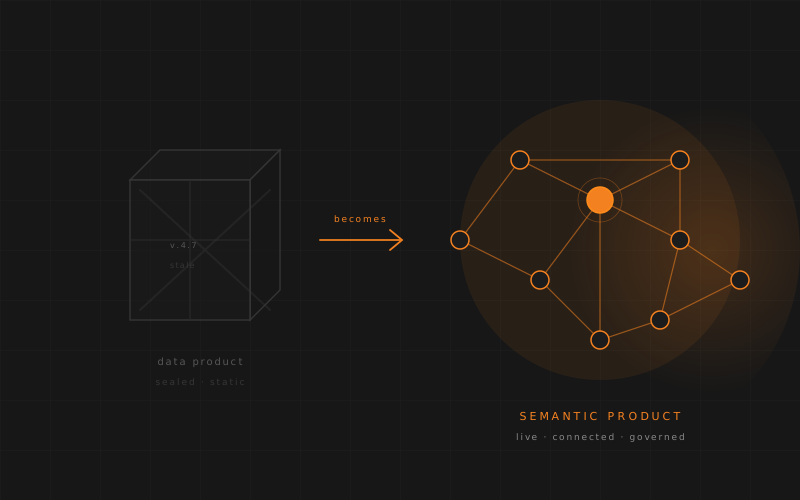
Data mesh (introduced by Zhamak Dehghani in 2019) rests on four principles, the fourth being federated computational governance: domains own their data products but adhere to a set of global rules. Without a federated semantic layer, every domain's definitions are siloed, and "customer" means one thing in sales and another in finance. A federated semantic layer defines shared entities once and resolves policy per domain and context. That is consistency plus autonomy, which is exactly what the mesh promises and rarely delivers without a meaning substrate. By 2026 the fabric-versus-mesh debate has effectively resolved into "use both," with the semantic layer as the shared brain across them.
The technical properties that make it work
Four properties define a semantic-first execution layer, and each technical property maps directly to a business requirement.
Decoupling meaning from storage. Meaning (entities, metrics, relationships, policies) is versioned and engine-agnostic. Storage is a swappable substrate. The business requirement this produces: portability and zero lock-in. You can change warehouses without rewriting your business logic.
Determinism. Compile intent through the semantic model once, deterministically, producing the same SQL every time. The business requirement this produces: auditability and trust. The same question in the same scope returns the same answer, and every answer carries a compile trace (graph version, definitions used, executed SQL, identity context). Contrast this with LLM-per-query, which is probabilistic by nature.
Portability. An agent, BI tool, or notebook asks the semantic layer for data and gets the same answer from any warehouse, over MCP or JDBC, without rewriting anything. The business requirement this produces: speed to production.
Autonomous maintenance. The semantic graph can be built and maintained by agents that watch sources, flag drift, and propose updates for human approval. The business requirement this produces: the graph compounds while the maintenance burden does not. Manual YAML authoring is the bottleneck that makes traditional semantic layers go stale within weeks.
The business case: speed, cost, and compliance
Speed to production
In a semantic-first stack, a new use case (an agent, a dashboard, an analytical question) plugs into MCP or JDBC and gets governed, deterministic data immediately. Time-to-insight is measured in days. In the traditional stack, the same use case means modeling, schema design, ETL, governance setup, and testing, measured in months.
The evidence is increasingly concrete. Sweetgreen's analytics lead reports that, "by leveraging AI and the dbt Semantic Layer, self-service analysis has become a 30-minute job, compared to the old process of reaching out to the data team and waiting two weeks." Zendesk's director of data engineering reports that "what used to take months now happens in weeks."
The cost of deferring semantics
Poor data quality costs organizations at least $12.9 million a year on average, per Gartner research. A useful illustrative figure is the "Reconciliation Tax" coined by Strategy (formerly MicroStrategy): a ten-person data team spending 35% of its time on metric reconciliation burns roughly $525,000 a year just to agree on what happened yesterday.
TCO: semantic-first versus the multi-tool stack
| Dimension | Traditional multi-tool stack | Semantic-first platform |
|---|---|---|
| Components | ETL tool + warehouse + BI tool + catalog + RLS/masking/audit | Warehouse + semantic execution layer |
| Where meaning lives | Re-encoded in each tool | Once, in a versioned graph |
| New use case | Months (model, ETL, govern, test) | Days (plug into MCP/JDBC) |
| Governance | Bolted on per tool, drifts | Compiled into definitions, by construction |
| Upfront cost | Lower (incremental) | Higher (modeling the graph) |
| Ongoing cost | Higher (maintenance, reconciliation) | Lower (graph compounds, autonomous upkeep) |
| Multi-warehouse | Redefine per engine | One graph, dialect-perfect SQL per engine |
Semantic-first costs more upfront because you model meaning deliberately. It costs less over time because that meaning is reused, governed once, and maintained autonomously. Gartner's spending data points the same way: in an April 2026 study of D&A and AI leaders, "organizations that report successful AI initiatives invest up to four times more (as a percentage of revenue) in foundational areas, such as data quality, governance, AI-ready people and change management, compared to those that experience poor outcomes."
Compliance velocity
When governance is compiled into definitions, compliance checks become queries, not manual reviews. Every query produces a point-in-time-reproducible audit trail. This matters as regulation expands: Gartner projects AI governance platform spending will reach $492 million in 2026 and surpass $1 billion by 2030.
The competitive landscape: warehouse-native versus independent
The market has split into two camps, and the split is the whole story.
Warehouse-native layers (Snowflake Semantic Views, GA in August 2025 with standard SQL querying GA in March 2026; Databricks Metric Views; BigQuery) are powerful inside their own walls. They offer native performance, zero extra infrastructure, and tight security integration. But they stop at the warehouse boundary. A warehouse-native layer can only know what has been ingested into that warehouse, and it cannot govern a metric that lives half in Snowflake and half in Postgres. Tellingly, Snowflake itself launched the Open Semantic Interchange (OSI) initiative in 2025, an attempt to make semantic models portable across platforms. You do not launch an interchange standard if your in-house layer is sufficient on its own.
Independent, engine-agnostic platforms sit above the warehouse: the dbt Semantic Layer / MetricFlow (GA October 2024; dbt Labs and Fivetran completed their merger on 1 June 2026 at roughly $600M combined ARR), Cube, AtScale, Timbr, and Colrows. These solve the multi-warehouse problem because meaning is decoupled from storage. The market is consolidating here, and Gartner's 2026 prediction is unambiguous: by 2030, universal semantic layers will be treated as "critical infrastructure, alongside data platforms and cybersecurity."
Where Colrows fits, honestly
Colrows is a semantic execution layer. It is not a BI tool, not a warehouse, and not an ETL vendor. It sits above the warehouse and below the prompt. It autonomously builds and maintains a typed, versioned semantic graph across your data estate, then compiles every agent or application intent into governed, deterministic, dialect-perfect SQL across 16-plus engines (Snowflake, Databricks, BigQuery, Redshift, Postgres, MySQL, ClickHouse, Trino, Oracle, SQL Server, and more).
Three properties define the approach. Compilation is deterministic: the same intent in the same scope produces the same SQL and the same answer, with a full audit trail. Governance is compile-time: RBAC, ABAC, and row/column predicates shape the allowed subgraph before any SQL touches the warehouse, so unauthorized plans are never generated. Maintenance is autonomous: drift detection, conflict detection, and schema evolution run continuously, proposing updates for human approval rather than breaking silently.
Where is Colrows not the answer? If your goal is mature human-facing BI (rich dashboards, pixel-perfect exploration, an analyst-owned modeling language), a dedicated BI tool like Looker remains a better fit, and the two coexist cleanly: keep the BI tool for analysts, add Colrows as the agent-execution surface. Colrows includes dashboards, but visualization is not its center of gravity. Its center of gravity is compiling agent intent into governed SQL. As the original framing puts it, Colrows is one implementation; the architectural pattern will outlast any single vendor.
Semantic-first data engineering wins because it puts meaning where agents can reason over it deterministically, rather than bolting more pipeline layers onto a stack that leaves definitions implicit. Fix the Context, Not the Model.
The question facing data leaders
The question is no longer whether semantic-first replaces pipeline-first. The consumer (the AI agent) is forcing it, and the benchmarks, the governance math, and the analyst consensus all point the same way. The real question is whether you do it deliberately, with one graph as the source of truth, or whether you keep adding layers to the pipeline-first stack until the meaning gap surfaces as a regulator's finding or a hallucinated number in a board deck. Semantic-first is the future of data engineering not because it is fashionable, but because meaning, finally, has to come first.
Frequently asked questions
What is semantic-first data engineering?
Inverting the stack so meaning is defined first in a versioned semantic layer, with SQL as the compile target and pipelines as execution plans.
How is semantic-first different from the traditional ETL/warehouse stack?
Traditional stacks load and transform data, then bolt meaning on per tool; semantic-first resolves meaning before any consumer touches the data.
Why do AI agents need a semantic layer?
Without grounding, GPT-4o solves only ~10% of enterprise text-to-SQL tasks (Spider 2.0); grounded in a well-modeled semantic layer, accuracy approaches 100%.
Is a warehouse enough on its own?
No. Warehouses store state, not meaning; they do not encode what a metric means, who can see it, or what caused it.
What is the difference between warehouse-native and independent semantic layers?
Warehouse-native layers (Snowflake Semantic Views, Databricks Metric Views) work inside one platform; independent layers (Colrows, dbt, Cube, AtScale) span engines.
How does semantic-first relate to data mesh?
It supplies the federated meaning that data mesh's fourth principle (federated computational governance) requires.
What is determinism in a semantic layer and why does it matter?
Compiling intent once into the same SQL every time makes results auditable and trustworthy, unlike probabilistic LLM-per-query.
Does semantic-first replace SQL?
No. SQL moves down the stack to become the compile target; the semantic graph becomes the authoring interface.
What does Colrows do?
It is a semantic execution layer that autonomously builds a semantic graph and compiles agent intent into governed, deterministic SQL across 16+ engines.