| Capability | The "Laggard" Enterprise | The "Future-Ready" Enterprise |
|---|---|---|
| Logic Foundation | Probabilistic/Heuristic | Deterministic/Compiled |
| Data Context | Disconnected/Siloed | Unified/Semantic Graph |
| AI Reliability | Hallucination-prone | Governed/Auditable |
| Data Governance | Manual/Runtime | Compile-time/Automated |
| Operational Scale | Linear (Human-bottlenecked) | Exponential (Autonomous-driven) |
The numbers are stark. Organizations lose an average of $12.9 million annually to poor data quality, according to Gartner. More troubling: 84% of enterprise data teams still encounter conflicting versions of the same metric; 42% of data leaders cite metric inconsistency as their top barrier to value; and 61% blame overly complex infrastructure as the greatest obstacle to AI implementation success. Yet on the other side of the divide, a 2026 Gartner analysis found that organizations investing in semantic-first data infrastructure lift their agentic AI accuracy by up to 80% and reduce costs by up to 60% with payback in under two months.
This is not a technology gap. It is an economic gap. And it is widening fast.
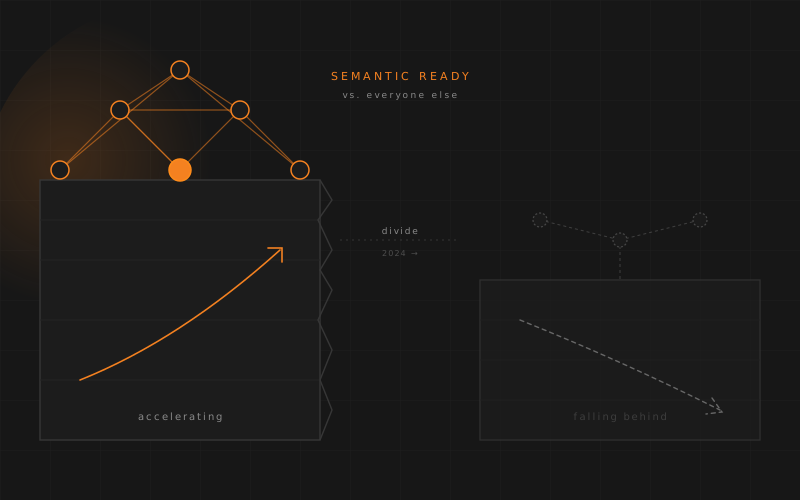
What exactly is the semantic divide?
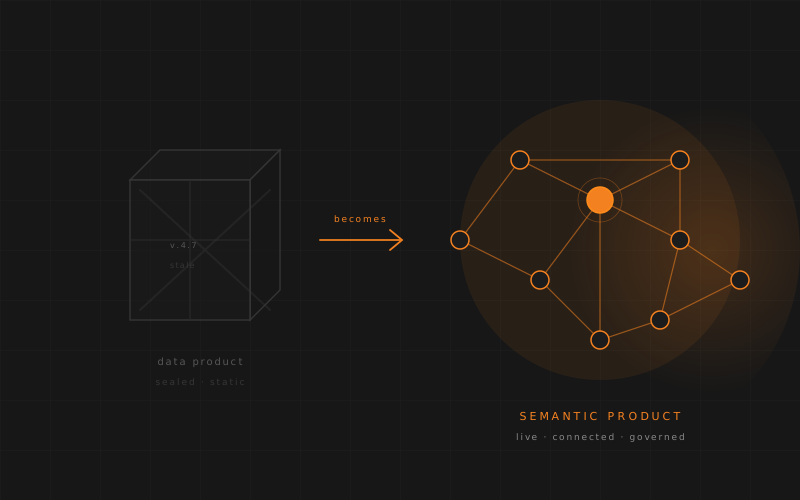
It is the structural separation between two operating models. On one side: enterprises where meaning (definitions, relationships, policies, context) is scattered across human memory, spreadsheets, Slack messages, and documentation that drifts over time. Teams redefine the same metric differently. Analysts spend their time rebuilding logic rather than discovering insight. Dashboards conflict. AI projects collapse under semantic ambiguity. This is the world of semantic debt: expensive, slow, and error-prone.
On the other side: enterprises where meaning is codified in a machine-interpretable semantic graph, continuously learned from data and behavior, automatically maintained by agents, and consistently applied across analytics and AI. Teams build on shared definitions. Analysts add value instead of maintaining definitions. Metrics reconcile. AI reasons grounded in enterprise logic. This is semantic leverage: the compounding advantage of meaning at scale.
The difference is not subtle. It is structural. And it grows exponentially.
Why the divide is widening now
Three forces have turned semantics from a "nice-to-have" feature into a board-level infrastructure decision. First, AI requires grounding. Language models achieve 86.6% accuracy on academic SQL benchmarks (Spider 1.0) but collapse to 10.1% on real enterprise schemas (Spider 2.0). The gap is not syntax. It is semantics. Without a semantic layer that encodes relationships, context, and governance, LLMs hallucinate joins, misinterpret metrics, and return confident, plausible-wrong answers at scale. A knowledge machine that grounds reasoning in typed semantic graphs recovers accuracy dramatically: GPT-4 goes from 16.7% to 54.2% on enterprise SQL when querying through a semantic graph (data.world/Sequeda study); dbt's own benchmark shows raw text-to-SQL at 84–90% vs 98–100% through the Semantic Layer.
Second, enterprises have outgrown manual semantics. No team can maintain thousands of definitions, relationships, events, and policies by hand. As Gartner noted in its March 2026 "Top Predictions for Data and Analytics," universal semantic layers are now a "must-do for D&A leaders" and will be treated as "critical infrastructure, alongside data platforms and cybersecurity" by 2030.
Third, regulators are demanding it. Compliance regimes from BCBS 239/RDARR (banking risk data) to the EU AI Act to GDPR enforcement are making semantic transparency and auditable lineage mandatory, not optional. And the penalties are board-level: GDPR fines reached €1.2 billion in 2024; PIPL penalties in China reach 50M RMB or 5% of turnover.
The economics of semantic debt
Semantic debt accrues in three ways. First, the reconciliation tax (the cost of reconciling conflicting numbers when different teams define the same metric differently). Strategy (MicroStrategy) quantified this as a "reconciliation tax" running near half a million dollars annually for some teams. Second, the time tax: nearly two in five (38.7%) data professionals spend more than half their work week on non-analysis tasks (collecting, integrating, and preparing data). When 43.8% of managers report their team spends 51%+ of the week on integration and quality checks, that is a direct cost of semantic fragmentation. Third, the project-failure tax: 88% of data integration projects face budget overruns or failure due to data quality; nearly 90% of AI/analytics pilots do not move to production.
Against this, the ROI of semantic clarity is measurable and large. A 2026 UserEvidence study commissioned by Strategy found that their Mosaic semantic layer delivered an average $3.4 million modeled net gain per organization (a 551% ROI with a two-month payback). End users reported 46% time savings; analysts 38%; BI developers 31%. Metric-consistency and report-accuracy confidence jumped 80%, and 67% reported reduced IT dependency.
For enterprises with rapid decision cycles, the value is even sharper. An organization that cuts time-to-insight by 80% (achievable with autonomous semantic systems that eliminate definition rebuild) and increases decision accuracy by 60% (documented in benchmark comparisons) is making compounding gains on competitors who are still manually reconciling data.
Regulatory forcing functions by vertical
Banking & Insurance (BFSI). The ECB's Risk Data Aggregation and Risk Reporting (RDARR) framework, published May 2024 and made a top supervisory priority for 2025–2027, explicitly demands accurate, complete, timely, and adaptable risk definitions with clear lineage and consistent methodology across the enterprise. Only 2 of ~31 G-SIBs were fully RDARR-compliant as of November 2023; most face material remediation costs. A semantic layer maps directly to RDARR principles 3–6: it codifies definitions, proves lineage, enforces timeliness, and enables adaptability at scale. For BFSI buyers, semantic governance is now a SREP (Supervisory Review and Evaluation Process) requirement, not an efficiency project.
Healthcare & Life Sciences. FDA 21 CFR Part 11 (electronic records/signatures) and EU GCP guidance on data integrity require auditable, traced definitions and decision logic. Drift detection and policy versioning (core features of autonomous semantic systems) map directly to these requirements and compress audit cycle time.
Public Companies (SEC/GDPR). SEC cybersecurity disclosure rules (Form 8-K Item 1.05, Reg S-K Item 106) and GDPR enforcement (€5.88B cumulative fines since 2018, with 2024 showing renewed regulator focus on personal liability of management) make governance and lineage visibility board obligations. Enterprises that cannot prove their metrics, definitions, and policies are under control face both regulatory fines and personal liability for executives. Semantic systems that generate point-in-time reproducible audit trails address this directly.
Global Enterprises (PIPL, DSL). China's PIPL, Data Security Law, and new Network Data Security Management Regulations require data classification, three-year processing records, and cross-border flow controls. Enterprises that can govern semantic meaning and apply policies by jurisdiction at compile time (rather than after query execution) gain a structural advantage in APAC markets where data residency and sovereignty are increasingly enforced.
The deterministic accuracy imperative
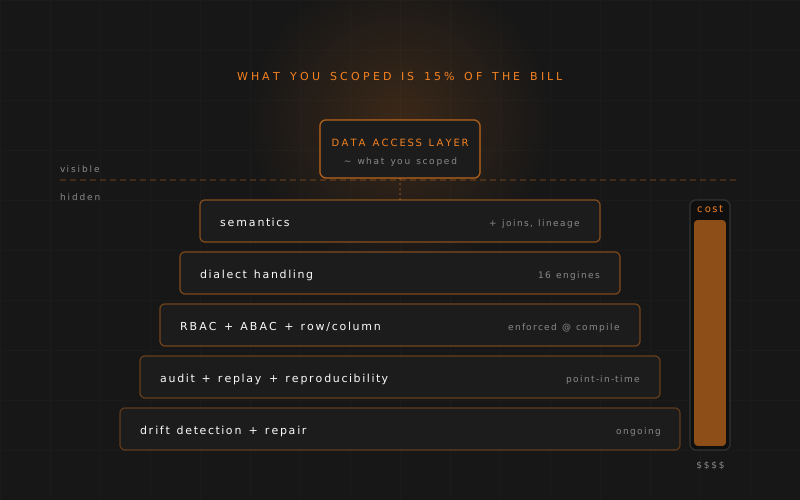
The defining difference between semantic layers and text-to-SQL approaches is determinism versus probability. A probabilistic model (GPT-4 writing SQL) might generate different queries for the same question on different runs; might hallucinate joins; might misinterpret a metric; and returns no guarantee of correctness. A deterministic semantic layer answers the same intent the same way every time because it resolves terms to grounded concepts, proves join paths via constrained graph search, injects governance at compile time, and fails explicitly rather than returning a plausible-wrong answer.
The benchmarks make this clear. dbt's April 2026 benchmark on 11 insurance-domain questions (20 runs each) found raw text-to-SQL at 84–90% accuracy vs 98–100% through the Semantic Layer. Snowflake's internal testing on 150 BI questions showed GPT-4o single-shot at ~51% accuracy vs 90%+ for Cortex Analyst (same model + semantic model). Spider 2.0, the academic benchmark on real enterprise schemas, shows o1-preview agent-frameworks at 21.3% vs 91.2% on the older Spider 1.0; GPT-4o at 10.1% on Spider 2.0 vs 86.6% on Spider 1.0. MIT CSAIL's BEAVER study (2026) found even GPT-5.2 agentic frameworks at only 10.8% on real enterprise warehouse logs.
The pattern is unmistakable: scale reduces accuracy unless you add structure. The structure is semantics. Enterprises that build this structure first move faster and make better decisions; enterprises that try to bolt it on later face rework, retraining, and re-validation.
Core Principle: Fix the Context, Not the Model. A well-governed semantic layer that understands business context creates more reliable AI-driven analytics than fine-tuning the model itself. Stop guessing at intent. Start architecting for precision. A deterministic semantic compiler is the foundation.
The competitive landscape and industry consensus
The semantic-layer category has matured visibly in 2025–2026. dbt Semantic Layer (MetricFlow), launched with code-first YAML metric definitions version-controlled alongside transformations, became the natural home for dbt-ecosystem customers. The October 2025 Fivetran/dbt Labs merger (all-stock, ~$600M combined ARR) signals consolidation around a "trusted data foundation for AI" positioning. dbt open-sourced MetricFlow under Apache 2.0 at Coalesce. Cube offers an open-source, define-and-serve model with pre-aggregation and multi-API serving (REST/GraphQL/SQL); Brex chose Cube over dbt and Looker because of its embedded/AI serving capabilities. AtScale operates as a virtual OLAP cube offering autonomous aggregates and sub-second query performance on billions of rows; it is a Leader in GigaOm's 2025 Radar but remains cube-output-focused. Looker now embraces "Agentic BI" with Gemini integration and a Knowledge Catalog "semantic graph," but remains BI-scoped. ThoughtSpot positions as search-driven agentic analytics, optimized for user-facing NL search rather than compile-driven, governed agent execution.
The industry itself acknowledged that semantic definitions must be portable and vendor-neutral: the Open Semantic Interchange (OSI), launched September 23, 2025 by Snowflake, Salesforce, dbt Labs, BlackRock, and others (with Google and AWS joining in November), published v1.0 in January 2026. This is proof the category has matured from vendor lock-in to standardization. Yet a standard for definition format (YAML) does not solve the verb: deterministic, governed compilation of agent intent across an entire data estate.
Where Colrows fits in this shift
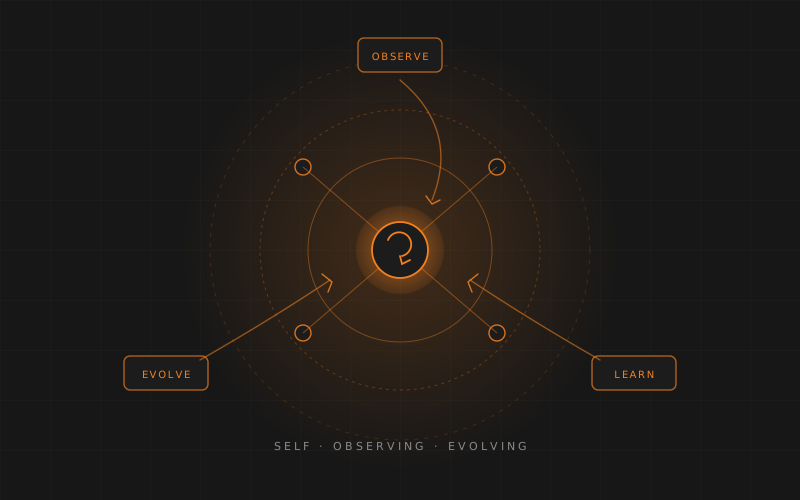
Colrows builds semantic execution, not just semantic storage. The goal is straightforward: autonomously build a typed, versioned semantic graph from across the data estate, then compile every agent query through it into governed, deterministic, dialect-perfect SQL with proven joins, compile-time policy injection, and reproducible audit trails. That is complementary to (not a replacement for) dbt, Cube, Looker, or AtScale at the data layer; many enterprises run Colrows as the agent-execution layer while keeping their existing BI platform for human dashboards. The divergence shows at the application layer: where competitors optimize for human curation or metrics-as-API, Colrows optimizes for machine reasoning with board-level auditability.
For regulated buyers (BFSI, pharma, healthcare), the deterministic compile-then-execute pipeline maps directly to audit defensibility and compliance requirements that no after-the-fact governance or probabilistic generation can satisfy. For enterprises with rapid decision cycles and agent-driven analytics, the autonomous graph-build and drift detection eliminate manual definition management and reduce time-to-new-metric from weeks to days.
The strategic case
Strip away the architecture. The divide comes down to this: one set of enterprises will wake up in 2027 and realize their AI initiatives are bogged down in semantic ambiguity, metric conflicts, and governance chaos. Unable to move fast. Unable to pass an audit. Unable to trust their answers. The other set will have moved the semantic problem upstream, codified meaning, automated its maintenance, grounded their AI in real enterprise logic, and spent 2027 building on that foundation instead of reworking it.
Gartner is explicit: by 2030, universal semantic layers will be treated as critical infrastructure. By 2027, the 80% accuracy lift and 60% cost reduction are real for early movers. The difference in competitive velocity compounds month over month. The time to cross the divide is not later. It is now. The question is whether you move first or move late. But you will move.
Frequently asked questions
What is the semantic divide?
It is the structural gap between enterprises where meaning is scattered across human memory, spreadsheets, and drifting documentation (semantic debt) and enterprises where meaning is codified in a machine-interpretable semantic graph, automatically maintained and consistently applied across analytics and AI (semantic leverage). The gap is structural and grows exponentially.
What is semantic debt and what does it cost?
Semantic debt is the accumulated cost of scattered, conflicting meaning. Organizations lose an average of $12.9 million annually to poor data quality per Gartner, 84% of enterprise data teams encounter conflicting versions of the same metric, and Strategy quantified a reconciliation tax running near half a million dollars annually for some teams.
What is the ROI of a governed semantic layer?
A 2026 UserEvidence study commissioned by Strategy found an average $3.4 million modeled net gain per organization, a 551% ROI with a two-month payback. End users reported 46% time savings, metric-consistency confidence jumped 80%, and 67% reported reduced IT dependency. A 2026 Gartner analysis adds up to 80% agentic AI accuracy lift and up to 60% cost reduction for semantic-first infrastructure.
Why do LLMs fail on enterprise SQL without a semantic layer?
The gap is semantics, not syntax. GPT-4o scores 86.6% on the academic Spider 1.0 benchmark but 10.1% on Spider 2.0's real enterprise schemas, and MIT CSAIL's BEAVER study found even GPT-5.2 agentic frameworks at only 10.8% on real warehouse logs. Grounding recovers accuracy: dbt's benchmark shows 98-100% through the Semantic Layer versus 84-90% raw.
Are semantic layers becoming mandatory for compliance?
In regulated verticals, effectively yes. BCBS 239/RDARR is a top ECB supervisory priority for 2025-2027 and only 2 of roughly 31 G-SIBs were fully compliant as of November 2023. GDPR fines reached €1.2 billion in 2024, and China's PIPL penalties reach 50M RMB or 5% of turnover. These regimes demand auditable lineage and semantic transparency.
How is Colrows different from dbt, Cube, Looker, or AtScale?
Colrows builds semantic execution, not just semantic storage. It autonomously builds a typed, versioned semantic graph and compiles every agent query into governed, deterministic, dialect-perfect SQL with proven joins, compile-time policy injection, and reproducible audit trails. It is complementary at the data layer; many enterprises run Colrows as the agent-execution layer while keeping their existing BI platform.