For most of the last decade, the semantic layer was quiet plumbing. It lived inside a BI tool, a handful of analytics engineers maintained it, and the rest of the business never thought about it. That era is over.
In its Top Data and Analytics Predictions for 2026, Gartner put the shift plainly: by 2030 it expects universal semantic layers to be treated as critical infrastructure, alongside data platforms and cybersecurity in the enterprise budget. The reason is not nostalgia for tidy data models. It is that every AI agent, copilot, and conversational analytics surface you are about to deploy needs the one thing your warehouse cannot give it on its own: business context.
This guide is for the people who now have to choose that infrastructure: chief data officers, heads of data platform, and the VPs of AI and analytics who will be accountable when an agent confidently reports the wrong revenue figure to the board. It does not rank vendors. It gives you a framework, built from how Gartner, Forrester, GigaOm, Dresner, and working practitioners actually score these systems, so you can run your own evaluation and defend the result.
Why your AI keeps giving confident, wrong answers
The failure pattern of 2025 was remarkably consistent. Teams connected a large language model to the warehouse, let it write SQL from a natural language question, and watched it return answers that looked authoritative and were quietly wrong.
The numbers behind that pattern are sobering. Gartner expects organizations to abandon 60 percent of AI projects through 2026 because the underlying data is not AI-ready, and predicts at least 30 percent of generative AI projects will be dropped after the proof-of-concept stage. MIT’s 2025 State of AI in Business study, run by its Project NANDA group, found that 95 percent of enterprise generative AI deployments produced no measurable return.
The common thread is not model quality. Frontier models are extraordinary. The problem is that they are guessing at what your business means. Terms like “revenue,” “active customer,” “churn,” and “recovery yield” are not in the schema. They live in tribal knowledge, in a hundred slightly different SQL snippets, and in the head of the one analyst who knows which join is safe.
A semantic layer fixes this by encoding that meaning once, in a governed place, and serving it to every human and machine that asks. The evidence that this works is now quantitative rather than anecdotal. In a 2026 benchmark from dbt Labs, a leading model answering directly against the warehouse scored 84.1 percent accuracy. Routed through a governed semantic layer, the same model scored 100 percent. A peer-reviewed paper on arXiv in April 2026 found that adding a small semantic context document lifted three frontier models by 17 to 23 percentage points each, and made the choice of model almost irrelevant.
The model was never the bottleneck. The missing business context was. Fix the context, not the model.
That is the strategic point most buyers miss. You do not get trustworthy AI by buying a bigger model. You get it by giving every model the same governed definition of your business. Which is precisely why the semantic layer you choose in 2026 matters more than the model you pair it with.
What the analysts actually measure
Before you score anything, it helps to know how the people who do this for a living frame the problem. Four reference points matter.
Gartner: the metrics layer is now a named capability
Gartner lists a metrics layer as one of the twelve Critical Capabilities in its Magic Quadrant for Analytics and Business Intelligence Platforms. It describes a virtualized layer where business metrics are defined as code, governed centrally, and served to downstream analytics, data science, and applications. That single definition already contains three buying criteria: definition as code, central governance, and broad serving.
Forrester: guardrails and access are AI criteria
In its 2025 Wave for Business Intelligence Platforms, Forrester added eight dedicated generative AI criteria. Two are squarely about the semantic layer: how the platform’s AI gets access to enterprise data and context, and what guardrails ensure users only see results they are allowed to see. Forrester’s widely cited research also explains why a layer bound to a single tool is a liability. Most enterprises run several BI tools at once, so meaning defined inside one of them does not travel to the others.
GigaOm and Dresner: modeling, openness, and AI enablement
GigaOm promoted semantic layers from an emerging technology to a mission-critical one in 2025, and its evaluation criteria read like a modern requirements list: advanced modeling for many-to-many and multi-hop relationships, open APIs, caching and pre-aggregation, DataOps integration, governance, and a specific line item for generative AI enablement including support for the Model Context Protocol. Dresner’s first dedicated semantic layer study, also in 2025, scored vendors on data integration and access control, modeling and transformation, and performance and optimization.
Put those together and a coherent picture emerges. Here is the framework we recommend taking into every evaluation this year.
The 12-point semantic layer evaluation framework
Score each candidate from 0 to 3 on every criterion. The first six are table stakes that analysts have measured for years. The last six are where 2026 buyers separate real AI infrastructure from a model with a nice demo.
Table stakes - what analysts have measured for years
- Governed single source of truth. Does one governed definition of each metric stay identical across every consumer, from a dashboard to a notebook to an agent? Or does each tool re-derive it?
- Metric expressiveness. Can it express nested aggregations, ratios across different grains, running totals, and period-over-period without spawning a sprawl of derived tables?
- Join-path correctness and grain validation. Does it protect against fan-out and chasm traps and handle multi-hop joins, or will it silently double-count when two facts share a dimension?
- Unified permissions and persona scope. Is the same row-level policy enforced for a BI user, a notebook user, and an AI agent, with no per-tool duplication and one audit trail?
- Lifecycle and DataOps. Git-friendly definitions, environments, testing, CI/CD, and lineage. Can you promote a change safely and see what it touched?
- Security and compliance posture. SOC 2 Type II, ISO 27001, and a complete audit trail, including the AI requests that were denied, not only the ones that were served.
The 2026 differentiators - where real AI infrastructure separates from a nice demo
- Deterministic query compilation. Does the layer compile a question into governed SQL, or does it hand context to a model and hope the generated SQL is right this time?
- Agent-native serving (MCP). Is there an authenticated, permission-aware, auditable endpoint built for agents, rather than a raw database connection wrapped in a model?
- Autonomy and self-maintenance. Does it self-build and self-maintain context from your data, query logs, and usage, and flag semantic drift? Or must humans hand-author every metric and join?
- Point-in-time reproducibility. Ask for last quarter’s number today, and again next year, and get the same answer. Can it reproduce any metric exactly as of any past date?
- Open interoperability. Does it align with open standards such as the Open Semantic Interchange so the context you build is portable, rather than a moat the vendor owns?
- Performance and cost at agent scale. Caching and pre-aggregation that keep complex queries sub-second and costs predictable when agents multiply your query volume overnight.
The four questions that separate a 2026 buyer from a 2021 buyer
Criteria one through six are well understood. The four shifts below are where most incumbents quietly fail, and where the demo script rarely goes unless you push.
1. Does it compile, or does it just suggest?
Many tools now market “AI on your semantic layer.” Look closely at what the model is allowed to do. If the layer hands the model some context and the model still writes the SQL, you have probabilistic output: different runs can produce different, subtly wrong answers, and nothing sits between the model and execution. A deterministic layer compiles the question into governed SQL built from definitions you control. The model selects from a menu of approved metrics and joins rather than improvising in the pantry. That is the difference between context and a contract, and it is what moved the dbt benchmark from 84 percent to 100 percent. It is also the exact line that separates a runtime semantic layer from a semantic execution layer - worth reading in full before you sign anything.
2. Was it built by hand, or does it build itself?
Almost every semantic layer on the market is hand-authored. Engineers write the models in a proprietary language, and then they maintain them forever. Practitioners are blunt about the cost: definitions drift out of date through a process the field literally calls semantic drift, and analysts still lose most of their week to data preparation and definition wrangling. In a world where agents fire thousands of questions a day, no team can hand-maintain context fast enough to keep up. The 2026 question is whether the layer can crawl your data, query history, and usage to build and maintain context on its own, and tell you when something has drifted.
3. Can it answer about the past, correctly?
Most semantic layers answer about now. Ask them what last quarter’s pipeline looked like as it stood at quarter end, and they recompute it against today’s data and definitions, which is not the same number. Point-in-time reproducibility, long treated as a feature-store concern, is becoming a semantic-layer requirement. If a regulator, an auditor, or your own board asks you to reproduce a number exactly as it was reported, the layer should be able to do it without a forensic project.
4. Was it designed for tools, or for agents?
Two standards are reshaping this space. The Model Context Protocol, released by Anthropic in late 2024 and donated to the Linux Foundation in December 2025, has become the common way agents connect to systems, with tens of millions of monthly SDK downloads. The Open Semantic Interchange, launched in September 2025 and finalized as a version 1.0 specification in January 2026, gives semantic definitions a vendor-neutral format. The practitioner consensus is consistent: MCP is the plumbing, and meaning lives in the semantic layer. Exposing a raw database over MCP simply lets an agent hallucinate against an unstructured schema. The layer you buy should serve agents over MCP with authentication, permissions, and audit enforced at the protocol level, and it should speak the open format so your context is portable. Worth noting honestly: the current OSI 1.0 core does not yet codify access policy as a first-class object, so governance remains a place where products genuinely differ.
How the structural categories stack up
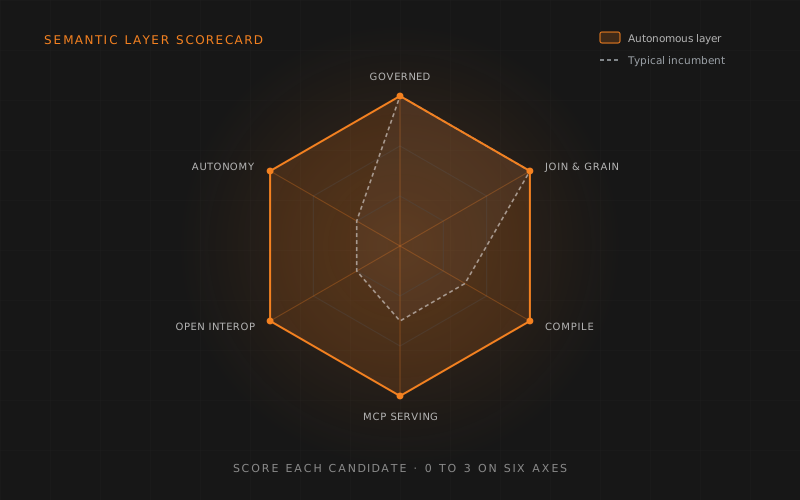
Rather than name products, it is more useful to compare the structural categories of semantic layer on the six areas that decide AI outcomes. Every product inherits the strengths and limits of its category. Ratings below reflect the documented behavior practitioners and analysts report, not marketing claims.
| Category | Governed consistency |
Join & grain safety |
Open interop |
Deterministic AI compilation |
Agent-native (MCP) serving |
Self-building autonomy |
|---|---|---|---|---|---|---|
| Autonomous semantic layer | Strong | Strong | Strong | Strong | Strong | Strong |
| BI-tool-bound modeling layer | Strong | Strong | Limited | Partial | Partial | Limited |
| Code-defined metrics layer | Strong | Limited | Strong | Partial | Partial | Limited |
| OLAP universal aggregation layer | Strong | Strong | Partial | Partial | Strong | Partial |
| Warehouse-native semantic model | Strong | Partial | Limited | Partial | Strong | Partial |
| Catalog and governance tool | Partial | None | Partial | None | Limited | Limited |
| Orchestration framework | None | None | Partial | None | Partial | None |
What each category gets wrong
- BI-tool-bound layers are powerful inside one tool, but the model does not travel to other BI tools, notebooks, or agents, so multi-tool enterprises end up with a new silo and a vendor-specific language only specialists maintain.
- Code-defined metrics layers are warehouse-agnostic and version-controlled, but everything is hand-authored, and several do not support multi-hop joins or fail outright on fan-out queries, which real-world schemas are full of.
- OLAP universal layers model and serve well and increasingly support agents, but the pre-aggregation lifecycle adds operational weight, and the design center is performance and governance rather than autonomy.
- Warehouse-native models reduce setup friction inside a single platform, but they recreate lock-in one layer up and become a fresh silo the moment your stack uses more than one engine.
- Catalogs and governance tools document and govern metadata beautifully, but they describe semantics rather than serve them at query time, so an agent cannot actually execute against them.
- Orchestration frameworks are great at wiring agents together, but they have no governed semantic substrate, so the agents reason over raw schemas with no contract and no policy.
How to run the evaluation in practice
A framework is only as good as the test you put it through. Skip the canned demo. Bring your own data and run these five exercises in every proof of concept.
- Bring your three ugliest questions. A multi-hop join across several tables, a ratio that mixes two different grains, and a period-over-period comparison. If the answers are wrong or impossible, the rest does not matter.
- Demand identical numbers across surfaces. Ask the same question in a dashboard, a notebook, and through an agent. If the three results disagree, you do not have a single source of truth.
- Ask for the past, as of the past. Request last quarter’s headline metric as it stood at quarter end. If the tool recomputes it against today’s data, point-in-time reproducibility is missing.
- Point a real agent at it over MCP. Then read the audit log. It should show the permissions applied and, critically, the requests that were denied, not only those that were served.
- Measure time to the first governed metric. Without an engineer hand-writing model files. This single number tells you whether you are buying autonomy or another maintenance backlog.
Where this leaves you
Most of the categories above were built for a world where humans asked the questions and a data team maintained the model by hand. That world is being replaced by one where agents ask thousands of questions a day and no team can hand-maintain context fast enough to keep pace. The frameworks the analysts use still apply, but the weighting has shifted decisively toward autonomy, determinism, reproducibility, and agent-native serving.
This is the gap Colrows was built for. Colrows is an autonomous semantic layer. It self-builds and self-maintains business context by crawling your data, query history, and usage. It validates its own join paths and grain so answers do not silently double-count. It compiles natural language into deterministic, governed SQL rather than letting a model freestyle. It reproduces any metric as of any point in time. And it serves all of that to agents over MCP, with persona-level permissions and a full audit trail, built to the open standards that are prying vendor lock-in open, so the context you build stays yours.
Fix the Context. Not the Model.
If you are evaluating semantic layers this year, take this 12-point framework into every demo and score honestly. And if you want to see what an autonomous semantic layer does against your own three ugliest questions, that is exactly the conversation we like to have.
Start the conversation: engage@colrows.com · colrows.com
Sources and notes
- Gartner, Top Data and Analytics Predictions for 2026 (March 2026); Magic Quadrant for Analytics and Business Intelligence Platforms (June 2025); Lack of AI-Ready Data Puts AI Projects at Risk (February 2025); 30% of GenAI projects abandoned after POC (July 2024).
- Forrester, The Forrester Wave: Business Intelligence Platforms, Q2 2025; multi-tool BI research (Boris Evelson). The 61% multi-tool figure dates to 2021 and is cited widely; verify currency before reuse.
- GigaOm Radar for Semantic Layers and Metrics Stores (2025). Dresner Advisory Services, 2025 Wisdom of Crowds Semantic Layer Market Study.
- MIT Project NANDA, The GenAI Divide: State of AI in Business 2025 (July 2025); evidence base of 300+ public initiatives, 52 structured interviews, and 153 survey responses.
- dbt Labs, Semantic Layer vs. Text-to-SQL 2026 Benchmark (reproducible, open repository). Rumiantsau et al., arXiv 2604.25149 (April 2026), paired benchmark across three frontier models.
- Open Semantic Interchange: launched September 2025; v1.0 specification published January 2026 (Apache 2.0). Model Context Protocol: released by Anthropic, November 2024; donated to the Linux Foundation Agentic AI Foundation, December 2025.
- Futurum Group, 1H 2026 Data Intelligence market sizing, which models the semantic layer as the fastest-growing sub-segment of the data intelligence stack. Practitioner sources on semantic drift, fan-out and chasm traps, and point-in-time correctness, paraphrased throughout.
This framework is the how. For the applied version, best semantic layer tools scores eight platforms against these criteria.
The reproducibility criterion in this guide is pulled apart in point-in-time query reproducibility, which shows why warehouse time travel and Git-versioned metrics do not close the audit gap.
Frequently asked questions
How do I evaluate a semantic layer in 2026?
Score each candidate from 0 to 3 across 12 criteria: six table stakes (governed single source of truth, metric expressiveness, join-path correctness and grain validation, unified permissions, lifecycle and DataOps, security and compliance posture) and six 2026 differentiators (deterministic query compilation, agent-native MCP serving, autonomy and self-maintenance, point-in-time reproducibility, open interoperability, and performance and cost at agent scale).
What separates a deterministic semantic layer from text-to-SQL?
A deterministic layer compiles the question into governed SQL built from definitions you control; the model selects from approved metrics and joins instead of writing SQL itself. In dbt Labs' 2026 benchmark, a leading model scored 84.1 percent answering directly against the warehouse and 100 percent routed through a governed semantic layer.
What should I test in a semantic layer proof of concept?
Run five exercises on your own data: bring your three ugliest questions (a multi-hop join, a mixed-grain ratio, a period-over-period comparison), demand identical numbers across a dashboard, a notebook, and an agent, ask for last quarter's number as it stood at quarter end, point a real agent at it over MCP and read the audit log, and measure time to the first governed metric without hand-written model files.
Why does point-in-time reproducibility matter when buying a semantic layer?
Most semantic layers recompute past questions against today's data and definitions, which is not the same number. If a regulator, an auditor, or your own board asks you to reproduce a number exactly as it was reported, the layer should be able to do it without a forensic project.
Do MCP and the Open Semantic Interchange matter in vendor selection?
Yes. The Model Context Protocol (donated to the Linux Foundation in December 2025) is how agents connect, and the layer should serve agents over MCP with authentication, permissions, and audit enforced at the protocol level. The Open Semantic Interchange (v1.0 published January 2026) keeps your definitions portable, though the 1.0 core does not yet codify access policy as a first-class object, so governance is where products genuinely differ.
Should I buy a warehouse-native semantic model instead of a standalone layer?
Warehouse-native models reduce setup friction inside a single platform, but they recreate lock-in one layer up and become a fresh silo the moment your stack uses more than one engine. In the category comparison, only the autonomous semantic layer scores Strong across all six axes that decide AI outcomes.