Short answer: RAG vs semantic layer comes down to where the truth lives. RAG retrieves prose that looks relevant, so it suits contracts, policies and other documents where a plausible answer is good enough. A semantic layer compiles the question through a typed graph, proves the join path, applies compile-time governance and emits SQL that returns the same answer every time. Use the semantic layer for governed numbers, and both when a question has a policy half and a data half.
RAG vs. Colrows Semantic Layer at a Glance
| Feature | RAG | Colrows Semantic Layer |
|---|---|---|
| Logic | Probabilistic (Retrieval) | Deterministic (Compiler) |
| Governance | None (Post-Retrieval) | Compile-time Enforcement |
| Data Accuracy | Susceptible to Hallucination | Guaranteed Accuracy |
| Auditability | Difficult / Black Box | Full SQL Lineage |
In one line: RAG fetches text that looks relevant. A deterministic semantic layer compiles your question through a typed graph, injects governance, and emits dialect-perfect SQL that produces the same answer every time. For enterprise AI agents operating against governed data, retrieval is necessary but not sufficient - compilation is the missing layer.
Two questions, two architectures
Every enterprise question an agent gets decomposes into one of two shapes:
- "What did we say about X?" The truth lives in prose: contracts, policies, runbooks, tickets, meeting notes. The answer is text. This is retrieval. RAG owns it.
- "What is true about X?" The truth is computed against governed structured data: warehouses, transactional systems, metric stores. The answer is a number or a row. This is compilation. A shared semantic memory for the organization owns it.
Confuse them and your agent retrieves when it should compile (returns a plausible paragraph instead of a defensible number) or compiles when it should retrieve (fabricates SQL against a schema it half-understands).
What RAG actually does, and where it stops
Classical RAG is three steps: chunk a corpus, embed the chunks into a vector space, and at query time fetch the chunks nearest the query embedding and feed them to the LLM. It is the right tool when the truth lives in prose and you want the model to read the relevant prose first.
Stated honestly, RAG has real strengths: unstructured coverage (most enterprise context is documents, and RAG is the only practical way to make an LLM read at scale), it is cheap and fast to ship (a useful v1 is a week of work), and it requires no formal modeling.
The limits are structural, not tuning problems.
Retrieval is the failure point, not generation. The comprehensive RAG robustness survey (arXiv 2506.00054, June 2025) shows how fragile the retrieval tier is: poisoning just 0.04% of a corpus produced a 98.2% attack success rate and 74.6% system failure in the BadRAG study. Production analyses consistently find that when RAG returns a wrong answer, the model did its job, it was handed the wrong context. The fix is upstream of the LLM.
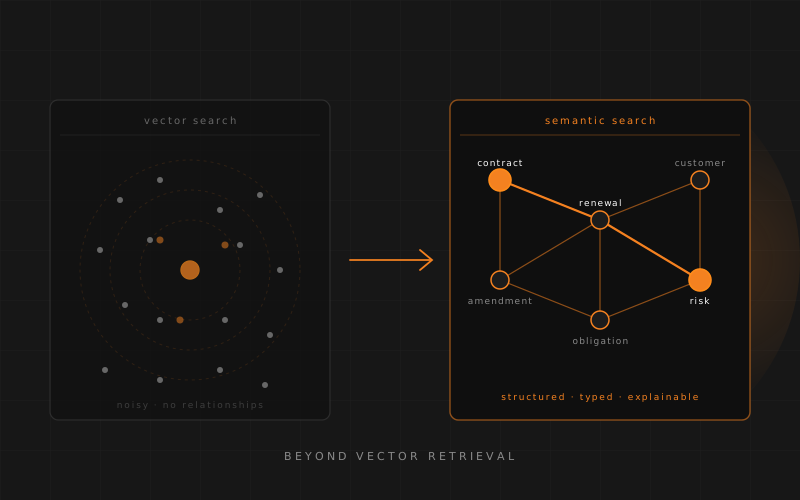
Ranking by relevance is not ranking by correctness. Vector search returns what is semantically near, not what is true. Concrete failure: a query for the current refund policy retrieves a deprecated 2021 policy because it is textually similar, and the LLM answers from it confidently. Embeddings carry no inherent recency prior; if the old and new docs are similar, the search can pick either.
Context rot. Stuffing more retrieved passages into the window degrades accuracy. Why retrieval-only patterns plateau at scale - bigger context is not better context.
The LLM misreads retrieved-but-correct context. Even when retrieval is perfect, generation is probabilistic. RAG retrieves the clause "maximum refund window: 30 days," and the model paraphrases it as "minimum 30 days." The source was right; the answer is wrong.
Nondeterminism, even at temperature 0. Setting temperature to 0 makes only token selection greedy. It does not make the system reproducible. Thinking Machines Lab ("Defeating Nondeterminism in LLM Inference," September 2025) sampled Qwen3-235B-A22B 1,000 times at temperature 0 on the single prompt "Tell me about Richard Feynman" and got 80 distinct outputs, with runs diverging at token 103. The cause is batch-variance in GPU inference kernels: your prompt gets batched with different other requests each time. Only after rebuilding batch-invariant kernels did runs become 100% bitwise-identical. For audit and compliance, "mostly deterministic" is not deterministic.
Embedding drift and the refresh tax. Embeddings decay. A document gets updated, the stale embedding still sits near the old query, retrieval returns the wrong version. Mixing two embedding-model versions in one index silently destroys recall because the vectors live in different geometric spaces. Keeping the index fresh means re-embedding changed content on a schedule, which is real recurring spend.
The advanced-RAG ladder
The 2026 discourse is loud about advanced variants. They are genuine improvements, but each adds structure, not better embeddings:
- Corrective RAG (CRAG) (Yan et al., arXiv 2401.15884) inserts a retrieval evaluator that scores documents and routes the query: use as-is, supplement with search, or discard and re-retrieve.
- Self-RAG (Asai et al., arXiv 2310.11511) trains the model to emit reflection tokens that govern its own retrieval.
- GraphRAG (Microsoft Research) restructures the corpus into entities, relationships, and community summaries, then queries that structure. It wins decisively on global synthesis that flat retrieval cannot do, at the cost of more latency and compute.
The honest read: climb the ladder only as far as your failure mode requires. None of these turn retrieval into compilation. They make the LLM read better. They do not prove a join.
The vector database landscape
Pinecone is the zero-ops managed default. Weaviate is the hybrid-search champion (mature BM25F, BlockMax WAND). Milvus scales to hundreds of millions of vectors at the cost of operational complexity. Qdrant is the performance-per-dollar self-host option with strong filtering. Chroma and pgvector are for prototyping. The common migration pattern is to start on Pinecone for speed and move to self-hosted Qdrant or Weaviate when cloud bills cross a threshold. None of these governs meaning. They store and search vectors. The definition of "revenue," the join path, the row-level policy: not their job.
What a semantic layer does, and why it is not RAG
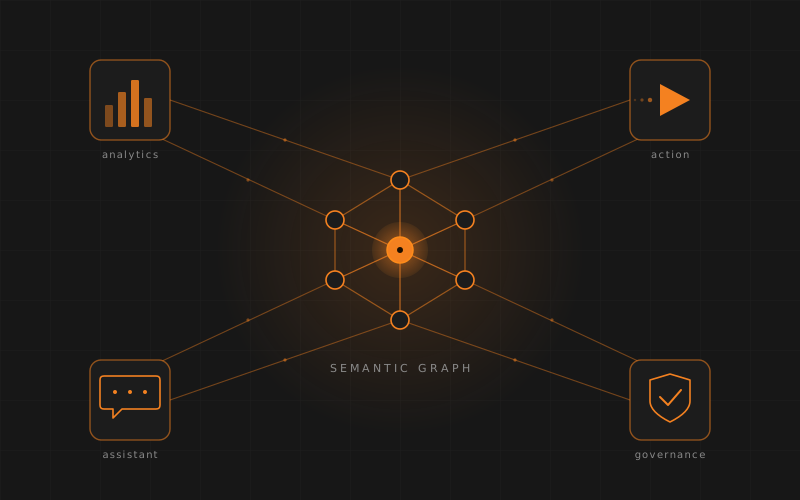
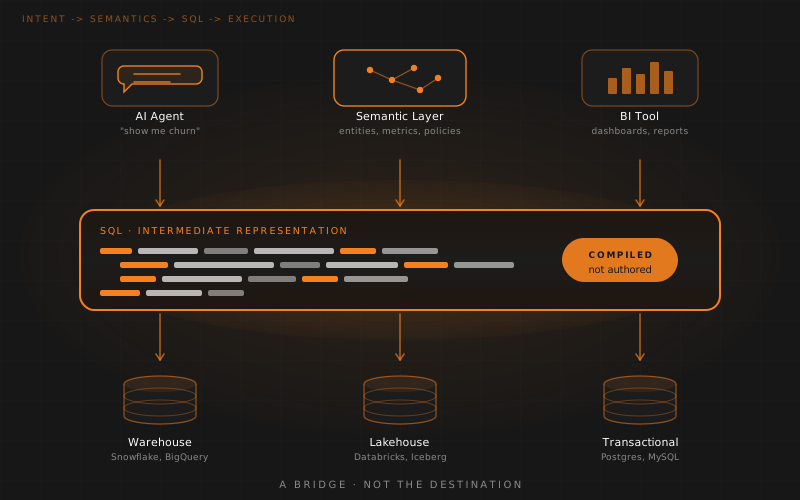
A semantic layer is a typed, versioned graph of the entities, metrics, and events the enterprise cares about, the join paths between them, and the policies that govern them. When an intent arrives, in natural language, API, or SQL, the layer compiles it: resolves every term against the graph, proves a join path, applies governance, and emits a SQL plan against the warehouse.
The output is a different artifact from RAG. RAG returns "here are five paragraphs that look relevant." A semantic layer returns "here is the row count under definition v3 of churn for the EU-finance scope, with the executed SQL and the audit trail."
What it is good at:
- Provable joins. A multi-hop query requiring three joins and a filter has either a valid path through the typed graph or it does not. No path means compilation fails. The agent cannot fabricate an answer.
- Compile-time governance. RBAC, ABAC, row/column predicates, and scope policies are applied before SQL leaves the planner. Unauthorized queries fail at compile time. Data is never read.
- Determinism and reproducibility. Same question, same scope, same graph version yields the same answer. The compiler is deterministic by construction. Why generic LLMs fail at enterprise tasks - there is no sampling step.
- Versioned definitions. When finance updates the revenue definition, the old version is preserved. Historical queries replay against historical definitions.
Accuracy on covered queries is the headline. The dbt Labs 2026 benchmark ("Semantic Layer vs. Text-to-SQL: 2026 Benchmark Update") found that for queries covered by a well-modeled semantic layer, accuracy approaches or hits 100%, because deterministic query generation means the LLM cannot produce a subtly wrong result set. dbt's internal testing puts raw-schema text-to-SQL near 40% accuracy versus 83% when grounded in the semantic layer. Snowflake's engineering team reported that agentic refinement of a semantic model boosted SQL accuracy by about 20 percentage points over a vanilla LLM, and that Cortex Analyst reaches 90%+ accuracy on real-world use cases. Enterprise deployments converge on 85-95% with a maintained semantic model versus roughly 40% on raw schema. (Those academic and vendor benchmarks were run on GPT-4o and Llama3-70B-Instruct, the frontier models at the time. As of August 2026 no vendor has published a comparable enterprise-schema study on Claude 4.7 or GPT-5 class models, so the accuracy gap is expected to hold in shape even as raw numbers move.)
Fix the Context, Not the Model. A well-governed semantic layer that understands business context creates more reliable AI-driven analytics than fine-tuning the model itself.
What it cannot do, stated as honestly as the RAG limits:
- It cannot read the contract. If the answer depends on a clause buried in a 60-page MSA, the semantic layer cannot reach it. That is RAG territory.
- Coverage gaps fail. Ask a question outside the model and a well-built layer declines gracefully or routes to human review. Narrow and deep, not wide.
- Modeling and curation are real work. Someone has to define the entities, the joins, and the policies, and keep them current.
The landscape
The semantic-layer field consolidated into three architectural patterns: transformation-layer (dbt MetricFlow, metrics as version-controlled YAML in Git, GA October 2024), warehouse-native (Snowflake Semantic Views and Databricks Unity Catalog Metric Views, both reaching GA through 2025), and OLAP-acceleration / headless (Cube, AtScale). Why warehouse-native layers stop at the warehouse boundary - enterprise meaning does not. From metric stores to knowledge machines is the journey.
Determinism: the architectural difference in one line
RAG's answer is a sample from a probability distribution. The semantic layer's answer is the output of a compiler. That is the whole difference. You can cache a RAG response to make your application deterministic at the boundary, but the underlying generation is not reproducible. A compiler is reproducible by design. For board numbers, regulatory filings, and audit findings, that distinction is the product. It is also the same distinction that separates a runtime semantic layer from a semantic execution layer.
RAG plus semantic layer: the stacking pattern
The mature enterprise pattern is not "pick one." It is RAG as the retrieval tier and the semantic layer as the answering tier. Consider a compliance agent at a regulated bank asked "is account X eligible for the new credit product?"
- The agent splits the question into a policy half and a data half.
- For the policy half it retrieves, via RAG, the regulator's bulletin and the internal product spec. Unstructured text. RAG is right.
- It extracts the structured constraints: minimum balance, employment-verification window, prior NPA flag.
- It hands those to the semantic layer, which compiles a query: resolve "Account" to an entity, prove join paths to "Employment Verification" and "NPA History," apply the regulatory scope, emit governed SQL.
- The compiled query returns a structured eligibility result with the audit trail.
- The agent composes the answer: cited regulation pages from RAG, structured eligibility row from the semantic layer.
Neither tier alone produces that answer. RAG retrieves the rule but cannot touch customer data safely. The semantic layer computes eligibility but cannot know which definition applies today. The two things that wire this together are MCP, which Anthropic introduced in November 2024, which collapses the M×N agent-to-source integration problem to M+N, and the semantic layer's compile step. MCP carries intent and result; the semantic layer carries meaning, governance, and proof. They are complementary, not competing.
A confidential Indian ARC applied this exact stacking pattern to loan-file NPA evaluation and reported greater than 95% reduction in evaluation cycle time with 100% regulatory coverage across RBI SARFAESI and DRT workflows (see the BFSI NPA case study). The pattern generalises: RAG reads the regulator's bulletin, the semantic layer proves the eligibility row.
The economics a CTO can sign off on
Vector infrastructure scales in three components, and the vector DB is rarely your biggest line item. Pinecone's published unit rates are $0.33/GB/month for storage, $16 per million read units on Standard (rising to $24 on Enterprise), and $4 per million write units on Standard (rates verified against Pinecone's current price page on 21 August 2026). Independent estimates for a production system at roughly 10 million vectors serving 100,000+ queries per day put the vector-DB component at about $300-800/month on Pinecone (PE Collective), or roughly $65-500/month for self-hosted Qdrant or Weaviate on compute alone, rising to ~$650-700 once you allocate DevOps labor.
The RAG cost that surprises teams is LLM generation, not the vector DB. RAG About It models a system that costs a few hundred dollars a month at 1,000 queries/day ballooning at 100,000 queries/day, where generation tokens dominate: roughly $22,500/month in LLM tokens for a GPT-4-class model at 7,500 tokens per query, scaling toward $50,000/month all-in depending on model choice. The vector database is the small number on that invoice.
Embedding generation is cheap; refresh is the recurring tax. At OpenAI's $0.02 per million tokens for text-embedding-3-small, embedding a 10M-document corpus (about 5 billion tokens) costs roughly $100 one-time, or about $650 with the larger 3-large model (LeanOps). The recurring cost is re-embedding changed content to fight drift: a weekly full re-index of that corpus runs about $3,380/year with the large model, and enterprise migrations cite $8,000-15,000 one-time embedding costs (Actian), plus the GPU hours to rebuild ANN indices.
The cost of getting it wrong is the real number. The AllAboutAI 2025 study put global business losses from AI hallucinations at $67.4 billion in 2024 (47% of enterprise AI users made at least one major business decision based on hallucinated content). EY's 2025 Responsible AI Pulse survey of 975 C-suite leaders found 99% reported AI-related financial losses, 64% of them above $1M, averaging $4.4M per affected company (both figures verified 21 August 2026). In regulated work the failure is concrete: in Moffatt v. Air Canada (2024 BCCRT 149), the British Columbia Civil Resolution Tribunal held the airline liable for a chatbot that invented a refund policy. A semantic layer's value is that on covered, high-stakes queries the wrong answer is structurally impossible: the query either compiles correctly or fails.
The build vs buy decision is mostly upfront modeling and ongoing curation, and at query time it is usually cheaper than RAG at scale because it runs governed SQL against a warehouse you already pay for, with no re-embedding and no re-ranking compute.
Decision framework
Reach for RAG when: the truth is in prose, the task is search or discovery, the questions are exploratory, time-to-value matters more than auditability, and a plausible answer is good enough.
Reach for a semantic layer when: the truth is in governed structured data, the query is high-stakes (revenue, risk, compliance), you need determinism and an audit trail, and a subtly wrong number is expensive.
Use both when: the question has a policy half and a data half, which most production questions in regulated industries do. RAG retrieves the constraint; the semantic layer compiles the metric under it.
| Dimension | RAG | Semantic layer |
|---|---|---|
| Primitive | Retrieval (ANN search) | Compilation (typed graph to SQL) |
| Truth lives in | Prose / documents | Governed structured data |
| Output | Probabilistic text | Deterministic row + audit trail |
| Accuracy shape | Wide, ~85% on anything | Narrow, near 100% on covered subset |
| Determinism | No (batch + sampling) | Yes (compiler) |
| Governance | Post-hoc / none | Compile-time (RBAC/ABAC/row/column) |
| Dominant cost | LLM tokens at query volume | Upfront modeling + curation |
| Fails by | Retrieving the wrong doc, misreading the right one | Declining queries outside coverage |
The trade-off in one sentence: a semantic layer is narrow and deep (near 100% on its covered subset, nothing outside it), and RAG is wide and shallow (it will attempt anything and be right most of the time). Match the shape to the stakes. The semantic layer buyer's guide for 2026 goes deeper.
Where Colrows fits, honestly
Colrows is the semantic execution layer: the typed graph, the compile-time governance, the dialect-perfect SQL emission, the audit trail. It is built so retrieval-side systems (your enterprise RAG, your document index, your agent framework) can hand it structured intent over MCP or HTTP and get back a governed, reproducible, auditable answer, without a rewrite.
The honest scope: Colrows governs data semantics, not documents. If your use case is "help me find the relevant pages in our document corpus," RAG is the right first choice and Colrows is not what you need. If your use case is "compute a defensible number against governed data, and prove how you got it," that is exactly the answering tier Colrows provides, and it sits above your existing retrieval stack rather than replacing it.
RAG is fast, flexible, and genuinely useful. Its cost is precision. For mission-critical analytics, precision is not optional, and that is the half of the problem a semantic layer exists to solve.
Technical deep dive: how compile-time SQL compilation works
The reason a semantic layer can guarantee deterministic answers - while RAG cannot - is structural, not statistical. Colrows resolves agent intent against a typed semantic graph (entities, relationships, metrics, policies), proves a join path exists, injects RBAC and ABAC predicates into the generated SQL, and only then executes against the warehouse. If the intent maps to ambiguous joins or unauthorized data, compilation fails before any query touches your data.
For a deeper look at our architecture, see how we implement compile-time SQL compilation as the foundation for autonomous agents - the same typed graph, governance pipeline, and audit trail that backs every Colrows query.
If you are still separating the two retrieval terms, RAG vs semantic search covers what each one returns before the architecture question starts.
Frequently asked questions
Is a semantic layer a replacement for RAG?
No. RAG retrieves unstructured prose; a semantic layer compiles governed queries against structured data. They solve different halves, and regulated enterprises increasingly run both.
Why is RAG nondeterministic even at temperature 0?
Temperature 0 only makes token selection greedy. Dynamic batching on shared GPU inference produces batch-variant numerics, so identical prompts can yield different outputs. Thinking Machines Lab got 80 distinct outputs from 1,000 temperature-0 runs of one prompt before fixing the kernels.
How accurate is text-to-SQL without a semantic layer?
dbt's internal testing puts raw-schema text-to-SQL near 40%; enterprise Spider 2.0 benchmarks show peaks of 38-59% and GPT-4o falling from 86% on Spider 1.0 to 6% on Spider 2.0. Grounding in a semantic model lifts accuracy to 85-100% on covered queries.
What is the difference between GraphRAG and a semantic layer?
GraphRAG retrieves graph fragments as context for the LLM. A semantic layer compiles the query through the graph and emits governed SQL. One improves reading; the other proves the answer.
When is RAG alone sufficient?
Search, discovery, and exploratory questions over documents where a plausible answer is acceptable and auditability is not required.
What does a vector database cost at scale?
At ~10M vectors and 100k queries/day, roughly $300-800/month on Pinecone or $65-500/month self-hosted, but at that query volume LLM generation tokens (potentially $20k-50k/month) dominate the bill, not the vector DB.
Can I add a semantic layer without ripping out my RAG stack?
Yes. Over MCP or HTTP, an agent routes governed queries to the semantic layer and keeps using RAG for retrieval.
Does a semantic layer eliminate hallucination?
On covered queries, yes, by construction: the query compiles correctly or fails. Outside coverage it declines or routes to a human rather than guessing.