Standard BI self-serve vs. Colrows autonomous self-serve
| Capability | Standard BI self-serve | Colrows autonomous self-serve |
|---|---|---|
| Logic source | Fragmented / spreadsheet-based | Centralized / compiled |
| Data consistency | Low (metric drift) | High (governed by compiler) |
| Access control | Runtime / patchwork | Compile-time / deterministic |
| Agent autonomy | Limited / high hallucination risk | Full / production-ready |
| Maintenance | High (human-in-the-loop) | Zero (schema-driven) |
The self-serve failure and the compiler fix
The self-serve failure: When business teams define metrics in standard BI tools, they create fragmented logic. Finance's "revenue" differs from Sales' "revenue". Marketing runs reports on spreadsheet definitions. Access control remains patchwork. Governance is bolted on after the fact. The result: shadow data silos, conflicting executive reports, and a data team drowning in requests to resolve inconsistencies.
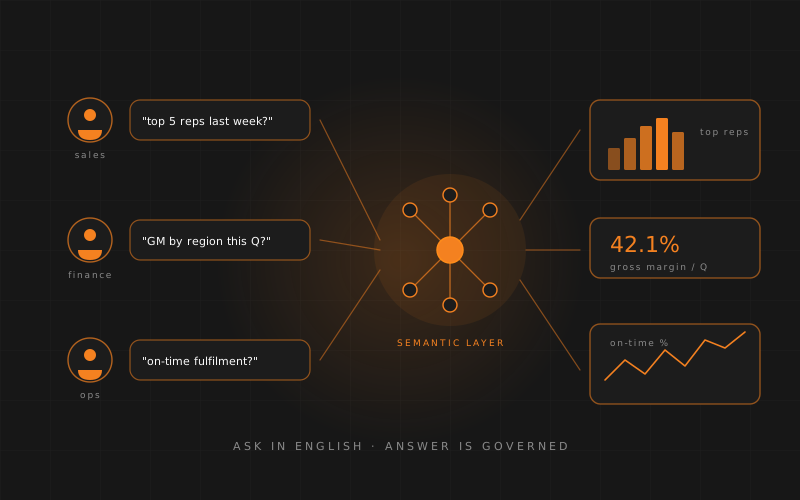
The compiler fix: Colrows resolves business definitions into SQL before the user ever sees the data. This means "Revenue" means the same thing to Finance, Marketing, and Sales, regardless of which agent or tool they use. Logic is centralized in a semantic graph. Access control is enforced at compile time, not runtime. Policies are deterministic. Self-serve becomes safe at scale because the compiler eliminates the ambiguity that creates shadow silos. See governance and the semantic control plane for how deterministic enforcement works, and the Colrows semantic compiler architecture for the full pipeline.
Do not trade data consistency for speed. Build a self-serve environment on a deterministic foundation. Fix the context, not the model.
Data teams are overwhelmed. Business teams are frustrated. The backlog of "just one quick request" keeps growing. The promise of self-serve analytics has never been more appealing. But for most organisations, it has remained impossible. Why. Security, governance, and consistency cannot be compromised. Traditional self-serve tools compromise all three. Below is the working alternative.
Why traditional self-serve analytics keeps failing
The 2010s self-serve BI wave (Tableau, Looker, Power BI, Mode) shipped powerful exploration tools and immediately created four predictable failure modes that any enterprise that lived through it can recite from memory:
- Shadow dashboards. Two analysts model "revenue" differently, build separate dashboards, ship them to different stakeholders, and the company has two contradictory numbers in board decks within a quarter.
- Definition drift. What "active customer" means in March is not what it means in October, because someone updated the SQL behind one dashboard but not the other twelve that share the term.
- Warehouse cost explosions. Curious users write unbounded queries against fact tables. The Snowflake bill triples without a clear owner.
- Quiet data exposure. A marketing analyst joins a customer table they were not supposed to be able to read. Nothing alerts. The leak is discovered six months later during a SOC 2 audit.
The common root cause: the BI tool was the policy layer. Governance was bolted on at the presentation tier, after queries had already been composed and run. By the time a dashboard renders the wrong number, the wrong query has already executed. There is no way to walk that back.
The architecture that works: governance under the BI tool, not over it
The working pattern in 2026 is to move policy below the BI tool, into a semantic execution layer that every query - whether composed by a human, an AI assistant, a notebook, or a dashboard - has to compile through. The BI tool becomes a thin interface on top of a governed substrate. Three components carry the load together:
1. A typed, versioned semantic graph (the substrate)
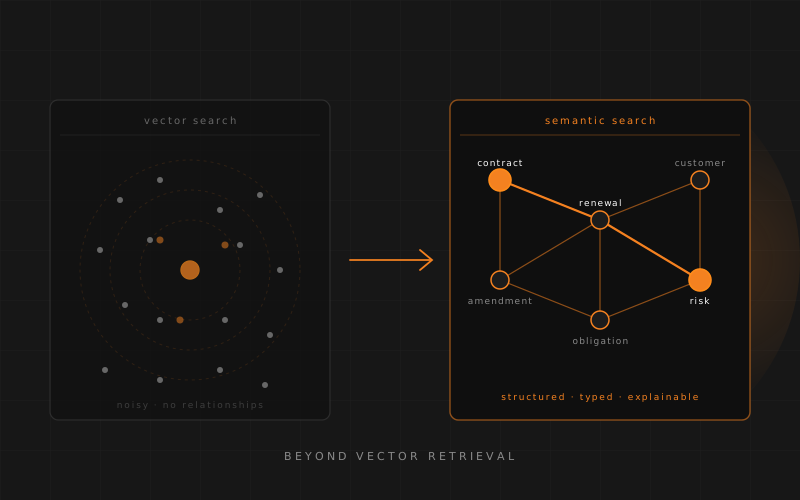
Entities, metrics, and events live in a graph with proven relationships, versioned definitions, and multi-scope semantics (global → tenant → persona → user). "Revenue" is a node, not a string. Its definition has a version. Its applicable scope is encoded. Two analysts asking for "revenue" cannot mean two different things - the graph forces resolution to the same versioned concept under their scope. This is the architectural piece that eliminates shadow dashboards at the root: there is one definition of revenue per scope, and the system knows which one applies.
For the deeper architecture see Building the Enterprise Memory Graph.
2. Three-layer access control composed together
"Self-serve with security" requires three policy mechanisms working in concert, not just one:
- RBAC (role-based) answers who is asking? Sales Manager, Finance Analyst, Customer Success Rep. A role binds permissions on semantic entities: who can resolve which metrics, who can see which dimensions.
- ABAC (attribute-based) answers under what conditions? The Sales Manager for the EMEA region, during business hours, for the current and prior fiscal year. Attributes compose where roles alone would create role-explosion.
- Row- and column-level predicates answer which slice? Even when the role and attributes pass, the data may be readable only in part - certain rows, with certain columns masked.
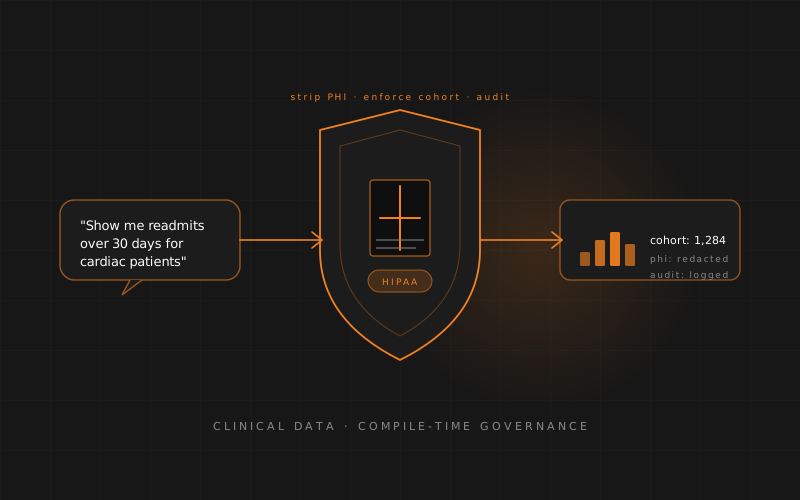
Critically, all three are enforced at compile time, inside the semantic execution layer, before SQL is emitted to the warehouse. An unauthorised intent fails compilation and produces a structured error; the warehouse is never queried; no data leaves the database. This eliminates the "quiet data exposure" failure mode at the architectural level. We covered this in more depth in Fine-Grained Data Access Control: Precision Security and The Semantic Control Plane.
3. Certified queries: a typology that scales
A common mistake is treating every query the same. In practice, self-serve queries exist on a spectrum, and a working system distinguishes them:
- Certified queries are pre-approved templates published by the data team. They are versioned, parameterised, and join-path-locked. A Finance Analyst running "Quarterly Recognised Revenue by Region" runs the same query the Finance VP sees on the dashboard. No ambiguity, no per-user drift.
- Composed queries are user-composed within constrained dimensions - the user picks from allowed metrics, allowed filters, allowed groupings. Composition is bounded by the semantic graph; impossible joins simply cannot be expressed.
- Exploratory queries are free-form within the user's policy envelope. The compile-time governance still applies, but the user has more latitude to ask new questions.
The typology matters because it lets the data team invest effort where it pays off (certifying the high-traffic metrics) without having to police every ad-hoc question. The compile-time governance covers the long tail; certification covers the load-bearing reports.
What changes when AI assistants enter the picture
The 2024-2026 wave of natural-language analytics ("ask your data in English") would have multiplied every failure mode of the 2010s wave - if the AI assistant sat above the BI tool. An LLM asked "what was Q3 EU revenue?" against an ungoverned warehouse will compose a plausible-looking SQL query, return a number, and be silently wrong a substantial fraction of the time.
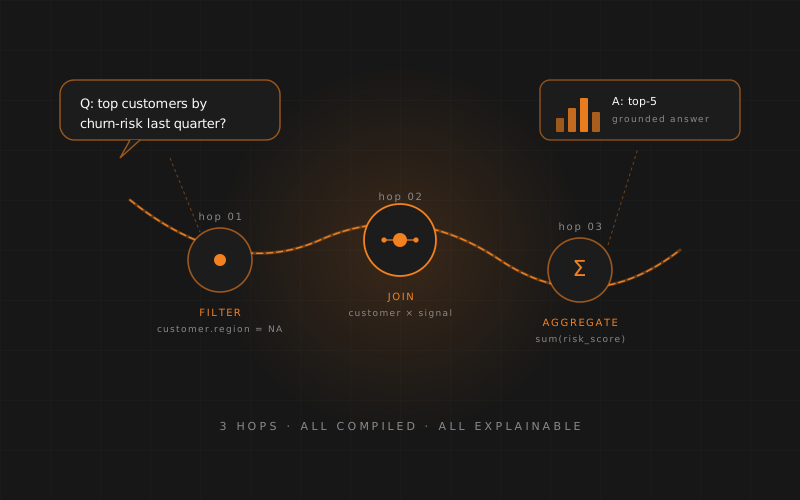
The architecture inverts when the AI assistant compiles through the semantic execution layer instead of writing SQL directly. The flow becomes:
- User asks a question in plain English: "How did EMEA renewals perform last quarter compared to the same quarter last year?"
- The AI assistant resolves the intent against the typed semantic graph - "renewals" is a versioned metric, "EMEA" is a typed entity, "last quarter" resolves against the requesting user's scope.
- The compiler proves a join path through the graph. If the path does not exist, compilation fails - the assistant receives a structured refusal, not a hallucinated answer.
- Compile-time governance applies. The user's role, attributes, and row/column predicates constrain the result. Unauthorised slices fail compilation.
- Dialect-perfect SQL is emitted, executed, and returned with a full audit trail (graph version, scope, definitions used, executed SQL, identity context).
The user never wrote SQL. The system never invented a join. The answer is identical for every user in the same scope. We covered the broader pattern in RAG vs Semantic Layer and Semantics for Enterprise AI Agents.
How this compares to other self-serve approaches
To make the architectural choice concrete, here is how the semantic-execution-layer pattern compares to the four main alternatives enterprise teams typically evaluate.
vs. Looker (LookML semantic model)
Looker pioneered the modern BI semantic layer with LookML - a hand-authored model that lives inside the BI tool. The strength is that every Looker query inherits LookML's definitions, which gave Looker the cleanest "single source of truth" story of any BI tool. The structural limit is that the semantic layer is presentation-time: it governs dashboards inside Looker, but the moment an AI agent, a notebook, or a downstream API tries to access the same data, the semantic layer has no enforcement power. The semantic execution layer pattern inverts this by moving the substrate below the BI tool, so the same governance applies whether the consumer is a dashboard or a Python script.
vs. dbt Semantic Layer / MetricFlow
dbt's semantic layer is built on top of dbt transformations. Metrics are declared in YAML; MetricFlow generates SQL on demand. For teams already deeply invested in dbt, it is a natural extension. The limits: it is a metric layer (not a graph), so multi-hop questions that require traversal across entities are out of scope. And it is downstream of dbt transformations - if the upstream models are inconsistent, the metric layer cannot reconcile them. Self-serve over dbt MetricFlow works well for the load-bearing 30 metrics; the question is what happens for the other 970.
vs. Cube (headless BI / metrics API)
Cube exposes a metrics API that any consumer can call. Self-serve here means "any frontend can build self-serve UI by hitting the metrics API." Strong for embedded analytics. The structural assumption is that someone hand-authors the metric definitions in YAML; the substrate is not autonomous and does not include a typed graph of entities and relationships beyond the metric scope. Compile-time governance is limited to what the metric definition expresses.
vs. ThoughtSpot (search-based BI)
ThoughtSpot's pitch is natural-language self-serve: users type questions, get charts. The substrate is "Lenses" - manually authored modelling of entities and relationships. The semantic layer is real, but it is hand-curated rather than autonomous, and the governance is dashboard-side rather than compile-time. Strong UX for business users; the architectural question is whether the modelling work scales as the data estate grows. See Colrows vs ThoughtSpot.
vs. Snowflake / Databricks built-in semantic layers
Both warehouses ship semantic features (Snowflake Cortex, Databricks Unity Catalog metric definitions). For self-serve scoped to a single warehouse, they are reasonable starting points. The structural limit is that the substrate stops at the warehouse boundary - any cross-warehouse or cross-datasource query falls back to the consumer reconstructing the substrate. Enterprises with multiple warehouses or external data sources hit this wall quickly. See Why Snowflake and Databricks Cannot Be Your Enterprise Semantic Layer.
The summary: each of these tools solves part of the self-serve problem. None of them puts a typed, autonomous, multi-source semantic graph with compile-time governance underneath every consumer - which is what the semantic execution layer pattern requires.
Rolling self-serve out by organisation size
The right rollout shape depends on the scale. Three rough stages:
- 50 people (early stage). The data team is two engineers. Self-serve here means "publish a dozen certified queries, give Sales and Finance bounded composition, and put an AI assistant in front of it." The governance load is light because everyone knows everyone; the payoff is huge because every ad-hoc request the data team avoids is half a day reclaimed.
- 500 people (growth). Multiple business units appear. Definitions start to diverge naturally. This is where multi-scope semantics begin to earn their keep - Finance and Product mean different things by "active customer" and the graph encodes both, scoped. RBAC + ABAC begin replacing tribal-knowledge access controls. The certified-query library grows past 100 entries and starts having owners.
- 5000 people (enterprise). Regulatory pressure becomes constant. Row/column predicates dominate the policy surface. AI assistants are deployed against thousands of users and have to enforce the same compile-time governance the BI tool does. Audit reproducibility (point-in-time replay of any past query against the historical graph state) becomes a regulator-mandated property, not a nice-to-have.
Across all three stages, the architectural shape is the same; what scales is the policy graph and the certified query library. The underlying execution layer does not need to be rebuilt as the company grows.
The failure modes you still need to design against
Even with the right architecture, the rollout can fail. Three traps to watch for:
- Over-certification. If the data team tries to certify every conceivable query, they recreate the old ticket queue under a new name. The certified library should cover the load-bearing 20% of queries; the rest should live in bounded composition or governed exploration.
- Under-scoped semantic graph. If the graph has metrics but not events or entities, the AI assistant can answer "what is revenue?" but not "what caused the revenue change?" - which is where business value lives. Coverage matters; thin graphs produce thin answers.
- Treating the BI tool as the governance layer. Any policy enforced only in the BI tool is bypassable the moment a user opens a notebook. Governance has to live in the compile layer below the BI tool, or it does not really exist.
Common objections from CISOs and data leaders
Anyone proposing self-serve analytics in a regulated enterprise will encounter a predictable set of objections from CISOs, heads of data, and compliance teams. The objections are reasonable, and the architecture above answers each of them with a specific mechanism. The short version:
"Self-serve means we lose audit reproducibility." Not if every query is compiled through the semantic execution layer. Each compilation produces an audit record containing the graph version, the resolved definitions, the applied policies, the executed SQL, and the requesting identity. A query run six months ago can be replayed against the historical graph state and produce the same answer. This is a stronger audit guarantee than most ticket-based workflows have today.
"Self-serve will leak PII." Not if column-level predicates are bound to the semantic graph and enforced at compile time. A user who is not authorised to see customer_email cannot generate a query that returns it - the column is not in their compiled plan. Bypassing this via a notebook is also blocked because the notebook compiles through the same substrate.
"Business users will write expensive queries and blow up our warehouse bill." Compile-time cost estimation catches this before execution. The user sees an estimated bytes-scanned and credits-consumed before they run anything; queries above a configurable threshold can require approval, hit a soft cap, or be auto-rewritten with a default LIMIT. Cost guards are policy, not afterthought.
"We have to keep separate definitions for finance, product, and the regulator." Multi-scope semantics is the answer. The same concept ("active customer") resolves to a finance definition for the CFO, a product definition for the head of product, and a regulator-aligned definition for the quarterly filing - all from the same graph, all consistent within scope, all explicitly versioned.
"AI assistants will hallucinate enterprise data." They will - if you let them write SQL freely. Compile-then-execute makes hallucination impossible at the SQL-emission step: the compiler refuses to generate a query that cannot prove a valid join path. We covered the mechanics in How to Prevent AI Hallucinations on Enterprise Data.
"Our existing BI stack is too entrenched to migrate." The semantic execution layer is designed to sit underneath existing BI - dashboards in Looker, Power BI, Tableau, and ThoughtSpot can all consume the governed metrics via the standard JDBC driver or HTTP API. The migration path is to bind those tools to the substrate without replacing them, then layer AI assistants on top once the substrate is established. No "rip and replace" required.
Measuring whether self-serve is actually working
Self-serve programs frequently get green-lit on a vision and then quietly stall because no one is measuring whether they are doing what they were supposed to do. Five KPIs are load-bearing - they catch failure early and provide a defensible "yes, this is working" signal to leadership.
- Ratio of self-serve to ticket-based queries per week. A successful rollout should see this climb from near-zero to over 70% within 6-9 months. If it stalls below 50%, either certified-query coverage is too narrow or users do not trust the platform yet.
- Time from question to answer for business users. The pre-rollout baseline is usually 1-3 days (ticket queue). Target is under 15 minutes for any question the certified library or AI assistant can answer. Track the 90th percentile, not the median - tail latency is what kills user confidence.
- Number of distinct definitions of load-bearing metrics. "How many definitions of revenue exist in the company?" Before: usually 4-12. After: should be 1-3 (with explicit scope). If this number stays high, the semantic graph is not being used as the single source of truth.
- Query failure-and-refusal rate. A healthy system refuses ~5-10% of queries (unauthorised intent, missing data, broken join paths) and surfaces clear errors. If refusal rate is near 0%, the governance is probably toothless. If it is over 25%, the user experience is too restrictive and people will route around it.
- Cost per insight. Total warehouse spend divided by number of distinct unique queries answered. A well-tuned self-serve program drives this down because certified queries are cached and reused. If it goes up, exploration is unbounded.
Three of these (ratio, time to answer, cost per insight) should be reported to the data leadership monthly. The other two (definitions count, refusal rate) are quarterly health checks. Together they answer: are users using it, do they trust it, and is it scaling?
What this looks like in production: a workflow example
A marketing analyst at a 1,500-person B2B SaaS company opens the analytics workspace on a Monday morning. She has questions about campaign attribution after a weekend product launch.
- She types in plain English: "Show me trial signups by campaign source for the last 30 days, segmented by self-serve vs enterprise tier."
- The AI assistant resolves the intent. "Trial signups" is a certified metric (versioned, owned by the growth team). "Campaign source" is a typed dimension. "Self-serve vs enterprise tier" maps to a known segmentation.
- Compile-time governance applies: she is a Marketing Analyst with EMEA scope; the policy graph restricts results to EMEA accounts and masks the customer-email column. The compiler injects the predicates into the plan.
- Dialect-perfect SQL is emitted against the warehouse, runs, returns rows.
- A chart renders. She drills into the SMB segment for one campaign. Cross-filter; same compiled plan; new chart in under a second.
- She bookmarks the analysis, shares it with the growth lead. The shared link replays the exact compiled plan against the live data; the growth lead sees the same numbers (because they share scope).
- The growth lead promotes the analysis into a Signal: a scheduled cron-driven re-run with a threshold alert. No one has rewritten the SQL; the compiled plan is reused.
Every step in that flow was self-serve. None of it bypassed governance. Every query is logged with full identity, scope, and audit trail. There is no shadow dashboard at the end of it, because there cannot be: there is one compiled plan per intent, and intents are deterministic against the (identity, scope, graph version) tuple.
Outcomes Colrows customers report
Across deployments in pharma, BFSI, and travel retail (see the Cipla, BFSI, and SSP Group case studies), the consistent self-serve outcomes are:
- 80% fewer ad-hoc data requests to engineering teams.
- Safer onboarding for new team members - their scope defines what they can see; no manual provisioning required.
- Faster time-to-insight across sales, marketing, ops, and product - measured in minutes rather than days.
- Audit pass-through: every query is replayable point-in-time, which has been a load-bearing property in regulated industries.
Self-serve analytics is not about removing the data team. It is about moving the data team from filling tickets to defining the substrate that thousands of self-serve queries compile through. The advantage is in the substrate, not in the dashboards.
Frequently asked questions about governed self-serve analytics
Does self-serve analytics replace the data engineering team?
No. It changes what they do. The team moves from filling tickets to building the substrate that thousands of self-serve queries compile through. That substrate work - modelling entities, defining metrics, declaring policies, certifying queries, monitoring usage - is more impactful and more strategic than the ticket queue ever was. Headcount usually stays flat or grows; per-engineer impact grows by an order of magnitude.
How long does it take to roll out governed self-serve?
The compressed answer is 90 days for a useful first version (10-20 certified metrics, two business teams onboarded, AI assistant deployed for a limited scope) and 12-18 months for a comprehensive program (full policy graph, hundreds of certified queries, all major business units onboarded, audit reproducibility verified). The first 90 days are the highest-impact period: getting the substrate right early dictates how easy the rest of the rollout is.
What is the difference between self-serve analytics and self-service BI?
Self-service BI (the 2010s wave) gave users tools to compose their own dashboards on top of warehouse tables. Governance lived in the BI tool's permission model. Self-serve analytics (the 2026 framing) gives users the ability to ask any question - in natural language, via dashboard, via API - against a governed semantic substrate. The difference is where the governance lives: in the BI tool vs. underneath every consumer.
Do certified queries make exploration impossible?
No. Certified queries cover the load-bearing, repeated questions ("what is recognised revenue this quarter?"). Exploratory queries cover the long tail, bounded by compile-time governance rather than by what has been pre-authored. Both coexist; users should not have to know which mode they are in. The system routes accordingly.
How does this work for non-technical business users?
Through the AI assistant. A marketing analyst types "show me trial signups by campaign source last 30 days, broken down by tier" in plain English; the assistant compiles the intent through the semantic graph; the result returns with the audit trail. The user never writes SQL, never picks dimensions from a menu, never has to know which table holds which data. The assistant does that work under the governance policies of the requesting user.
What happens to existing dashboards built in Tableau, Looker, or Power BI?
They continue to work and they get better. The BI tool connects to the semantic execution layer over JDBC or the HTTP API; existing dashboards inherit the governed metric definitions without being rebuilt. Over time, the more load-bearing dashboards migrate to the semantic substrate directly, but there is no big-bang migration required.
How do we measure ROI on a self-serve program?
Three measurable wins compound. First, hours reclaimed from the data team's ticket queue - typically 8-15 hours per engineer per week within the first quarter. Second, decision latency reduction across business teams - days-to-hours for the load-bearing questions. Third, audit and compliance time savings - replayable queries collapse weeks of manual reconciliation into structured logs. Combined, the ROI is usually positive within 6-9 months on direct cost alone; the strategic value (faster decisions, fewer wrong numbers, more trust in data) is larger but harder to quantify.
What does compile-time governance actually mean if the user does not see it?
It means that by the time the user sees a result, the policy has already been enforced. The user does not need to know which policies fired; they just experience that some questions return results and some return structured refusals. That is the design goal: governance is invisible until it bites, and when it bites it is clear and auditable.
Governed self-serve does not come from a smarter dashboard or a bigger AI model; it comes from the semantic substrate every question compiles through, where identity, scope, and metric definitions are enforced at compile time. Fix the Context, Not the Model.
Closing thought
The 2010s self-serve BI wave failed. It gave power without constraints. Users could bypass governance. The 2026 wave inverts this. Business users get more power. They ask any question in plain English against the entire data estate. Every query compiles through a deterministic substrate that makes the wrong answer impossible. No more shadow dashboards. No more backlogs. No more silent leaks. Just safe, scalable, governed access to truth at the speed of curiosity.