Probabilistic AI analytics vs governed AI analytics for BFSI
| Requirement | Probabilistic text-to-SQL | Governed AI analytics (Colrows) |
|---|---|---|
| Reproducibility | Same question can yield different SQL | Deterministic; same question, same scope, same number |
| Governance timing | Applied after generation, if at all | Compile-time; restricted rows are never read |
| Join safety | Joins can be fabricated | Join path proof or explainable refusal |
| Audit | Partial query logs | Point-in-time reproducible audit trail per answer |
| Regulatory posture | Hard to demonstrate control | Controls that assist RBI SARFAESI, DRT, and audit needs |
Why the BFSI bar is different
Financial services teams do not just need a fast answer. They need to prove, later, that the answer was correct, that the person asking was allowed to see the data, and that the same question reproduces the same number. Three requirements follow.
- Determinism. A risk number that changes between runs cannot go in a filing. Reproducibility is non-negotiable.
- Proof of non-access. Masking output is not enough. Regulators increasingly expect evidence that restricted data was never read, not merely hidden. See why authorization fails at the BI layer.
- Auditability. Every number needs a lineage: which definition, which policy, which data version produced it. See engineering auditable SQL for BFSI.
Fix the Context, Not the Model. No amount of model tuning makes a guessed join auditable. Trust in BFSI analytics comes from a semantic layer that proves the query and governs it before execution.
How compile-time governance meets the BFSI bar
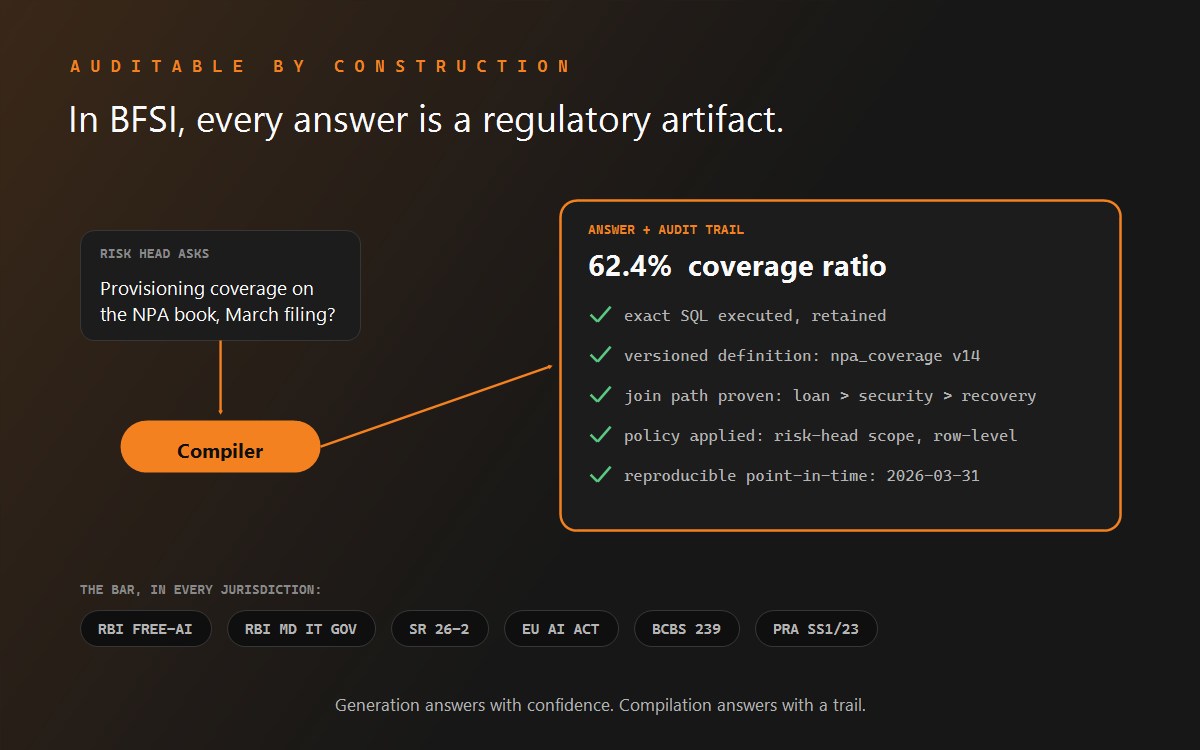
Colrows compiles agent intent through a typed semantic graph and enforces policy before any SQL runs.
- Deterministic SQL. The same question in the same scope compiles to the same SQL, so numbers are reproducible for filings and audits.
- Compile-time governance. RBAC, ABAC, and row/column predicates are evaluated at compile time. Unauthorized plans cannot be generated, so filtered rows are never read.
- Join path proof. Cross-dataset questions prove a deterministic join path or fail with an explainable error, instead of guessing.
- Point-in-time reproducibility. Every answer carries an audit trail tying the number to the definitions and policies in force at the time.
- Prevented hallucination. Ambiguous requests refuse at compile time rather than returning a confident wrong answer. See how to prevent AI hallucinations on enterprise data.
Proof from a regulated deployment
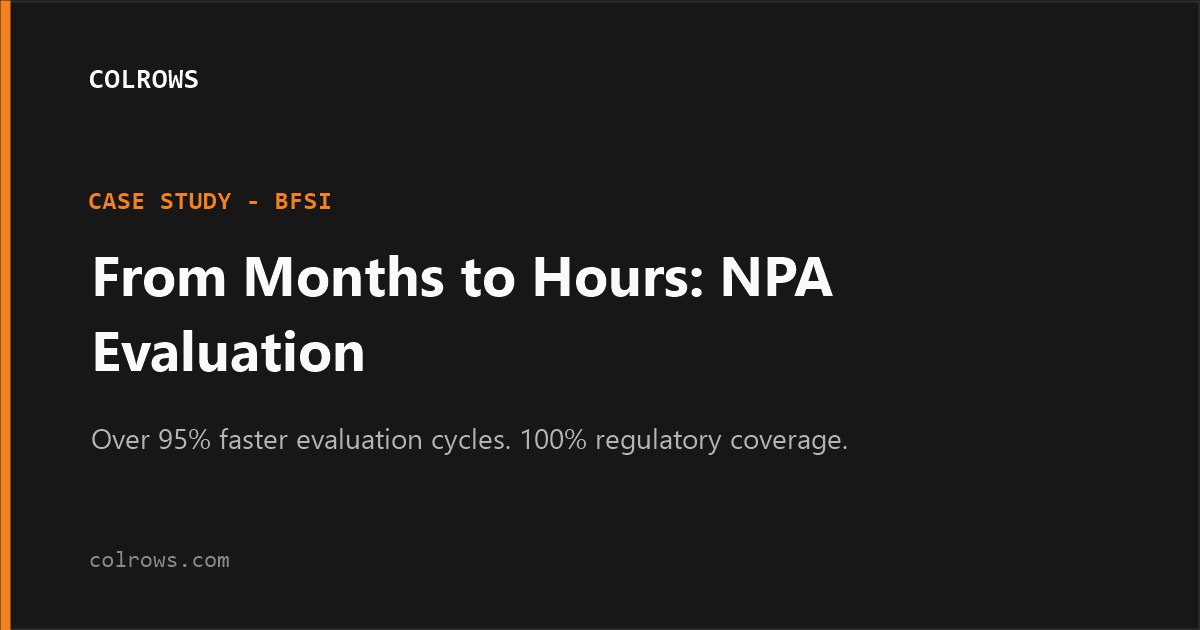
A Colrows deployment at a confidential asset reconstruction company, evaluating non-performing-asset portfolios, reported over 95% reduction in evaluation cycle time with 100% regulatory coverage across RBI SARFAESI and DRT requirements. The point is not just speed. It is that the speed came with governed, auditable, reproducible answers, which is the only kind that survives in BFSI. Read the BFSI NPA case study.
Frequently asked questions
Why is probabilistic text-to-SQL risky for banking?
Because the same question can produce different SQL, joins can be fabricated, and governance is often applied after generation. In BFSI, an unreproducible or ungoverned number is a compliance problem.
What makes AI analytics safe for financial services?
Deterministic reproducible SQL, compile-time governance so restricted rows are never read, join path proof, and a point-in-time reproducible audit trail.
Can AI analytics meet BFSI regulatory requirements?
Compile-time governance and auditability are controls that can assist with requirements like RBI SARFAESI and DRT; they do not by themselves guarantee compliance. A confidential ARC deployment reported over 95% faster evaluation with 100% regulatory coverage.