What Google publishes (and doesn't)
As of 21 August 2026, cloud.google.com/looker/pricing lists three editions - Standard, Enterprise, and Embed - every one priced "Call sales," on annual commitment with 1-, 2-, or 3-year terms. What the page does specify is the inclusions: each edition includes one production instance, 10 Standard Users, and 2 Developer Users; additional users are licensed per-seat (Developer, Standard, Viewer roles), also unpriced on the page. If you have read older guides quoting Google list prices for these editions, note the change: those numbers no longer appear on the live page - which matters, because most "Looker pricing" articles in circulation are reciting figures Google has withdrawn from publication.
The one published meter: Gemini Data Tokens
The exception to the opacity is new, precise, and dated - and it is the freshest fact in this guide. The same pricing page publishes the monthly Gemini Data Token allowances that meter Looker's AI features (Conversational Analytics and the rest of Gemini in Looker):
| Edition | Input tokens / month | Output tokens / month |
|---|---|---|
| Standard | 60M | 1.2M |
| Enterprise | 300M | 6M |
| Embed | 1.2B | 24M |
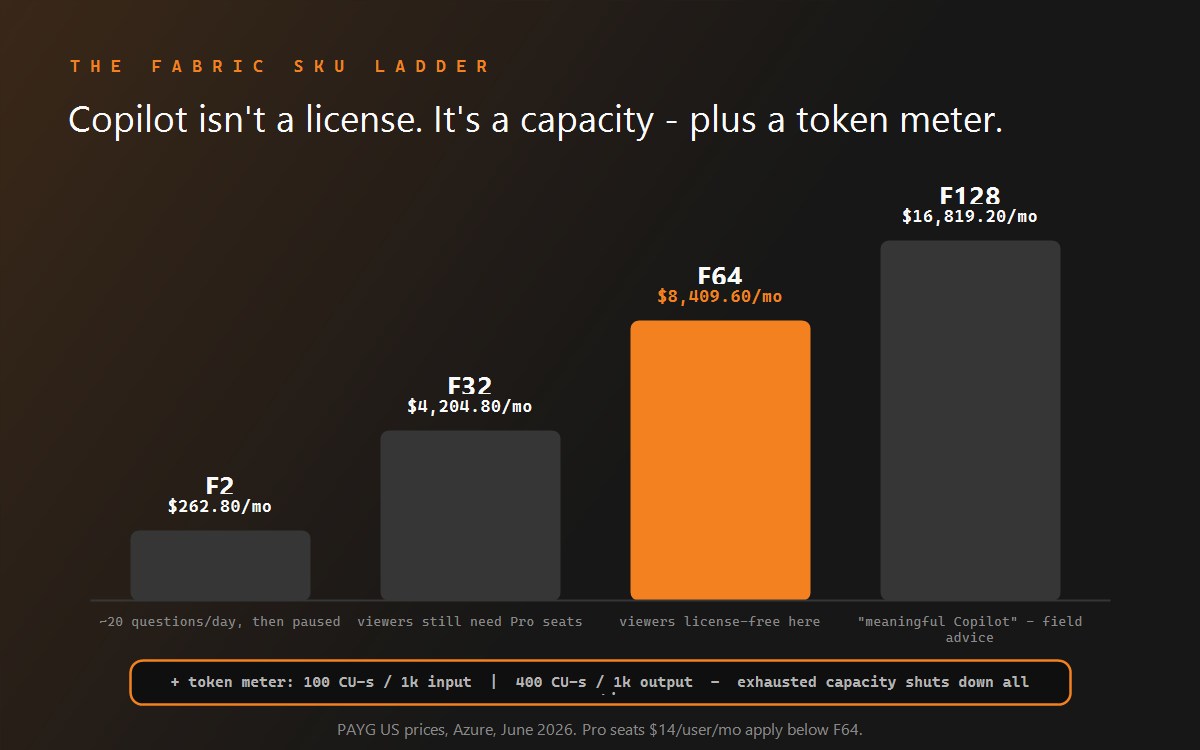
Usage beyond the allowance is free within fair use until 30 September 2026; from 1 October 2026, overage bills at $3.00 per million input tokens and $20.00 per million output tokens. That date is now roughly six weeks away and the rates are unchanged in Google's latest pricing page (verified 21 August 2026). Read it as a strategy signal, not just a price. Google has built the meter for AI on Looker and started the clock. If conversational analytics is why you are buying, or if AI agents will query through Looker, model this line before your renewal. Agent workloads consume tokens the way dashboards never did. (The same pattern - AI metered on top of the platform - is appearing across the category; we covered Power BI's version in the Copilot pricing guide.)
What buyers reportedly pay
With no list prices, the planning numbers come from third parties - useful, but label them honestly. Recent independent pricing analyses (Holistics, Toucan Toco, Shearwater Data, Mammoth, all 2025-2026) consistently report Standard-edition platform fees around $60,000-66,600/year, with per-user adders reported in the ranges of roughly $125/month per Developer, ~$800/year per Standard User, and ~$400/year per Viewer - figures that vary across sources and should be treated as negotiation anchors, not quotes. At the contract level, marketplace data attributed to Vendr (as reported by those same analyses; Vendr's own Looker page was not directly reachable when we checked) describes 355 analyzed Looker deals averaging ~$150,000/year, with a maximum of $1.77M and ~5% annual renewal uplifts as standard. Those specific figures are no longer displayed on Vendr's live Looker page, but the same numbers still appear across independent analyses in circulation (verified 21 August 2026); treat them as the last-published anchor, not a live quote.
The arithmetic sanity-check holds: a $60K platform plus a few developers, thirty standard users, and a viewer population lands a mid-size deployment in the $90-150K band before negotiation - consistent with the reported average. Budget anchor: low six figures per year, quote-dependent, with a built-in escalator to negotiate away.
The disambiguation: Looker is not Looker Studio
A large share of "Looker pricing" searches are really asking about a different product. Looker Studio (formerly Google Data Studio) is the free dashboarding tool, with a paid Pro tier for enterprise management features. Looker is the enterprise BI platform built on the LookML modeling layer - governed, quote-only, six figures. They share a brand and little else: Studio has no LookML, no semantic governance model, and no annual-commitment sales motion. If your need is free dashboards, Studio answers it; everything else on this page is about the platform.
The line no quote includes: the LookML practice
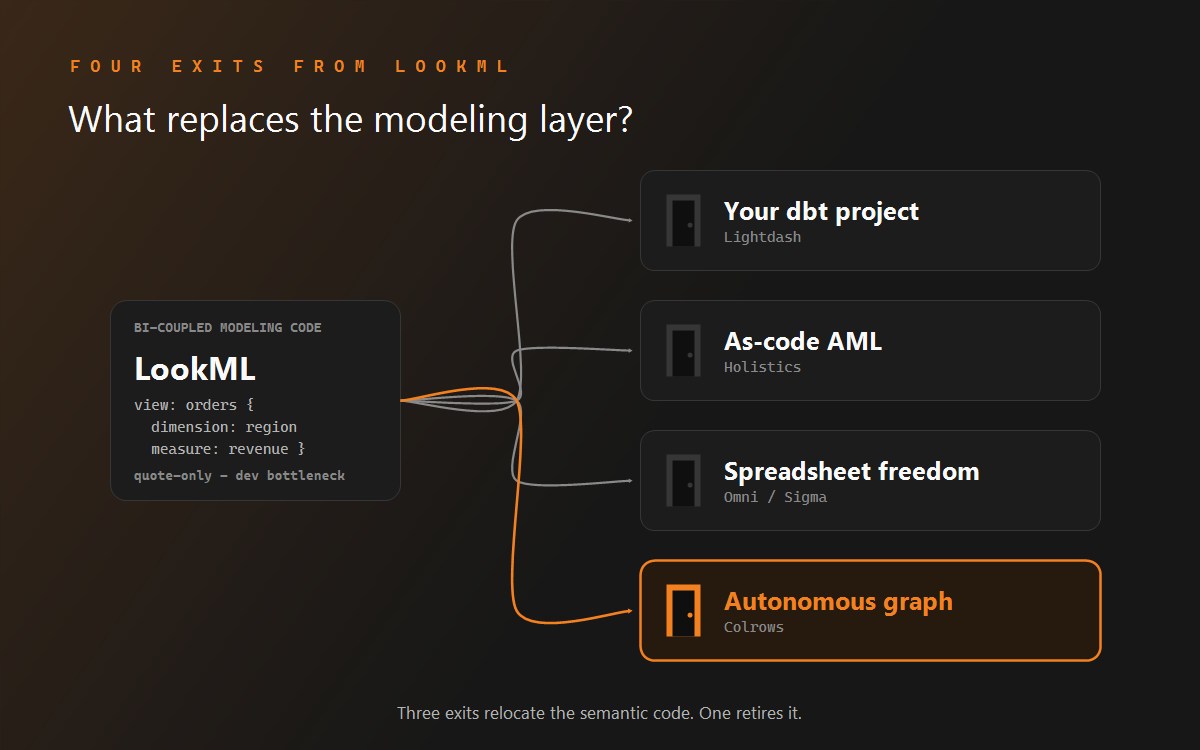
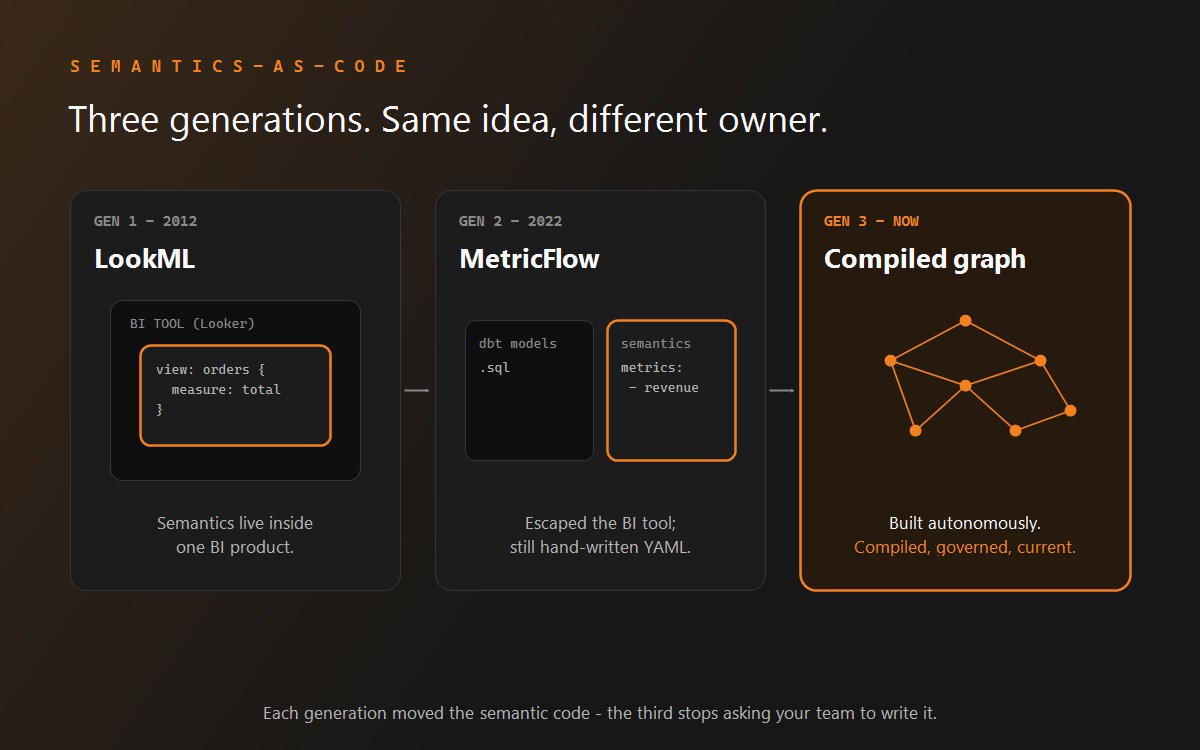
Looker's distinctive value - centrally governed metrics everyone trusts - is produced by hand-written LookML, and the labour that implies is the recurring cost no sales conversation itemizes. The public record is consistent: G2 reviewers describe a steep learning curve "especially when working with LookML," and Gartner Peer Insights reviewers report that data requests "still bottleneck with the engineering team." In budget terms: plan for LookML as a software practice - dedicated developer capacity for building, reviewing, and maintaining the model as schemas and definitions change - on top of the platform fee, the seats, and (from October) the tokens. The deeper architecture analysis is in LookML vs dbt Semantic Layer vs a Compiled Semantic Layer.
Fix the Context, Not the Model. A well-governed semantic layer that understands business context creates more reliable AI-driven analytics than fine-tuning the model itself. Every dollar you save on the Gemini token meter is a dollar the modeling layer earned by asking the right question the first time.
Five questions for the sales call
- Get the per-role unit prices in writing - Developer, Standard, Viewer - and the volume breaks; the reported ranges above are your sanity check.
- Pre-negotiate the escalator: the reported ~5% annual uplift is standard, which means it is removable.
- Model the token meter against your AI roadmap - ask what your edition's allowance covers in real Conversational Analytics sessions, and what an agent integration would burn after 1 October 2026.
- Price the instance boundary: editions include one production instance; multi-instance estates (dev/staging/regional) are additional line items.
- Ask reference customers about LookML staffing - how many developer-hours per month keep the model current at your scale. That answer is the largest number nobody volunteers.
Where Colrows changes the math (our product)
Disclosure: Colrows competes for Looker's governed-analytics workload; see 8 Looker Alternatives for the wider field. The pricing-relevant difference is which lines exist at all: the LookML-practice line disappears (the semantic graph builds and maintains itself with drift detection), per-seat counting disappears (the free tier includes unlimited users, datasources, and access policies, with metered compute), and AI consumption is deterministic compiled queries rather than generative token burn. If the budget exercise above produced a number that surprised you, the structural comparison is worth an hour before the renewal call.
Comparing more than one option? Semantic layer pricing compared puts Looker's meter side by side with Cube, dbt, AtScale, Power BI Copilot and ThoughtSpot, scored on what actually triggers overage.
Frequently asked questions
How much does Looker cost?
Google publishes no list prices - all editions are "Call sales" on annual commitment (each including 1 instance, 10 Standard Users, 2 Developer Users). Reported figures: ~$60-66K/year Standard platform fees, per-seat adders, and ~$150K/year average contracts per marketplace data attributed to Vendr - all labeled reported, not list.
Looker vs Looker Studio - what's the price difference?
Different products: Looker Studio is the free dashboard tool (paid Pro tier available); Looker is the quote-only, LookML-based enterprise platform, typically six figures annually.
What does Looker's AI cost?
The published part: Gemini Data Token allowances per edition (Standard 60M in / 1.2M out monthly, up to Embed's 1.2B / 24M), free within fair use until 30 September 2026, then $3/1M input and $20/1M output tokens from 1 October 2026.
What are the hidden costs?
The LookML developer practice (the bottleneck reviewers consistently report), the ~5% reported annual escalator, multi-instance fees, and - from October - the token meter against any serious AI usage.
A note on the claims
Google-published facts (editions, inclusions, token allowances, overage rates and dates) reflect cloud.google.com/looker/pricing as of 21 August 2026. The 1 October 2026 overage activation is unchanged in Google's live page as of this review. All dollar figures for platform fees, seats, and contracts are third-party or marketplace-attributed reports, labeled as such, with variance across sources; use them as anchors, not quotes. We are a competitor; audit accordingly. This page is reviewed quarterly, and the 1 October 2026 overage activation is a scheduled change worth re-checking at that date.