Despite the sophistication of modern data stacks, the semantic layer - the layer of meaning - has remained a fragile, human-maintained artefact. This gap is why the industry is witnessing the rise of autonomous semantic systems.
What are autonomous semantic systems?
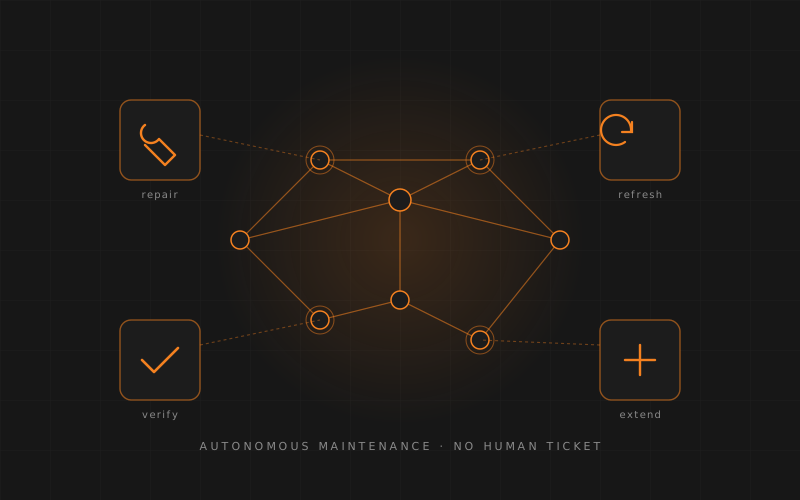
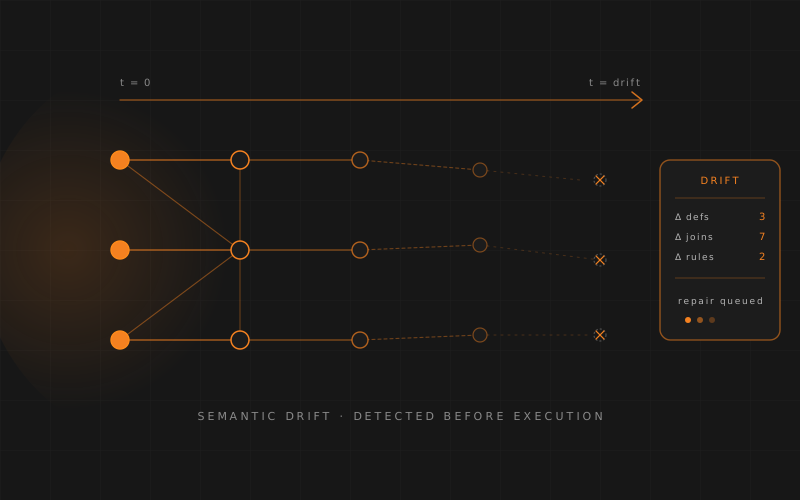
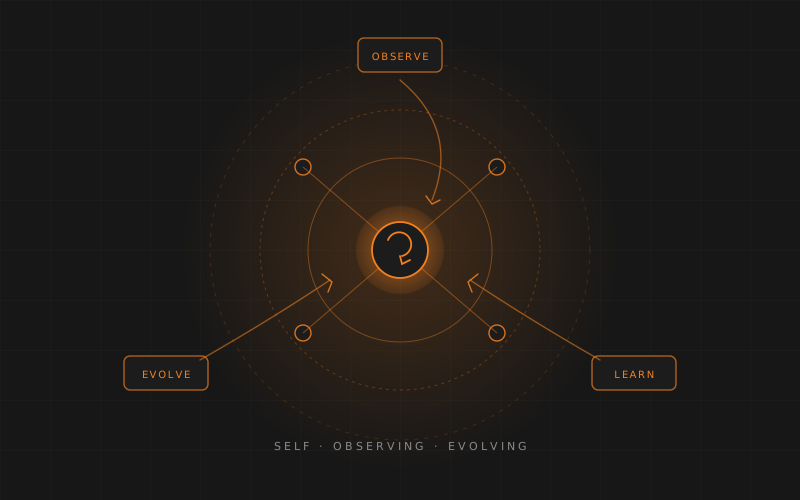
An autonomous semantic system isn't a glossary, a catalogue, or a set of metric definitions. It is a living layer of meaning that understands business concepts - entities, metrics, events, triggers, processes, and relationships. It learns from the enterprise's language through embeddings, contextual vocabularies, and LLM reasoning. It maintains itself without manual documentation: detecting drift, inconsistencies, schema changes, and definition conflicts. And it powers both human and machine intelligence - NL→SQL, multi-hop reasoning, causal chain evaluation, policy-aware insights.
Autonomous semantics became possible through the convergence of three forces: LLM reasoning (models can now reason across definitions, logic, and intent), vector memory (embeddings allow systems to understand meaning, not just structure), and autonomous agents (which can operate continuously, scanning sources and maintaining semantic consistency).
Why are manually-maintained semantics collapsing?
For years, companies tried glossaries, Confluence pages, catalogues, lineage diagrams, data product documentation, metric definitions in spreadsheets, and tribal knowledge in Slack. All failed for the same reason: human-written semantics cannot keep pace with a living enterprise. Enterprises evolve weekly. Data evolves daily. Metrics evolve monthly. Meaning evolves continuously.
Is the autonomous semantic layer the enterprise brain?
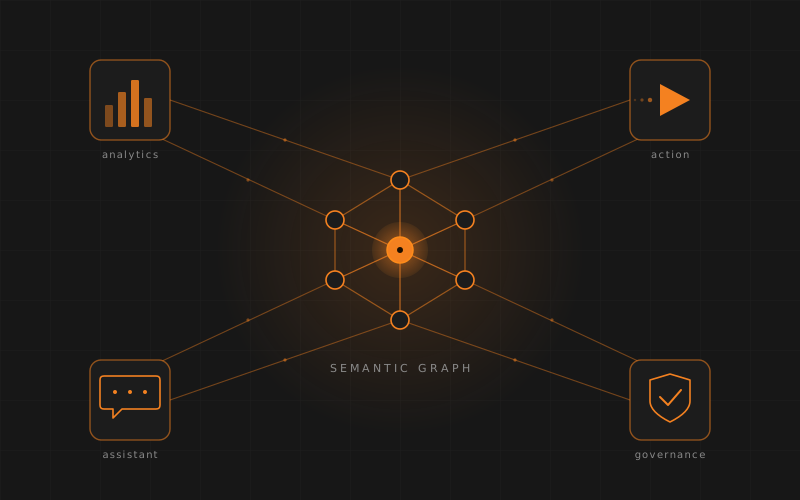
Today's stack is full of specialised tools - warehouses store, pipelines move, BI visualises, AI predicts, governance tools restrict. But nothing understands meaning. Autonomous semantic systems change that by providing a unifying conceptual intelligence layer: what an event means, how metrics relate, what concepts depend on each other, how entities interact, how triggers cause changes, how SQL maps back to business meaning.
What are the 5 pillars of autonomous semantic systems?
- Contextual vocabulary - the enterprise's language, learned from SQL, docs, usage, and natural communication
- Multi-scope semantics - different meanings across global, datastore, persona, or user contexts (a first-class citizen in Colrows' Consensus)
- Reasoning engine - multi-hop logic, embeddings, and LLM reasoning working together
- Autonomous agents - agents that rewrite definitions, fix drift, update the graph, and maintain consistency
- Semantic graph - a continuously evolving graph of concepts, events, metrics, relationships, and lineage
Together, they form a cognition layer that a modern enterprise can no longer operate without.
Every major transformation in data has replaced human-maintained artefacts with machine-maintained systems. Version control replaced shared folders. CI/CD replaced manual deployments. Now: autonomous semantics will replace manual definitions, documentation, and knowledge drift.
What does the enterprise look like without autonomous semantics?
Enterprises that avoid this shift will face increasing inconsistency, conflicting logic, slower analytics cycles, failed AI initiatives, rising semantic debt, manual reconciliation across teams, and growing governance chaos. As organisations grow, the absence of a semantic layer doesn't create linear cost - it creates exponential friction.
We are stepping into an era where semantics evolve automatically, definitions stabilise, events form causal chains, insights become explainable, and AI becomes grounded. The shift is profound but inevitable: from systems of record → to systems of intelligence → to systems of understanding.
Companies who adopt autonomous semantics early will operate with a clarity, speed, and intelligence that others simply cannot match.