Short answer: In 2026, conversational voice AI splits into two problems. Natural speech, from speech-to-speech models and agent platforms, is becoming a commodity interface. The harder problem is answering correctly against governed enterprise data: resolving business definitions, real schemas, and permissions. An autonomous semantic layer sits below the voice model and compiles each question into governed, auditable SQL, so the voice model stays swappable while business meaning stays fixed.
A human-sounding agent is not the same as a correct agent. The voice is the simpler half of the problem.
Ask a voice agent about revenue, churn, risk exposure, or portfolio performance. The agent must then do four things. It must understand your business definitions. It must resolve your data structures. It must apply your access controls. It must return a number that your team can defend. These four tasks do not happen in the voice model. They happen below it, in the data layer.
This guide compares the main voice AI models and platforms in November 2026. It groups them by function, because the market mixes four different product types under one word. It uses the criteria that decide enterprise deals: latency, cost, deployment, and data control. It then examines the part that many buyers underrate: correct answers against governed enterprise data.
Two problems, not one
Start by splitting the job in two. A voice agent has to do two different things, and they are not the same kind of hard.
Problem A, conversational intelligence. Recognise speech accurately. Handle interruptions and overlapping talk. Understand accents, emotion, and context. Reply naturally with low latency. Call tools and hold a thread.
Problem B, enterprise intelligence. Work out what the user means in business terms. Pick the correct metric and its approved definition. Resolve ambiguous entities and filters. Read a complex warehouse schema. Respect data permissions. Return an answer that is correct, reproducible, and explainable.
A model can be excellent at Problem A and still fail Problem B. It can get a simple business question wrong, one that a junior analyst would answer in a minute. The second half of this guide examines why.
Three architectures
Voice systems are built in one of three ways. The choice drives latency, transparency, and how much of the conversation the model actually understands.
Cascaded: STT then LLM then TTS
Speech-to-text transcribes the user. A turn detector decides when the user stops. A text LLM writes the reply. Text-to-speech speaks it. Each handoff adds delay. The transcript also loses how the user said something. The benefit is control. You select the strongest model for each stage. You swap any one model. You read a transcript at every step. Some regulated buyers require this transparency. Deepgram, Vapi, LiveKit, and ElevenLabs in classic mode use this design.
Native speech-to-speech
One model hears audio and speaks audio directly. This design has fewer hops and lower latency. It also keeps the tone and accent that a transcript loses. The trade-off is less transparency and tighter coupling to one vendor's voices. OpenAI, Google, Amazon, and xAI all ship native speech-to-speech models.
Full-duplex
Full-duplex is a further step. Keep it separate from native speech-to-speech, because not every native model is full-duplex. A full-duplex model listens and speaks at the same time. It can give short acknowledgements, react mid-sentence, and hand back the turn smoothly. OpenAI's GPT-Live-1, Kyutai's open-source Moshi, and Block's Dessa research preview are the reference points. Most native speech-to-speech models are still turn-based internally, even when they handle interruptions well.
Transport matters nearly as much as the model. A WebRTC connection over UDP is usually faster than a WebSocket over TCP on first-audio latency. For this reason, two agents on the same model can perform differently on a phone call.
Category 1: Native speech-to-speech models
These are the foundation models that an agent is built on. Compare them with each other, not with the platforms in Category 3.
OpenAI (gpt-realtime-2.1, GPT-Live-1)
OpenAI shipped gpt-realtime-2.1 and 2.1-mini in July 2026 with better alphanumeric recognition and interruption handling, and says p95 latency dropped at least 25 percent.1 GPT-Live-1, its full-duplex model, reached the API on 10 September 2026.2 Pricing: gpt-realtime-2.1 is $32 per million audio input tokens and $64 per million output, with cached input at $0.40.3 GPT-Live-1 is $0.05 per minute plus the backend model and tools.2
OpenAI is strong on tool calling, transport options (WebRTC, WebSocket, SIP), and partner support. One correction to the common view: OpenAI does not lead the blind-preference boards today. On the Artificial Analysis Speech Agent Arena, its best entry ranked sixth when read in late October and early November 2026.4 It does lead on conversational-dynamics scores and shows strong task-success numbers. The accurate summary is "fast and capable at tool use," not "best overall." OpenAI is cloud only. It has no on-premise option. The older gpt-realtime models retire on 20 January 2027, so plan the migration.1
Google (Gemini 3.8 Live)
Gemini 3.8 Live and a reasoning variant became generally available in September 2026. Audio costs $3 per million input tokens and $12 per million output. This is roughly $0.005 and $0.018 per minute on Google's own rates.5 These are among the lowest published audio-token rates of the hyperscaler speech-to-speech APIs in this guide. This is not the same as "cheapest complete agent," because your reasoning model and telephony cost extra. Gemini 3.8 Live supports about 97 output languages, the most in this guide. It supports asynchronous function calling, so the conversation continues while a backend tool runs.6 On the Speech Agent Arena, Gemini variants ranked second and third behind Cartesia in late October and November 2026.4 It is WebSocket-native, with WebRTC through partners. Residency controls exist on Google's enterprise agent platform. Verify your region.
Amazon (Nova 2.5 Sonic)
Nova 2.5 Sonic reached general availability in October 2026 at Nova 2 Sonic's price: $3 per million speech input tokens and $12 per million output.7 AWS reports a 1.08 second median time-to-first-audio, down from 1.50 on the prior model.7
Nova 2.5 Sonic supports seven languages. It is native to AWS identity, VPC, and billing. It is the natural choice if you run Amazon Connect.
Microsoft Azure (Voice Live)
Voice Live runs either natively or as a managed cascade (Azure speech-to-text plus a text LLM plus Azure TTS). It includes noise suppression, semantic turn detection, avatars, and function calling. Its main benefit is procurement through existing Microsoft agreements, custom neural voices, and Azure compliance boundaries. Per-token rates from its 2025 announcement were about $17 input and $38 output per million audio tokens for standard voices. Treat these rates as dated until you confirm them on the current Azure pricing page. Microsoft publishes no latency benchmark.
xAI Grok Voice 3.0
Grok Voice 3.0 is a native speech-to-speech model at about $0.08 per minute. xAI reports latency under one second. It supports more than 20 languages, SIP, and built-in web and X search. It belongs in the main comparison. It placed fifth on the Speech Agent Arena. It posted the second-highest accuracy on ServiceNow's EVA-Bench enterprise-scenario benchmark at launch, behind Cartesia.4
Category 2: Specialist speech models (STT and TTS)
These are components, not whole agents. You connect them into a cascade or a platform. Judge them on recognition accuracy and voice quality, not on end-to-end conversation.
ElevenLabs
ElevenLabs has some of the most natural voices in the market and strong voice cloning. It also offers an agent platform. It launched Eleven Realtime v1 Mini and Max in October 2026, reporting 620 and 570 millisecond time-to-first-audio.10 Self-serve agent minutes cost $0.08. The LLM is billed separately.
Check compliance per model, not per vendor. Realtime Mini is not available under HIPAA or Zero Retention Mode. Realtime Max is available under both, in the US and EU. Mini offers India and Singapore residency. Max does not.11 On-premise and on-device deployments were announced as early access. VPC is available. Separate "announced" from "generally available" when you scope a deployment.
Deepgram
Deepgram is the strongest specialist on deployment flexibility. Its Voice Agent API runs in the cloud, on single-tenant dedicated infrastructure, or self-hosted in your own VPC or on-premise hardware.12 Its Flux speech-to-text model decides end-of-turn with a model, not a silence timer, and claims under 400 milliseconds. Voice Agent pricing is $0.075 per minute standard. It drops to $0.05 per minute with your own LLM and TTS. Billing runs on connection time, so idle open calls still cost money. Deepgram holds SOC 2 Type 1 and Type 2, signs BAAs for enterprise, and offers an EU endpoint. Deepgram's own documentation states that no provider publicly confirms the exact scope of a self-hosted HIPAA BAA. This is a useful honesty signal when you compare vendors.12
Cartesia
Cartesia's Sonic TTS ranked first of 92 on the Artificial Analysis speech arena in September 2026.13 Its latency claim is model-level only, under 90 milliseconds, and excludes the network. Do not read it as an end-to-end figure. Independent measurements are closer to 150 to 300 milliseconds in production.13 Cartesia deploys on-premise, including air-gapped, or in your VPC. In late October 2026, Cartesia also launched a full agent platform, Managed Agents, which places it in Category 3 as well.
Category 3: Agent platforms and orchestration
These platforms assemble speech, reasoning, telephony, and tools into a running agent. Their value is orchestration and integration, not their own speech intelligence. Do not compare one of these platforms to a raw model. Most platforms can run several underlying models.
| Platform | What it is | Headline price | Deployment / data control | Best for |
|---|---|---|---|---|
| Cartesia Managed Agents | Hosted end-to-end agent on Cartesia's own models | ~$0.03/min at launch, plus LLM and telephony | Cloud; Cartesia also offers on-prem / VPC / air-gapped for its models | Top blind-preference and EVA-Bench scores at launch14 |
| Retell AI | Managed, metered per component | ~$0.07 to $0.31/min blended; realistic builds ~$0.13 to $0.15 | Cloud; SOC 2, HIPAA with self-signed BAA, GDPR | Fast-to-production phone agents |
| Vapi | Orchestration, bring your own providers | $0.05/min platform fee plus pass-through | Cloud; Scale contract adds SOC 2, HIPAA, PCI, residency | Teams assembling a custom stack |
| Bland AI | Self-hosted proprietary stack, one all-in rate | $0.11 to $0.14/min by plan | Dedicated infra; VPC and BAA on Enterprise | High-volume telephony, single data boundary |
| LiveKit | Open-source WebRTC + Agents framework | Cloud from free; self-host open source | Fully self-hostable (Apache 2.0) | Full control, residency, multi-vendor flexibility |
One pattern applies across this category and matters for the rest of this guide. The "keep talking while the backend works" method is not unique to any one vendor. OpenAI's GPT-Live-1 supports it. Gemini 3.8 Live and Nova 2.5 Sonic support it through asynchronous tool calls.6 The voice model continues the conversation while a backend system does the data work. This matters for where Colrows fits, below.
Category 4: Open and experimental models
Kyutai Moshi
Moshi is an open full-duplex model from a Paris nonprofit, with Apache 2.0 code and CC-BY weights and a reported 160 millisecond theoretical latency.20 It is self-host only, has no SLA, and has weak tool use in the base model. Use it for sovereign or air-gapped experiments and as an open baseline, not for a production contact centre.
Block Dessa
Block announced Dessa on 23 October 2026. Block states that Dessa is a full-duplex speech-to-speech model trained only on recorded human conversation, with no text and no pretrained models, and that it runs locally on a MacBook Pro M4 Max.15 Speech-only training is a different research approach.
A word on vendor viability
Treat vendor survival as a selection criterion. Hume AI announced that its EVI and TTS voice APIs end on 13 November 2026, and that account data is deleted afterward.16 If a voice vendor is central to your roadmap, ask for a written deprecation notice period and a data-and-voice export path before you sign.
The enterprise buyer's lens
Latency: four different numbers, do not stack them
Vendors quote latency in at least four different ways. One shared column would create a false comparison. The table below keeps the four measures separate.
| What is measured | What it tells you | Example figure | Source type |
|---|---|---|---|
| Model inference latency | Raw model speed, excludes network | Cartesia Sonic sub-90 ms | Vendor, model-only |
| Time-to-first-audio | First sound out, often excludes turn detection | Nova 2.5 Sonic 1.08 s median | Vendor benchmark |
| End-of-speech to first response | Closest to how fast the call feels to a caller | Deepgram Flux end-of-turn under 400 ms | Vendor, component |
| Full round-trip | Network, turn detection, reasoning, and speech, combined | Only your own test shows this | Measure it yourself |
For a phone agent, the third measure matters most. The p95 figure matters more than the median. An 8 kHz PSTN path and SIP hops add delay that no vendor benchmark includes. Test your own round trip before you accept any single number.
Cost: incompatible billing units
Vendors bill in different units: audio tokens, session minutes, connection minutes, characters, or a platform fee plus pass-through costs. A single headline price hides most of the real cost. Ask every shortlisted vendor to price one standard scenario end to end. For example, a five-minute inbound call, including audio in and out, the reasoning model, telephony, orchestration, and any redaction or QA add-ons. For token-billed models, ask about context replay and prompt caching. An uncached multi-minute call can cost several times as much as a cached one.
Deployment and data control: do not lump these together
VPC, single-tenant dedicated SaaS, on-premise, and air-gapped are four different things. Among the vendors here, only Deepgram, Cartesia, Bland Enterprise, LiveKit, and Kyutai offer credible self-hosting or on-premise deployment. ElevenLabs advertises VPC and on-premise for enterprise and healthcare, and some of it is early access. The hyperscaler speech-to-speech models are cloud only, with regional processing options. For BFSI, healthcare, and government buyers, the deployment type is often the deciding constraint. Make each vendor state it precisely.
Compliance: eligibility is not the same as a signed BAA
Turn compliance into explicit procurement questions, each answered per endpoint and per model, not per vendor:
- Processing residency and storage residency, which can differ.
- Retention of audio, transcripts, and prompts, and whether your data trains their model.
- BAA scope: whether your exact endpoint and configuration are covered, not just whether the service is "HIPAA-eligible".
- Self-hosting: whether the whole inference stack can run inside your infrastructure.
- Auditability: whether calls, tool calls, and decisions can be reconstructed.
- SLA: uptime, support response, and a model-deprecation notice period.
HIPAA eligibility, a signed BAA, and a compliant deployment are three separate claims. Get all three in writing.
The real bottleneck: answering correctly against enterprise data
Many voice buyers underrate this part. A voice agent that sounds human but returns the wrong number is more dangerous than an old touch-tone menu. People trust a confident human voice, so they act on the wrong number.
After speech becomes intent, the agent must still convert the question into a correct query. Take the question "What was our net revenue in the Northeast last quarter, excluding cancelled enterprise accounts." The agent must run this over your real schema, your business definitions, and your access rules. This is a separate problem from the voice interface. The evidence shows it is far from solved.
Spider 2.0 shows the problem. It is a benchmark built from real enterprise databases. On its harder splits, strong systems solve only a small fraction of the tasks that the same class of model answers easily on academic benchmarks. Real enterprise databases have hundreds of columns, multiple SQL dialects, and documentation that the system must read to write a correct query.17
Leaderboard progress does not transfer to messy schemas. A September 2026 study introduced DevRev, a benchmark built from one production database with deeply nested arrays, structs, and polymorphic links. Three systems that score between 63 and 73 percent on the public Spider 2.0-Snow leaderboard answered only 27 to 37 percent of DevRev's questions correctly.18
Production teams report the same gap, not only benchmarks. LinkedIn's 2025 account of its internal text-to-SQL chatbot describes a knowledge graph built from schema metadata, query logs, wikis, and code to supply business context. The chatbot has over 300 weekly users. Expert review found 53 percent of responses correct or close to correct.19 This is a capable model with a dedicated engineering team and a custom knowledge graph, and it still reaches only about half correct on internal questions. That is the current state of the art.
What the evidence actually supports
State the claim precisely. The research above does not prove that any one product is the only fix. It proves a narrower and stronger point.
Enterprise voice agents need more than a capable conversational model. They need a governed way to resolve business definitions, read real schemas, enforce permissions, and validate execution. The common thread across the evidence is clear. Business context must be structured and governed in one place. The model must not guess it per query.
The approaches differ in cost and repeatability. LinkedIn built a bespoke knowledge graph with a dedicated engineering team, and it reached about 53 percent correct. The DevRev paper's system also uses schema selection, metadata retrieval, a knowledge graph, and query repair. These are custom builds. A semantic execution layer provides the same governed capabilities as a product, rather than as a per-company engineering project. This is the practical difference: a governed layer you adopt, not a knowledge graph you build and staff.
Note where this matters and where it does not. A customer-service agent answering "where is my order" calls an order API and reads back a status. It needs no warehouse semantic layer. The argument here is about the second type of question, the analytics-grade question: "net revenue in the Northeast last quarter, excluding cancelled enterprise accounts." That question contains several hidden definitions. What counts as net revenue. Which fiscal calendar defines last quarter. What a cancelled enterprise account is. Whether Northeast is a sales territory or a geography. Who is allowed to see the answer. A governed layer is justified on this type of question.
Where Colrows fits
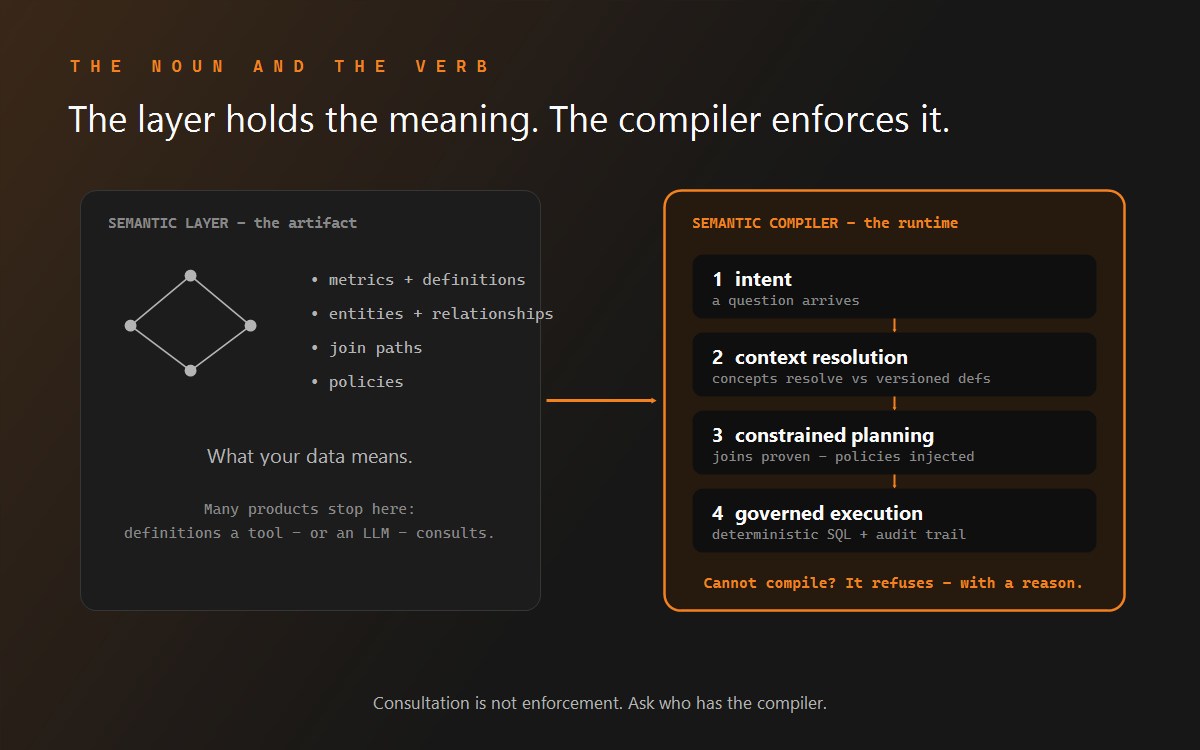
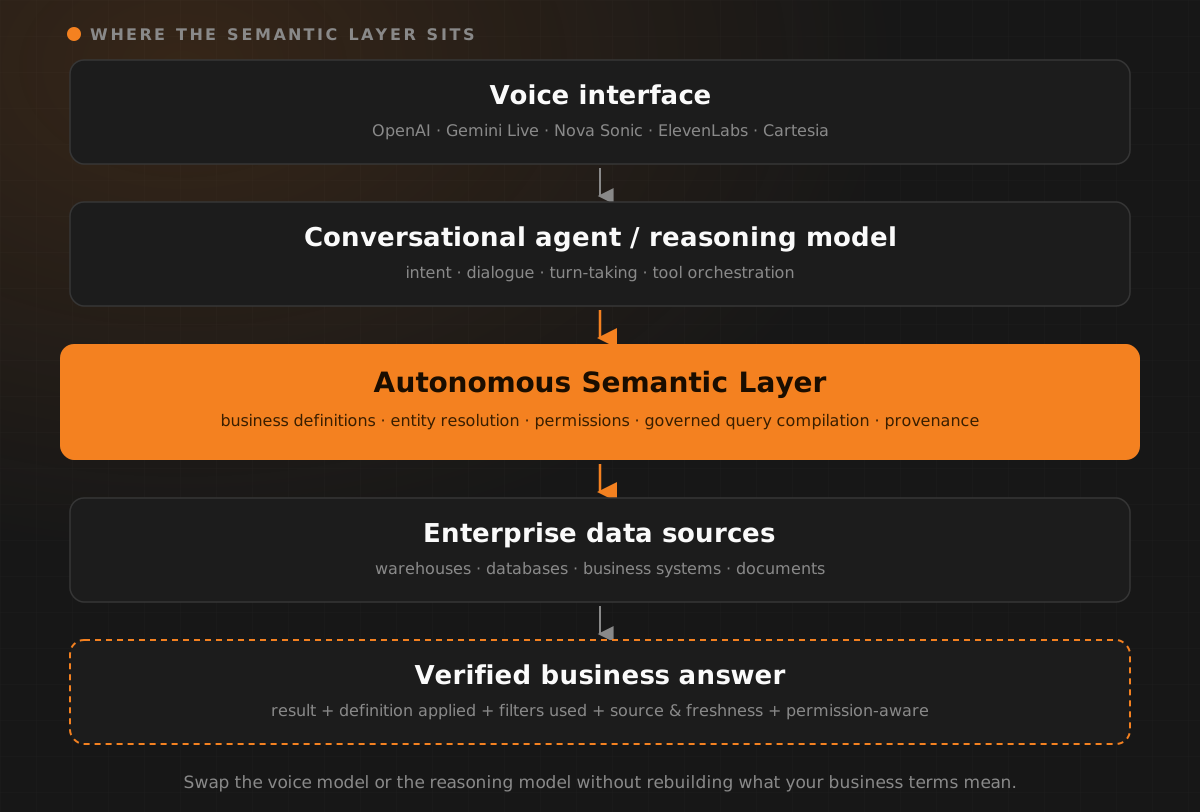
Colrows is an Autonomous Semantic Layer. It is not another voice model and not another reasoning model. It sits between the agent and your data. It holds the part that does not change when you swap models: your business definitions, your entity resolution, your permissions, and governed query compilation with provenance. At its core, Colrows is a deterministic semantic compiler. It compiles a business question into governed, auditable SQL against approved definitions. It does not generate a fresh guess each time.
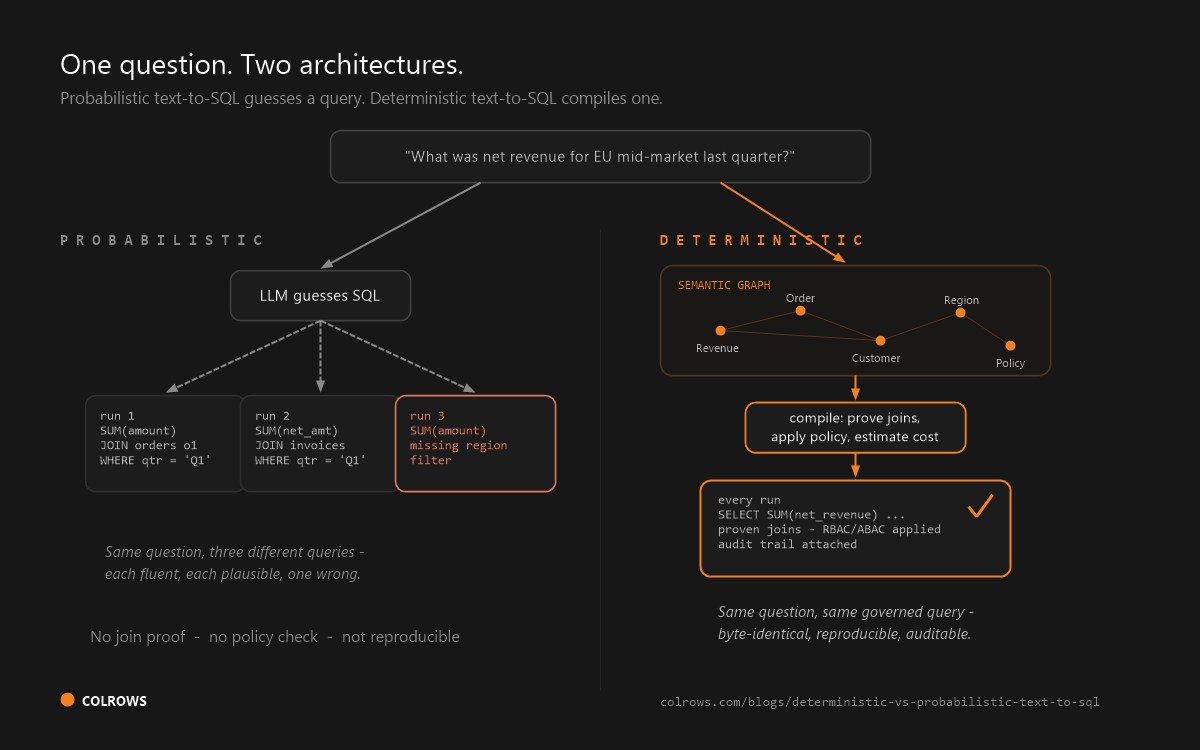
This is the key contrast. A raw text-to-SQL model or a RAG system produces a probabilistic guess at the metric, the filters, and the join path. A deterministic semantic compiler resolves each of these against governed definitions. The result is the same query for the same question every time. This removes two common failures: a hallucinated metric definition, and access to data the caller is not allowed to see.
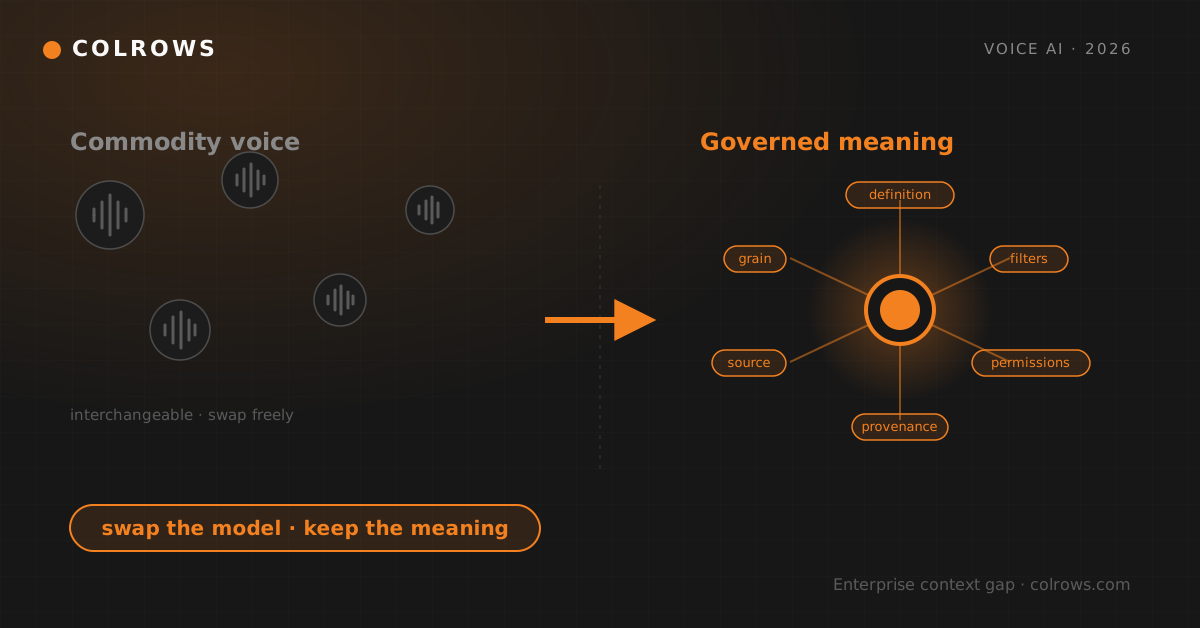
This placement is the main argument of this guide. Voice models are becoming interchangeable interfaces. Your business context is not interchangeable. You should be able to change your speech model, your reasoning model, or your orchestration platform without rebuilding what revenue, churn, or an enterprise account means. When the governed meaning lives in a layer of its own, the voice model becomes a replaceable part. The business definitions you spent years building stay in place.
The asynchronous pattern from Category 3 makes this work in a live call. The voice model continues the conversation, for example "let me pull that up," while the Autonomous Semantic Layer runs the governed query in the background. Gemini, Nova, and GPT-Live all support asynchronous tool calls, so the layer works with any of these voice models.
The answer that returns is not a bare number. For the earlier question, "net revenue in the Northeast last quarter, excluding cancelled enterprise accounts," a governed response carries the result and its full context. It states the net-revenue definition used. It states the fiscal calendar for last quarter. It states that Northeast is the sales territory, not the geography. It states that cancelled enterprise accounts are excluded. It states the source table and its freshness. It applies the caller's data permissions. So the agent can say: "Net revenue for the Northeast sales territory last quarter was X, using the finance-approved definition, excluding accounts cancelled before activation." The figure is illustrative. The structure is the point: a number with its meaning and its provenance attached.
One qualifier, for accuracy. A semantic compiler governs definitions, relationships, permissions, and provenance, and it makes correctness repeatable and auditable. Final correctness also depends on source-data quality and correct intent capture. The compiler removes the guesswork in metric definition and access control. It does not fix a wrong number in the source warehouse.
Approaches to the enterprise-context problem
| Capability the question needs | Model-only or RAG | Colrows (Semantic Compiler) |
|---|---|---|
| Business metric definition | Guessed per query, varies | Governed, one definition |
| Entity and filter resolution | Model guess or retrieval hit | Context graph, deterministic |
| Permissions | Implemented elsewhere, rarely enforced | Enforced in the layer |
| Query execution | Generated SQL, variable | Governed compilation, repeatable |
| Answer provenance | None, or a source snippet | Definition, filters, source, freshness |
| Swap the voice or reasoning model | Context rebuilt | Unaffected |
This table compares approaches, not named competitors. The correct next step for any such claim is a controlled evaluation. Use the same reasoning model and the same dataset. Measure answer correctness, wrong-answer rate, correct refusals, permission enforcement, latency, and cost, both with and without the governed layer. Colrows holds itself to this test. Any buyer should ask every vendor for it, Colrows included.
Recommendations
- Shortlist by constraint, not by headline. For premium tool-use conversations, use OpenAI gpt-realtime-2.1 or GPT-Live-1. For multilingual or cost-sensitive scale, use Gemini 3.8 Live. For AWS or Amazon Connect, use Nova 2.5 Sonic. For a Microsoft estate or a branded voice, use Azure Voice Live. For on-premise, VPC, or air-gapped, use Deepgram plus Cartesia on self-hosted LiveKit, or Bland Enterprise for a single vendor. For voice quality as the main need, use ElevenLabs, and check the per-model compliance limits.
- Run a two-week trial on your own telephony path. Test accents, noisy lines, proper names, numbers, and account identifiers. Test deliberate interruptions. Test spoken paraphrases of the same question. Measure p50 and p95 end-of-speech to first audio. Measure tool-execution success, not only whether the vendor supports function calling.
- Model cost on one standard call, end to end. Get written rates for context caching, burst concurrency, and connection-time billing.
- Contract for exit. Require data export, voice-clone portability, and a deprecation notice period. The January 2027 OpenAI retirement and the November 2026 Hume shutdown show why this matters.
- Build the data layer before the voice layer. Define governed metrics and entities. Restrict the agent to governed queries, not free-form SQL. Add read-back confirmation for actions with consequences. Test accuracy on spoken, paraphrased questions, not typed ones.
Swap the model. Keep the meaning.
Fix the Context. Not the Model.
If you are putting a voice agent in front of enterprise data, the governed layer underneath decides whether the answers hold up. That is what the Colrows Autonomous Semantic Layer provides. Bring 10 real business questions and your schema. We will walk through the governed answer for each one with you, in a working session.
Book a 10-question governed-answer sessionSources
- OpenAI, API changelog and realtime model announcements (gpt-realtime-2.1, retirement dates). developers.openai.com/api/docs/changelog
- OpenAI, GPT-Live-1 API availability and per-minute pricing. openai.com/api
- OpenAI, realtime audio token pricing. openai.com/api/pricing
- Artificial Analysis, Speech Agent Arena (blind-preference Elo, read Oct to Nov 2026); EVA-Bench results via launch reporting. artificialanalysis.ai/speech-to-speech/arena
- Google, Gemini Live API pricing and language support. ai.google.dev / aistudio.google.com/docs/pricing
- Google Cloud documentation, Gemini Live asynchronous function calling; AWS, Nova Sonic asynchronous tool use. docs.cloud.google.com
- AWS, Amazon Nova 2.5 Sonic general availability, pricing, and latency. aws.amazon.com/blogs
- AWS, Nova 2.5 Sonic model card (in-region inference; Geo and Global not supported; four listed regions). docs.aws.amazon.com/bedrock/latest/userguide/model-card-amazon-nova-2-5-sonic.html
- AWS, Bedrock regional availability by model (conflicting cross-region table). docs.aws.amazon.com/bedrock/latest/userguide/models-region-compatibility.html
- ElevenLabs, Eleven Realtime v1 Mini and Max announcement and latency. elevenlabs.io/realtime
- ElevenLabs, realtime model compliance and residency matrix (HIPAA/ZRM, India, Singapore). elevenlabs.io/docs
- Deepgram, Voice Agent API pricing, deployment options, and self-hosting / BAA notes. deepgram.com/pricing and deepgram.com/blog
- Artificial Analysis speech arena (Sonic ranking); Coval and vendor latency figures for Cartesia Sonic. artificialanalysis.ai; cartesia.ai
- Cartesia, Managed Agents launch: Speech Agent Arena and ServiceNow EVA-Bench results, $0.03/min launch price. cartesia.ai
- Block, Dessa announcement (speech-only training, full-duplex, local M4 Max inference, research preview). As reported 23 Oct 2026.
- Hume AI, EVI and TTS API shutdown notice, effective 13 November 2026. hume.ai
- Spider 2.0: Evaluating Language Models on Real-World Enterprise Text-to-SQL Workflows (ICLR 2025). arXiv:2411.07763
- A Cost-Aware Agentic Architecture for NL-to-SQL over Nested Enterprise Schemas, with a New Benchmark (DevRev), September 2026 preprint. arXiv:2609.04641
- Chen et al., Text-to-SQL for Enterprise Data Analytics, LinkedIn, KDD 2025 workshop (knowledge graph; 300+ weekly users; 53% correct or close). arXiv:2507.14372
- Kyutai, Moshi: a speech-text foundation model for real-time dialogue (full-duplex, latency figures, open weights). Kyutai Labs, github.com/kyutai-labs; arXiv:2410.00037
Frequently asked questions
Which conversational voice AI model should an enterprise choose in 2026?
There is no single winner. OpenAI's realtime models lead on tool use and responsiveness, Gemini 3.8 Live offers the lowest published audio-token rates and widest language support, Nova 2.5 Sonic fits AWS estates, and Cartesia Managed Agents topped blind-preference and enterprise-scenario benchmarks at launch. The right choice depends on latency, cost, deployment, and data-control constraints.
Why do voice agents give wrong answers about business data?
The voice model is rarely the problem. Turning a spoken question into a correct query over a real enterprise schema, with the right metric definitions, entity resolution, and permissions, is a separate and harder problem. Enterprise text-to-SQL benchmarks such as Spider 2.0 and DevRev, and LinkedIn's production chatbot at roughly 53 percent correct, show how far from solved this is.
What is an autonomous semantic layer and where does it fit in a voice agent?
An autonomous semantic layer sits between the conversational agent and the enterprise data. It holds governed business definitions, entity resolution, permissions, and deterministic query compilation with provenance, so it acts as a deterministic semantic compiler rather than a per-query guess. It makes answers correct, repeatable, and auditable, and it is independent of which voice or reasoning model is used, so the model becomes swappable while business meaning stays fixed. Colrows is an autonomous semantic layer.