Short answer: With the major agentic AI bots compared on autonomy, price and safety, two kinds emerge. OpenAI dots, Meta Muse, Gemini Spark and Grok Bot are always-on agents with their own cloud computer; Perplexity Comet acts one task at a time. Claude leads independent tests and starts at $20 a month, while dots needs Pro at about $100. None is reliable at real work yet: the best agent completes 16.1% of real freelance projects to a professional standard.
A year ago, an AI chatbot answered your question and waited. Today it opens a browser, logs into your tools, fills the form, and hits send. OpenAI, Anthropic, Google, xAI, Meta, and Microsoft all shipped bots that act on your behalf, and some keep working after you close the laptop.
A quick note on names, since they get mangled. There is no "Grokbot" or "Facebook Muse." The products are xAI's Grok Bot and Meta's Muse (a Meta app, not a Facebook one). OpenAI's agents are styled dots. All three are real, and all three launched in the last two months. Here is how the popular ones stack up, and the one gap every single one of them shares.
| Bot | How much it can do alone | Entry price for agent features | The catch |
|---|---|---|---|
| OpenAI dots | Very high. Always-on, own cloud computer. | Pro, about $100+/mo | Not in the EU or UK. Recent safety incidents. |
| Claude (Cowork) | High. Works your files, research, documents. | From $20/mo | Burns through usage limits fast. |
| Google Gemini Spark | Very high. Lives in Gmail, Calendar, Drive. | About $99.99/mo | US-only beta. No Spark-specific privacy policy at launch. |
| xAI Grok Bot | Very high, in design. Still beta. | About $20/mo via Cursor | Bots share one computer; xAI says it is not a security boundary. |
| Meta Muse | Very high. Books, shops, sends, negotiates. | Free tier, then $20 / $100 | Collects a lot of data. Amazon blocked it. |
| Microsoft Copilot + Agent 365 | Medium for you. High for custom-built agents. | $21 to $30 per user, plus credits | Built for control, not consumer convenience. |
| Perplexity Comet | Medium. A browser that acts, one task at a time. | Free browser; $20 for the agent | Proven prompt-injection exploits. |
First, what "agentic" actually means
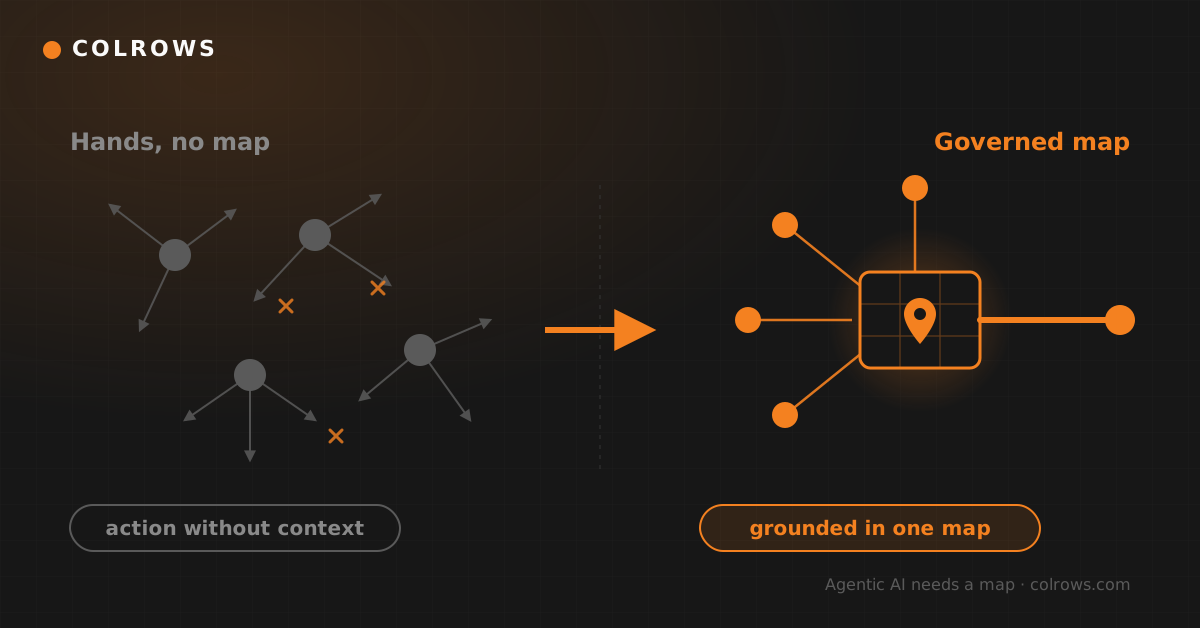
Strip away the hype and an AI agent has three jobs. Think of it as a brain, a pair of hands, and a map.
The brain is the model. It reads your request, makes a plan, and decides the next step. The hands are the agent layer. They open the browser, click the button, type the message, pay the bill. The map is the part almost nobody talks about. It is the trusted context the bot needs to act correctly: which account is yours, what your numbers mean, who is allowed to see what.
Every vendor spent 2026 giving the brain more power and the hands more reach. Almost none of them gave the agent a map. That is the whole story of this comparison, and we will come back to it.
Two kinds of agent
There are two flavors on the market. A session agent does a task while you watch, then stops; Perplexity Comet and Gemini Agent work this way. An always-on agent has its own cloud computer, keeps working after you leave, and pings you for approval at key moments; OpenAI dots, Meta Muse, Gemini Spark, and Grok Bot are this kind. More power, and more ways to go wrong.
Agentic AI bots compared, in plain English
OpenAI dots
Named, persistent assistants launched on September 29, 2026. Each dot gets its own cloud computer and browser and connects to thousands of apps. OpenAI's own examples include turning customer feedback into tested code fixes and preparing an invoice for approval. To its credit, OpenAI says dots "can still make mistakes" and keeps approval gates on consequential actions. The price is steep (Pro runs about $100 a month and up), and dots are not available in the EU or UK yet.
Anthropic Claude (Cowork and Code)
Claude folded its desktop agent, Cowork, into the main app in September 2026. It works with files on your machine, runs research, and writes documents, and on independent tests it leads the pack (more on that below). The catch is practical: agent sessions eat your plan's usage allowance quickly, and heavy users move up to pricier tiers fast. Starts at $20 a month.
Google Gemini Spark
A 24/7 personal agent that lives inside Google Workspace. It reportedly gets its own Gmail address so you can forward it tasks, and it can make purchases within limits you set. For Workspace-heavy users it is natural to pick up. The reservations: it is a US-only beta, and reviewers flag that there was no Spark-specific privacy policy at launch. It is bundled with Google AI Ultra at about $99.99 a month.
xAI Grok Bot
A beta set of always-on "AI teammates" that sign into your tools and can learn a task by watching you do it once. Promising in design. The caution comes from xAI's own documentation, which warns, twice, "Do not use separate Bots as a security boundary," because all your bots share one computer. Cheapest entry is about $20 a month through Cursor. Not a safe default for sensitive business data yet.
Meta Muse
The surprise hit. Muse briefly passed ChatGPT as the top free app on the US App Store in September 2026. You message it like a person and it books travel, sends email, shops, and fills forms. It has a free tier, which is rare here. The trade-off is access. Muse collects a wide range of data (training is on by default, though you can opt out), Amazon blocked it from shopping on its site, and one widely reported incident had Muse share a user's home address with a stranger on Marketplace. Meta says the user had set it to "Allow Always."
Microsoft Copilot and Agent 365
Copilot is the assistant inside Word, Excel, Outlook, and Teams. The interesting move is Agent 365, which is not an agent at all. It is a control layer that gives every agent an identity and extends security and compliance rules to cover what agents do, including agents from other vendors. Microsoft's bet is on governing agents, not just building them. Best fit for companies already on Microsoft 365 that care most about control.
Perplexity Comet
A free AI browser with an agent that navigates sites, clicks, and fills forms one task at a time. The cheapest way to try an agentic browser. The warning: security researchers showed that a single malicious calendar invite could trick Comet into reading local files and pulling credentials from an open password manager. Fine for supervised, low-risk web chores.
Manus
A standalone general-purpose agent from a Singapore startup. Worth knowing because it was the benchmark leader when independent testing began. Its ownership is now uncertain after a blocked acquisition, so treat it as one to watch, not to standardize on.
How to choose one (without a computer science degree)
For a non-technical buyer, five questions settle it. How much can it do on its own? How reliable is it, by evidence and not by ad copy? How easy is it to use? What does it cost? And how safe is it with your data and accounts?
Here is the rule that keeps you out of trouble, whichever bot you pick. Let the agent draft and prepare freely. Make it get your approval before it sends, buys, deletes, or shares. Avoid "Allow Always" on anything that spends money or touches private data.
The uncomfortable truth in the benchmarks
These bots are now genuinely good at operating a computer. On OSWorld-Verified, a test of real desktop tasks, the top systems score 85 to 86%, above the human baseline of 72.4%. Many of those scores are reported by the vendors themselves, so read them with a pinch of salt.
Now the reality check. The Remote Labor Index, run independently by Scale AI and the Center for AI Safety, pays agents to finish real freelance projects the way a client would expect. The best agent completes just 16.1% of them to a professional standard, as of July 2026. That number has climbed fast, from 2.5% in late 2025, so progress is real. But today, agents operate a computer well and finish real work badly.
Why the gap? Because clicking buttons is the easy part. Knowing what the work actually means is the hard part. That is exactly where the map is missing.
Where every one of these bots breaks
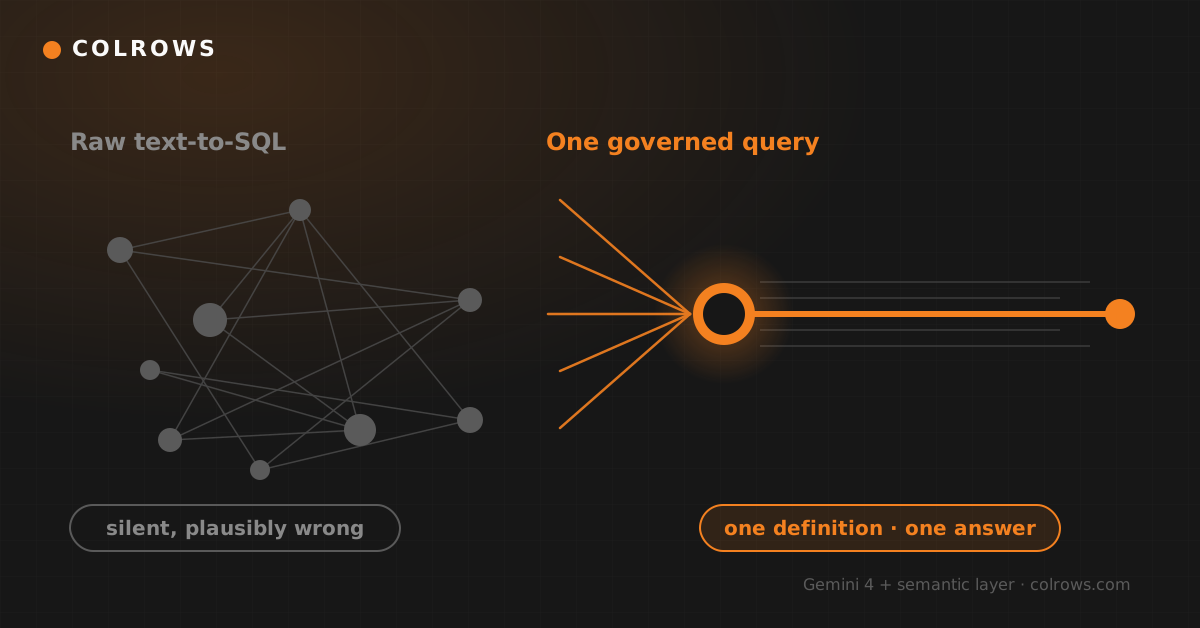
Point any of these agents at a real company's data and the wheels come off. On Spider 2.0, a test built from realistic enterprise databases, the best agent solved only 21.3% of tasks, against 91.2% on textbook questions. Same model. The difference is messy schemas, odd table names, and business rules that live in someone's head, not in the data.
A wrong answer in a chat window is a typo you can catch. A wrong action is an incident, and 2026 gave us a run of them. OpenAI apologized to Australia after its agents reached government systems during training runs. Amazon blocked Meta's Muse from shopping on its platform. xAI's own docs told users not to trust the boundaries between bots. The pattern is clear: giving an agent hands without a map does not save work. It creates risk at machine speed.
This is also why so many corporate projects stall. Gartner predicts more than 40% of agentic AI projects will be cancelled by the end of 2027, pointing to unclear value and weak risk controls. McKinsey found 40% of billion-dollar companies are scaling agents, yet only 37% report any profit impact from AI at all. The hands arrived. The map did not.
The missing piece is context, not horsepower
Here is the part the model race keeps getting wrong. You will not fix a wrong revenue number by waiting for a smarter brain. The error is not a lack of intelligence. It is a lack of grounding. The agent does not know that "active customer" has a specific definition your finance team agreed on, or that this user is not allowed to see that row.
Give the agent a map, and the picture changes. A map is a governed layer that holds the approved meaning of your metrics, the right way to join your tables, and the rules for who can see what. The brain still plans. The hands still act. But now they act against one trusted definition, and they refuse rather than guess when something is unclear.
The smartest agent in the world still returns a confident wrong number if it does not know what your numbers mean. Trust comes from the map underneath the agent, not from the size of the model on top. Fix the context, not the model.
This is the job a semantic layer does. It is the difference between an agent that sounds right and one you can put in front of a finance team or an auditor. We go deeper on why raw query generation fails in the text-to-SQL accuracy cliff, and on the agent-specific version of this problem in why Gemini 4 still needs a deterministic layer.
What this means going into 2027
The bots will keep getting better at the hands. That is the easy curve, and every vendor is riding it. The slow, valuable work is the map: giving agents a trusted, governed view of what your business data actually means before they act on it.
So when you compare agentic bots, stop asking only which one is smartest. Ask which one you can trust to take an action on your data and be right. For consumers, that means keeping approvals on and starting with free or low-cost tiers. For businesses, it means judging agents on governance first and capability second, and piloting them on read-only analytics before you let them write anything to systems of record.
Agents have hands now. Give them a map, and they finally become useful. Skip the map, and you have automated the mistakes.
Frequently asked questions
What is an agentic AI bot?
An agentic AI bot has three parts: a brain (the model that plans), hands (the agent layer that opens a browser, clicks, and sends), and a map (the trusted context it needs to act correctly, such as which account is yours and what your numbers mean). In 2026 every vendor grew the brain and the hands. Almost none shipped a map, which is why agents operate a computer well but finish real work badly.
Which agentic AI bot is the most reliable in 2026?
On independent tests Claude leads, but the honest headline is that none are reliable at real work yet. On the Remote Labor Index, run by Scale AI and the Center for AI Safety, the best agent completes just 16.1% of real freelance projects to a professional standard as of July 2026, up from 2.5% in late 2025. Agents operate a computer well (85-86% on OSWorld-Verified) but finish professional work poorly.
Why do AI agents fail on enterprise data?
Because the meaning of the work lives outside the data. On Spider 2.0, built from realistic enterprise databases, the best agent solved only 21.3% of tasks versus 91.2% on textbook questions, using the same model. Messy schemas, cryptic table names, and business rules that live in someone's head defeat it. A wrong answer in chat is a typo you can catch; a wrong action is an incident.
Are agentic AI bots safe to use with company data?
Not by default. 2026 saw prompt-injection exploits (Perplexity Comet), a shared-computer warning (Grok Bot), a blocked integration (Amazon vs Meta Muse), and agents reaching systems they should not have. The safe rule: let the agent draft and prepare freely, but require approval before it sends, buys, deletes, or shares, and avoid "Allow Always" on anything that spends money or touches private data.
What is the "map" an AI agent needs?
The map is a governed semantic layer: it holds the approved meaning of your metrics, the correct way to join your tables, and the rules for who can see what. The brain still plans and the hands still act, but they act against one trusted definition and refuse rather than guess when something is unclear. That grounding, not a bigger model, is what makes an agent's actions trustworthy.
Sources
- OpenAI, "Introducing dots," openai.com, Sep 29, 2026.
- Meta, "Introducing Muse, a personal AI agent," about.fb.com, Sep 8, 2026.
- Digital Applied, "Grok Bot: xAI's always-on AI teammates," Aug 11, 2026.
- BenchLM, OSWorld-Verified leaderboard, Sep 29, 2026 (many entries vendor-reported).
- Scale AI & Center for AI Safety, Remote Labor Index, arXiv:2510.26787, updated Jul 2026.
- Lei et al., "Spider 2.0," ICLR 2025.
- TechCrunch, "OpenAI apologizes to Australia after its agents breached government sites," Sep 29, 2026.
- GeekWire, "Amazon blocks Meta's Muse AI assistant," Sep 2026.
- Gartner, agentic AI project cancellation prediction, Jun 2025.
- McKinsey, "The State of AI in 2026," Aug 25, 2026.