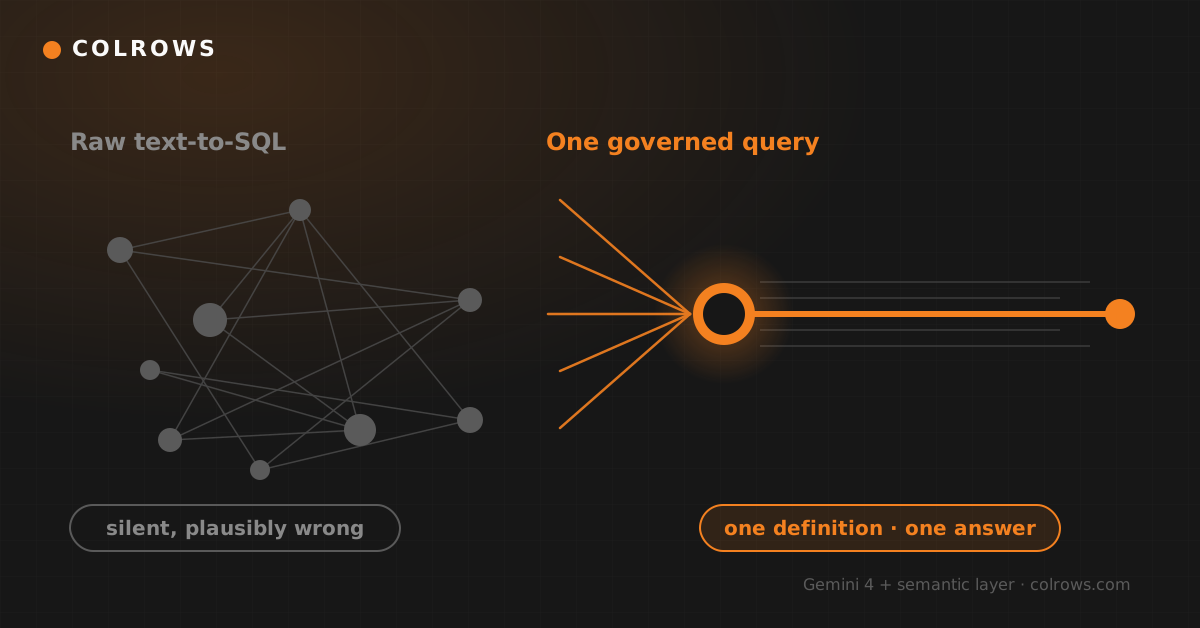
Short answer: Gemini 4 Argon tops several reasoning benchmarks, but on enterprise data it still needs a semantic layer. Your schema does not hold business definitions, join logic or access policy, so a model writing raw SQL can return a plausible wrong number. The working split: Gemini 4 interprets the question, and a deterministic semantic layer compiles governed SQL and enforces policy before execution. Google reports this routing cut data errors in generative AI queries by as much as two thirds.
On September 30, 2026, Google released Gemini 4 Argon. It ties for the top score on the Artificial Analysis Intelligence Index at 53, posts a state-of-the-art 77.9% on DeepSWE v1.1, and takes first place on the Vals Index at 68.9%, with a one-million-token output limit.1,2 This is a real step forward, and it deserves the credit.
Now point it at your Snowflake or BigQuery instance and ask for net revenue by region for the last fiscal quarter. The model that just topped the benchmarks will write a query that runs, returns a clean number, and may be wrong in a way no one in the room can see. That gap is the whole story.
| On enterprise data | Gemini 4 writing raw SQL | Gemini 4 + Colrows semantic layer |
|---|---|---|
| Who builds the query | The model guesses joins and grain from the schema. | The model reads intent. Colrows compiles the query. |
| Failure mode | Silent. A plausible but wrong number. | Loud. An explicit error, not a fake answer. |
| Business definitions | Not in the schema. The model invents them. | Governed, versioned, applied the same way every run. |
| Security | Row-level and tenant rules live downstream, if at all. | Policy enforced before the query executes. |
| Consistency | Same question, different answers across runs. | One definition. One answer. Auditable lineage. |
Argon is a better interpreter, not a better accountant
Start with the number people are quoting this week. On the AA-Omniscience test, Argon has a 15% hallucination rate, the lowest of any model scoring 45 or higher on the Intelligence Index. The same source puts GPT-6 Astra at 51% and GPT-6.1 Sol at 54%.2 That is good news: Argon is more willing to admit when it does not know.
Read the next sentence in that report, though. Argon's accuracy is 50%, which is 13 points below GPT-6 Astra at 63%.2 The hallucination rate is low partly because Argon abstains more often, not because it knows more. And AA-Omniscience tests closed-book factual recall with no tools. It does not test whether a model picks the right join path on your schema.
So the headline figure is real, and it is the behavior enterprises want. It also says almost nothing about how often a generated query returns a wrong revenue number. Those are two different jobs. Argon is an excellent interpreter of language and intent. Running your numbers is a different task.
The benchmark that actually looks like your warehouse
One benchmark is built for enterprise reality. Spider 2.0 uses real enterprise workflow tasks, with schemas of hundreds to thousands of columns across BigQuery, Snowflake, and SQLite. When the field moved from the clean Spider 1.0 to Spider 2.0, a leading reasoning model fell from 91.2% to 21.3%.3
That collapse is the point. General intelligence does not translate into warehouse execution. A model can ace a reasoning test and still fail four out of five real analytics tasks on a messy schema.
Here is the nuance, and it strengthens the case rather than weakening it. The systems that later climbed back into the 90s on Spider 2.0 did not get there on raw model power. They got there by wrapping the model in a governed layer that holds business logic, metric definitions, and join paths.5 The recovery is itself the argument for a semantic layer. The model handles language. The layer handles correctness.
Why a bigger model does not close the gap
The errors are structural, not a matter of raw capability. One analysis of 4,602 incorrect queries found schema errors cause over 80% of execution failures.4 The deeper problem is detectability. When a model writes syntactically valid but semantically wrong SQL, the query runs, returns a result, and the user, who never sees the SQL, trusts it. Researchers call this silent hallucination. It is the most dangerous failure in analytics, because nothing looks broken.
Your schema does not contain your business
A popular counter-argument says models are improving so fast that good data modeling alone is the semantic layer. There is truth in it. Raw text-to-SQL accuracy has roughly doubled in three years. But in a real enterprise, that argument runs into three walls.
Greenfield schemas do not exist. Your warehouse is decades of technical debt, denormalized reporting tables, and conflicting departmental views spread across Snowflake, BigQuery, and Databricks. No model infers clean logic from that on its own.
DDL does not store business logic. A column named arr or active_user does not tell a model how your finance committee defined churn this quarter, or where the fiscal year starts. Those definitions live in people's heads and in spreadsheets, not in the table structure. A controlled study makes the mechanism clear: adding a short business-context document improved accuracy by 17 to 23 points, and three frontier models were statistically indistinguishable without it.4 The authors put it precisely. Explicit business semantics suppress the dominant class of text-to-SQL errors not by making the model smarter, but by changing what the model is asked to do.
Schemas do not enforce security. You cannot push attribute-based access control, tenant isolation, or dynamic row-level masking down into table DDL without breaking downstream pipelines. Those constraints have to be compiled in before the query executes. A model writing free-form SQL has no reliable place to apply them.
The decay objection is fair. Hand-built definitions do rot when a human has to maintain every one of them. That is an argument for making the layer autonomous, not for deleting it. We go deeper on this in RAG vs. the semantic layer: which one AI agents actually need.
The architecture everyone is quietly converging on
Watch what the model vendors do, not what the hype says. When an enterprise user asks a governed KPI question in Google's own stack, the request is not handed to a model to write raw SQL. It is routed to a semantic layer that generates deterministic SQL from version-controlled business logic. Google's own framing is blunt: natural-language-to-SQL models often guess how schemas fit together, which leads to inconsistent metrics and hallucinations that erode trust. Google reports that routing through its semantic layer cut data errors in generative AI queries by as much as two thirds in internal testing.6
Read that carefully. The company with one of the best models on earth chose not to let that model write the final query over governed metrics. It split the work. The model interprets. A deterministic layer compiles.
This is the separation of concerns that matters, and it is where the market is heading. Gartner predicts that by 2030, universal semantic layers will be treated as critical infrastructure, alongside data platforms and cybersecurity.7 A Futurum survey of 818 decision-makers at companies above $100M in revenue found nearly 59% directing extra budget toward semantic layers, with accuracy and hallucination risk named as the top reservation about generative AI in analytics.8 Both are analyst projections and survey data, so treat them as direction, not gospel.
What a semantic execution layer does differently
Here is the distinction that decides whether your agents are trustworthy. A traditional semantic layer is a passive catalog of definitions that a team curates by hand, mostly so humans can click dashboards. That model struggles the moment autonomous agents start asking thousands of questions a minute across federated schemas.
Colrows is an autonomous semantic layer built for that moment. It resolves intent dynamically, compiles deterministic SQL against governed definitions, and enforces access policy before anything touches the warehouse. The model brings the language. Colrows brings the guarantee that the answer matches one version of the truth, every time, with lineage you can hand to an auditor.
The difference shows up in the failure mode, and the failure mode is everything. With raw text-to-SQL, failure looks like a plausible but incorrect answer. With a semantic layer, failure looks like an error message. For a board deck, a regulator, or a company KPI, an explicit error is survivable. A silent error in your revenue figure is not. This is the same split that makes always-on agents like OpenAI Dots safe to point at a warehouse.
You will not out-train silent SQL errors by waiting for the next model. You remove them by changing what the model is asked to do. Let Gemini 4 handle intent. Let a deterministic semantic layer compile the query, enforce the policy, and own the definition. Fix the context, not the model.
What happens as Argon reaches production
Argon is rolling out first to cyber defenders, then to paid API customers.1 When it lands in conversational analytics tools and enterprise agents, more people than ever will point a frontier model at their warehouse and ask hard questions in plain language. That is good. It also means the last mile, the gap between a fluent answer and a correct one, is about to get a lot more traffic.
The better the interpreter, the more valuable the compiler underneath it. Teams that put a governed layer between the model and the data will ship conversational analytics they can defend. Teams that let the model freestyle SQL will ship confident wrong numbers at scale. If you want the mechanics of why accuracy breaks down at the query layer, read why text-to-SQL accuracy drops on real schemas.
Model intelligence keeps improving. Context compilation still has to be built. Build it, and Gemini 4 becomes exactly what it should be: the best front end your data has ever had, sitting on top of a layer that refuses to guess.
Frequently asked questions
Can Gemini 4 Argon write accurate SQL on an enterprise warehouse?
Not reliably. Argon tops several reasoning benchmarks, but general intelligence does not transfer to messy production schemas. When the field moved from the clean Spider 1.0 benchmark to the enterprise-shaped Spider 2.0, a leading reasoning model fell from 91.2% to 21.3%. The failure is structural, not a matter of model size: one analysis of 4,602 incorrect queries found schema errors cause over 80% of execution failures.
What is Gemini 4 Argon's hallucination rate?
On the AA-Omniscience test, Argon has a 15% hallucination rate, the lowest of any model scoring 45 or higher on the Intelligence Index (GPT-6 Astra sits at 51%). But the rate is low partly because Argon abstains more: its accuracy is 50%, 13 points below GPT-6 Astra at 63%. AA-Omniscience tests closed-book recall with no tools, so it says little about whether a generated query returns the right revenue number.
What is silent hallucination in text-to-SQL?
Silent hallucination is a query that is syntactically valid but semantically wrong. It runs, returns a clean result, and the user, who never sees the SQL, trusts it. It is the most dangerous failure in analytics because nothing looks broken. A deterministic semantic layer converts that silent wrong answer into a loud, explicit error.
Why does better data modeling not replace the semantic layer?
Because the schema does not contain the business. Greenfield schemas do not exist; DDL does not store how finance defined churn or where the fiscal year starts; and schemas cannot enforce attribute-based access control or row-level masking. A controlled study found that adding a short business-context document improved accuracy by 17 to 23 points, and three frontier models were statistically indistinguishable without it.
How does a semantic layer make Gemini 4 trustworthy on enterprise data?
It splits the work. The model interprets language and intent; a deterministic semantic layer compiles the query against governed, versioned definitions and enforces access policy before anything touches the warehouse. Google uses the same split in its own stack and reports it cut data errors in generative AI queries by as much as two thirds. Failure becomes an explicit error instead of a confident wrong number.
Sources
- Google, "Gemini 4 Argon: our next era of frontier intelligence," blog.google, Sep 30, 2026.
- Artificial Analysis, "Gemini 4 Argon: Google is back as one of the top three labs," Sep 30, 2026.
- Lei et al., "Spider 2.0," ICLR 2025.
- Cube, "Business semantics and text-to-SQL error reduction," arXiv:2604.25149, Apr 2026.
- dbt Labs, "Semantic Layer vs. Text-to-SQL: 2026 Benchmark Update," Apr 7, 2026.
- Google Cloud, "Integrating Looker and Gemini Enterprise," Aug 11, 2026.
- Gartner, "Top Predictions for Data and Analytics in 2026," Mar 11, 2026.
- Futurum Group, "1H 2026 Data Intelligence Decision Makers Survey," Mar 30, 2026.