Fragmented retail BI vs governed conversational analytics
| Requirement | Fragmented retail BI | Governed conversational analytics (Colrows) |
|---|---|---|
| One version of a metric | Each region defines sales, margin, stockouts differently | One governed definition; every store sees the same number |
| Access | Broad dashboards or IT-gated reports | Role-based; each user sees only their scope |
| Speed | Answer arrives after the decision | Plain-language answer in the moment |
| Reproducibility | Numbers shift between runs and tools | Deterministic; same question, same answer |
Why retail analytics fragments
Scale is the enemy of consistency. A retailer with hundreds or thousands of locations accumulates region-specific definitions, local spreadsheets, and one-off reports. The result is familiar: three dashboards, three numbers for the same metric. See why BI metrics do not match across dashboards. For frontline retail teams, that is not an academic problem, it decides whether a store reorders, reprices, or reacts to a stockout today or next week.
- Decisions are distributed. Store managers, category buyers, and regional leads all need answers, and none of them should wait on a central BI queue.
- Definitions drift. Without one governed layer, "same-store sales" or "sell-through" means different things in different regions.
- Data is scattered. POS, inventory, e-commerce, and loyalty systems rarely live in one place.
Fix the Context, Not the Model. A retail chatbot on top of fragmented definitions just spreads the disagreement faster. Consistency comes from one governed semantic layer, not a better model.
How a semantic execution layer fixes it
Colrows puts one governed semantic graph in front of the whole estate and lets business teams ask in plain language.
- One governed definition. Metrics are defined once in the semantic graph, so a store, a region, and HQ all get the same number for the same question.
- Self-serve without IT in the loop. Business users ask in plain language and get governed answers, freeing the data team. See self-serve analytics for business teams.
- Role-based access. Compile-time governance means each user only sees their store, region, or category, enforced before the query runs.
- Deterministic and fast. The same question compiles to the same SQL every time, across POS, inventory, and e-commerce data in 16+ engines.
Proof at retail scale
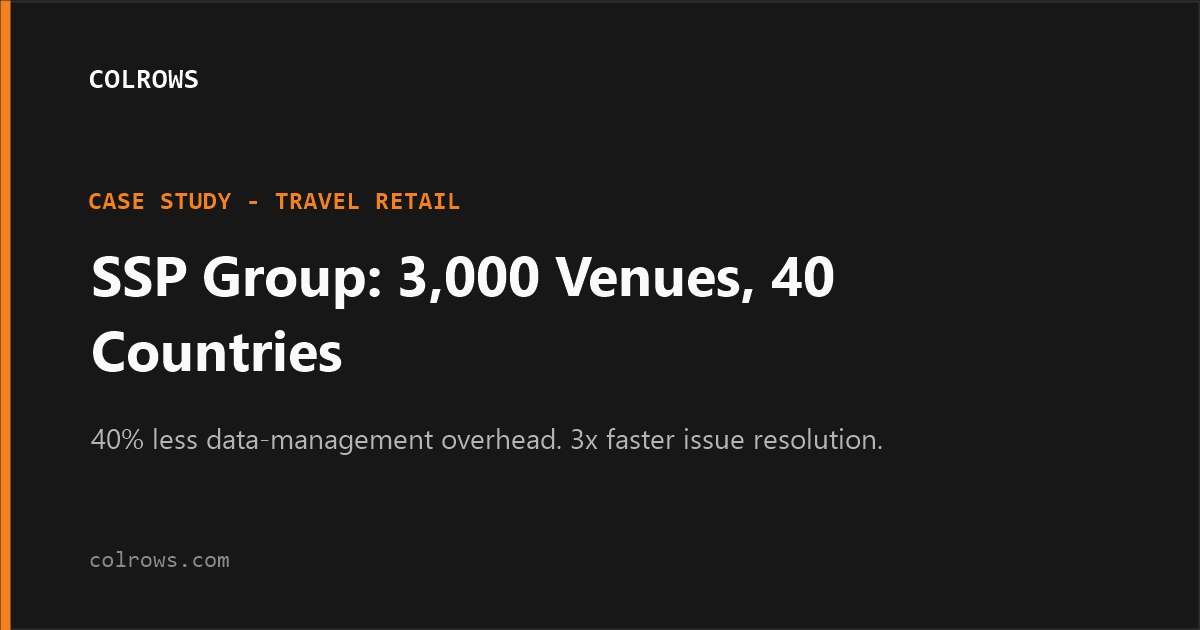
Travel retail is retail at its most demanding: thousands of outlets, dozens of countries, constant turnover. A Colrows deployment at SSP Group, operating roughly 3,000 venues across 40 countries, reported a 40% reduction in data-management overhead, 3x faster issue resolution, and an 80% improvement in collaboration. The pattern generalizes: when every team shares one governed layer, the arguments about whose number is right disappear, and the time goes back into running the business.
Frequently asked questions
Why do retail dashboards disagree with each other?
Because each region defines metrics differently and queries different sources. Without one governed semantic layer, the same metric resolves to different SQL and different numbers.
What does AI analytics for retail need to be safe for self-serve?
Governed definitions, deterministic SQL, role-based access enforced before the query, and speed. A semantic execution layer provides all four.
Is there proof it works at retail scale?
Yes. SSP Group, a travel-retail operator spanning roughly 3,000 venues across 40 countries, reported 40% less data-management overhead, 3x faster issue resolution, and 80% better collaboration with Colrows.