Short answer: YC's AI for City Hall asks founders to let AI run municipal work, starting with permits and moving to 311, public records, licensing and inspections. Honolulu's AI pre-screening cut eligible residential permit times from 73 to 32.5 days; NYC's MyCity drew on official content, gave inconsistent and sometimes illegal answers, and was shut down. Official sources are necessary but not sufficient. Government AI needs the right rule, at the right version, for the right person, with every claim cited and every run logged. Colrows is an agent orchestration platform on an autonomous semantic layer that provides that governed foundation, alongside specialist tools and city staff.
"In some cities, getting the permit takes longer than building the house." That line opens "AI for City Hall", one of Y Combinator's Winter 2027 Requests for Startups. YC wants founders to "let AI help run City Hall", starting with permits and moving on to 311, public records, licensing and inspections.
Two city experiences show what that takes. Honolulu used AI to pre-screen residential permit applications before a reviewer opened the file, and average decision times for eligible permits fell from 73 to 32.5 days. New York City's MyCity chatbot drew on official city content, yet auditors found it gave inconsistent answers to the same question, and the city shut it down in February 2026.
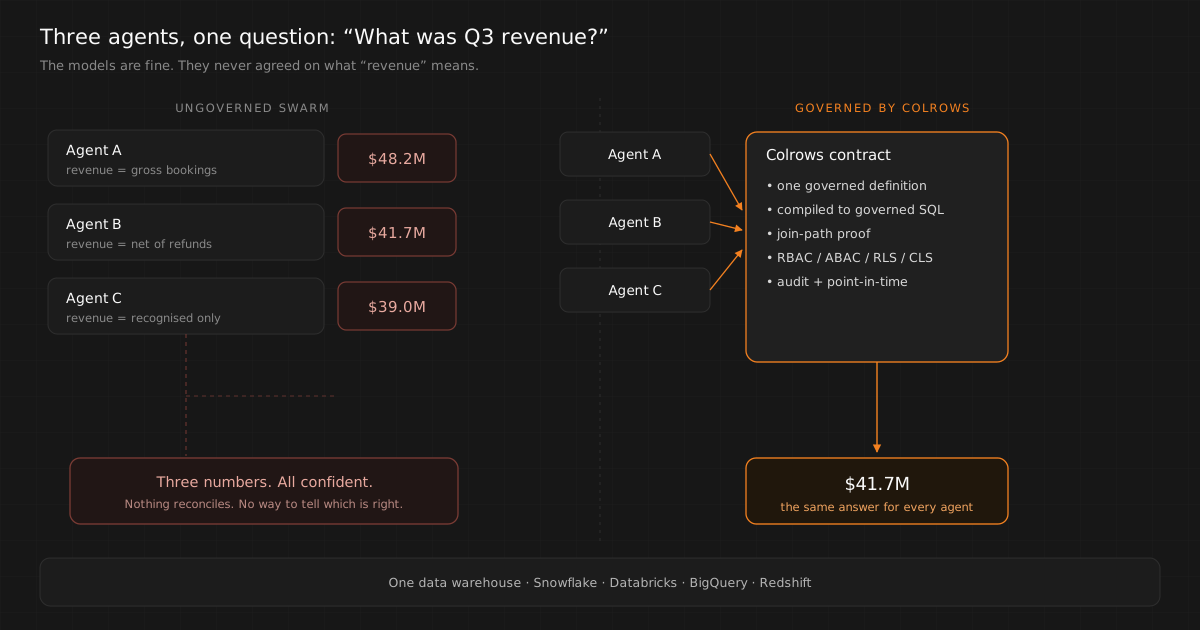
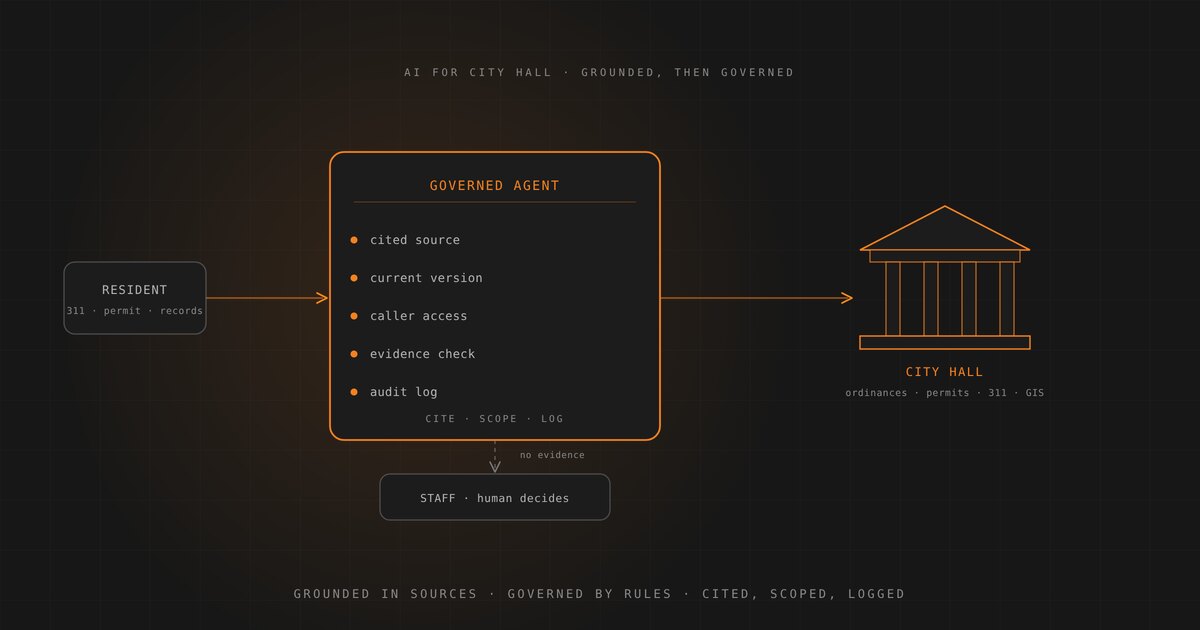
Official sources are necessary but not sufficient. Government AI needs the right rules, interpreted correctly, at the right version, for the right person, with a record of what happened. Colrows is an agent orchestration platform built on an autonomous semantic layer, and it provides that governed foundation. It works alongside specialist tools and city staff. Here is how the architectures compare.
| Requirement | Standalone chatbot | Specialist municipal AI | Agents governed by Colrows |
|---|---|---|---|
| Business context | Retrieved pages, interpreted fresh each time | Rules and records for one workflow | One versioned semantic model shared across departments |
| Permissions | Set by the application | Set per tool | Central agent registry; each run limited to approved tools and the caller's access |
| Validation | Varies by implementation | Domain checks inside one workflow | Every claim mapped to a cited source; governed SQL for data |
| Audit | Application logs | Per-tool logs | Cross-agent run history, exportable for the city's own retention |
What YC asked for in AI for City Hall
The item sits in YC's Winter 2027 Requests for Startups. The YC page shows no byline on it; press coverage credits YC partner Gustaf Alströmer (The Future Media). The core of the request:
"City staff are buried in repetitive work: checking drawings against the code, matching applications to zoning rules, sending corrections back and forth. AI models can do all of this... Start with permits, but also take on 311, public records, licensing, and inspections. There are 19,000 cities in America, and almost all of them still do all this by hand."
YC adds its own estimate: "We did some math: if all building permits in America were approved in 10% of the current time, US cities would make $16 billion a year in additional tax revenue." YC publishes no method, so treat the figure as YC's claim. It also takes on the old objection: "The conventional wisdom says you can't sell software to government. That used to be true. It isn't anymore."
Two neighbouring items complete the picture. "Plaid for Government Benefits" says AI agents will soon handle enrollment, "but only if they can trust the data." Brad Flora's "The $15-an-Hour Expert" asks for AI that turns ordinary workers into experts in benefits, taxes and claims. YC is describing government work done by agents, not another chatbot.
What City Hall is up against
Scarce skills and a retirement wave
In MissionSquare's 2026 survey of 606 state and local HR managers, engineering was the hardest category to fill, at 66%, and 44% said their biggest retirement wave is still ahead (MissionSquare, 2026). Engineering is the skill plan review needs. When experienced staff retire, the interpretations they carried leave with them.
A flood of records requests
Albuquerque received more than 16,000 public records requests in 2025, up 300% since 2017, and 1,807 were open for more than 30 days as of March 2026 (Albuquerque Journal). Records law also reaches AI: Cascade PBS obtained ChatGPT logs from Washington city officials through records requests (CSDA). An agent's own activity becomes a public record.
Old systems nobody can afford to leave
In EY's 2025 survey of 300 state and local IT leaders, 71% said modernising legacy systems costs too much, and 71% said moving off them costs too much (EY, 2025). Tools that work on top of existing systems have an advantage over tools that need a migration.
A governance gap wider than the adoption gap
In ICMA's survey of 635 local managers, 9% had an organisation-wide AI policy and 10% had staff responsible for AI (ICMA). In a PTI survey of local IT executives, 63% had no one coordinating AI (Smart Cities Dive).
Honolulu, Seattle and MyCity: why official sources alone are not enough
Honolulu: remove repetitive work before the specialist
Honolulu began rolling out AI pre-screening from CivCheck, now owned by Clariti, in August 2025, as part of a $7 million replacement of 30-year-old permitting systems. The tool catches missing information and likely code issues before a reviewer opens the file, and applicants fix them first. For single-family homes, duplexes, ADUs, additions and renovations, average permit decision time fell from 73 days to 32.5 days in the first quarter of 2026 (HousingWire). Reviewers still make the decisions. The value came from removing repetitive work before the specialist got involved.
Seattle: coverage matters as much as accuracy
Seattle tested the same tool on real applications. Completeness checks were 87% accurate and design-compliance checks 92% accurate. The city found that "check coverage... matters as much as accuracy": to save an applicant a whole review cycle, pre-screening has to flag every correction a reviewer would find. Completeness checks cover a smaller set of rules and were easier to automate than compliance against thousands of code requirements. Seattle recommended a production pilot for completeness pre-screening (Seattle Innovation & Performance, June 2026).
A system can be accurate on the checks it runs and still miss the outcome, because it does not cover enough of the rules.
MyCity: grounded, and still unreliable
MyCity's chatbot drew on MyCity Business and NYC311 content. In 2024 testing, The Markup and THE CITY found it told businesses they could take workers' tips and refuse cash (The Markup). The New York City Comptroller's December 2025 audit found more (NYC Comptroller):
- Of 70 users who left feedback in July and August 2025, 50 (71.4%) were negative.
- In one review of 48 questions it should have answered, it failed to answer 23.
- Identical questions produced different answers, and small changes in wording changed the result.
- Ongoing updates to the content behind it could make responses inconsistent.
- Counted by questions asked, auditors put August 2025 accuracy at 84.8% to 92.7%, below the city's own figure.
The city took the chatbot down on 4 February 2026.
| MyCity failure | What the architecture needs | How Colrows addresses it |
|---|---|---|
| Official content did not guarantee correct answers | Every claim tied to evidence | Each claim must map to a cited source before the answer goes out |
| Same question, different answers | Repeatable answers and testing | Verified queries for common questions; evaluations before an agent version is seated |
| Content changes shifted responses | Versioned knowledge | Versioned definitions with replayable past states |
| No safe path when evidence was missing | Escalation | An answer without supporting evidence goes to staff |
| Accuracy was hard to interpret | Question-level records | A run history of every question, tool and outcome |
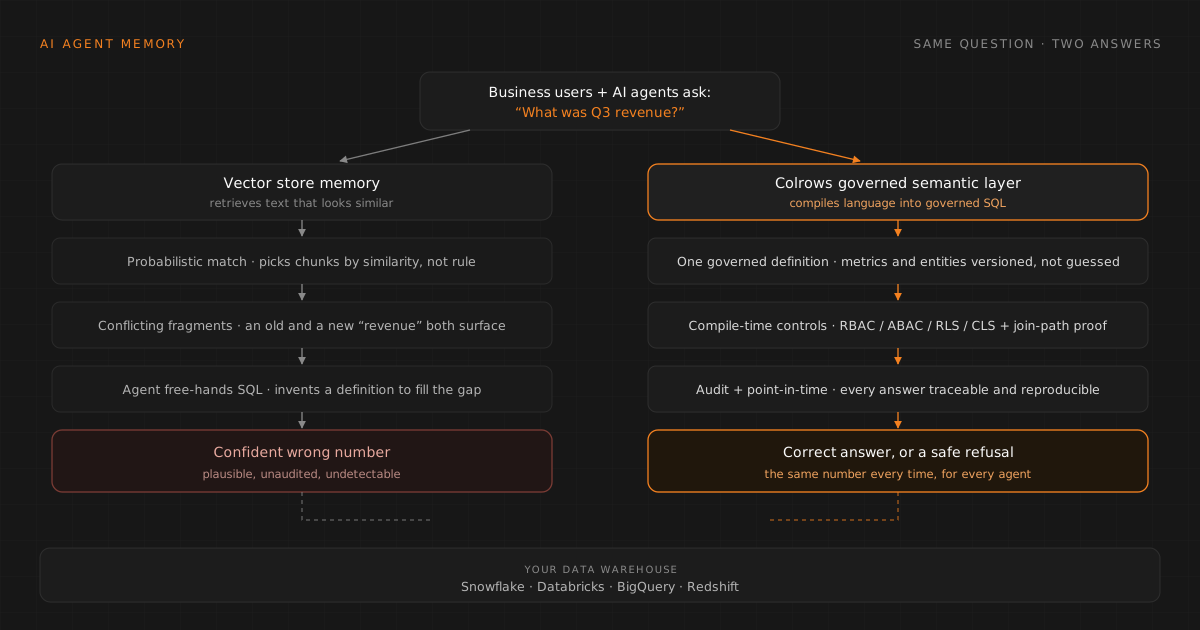
MyCity had official content. What it lacked was governance around that content: which source applies, which version is current, whether each claim has evidence, and what happens when it does not. That context sits around the model, and that is where the fix belongs.
What leading digital governments do first
The most advanced digital governments set up agent governance before they scale agents. Singapore's GovTech is building an AI agent registry for 150,000 public officers, with agents that run on rules and sanctioned tools (The Star). The order matters: first decide which agents exist, who owns them and what they may touch, then put them in front of residents.
Most US local governments are at the other end, with 9% holding an AI policy. A city that starts with a registry, governed sources and an audit trail can add permitting, 311 and records agents on the same footing.
The rules converge: cite, review, log, keep data local
No single law governs how a city uses AI, but the rules that touch it repeat the same demands.
- A federal reference framework. OMB memo M-25-21 binds federal agencies, not cities, but it is a useful model for a city policy. For "high-impact" AI, including AI used to decide access to benefits and services, it requires pre-deployment testing, impact assessment, monitoring, operator training, human oversight, appeals and public feedback (OMB M-25-21).
- State law. Texas TRAIGA, in force since January 2026, requires governmental entities to disclose when people interact with AI (Perkins Coie). Colorado's SB 26-189 covers automated decision-making that materially influences consequential decisions, including essential government services, with documentation, notice and human-review duties from January 2027 (Legal 500). It does not cover every government chatbot, which is one more reason to keep officials responsible for denials and eligibility decisions.
- City procurement. The GovAI Coalition, founded by San José, counts 900+ agencies and asks vendors to complete an AI FactSheet (Cities Today).
- Security and accessibility. The FBI released CJIS Security Policy v6.1 in June 2026, with stronger encryption and monthly vulnerability scanning for criminal justice information. Priority 1 controls are already enforceable, and others have a grace period until 30 September 2027 (SC Media). The DOJ's ADA Title II web rule requires WCAG 2.1 AA by 26 April 2027 for governments serving 50,000+ people, and by 26 April 2028 for smaller ones (Reed Smith).
- Outside the US. The EU AI Act treats AI used by public authorities to decide access to essential public services as high-risk, with obligations from 2 December 2027 (Gibson Dunn); India's DPDP Rules apply their main duties from 13 May 2027 (AZB & Partners).
The common thread is to show the source, keep a human in charge, log every action, and keep data where the government says.
How Colrows builds AI agents for City Hall
Colrows does not read architectural drawings, approve permits or replace a city's case system. Plan-review specialists check drawings, and officials sign decisions. Colrows is the shared intelligence and control layer that lets specialised agents work across departments. Three capabilities answer the risks city IT leaders worry about most.
Capture institutional knowledge before it retires
Colrows reads what the city has written down: databases, catalogs, dashboards, wikis, ordinances and policy PDFs. It reconciles conflicting sources, proposes definitions and relationships with the evidence behind them, and records every ruling staff make while they review them. Close to 80% of definitions and relationships are proposed automatically; staff review, approve and add the rest before agents rely on them. When an inspector settles an edge case, decision memory keeps the ruling for the next agent and the next hire. (In the product, this is the Consensus engine and the Curator agent.)
Government sources carry different authority. A statute, an ordinance, a departmental procedure and an FAQ are not interchangeable. Each definition carries its source, version and approval status, and when two authoritative sources conflict, Colrows surfaces the conflict for an authorised official. It does not decide which legal reading wins.
Answer from records, with every claim cited
Questions about structured data compile into governed SQL that runs in place on the city's existing systems, with no migration, so numbers come from the records under the city's definitions. Questions about documents get answers within each user's document access (Docent). Before an answer goes out, every claim must map to a cited source. An answer with an unsupported claim goes to staff instead.
Produce the evidence governance asks for
Quorum, the Colrows agent control plane, registers every agent with an owner, a spec, its tools and its scope. Administrators review and seat each version before it runs, with evaluations where required. Every run is audited: who ran what, as whom, with which tools and outcome. Agents run on workers in the city's own environment, with short-lived tokens limited to approved tools, and raw SQL is never part of a run's grant. Audit logs can be exported and retained, so a city can apply its own records-retention schedule.
That gives a city the agent inventory, pre-launch review records and run logs its policies depend on. Impact assessments, appeal processes, accessibility checks and risk sign-off remain the city's decisions.
Colrows ships with an AI Analyst and a Curator agent, and cities can build their own agents in the framework they choose, connected through Agent REST or Agent MCP. See the Colrows MCP integration, and read how to build multi-agent systems that don't fail.
| YC's target | What Colrows-governed agents do | What stays with specialists or staff |
|---|---|---|
| 311 | Answer residents from the city's cited sources, route cases across departments, and reach residents on WhatsApp or Teams | Running the phone line; replacing the case system |
| Public records | Search repositories within each user's access, flag personal data, help staff match near-identical requests to prior releases, and record which documents were retrieved | Ruling on legal exemptions |
| Permits | Resolve parcel, zoning and permit type; pass the case to a plan-review tool; return a structured file with exceptions and sources to the reviewer | Checking drawings against code; signing the approval |
| Licensing | Apply eligibility rules held as governed definitions and check status across legacy systems | Verifying income or identity at source |
| Inspections | Summarise each property's history and open violations, and prioritise queues | Field work and enforcement decisions |
Worked example: a permit question on WhatsApp
A resident asks on WhatsApp: "Why is my ADU permit stalled, and what do I need to fix?"
- The agent is approved before it runs. The city's permit-status agent is registered in Quorum with read access to the permit system, the GIS layer and the code library. An administrator seated it after evaluation.
- Identity decides what it may see. An anonymous visitor asking about general ADU rules gets an answer from public sources only. This resident has signed in through the city's identity service, so the run uses a short-lived token limited to approved tools, and access policies limit it to that resident's records.
- It resolves meaning first. The semantic layer maps "ADU" and "stalled" to the city's definitions and finds the open correction notice. Docent cites the code section the correction refers to, at its current version.
- It checks before it answers. Every claim in the reply must map to a cited source. If one does not, the case goes to staff.
- It leaves a record. The audit trail shows the agent, the user, the tools and the outcome, and the city keeps it under its own retention schedule.
Deploy where the city's rules say
Colrows runs as SaaS on AWS, Azure and Google Cloud, or on-premise. For sovereign and air-gapped sites it deploys open-weight models such as Gemma, Llama, Nemotron or Qwen inside the network, and on-premise installs make no telemetry, licence-check or update calls out of it. PII is anonymised before any prompt reaches a model, and the platform includes defences against prompt injections. Its document intelligence reads scanned records, which many city archives still are.
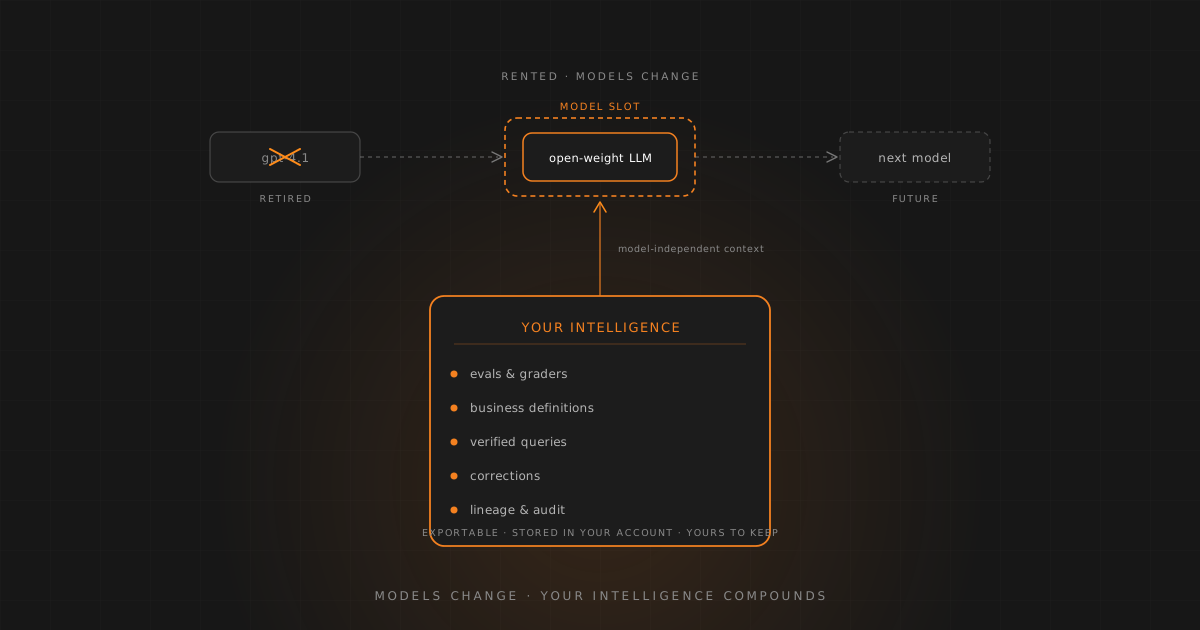
The city keeps what it builds. The semantic model, including definitions, verified queries, policies and version history, exports as JSON and other formats and stays with the city if the contract ends. In the US, Colrows works through partners.
The case against selling AI into City Hall
Procurement is still slow. AVA Ventures writes that "selling to government is slow" (AVA Ventures). Small towns make up most of the 19,000, and they report the least readiness: 48% of ICMA's respondents rate AI a low priority.
Much of the traction in this market is self-reported. YC's "growing faster than almost anything else we've seen" names no company, and Founderland could not find procurement records for some early startups' claimed contracts. Funding has also cooled: govtech deal value hit a record $20.5 billion in 2025, then fell to $4.5 billion in the first half of 2026 (GovTech).
A governance platform also needs a buyer who owns AI, and about one local government in ten has one. So start in phases:
- One department, one workflow. Public records search, 311 resolution or permit-status coordination, with one measurable result.
- The shared foundation. Build the initial semantic model, connect the systems, set up SSO and access policies, and register agents in Quorum. Colrows' forward-deployed engineering targets about eight weeks for this (Map, Build, Ship, Handover), once data access and security approval are in place. See how we deploy.
- More agents, same footing. Add departments without rebuilding the architecture.
Five checks before a city deploys an AI agent
- Does every claim cite its source? Each answer should point to a code section, record or verified query, at its current version.
- Does it run with the caller's access? Anonymous visitors and signed-in applicants should see different things.
- What happens without evidence? An answer that cannot be supported should go to staff.
- Is every run logged and retained? Records officers will ask. Agent logs need a retention schedule like any other record.
- Does the data stay where your rules say? Confirm where the model runs, where the data sits, and what leaves the network.
If any answer is no, fix it before launch. For why agents also need governed memory, read why AI agent memory fails on enterprise data, and for the model-ownership side of the same question, YC's Own Your Intelligence RFS. More on this theme in Governance & Security.
AI for City Hall: frequently asked questions
What is YC's AI for City Hall RFS?
A Winter 2027 Request for Startups asking founders to "let AI help run City Hall", starting with permits and moving on to 311, public records, licensing and inspections.
Has AI worked in city permitting?
In Honolulu, AI pre-screening ahead of human review came alongside a fall in average decision time for eligible residential permits from 73 to 32.5 days. Seattle found coverage matters as much as accuracy and recommended a narrower completeness pilot.
Why did NYC shut down MyCity?
It drew on official city content but gave inconsistent and sometimes illegal answers. The Comptroller's audit found 71.4% negative feedback and different answers to identical questions. The city took it down in February 2026.
Does Colrows replace permit software?
No. Plan-review specialists check drawings. Colrows governs the agents and data around them, with cited answers, scoped access and an exportable audit trail.
Sources
Every figure is the cited source's own published claim. Several figures (YC's $16 billion estimate, some vendor and market numbers) are self-reported; treat them as the source's claim, not an independent measurement.
- Y Combinator, Requests for Startups, Winter 2027
- The Future Media, What Y Combinator wants to fund next (28 Oct 2026)
- MissionSquare Research Institute, State and Local Workforce Survey 2026
- Albuquerque Journal, Public records in the age of artificial intelligence (6 Mar 2026)
- CSDA, Public Records Act meets AI (May 2026)
- EY, State and local government survey 2025
- ICMA, Local government practitioners weigh AI
- Smart Cities Dive, PTI local government AI readiness survey
- HousingWire, How Honolulu used AI to cut permit review times in half
- Seattle Innovation & Performance, CivCheck pilot findings (Jun 2026)
- The Markup, Mamdani to kill the NYC AI chatbot (Jan 2026)
- NYC Comptroller, Audit of the MyCity System (30 Dec 2025)
- The Star / Straits Times, Singapore AI agent registry (Jun 2026)
- OMB, Memorandum M-25-21 (Apr 2025)
- Perkins Coie, Texas Responsible AI Governance Act
- Legal 500, Colorado SB 26-189
- Cities Today, GovAI Coalition (Apr 2026)
- SC Media, CJIS Security Policy v6.1 (Sep 2026)
- Reed Smith, DOJ extends ADA Title II digital accessibility dates
- Gibson Dunn, EU AI Act Omnibus agreement
- AZB & Partners, India DPDP framework comes into effect
- AVA Ventures, YC Requests for Startups guide
- GovTech, Gov Tech Biz quarterly roundup Q2 2026