Short answer: AI agent memory is any store that lets an agent carry information across turns and sessions, because the model itself keeps nothing between calls. It comes in four types: working memory for the current task, episodic memory for past sessions, procedural memory for how the agent acts, and semantic memory for the definitions, metrics and relationships it needs to answer correctly. Tools like Mem0 and Zep remember the user; a governed semantic layer remembers the business.
| For enterprise analytics | Vector retrieval memory | Colrows governed semantic memory |
|---|---|---|
| Core mechanism | Probabilistic similarity match | Deterministic compile to governed SQL |
| What it stores | Unstructured text chunks | Versioned metrics, entities, relationships |
| Truth model | Old and new definitions both surface | One governed definition, superseded on change |
| Failure mode | Confident, plausible, wrong number | A safe refusal when data is missing |
| Access control | Bolted on at the document level | Row and column policy enforced at query time |
Y Combinator put a name on the gap this year. Its Summer 2026 Request for Startups asked founders to build a “company brain”: a system that pulls scattered know-how out of documents, tickets, and databases, keeps it current, and turns it into an executable skills file for AI. YC was direct about what it is not. Not a company-wide search tool. Not a chatbot over your documents. A living map of how a company actually works.
That is a memory problem. And it is the part of memory the popular tools do not solve.
Why AI agents fail without memory
A language model keeps nothing between calls. It is stateless. To look coherent across a conversation, the application resends the transcript on every turn. Cost climbs with each turn. Reliability does not climb with it. Three findings show why.
Position beats volume. In the Lost in the Middle study (Liu et al., Transactions of the ACL, 2024), accuracy fell by more than 20 points when the relevant fact sat in the middle of a long input rather than at the start or end. In some runs, adding retrieved context pushed accuracy below what the model scored with no context at all.
Longer context gets less reliable. Chroma's 2025 Context Rot report tested 18 current models, including GPT-4.1, Claude 4, and Gemini 2.5. Every one grew less reliable as input length rose, even on simple tasks. A bigger context window is not a memory system.
Assistants forget across sessions. On LongMemEval (Wu et al., ICLR 2025), commercial chat assistants showed roughly a 30 percent accuracy drop when they had to recall information across sustained, multi-session interactions.
The agent-memory tools you have read about, Mem0, Zep, Letta, and the memory features inside ChatGPT, Claude, and Gemini, exist to patch this. They store user facts and past conversations outside the window and retrieve them on demand. For remembering a user, that works. For remembering your business, it does not, and the reason is structural.
A note on the benchmark wars. Most published agent-memory scores are run by the vendors whose tools are being measured, and independent reproductions often come in lower. Treat any single-vendor number as directional, not settled. The enterprise question is not which memory tool wins a public leaderboard. It is whether your agent computes the same revenue figure twice.
The four types of AI agent memory, and the one enterprises miss
Research on agent design borrows four memory types from cognitive science. The CoALA framework (Sumers et al., 2023) lays them out, and they show exactly where the enterprise gap sits.
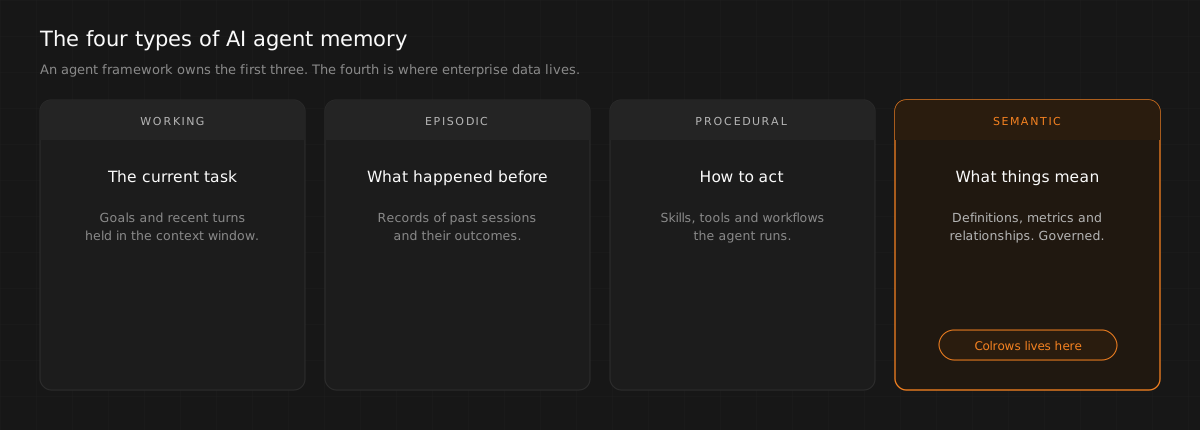
Working memory holds the current task in the context window. Episodic memory records what happened in past sessions. Procedural memory is how the agent acts: its skills, its tools, its plans. Orchestration frameworks like LangGraph and Letta own that layer, and they should.
Colrows does not compete for those three. It claims one: semantic memory. Semantic memory is what things mean. It is the set of definitions, metrics, and relationships an agent needs before it can answer a question about your data correctly. In most stacks that memory is empty, or it is a pile of text chunks in a vector store. That is the gap.
Split it in one line. Use a tool like Mem0 or Zep to remember the user. Use a governed semantic layer to remember the business. We drew the wider version of this argument in RAG versus a semantic layer.
Why vector databases fall short for enterprise metrics
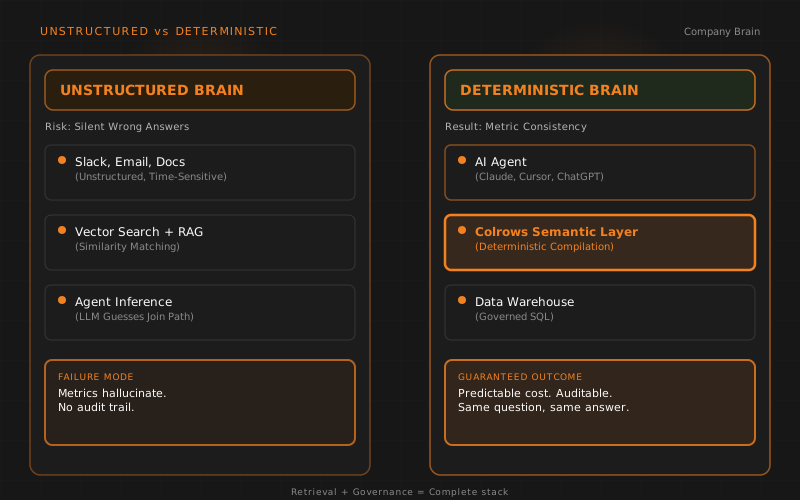
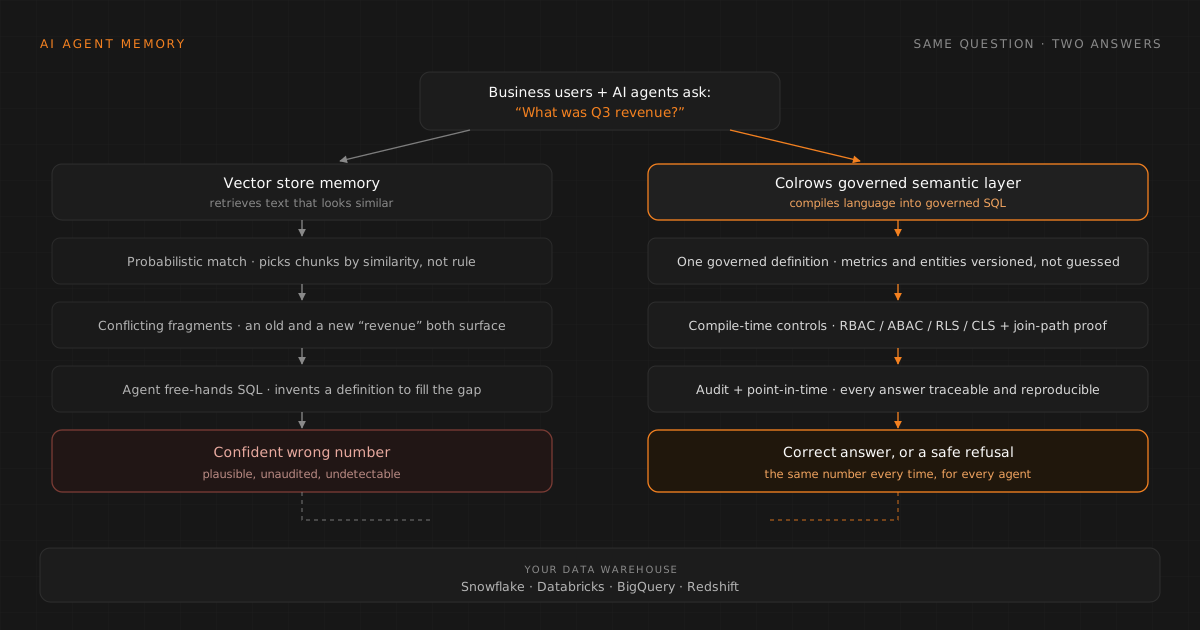
A vector store retrieves text that looks similar to the question. Similarity is not correctness, and for analytics that difference is expensive.
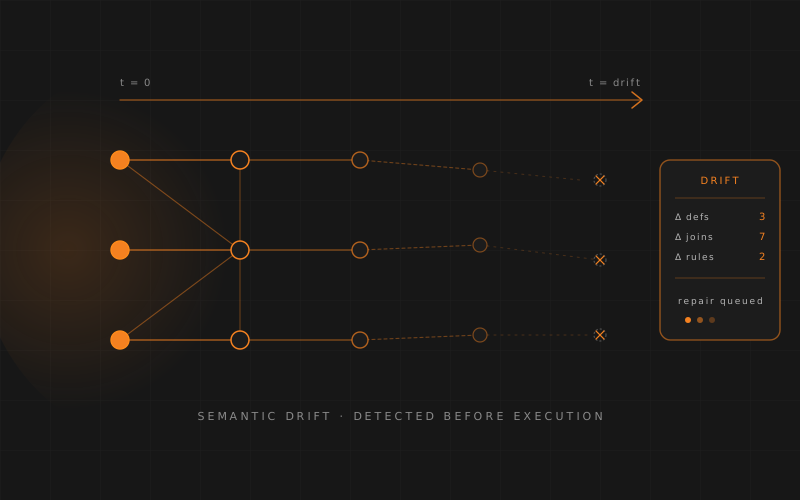
It cannot tell an old definition from a current one. If your finance team redefined “active customer” last quarter, the old and the new description can both sit in the store, and both can come back. The agent has no rule to pick. That drift is its own failure mode, one we cover in knowledge drift and semantic decay.
It has no sense of time. A fact that was true in 2024 and the fact that replaced it in 2026 are just two nearby vectors.
It carries no relationships. “Revenue by region, net of returns” is a join and a formula. A pile of chunks does not know the join path.
So the agent does what engineers have watched agents do. It free-hands the SQL and invents its own definition to fill the gap. The answer looks clean. It is wrong. And because it is phrased with confidence, nobody catches it until a board deck is already out the door. Vector databases are not useless. They are the wrong tool for governed business definitions.
The evidence: governed semantics change how agents fail
Give a model the governed definitions and the failure mode itself changes.
dbt Labs re-ran its semantic-layer benchmark in 2026. Semantic-layer grounding lifted accuracy from 90.0 to 98.2 percent for Claude Sonnet 4.6, and from 84.1 to 100 percent for GPT-5.3-Codex. Raw text-to-SQL over bare schema topped out at 84 to 90 percent on the same frontier models. The more important finding was qualitative. With the semantic layer, the model's failures turned into refusals rather than confident wrong numbers. For anything that lands in a regulatory filing or a lender's recovery report, a refusal you can see beats a wrong number you cannot.
An independent 2026 study reached the same shape. Cube's paired benchmark (arXiv 2604.25149) tested three frontier models with and without a small semantic-layer document. Adding it raised first-shot accuracy by 17 to 23 points, and the gain was statistically significant for every model. This one matters because the authors were not selling the model being tested.
The pattern is not new. Back in 2023, data.world showed GPT-4 answering enterprise questions at 16.7 percent accuracy over raw schema, rising to 54.2 percent when the same questions ran over a governed knowledge-graph representation (Sequeda et al., 2023). Models have improved since. The shape holds: structure beats raw text for analytical accuracy. The full set of figures sits in our text-to-SQL benchmark.
Analysts now treat this as infrastructure. Gartner's March 2026 data and analytics predictions state that by 2030, universal semantic layers will be treated as critical infrastructure, on the same footing as data platforms and cybersecurity, and name the semantic layer as the route to aligning multi-agent systems and stopping inconsistent numbers before they spread. The same set of predictions warns that by 2028, 60 percent of agentic analytics projects that rely on the Model Context Protocol alone will fail for want of a consistent semantic layer.
How Colrows makes the semantic layer your agent's memory
Colrows is an autonomous semantic layer that sits above your warehouse: Snowflake, Databricks, BigQuery, or Redshift. It is the semantic memory an agent is missing.
When a business user or an AI agent asks a question in plain language, Colrows does not hand the model a bag of text to interpret. It compiles the question into governed SQL at compile time, against one versioned set of metric and entity definitions. Along the way it enforces role and attribute access controls (RBAC, ABAC, and row and column-level predicates), proves the join path, writes an audit trail, and makes every answer reproducible to a point in time. The mechanics are in what a semantic compiler does, and the enforcement point in how to secure AI agent database access.
The result is the property enterprise agents need and vector memory cannot give. Every agent, every user, and every session computes the same metric the same way. When the data to answer safely is not there, the layer refuses instead of inventing. That is memory you can put in front of an auditor.
Fix the Context, Not the Model. A governed semantic layer that understands your business context produces more reliable agents than any amount of fine-tuning. The model was never the problem. The missing context was.
This is also why Colrows sits beside your agent-memory tools rather than replacing them. Keep your user and conversation memory where it is. Add the governed layer as the memory for definitions, metrics, and relationships. It is a governance layer, not a rip-and-replace.
What this looks like in production
The stakes are highest where a wrong number is not embarrassing but reportable. Two live patterns show it.
In Indian asset reconstruction, agents run under full audit on recovery scoring, non-performing-asset valuation, and portfolio analytics. Every figure has to be traceable and reproducible on demand. A confident hallucination is not an option, so the definitions cannot live in a vector store. They live in a governed layer that compiles them the same way every time, with RBI SARFAESI and DRT logic modeled in.
In pharma field-force analytics, a sales operation of tens of thousands of representatives needs one consistent definition of coverage, call adherence, and territory performance. If each agent invents its own version, the reporting collapses. A shared semantic memory keeps every answer aligned across the whole organization.
The company brain needs a governed memory layer
Return to YC's company brain. The market instinct is to build it as search over documents or a chatbot over a wiki. YC ruled that out, and the memory research explains why. Retrieval over text gives you plausible recall. It does not give you a definition your agents can execute and an auditor can trust.
A company brain that works is a governed semantic memory: the metrics, entities, and rules of how the business operates, versioned and enforced. That is the same thing an enterprise agent needs to stop inventing numbers. The two problems are one problem. We wrote more on that in what YC's company brain RFS got right, and wrong.
Agent frameworks will keep improving how agents plan and act. The model layer will keep getting better. Neither will teach an agent what your company means by “revenue.” A governed semantic layer does, and it is the piece most enterprise agent stacks are still missing.
A note on the sources
Figures here carry named primary sources. The long-context findings are from Liu et al., Transactions of the ACL, 2024 (arXiv 2307.03172); Chroma's Context Rot report, July 2025; and Wu et al., LongMemEval, ICLR 2025 (arXiv 2410.10813). The memory taxonomy is from the CoALA framework, Sumers et al., 2023 (arXiv 2309.02427). The accuracy evidence is from the dbt Labs 2026 semantic-layer benchmark update, Cube's paired benchmark (arXiv 2604.25149), and Sequeda et al., data.world, 2023 (arXiv 2311.07509). The infrastructure framing is from Gartner's Top Predictions for Data and Analytics, 11 March 2026. Benchmark scores are point-in-time snapshots and drift as evaluations update. This page is not legal advice.
Frequently asked questions
What is AI agent memory?
AI agent memory is any store that lets an agent carry information across turns and sessions, because the model itself keeps nothing between calls. It spans four types: working memory (the current task), episodic memory (past sessions), procedural memory (how the agent acts), and semantic memory (the definitions, metrics, and relationships an agent needs to answer correctly). Most enterprises have the first three and are missing the fourth.
Why do vector databases fall short for enterprise agent memory?
A vector store retrieves text by similarity, not by rule. For analytics it can surface an old and a current definition of the same metric at once, it carries no sense of time, and it holds no join paths, so the agent guesses. That produces confident, plausible, wrong numbers. Vector stores are useful for remembering a user or a conversation. They are the wrong tool for governed business definitions.
What is a semantic layer for AI agents?
A semantic layer is a governed set of definitions for metrics, entities, and relationships. For an AI agent it acts as semantic memory. It compiles a plain-language question into governed SQL against one versioned definition, with access controls, a proven join path, and an audit trail, so every agent computes the same metric the same way, and refuses when the data to answer safely is not there.