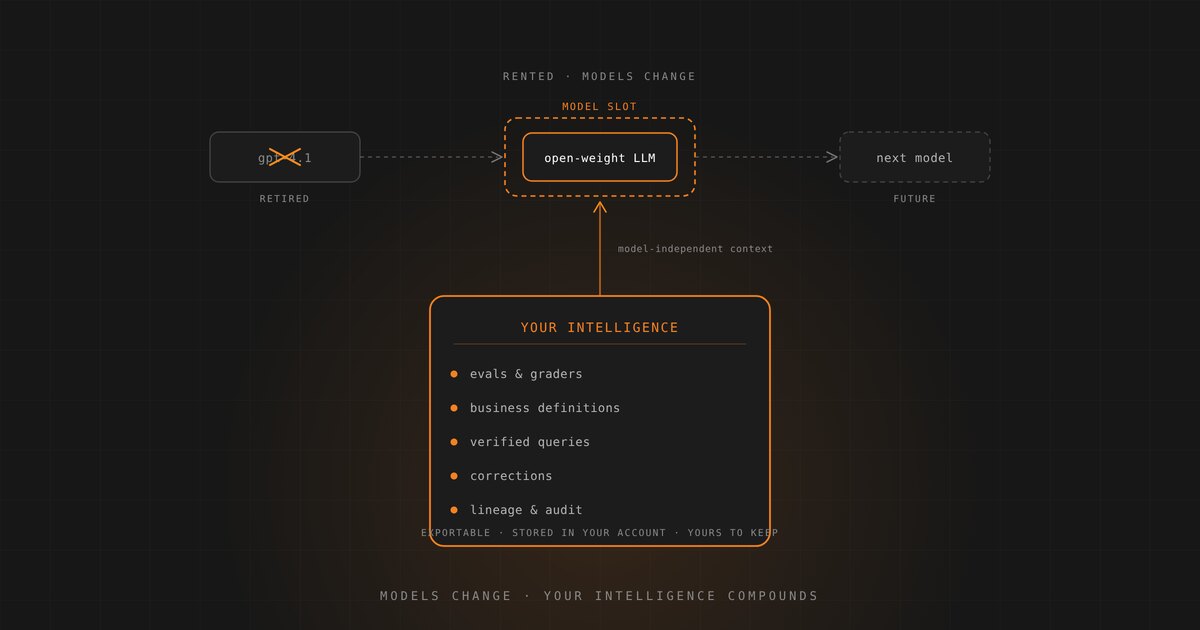
Short answer: Own the assets that outlast any single model: evals and graders, business definitions, verified questions, production corrections, and lineage. Open-weight models now make owning the weights realistic, but the weights are the part most likely to change. Keep the rest in governed context that any model can read, and a model switch becomes a re-test instead of a rebuild. Colrows, an autonomous semantic layer, holds that context, versioned, exportable and stored in your own account.
"Today, nearly every company building with AI rents its intelligence." That is the opening line of "Own Your Intelligence", a Winter 2027 Request for Startups from Y Combinator partner Jon Xu. He argues that open-weight models are now good enough for companies to own the models they rely on.
Owning a model is one part of owning your intelligence. The bigger question is whether your business keeps what it has learned when the model changes. Hosted models get retired, and fine-tunes built on them go with them. Self-hosted weights stay under your control, but they do not pick up the next generation's gains. Either way, the evals, business definitions, production corrections and lineage have to carry forward. Colrows, an autonomous semantic layer, keeps that part under your control. Here is where each asset tends to live.
| Enterprise asset | Where it often lives today | Where it lives with Colrows |
|---|---|---|
| Business definitions | Prompts per team, or inside fine-tuned weights | A governed, versioned semantic model in your account, exportable as JSON and other formats |
| Verified business questions | Spreadsheets and analysts' heads | Verified queries compiled and validated against governed definitions |
| Access policies | Prompt instructions the model may ignore | RBAC, ABAC, row- and column-level rules applied when the query is compiled |
| Corrections and audit history | Chat logs, if anyone kept them | Audit traces and replayable past states of every definition |
What YC asked for in the Own Your Intelligence RFS
The item sits in YC's Winter 2027 Requests for Startups, published in late October 2026. The core of it:
"Open-weight models are now competitive with the top frontier models on meaningful benchmarks. And as AI moves to the center of how businesses run, companies have become more aware of their dependency on model rental. We think more companies will want to own the models they rely on: improve them on their own data, run them where they choose, and decide for themselves when they change."
Xu then names the gap:
"But there's still a big gap between downloading an open model and owning intelligence that improves a business. Someone has to turn workflows into evals, expertise into training data, production failures into improvements, and carry all of it forward with each new base model."
Three details matter for enterprise buyers. YC singles out regulated industries, "where strict data governance and locked-down infrastructure make renting even more expensive for the performance they get." Xu co-founded FutureAdvisor, which BlackRock acquired, and YC lists his expertise as "B2B platforms for regulated industries" (YC). YC does not predict the end of renting: "Companies will keep renting frontier intelligence for their hardest problems." And the theme runs through YC. Garry Tan gave a Startup School talk with the same title in August, with the line "Model quality is rented, but your brain is owned" (YC Library).
Open-weight models are viable for more workloads, not all of them
Xu's capability claim holds on broad indices and weakens on the hardest tasks. Epoch AI measured open-weight models trailing the closed frontier by about four months for releases since January 2026 (Epoch AI, May 2026). In Artificial Analysis's April 2026 snapshot, the top open models scored 54 against 60 for GPT-5.5, and 43 to 46% against 61% on the harder TerminalBench Hard test. Leading open models cost one-half to one-sixth as much as comparable closed models (Artificial Analysis, April 2026).
On 27 October 2026, Artificial Analysis launched Intelligence Index v5 with a new set of evaluations, so its scores are not comparable with the April snapshot. It lists Kimi K3.1 Pro fourth overall, as the model that "will lead open weights models" (Artificial Analysis). Check whether a model's weights are released before you plan to self-host it.
The practical test is your own workload. Some enterprise tasks are bounded and routine. Others, such as multi-hop analytical questions, financial calculations and exception handling, are hard for any model. Choose by measured performance on your questions, plus cost, data control and operating needs. Regulated buyers should also note that all ten of the top open-weight models in the April snapshot came from labs based in China. Colrows keeps business context separate from the model, so the base model is your choice: Gemma, Llama, Nemotron or Qwen on your own servers, or frontier models hosted in your private cloud.
Hosted models get retired on someone else's schedule
The clearest case for ownership comes from vendor documentation. OpenAI gives at least six months' notice before retiring a generally available model, and its policy states: "Fine-tuned versions of these base models follow their base model's shutdown schedule" (OpenAI deprecations). On 14 October 2026, OpenAI announced that gpt-4o, gpt-4.1 and their mini variants retire on 14 January 2027.
OpenAI's reinforcement fine-tuning platform "is no longer accessible to new users", and existing customers can create training jobs only until 6 January 2027 (OpenAI RFT guide). Anthropic commits to at least 60 days' notice and retired Claude Sonnet 4 and Opus 4 about 13 months after release (Anthropic). Enterprises also switch by choice: 37% use five or more models, up from 29% (a16z, 2025).
Self-hosting removes the forced retirement. It does not remove the reasons to upgrade: better performance, security fixes and hardware changes. Every switch means re-testing prompts and evals and redoing any fine-tune. That is why Xu's fourth job, carrying everything "forward with each new base model", applies to owners and renters alike.
Models change. Enterprise intelligence should compound.
Five assets carry across a model change, if you keep them outside the model.
| Asset | Survives a model change? | Why it matters |
|---|---|---|
| Evals and graders | Yes | Quality is the top blocker to production, and evals gate any tuning |
| Curated examples | Yes | Quality of examples matters more than volume |
| Business definitions | Yes, if held outside the weights | Facts that change often are better kept as governed context |
| Production feedback loops | Yes, as a pipeline | Systems that do not learn from use stall |
| Governance and lineage records | Yes | Regulators ask for them whatever the model |
1. Evals encode your definition of "correct"
In LangChain's State of Agent Engineering report (published June 2026, 1,340 responses), 32% named quality as their primary blocker to production, ahead of latency at 20%. Only 52.4% run offline evaluations on test sets (LangChain). Evals are hard to buy ready-made. UC Berkeley researchers describe "criteria drift": people refine their grading criteria only after they see real outputs (Shankar et al.). OpenAI's tuning guide sets a similar bar: if qualified experts "do not converge on the same answers, the task may be too ambiguous" for reinforcement fine-tuning.
2. Quality of examples matters more than volume
Meta's LIMA study tuned a 65-billion-parameter model on 1,000 curated examples. In a controlled human comparison, its answers were equivalent to or preferred over GPT-4 in 43% of cases (arXiv:2305.11206). OpenAI recommends starting reinforcement fine-tuning with "between several dozen and a few hundred examples", then testing whether more data helps. Neither shows that small sets always win. Both show that expert-checked examples are the scarce input, and those examples belong to the business.
3. Business definitions belong outside the weights
Google and Technion researchers found that when models learn new facts through supervised fine-tuning, those facts "linearly increase the model's tendency to hallucinate" (Gekhman et al.). Microsoft researchers found retrieval "consistently outperforms" unsupervised fine-tuning for adding knowledge in their tests (Ovadia et al.). The practical reading: facts, definitions and policies that change often are better kept as governed context than embedded in weights. Fine-tuning still has a role in teaching a model how to do a task.
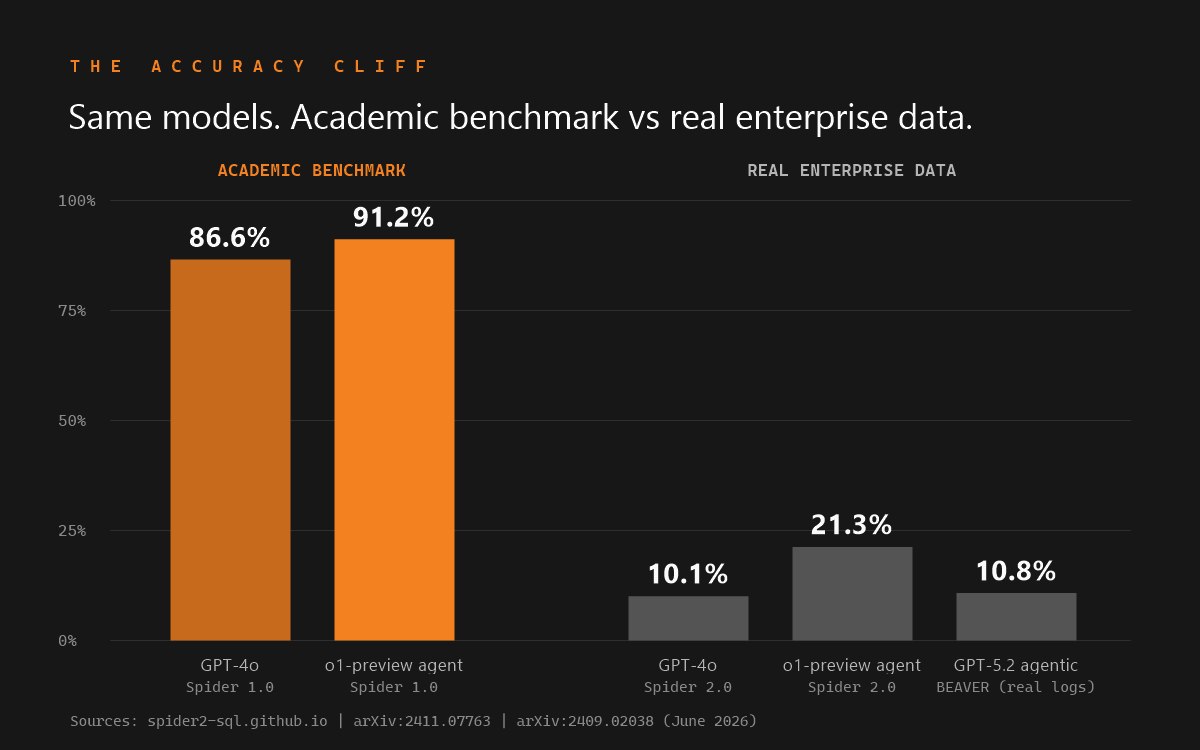
Enterprise data benchmarks show what happens without that context. On BEAVER, built from private enterprise warehouses, agentic frameworks using GPT-5.2 reached 10.8% accuracy (arXiv:2409.02038). In data.world's insurance benchmark, GPT-4 rose from 16% to 54% when questions ran over a knowledge graph of the business (arXiv:2311.07509). We cover the pattern in the text-to-SQL accuracy cliff.
Semantic layers have a known weak spot. In dbt Labs' small 2026 re-run of that benchmark (11 questions, 20 runs each), a hand-built semantic layer scored 100% on questions within its coverage and 0% on questions outside it (dbt Labs). Colrows addresses that edge in two ways. It builds and updates its semantic model from schemas, catalogs and documents: in Colrows deployments, close to 80% of the semantic layer is constructed automatically, and people review and add the rest. When a request cannot be bound to exactly one governed definition, compilation fails and nothing runs, so the gap shows up for review instead of as a wrong number.
4. Feedback loops turn failures into improvements
MIT's Project NANDA described the core problem in 2025: "Most GenAI systems do not retain feedback, adapt to context, or improve over time" (Virtualization Review). The loop has to record what failed, why, and what the correct answer was. A recorded correction can be reused with any model.
5. Governance records are the raw material and the audit trail
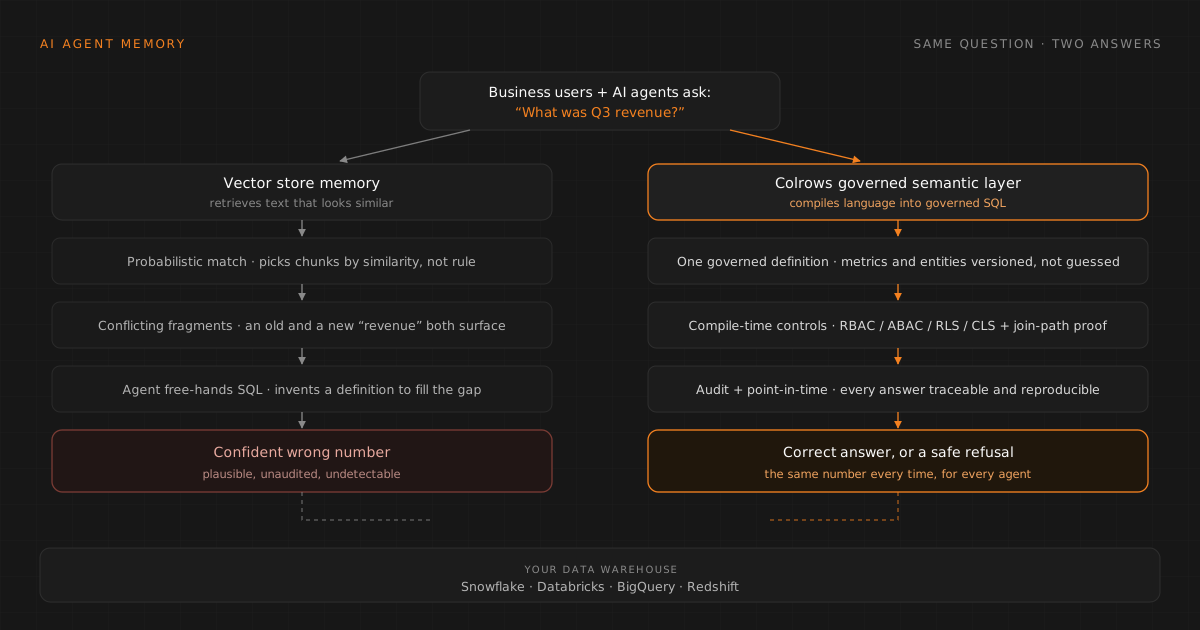
Gartner predicts that through 2026, organizations will abandon 60% of AI projects unsupported by AI-ready data (Gartner, February 2025). In Informatica's 2025 survey of 600 data chiefs, 38% cited lack of trust in data quality as a barrier to showing AI value (Informatica). For why agent memory alone does not fix this, read why AI agent memory fails on enterprise data.
Put facts, definitions and corrections in governed context that any model can read. Then each new model starts with everything your business has learned, and a model switch becomes a re-test.
What Cursor and Harvey own, and what a bank should own
Cursor built Composer 2 on Moonshot AI's open Kimi K2.5 base, with continued pretraining and large-scale reinforcement learning (Cursor). Its "real-time RL" uses user interactions as reward signals and can ship an improved, eval-gated version "as often as every five hours" (Cursor). Harvey built Tenet by post-training a Kimi K3 base on about 1,750 legal task environments, and reports nearly twice as many completed held-out tasks as the base model (Harvey). Both results are company-reported.
Both companies invested in three things around the weights: proprietary eval environments, feedback pipelines, and domain task examples. They also run model-training operations, because the model is their product.
Most banks, manufacturers and hospitals will not build a training lab. A bank still needs to own its loan definitions, risk calculations, portfolio relationships, policies, verified questions and history of corrections. Those assets are private and change every week, which makes them a poor fit for weights and a good fit for governed context. Colrows helps an enterprise keep and grow them without becoming a model developer.
How Colrows helps you own your intelligence
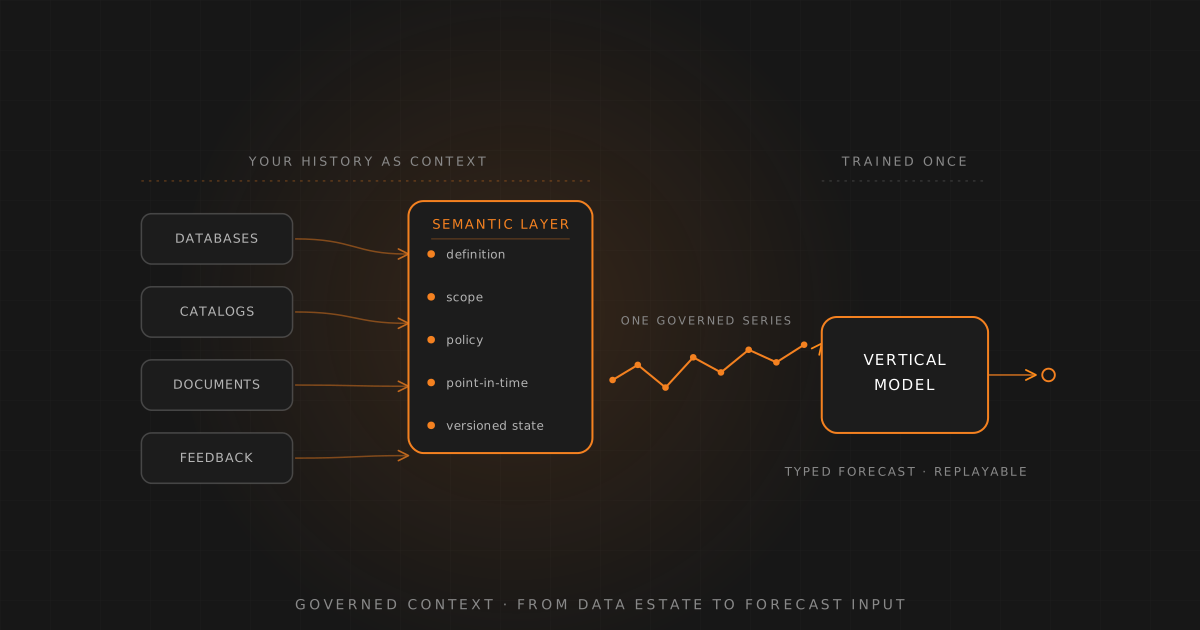
Start with scope. Colrows does not train or fine-tune models, and it does not supply GPUs. Colrows is an autonomous semantic layer. It sits above your warehouses and source systems and works as a semantic execution layer, compiling every request into governed SQL before anything runs. It holds what your data means, who may see it, and what any model or agent receives.
Colrows does not replace the model-training or evaluation tooling YC describes. It supplies a critical part of the foundation: governed business definitions, verified data queries, operational corrections and history that can be reused across models and agents. Those assets give you a more reliable base for building evals and training datasets.
| Xu's job | What Colrows contributes | What sits outside the semantic layer |
|---|---|---|
| "Turn workflows into evals" | Verified queries and governed metrics with expected results, usable as deterministic test cases for data agents | A full evaluation setup, grading logic, regression tracking and evals for non-data tasks |
| "Expertise into training data" | Business definitions, exceptions, relationships and reviewer corrections | Labelled training sets, train and test splits, and model training |
| "Production failures into improvements" | Query failures, corrections and semantic-model updates that apply to every agent at once | Prompt and tool changes, reinforcement learning and new weights |
| "Carry it forward with each new base model" | Model-independent definitions, policies, relationships and verified queries | Model-specific adaptation and integration testing |
Your intelligence should not be locked into another platform
A fair question for any vendor in this space: if my definitions live in Colrows, have I swapped one dependency for another? Colrows manages and evolves your business context. It does not take ownership of it.
- You can export it. The semantic model, including definitions, verified queries, policies and version history, exports as JSON and other formats.
- You can back it up and restore it on your own schedule.
- It is stored in your environment. In SaaS deployments, semantic assets sit in your cloud account. On-premise, they sit on your infrastructure.
- It stays with you. If the contract ends, the assets remain with the customer.
- It is reachable through standard interfaces. Agents and tools read the governed context through a documented REST API and an MCP endpoint.
- The model is swappable. No Colrows-specific model weights sit in the path, so you can change the underlying LLM.
Worked example: a forced model migration
A bank's analytics agents run on gpt-4.1, which retires on 14 January 2027. The bank decides to move to an open-weight model on its own servers.
- Keep the context. Metric definitions, join paths, row- and column-level policies and masking rules stay in the semantic model. None of them lived in the old model.
- Re-test before production. The team runs its verified questions against the new model. Colrows compiles and validates the SQL before anything touches production data, and the team compares it with the verified answers.
- Fix gaps in context first. Where the new model misreads a question, the team adds a definition or a verified example. If the problem is the model's behaviour rather than missing context, the team adjusts the prompt or tools, or tunes the model.
- Switch with an audit trail. Every answer before and after the switch keeps its trace, so an auditor can see which definitions produced which numbers on which date.
The same steps apply when the bank later moves to a better model by choice.
Run it where you choose
Colrows runs as SaaS on AWS, Azure and Google Cloud, or on-premise. For air-gapped sites, Colrows deploys open-weight models such as Gemma, Llama, Nemotron or Qwen inside your network. It can also use frontier models hosted in your private cloud. On-premise installs make no telemetry, licence-check or update calls out of the network. Colrows queries sources in place, so data is not copied into a new store. PII is anonymised before any prompt reaches an LLM, the platform includes defences against prompt injections, and it reduces token spend on AI workloads.
Someone has to do the work: deploy, then hand over
Xu's "someone has to" is a delivery problem as much as a product problem. Colrows covers it with forward-deployed engineering: Map, Build, Ship, Handover, in about eight weeks. In that window, engineers set the initial ground truth (core definitions and verified questions), connect SSO and access policies, and build and ship your data AI agents. After handover, the autonomous layer keeps the semantic model current as schemas and usage change, and your team owns the definitions, verified queries, policies and agents. See how we deploy and the Colrows system architecture.
Colrows runs in production under full audit at an Indian asset reconstruction company, across portfolio ingestion, recovery scoring and NPA valuation agents.
Owning a model in a regulated industry
What applies depends on how a system is classified and on your role.
The European Commission's guidelines for general-purpose AI give an indicative criterion: a downstream modifier may become a "provider" of a modified model if its additional training compute exceeds one-third of the original model's (EU AI Act GPAI guidelines). The guidelines are not legally binding, and each case needs its own assessment.
High-risk systems face stricter data rules. Article 10 requires governance of training, validation and testing data, including "the origin of data" and "the information that the data are supposed to measure." Under the Digital Omnibus, Annex III high-risk obligations apply from 2 December 2027 (Hunton Andrews Kurth).
In US banking, SR 26-2 replaced SR 11-7 in April 2026. It is expected to matter most to banks with over $30 billion in assets, and regulators have placed generative and agentic AI outside its scope (Cutover). Banks still need governance for those systems, but SR 26-2 is not the rulebook for them.
Colrows provides controls that can assist in meeting these requirements: documented definitions, lineage, access policy and point-in-time replay. Compliance depends on the whole system and the processes around it.
The case against owning your intelligence
The counter-evidence deserves a fair hearing. Menlo Ventures found open-source models held 11% of enterprise LLM usage in 2025, down from 19%, with Anthropic, OpenAI and Google at 88% (Menlo Ventures). In McKinsey's survey, 48% said proprietary tools reach value faster, while 63% of organizations used an open-source model somewhere (McKinsey, 2025). The surveys measure different things, and "open source" in them is broader than YC's "open-weight": access to weights does not always come with training data, code or unrestricted licence rights.
Most enterprises will run a hybrid: rented frontier models for hard tasks and open-weight models for specialised, local or cost-sensitive work. That makes a model-independent semantic layer more useful, because it stays constant while the model mix changes.
Three checks before you own a model in 2027
- Can you grade it? Do you have business questions with verified answers that any model can be tested against?
- Do your definitions live outside the model? If you switched models tomorrow, would your metric definitions, policies and exceptions come with you?
- Can you prove what happened? Can you show which definitions and data produced an answer on a past date?
If any answer is no, fix that before you choose a base model. Our piece on knowledge drift and semantic decay explains why those answers degrade without an autonomous layer, and YC's Vertical Foundation Models RFS makes the same case for domain-specific models. More on this theme in Semantic Layer & AI Agents.
Own Your Intelligence: frequently asked questions
What is the YC Own Your Intelligence RFS?
A Winter 2027 Request for Startups by YC partner Jon Xu. It argues that open-weight models now let companies own the models they rely on, and asks for startups that help them do it.
What does YC say is the hard part?
Turning "workflows into evals, expertise into training data, production failures into improvements", and carrying all of it forward with each new base model.
Are open-weight models as good as frontier models?
Close on broad indices and behind on the hardest tasks. Test them on your own workloads.
Am I locked into Colrows?
No. The semantic model exports as JSON and other formats, is stored in your account or infrastructure, and stays with you if the contract ends.
Sources
Every figure is the cited source's own published claim. Benchmarks and surveys measure different things; treat the numbers as evidence of a directional pattern, not universal constants.
- Y Combinator, Requests for Startups, Winter 2027
- Y Combinator, Jon Xu profile
- YC Library, Garry Tan: Own Your Intelligence (Aug 2026)
- Epoch AI, Open vs closed capability gap (May 2026)
- Artificial Analysis, Recent open-weights model launches (Apr 2026)
- Artificial Analysis, Intelligence Index v5 announcement (27 Oct 2026)
- OpenAI, Deprecations
- OpenAI, Reinforcement fine-tuning guide
- Anthropic, Model deprecations
- a16z, How 100 enterprise CIOs are building and buying gen AI (2025)
- LangChain, State of Agent Engineering (Jun 2026)
- Shankar et al., Who Validates the Validators? (2024)
- Zhou et al., LIMA: Less Is More for Alignment (2023)
- Gekhman et al., Fine-tuning on new knowledge and hallucination (EMNLP 2024)
- Ovadia et al., Fine-tuning or retrieval? (EMNLP 2024)
- BEAVER enterprise text-to-SQL benchmark (v3, May 2026)
- Sequeda et al., Knowledge graphs and LLM accuracy on enterprise SQL (2023)
- dbt Labs, Semantic layer vs text-to-SQL (Apr 2026)
- Virtualization Review, MIT NANDA GenAI Divide report (Aug 2025)
- Gartner, Lack of AI-ready data puts AI projects at risk (Feb 2025)
- Informatica, CDO Insights 2025
- Cursor, Composer 2 technical report (Mar 2026)
- Cursor, Real-time RL for Composer
- Harvey, Post-training update: Harvey Tenet (Aug 2026)
- EU AI Act, GPAI guidelines overview
- EU AI Act, Article 10: Data and data governance
- Hunton Andrews Kurth, Digital Omnibus on AI enters into force
- Federal Reserve, SR 26-2 (Apr 2026)
- Cutover, What SR 26-2 means for banks deploying agentic AI
- Menlo Ventures, State of Generative AI in the Enterprise 2025
- McKinsey, Open source technology in the age of AI (Apr 2025)