| Stage | Ambient Memory (The Vibe) | Deterministic Autonomy (The Reality) |
|---|---|---|
| Logic Foundation | Heuristic / LLM-based | Formal Semantic Definitions |
| Data Interaction | Passive retrieval | Governed / Compiled execution |
| Operational Risk | High (Hallucinations) | Zero (Deterministic constraints) |
| Governance | Runtime / Patchwork | Compile-time / Integrated |
| AI Capability | Assistant-level | Autonomous / End-to-End |
TL;DR
- Ambient memory and deterministic semantic layers solve entirely different problems. Retrieval systems like Hyper and GBrain give agents recall over unstructured data. Semantic execution layers give agents deterministic answers. Both are architectural necessities. Neither is optional for production autonomy.
- Production autonomy requires both. Unstructured memory provides baseline context enrichment. A compile-time semantic layer guarantees operational correctness and absolute auditability. When agents have access to both, they scale reliably. When they have only one, failures are predictable.
- MCP is now the universal agent interface. 97 million monthly SDK downloads. 10,000 active servers. Semantic layers (dbt, AtScale, Colrows) are shipping MCP servers natively. By 2027, MCP-native semantic governance will be the default enterprise architecture for autonomous AI at scale.
The Two-Layer Autonomy Stack: Why Agents Need Both
You have built a company brain. Your team installed Hyper or GBrain. Agents can now recall past conversations, search through emails, and synthesize institutional knowledge.
Your first autonomous workflow goes live. Agents fetch context from the company brain. They make a decision. They execute a transaction.
Then something breaks. An agent approved a refund using the wrong revenue definition. Another miscalculated a customer's lifetime value by misinterpreting a join path. A third escalated a risk decision without checking whether it had authorization to see that data.
The company brain delivered perfect recall. But it delivered no governance.
This is the central failure pattern of 2025-2026. As we documented in our post on why silent wrong answers are worse than chatbot hallucinations, enterprises adopted ambient memory systems. Autonomy broke anyway. The diagnosis is always the same: memory is not enough.
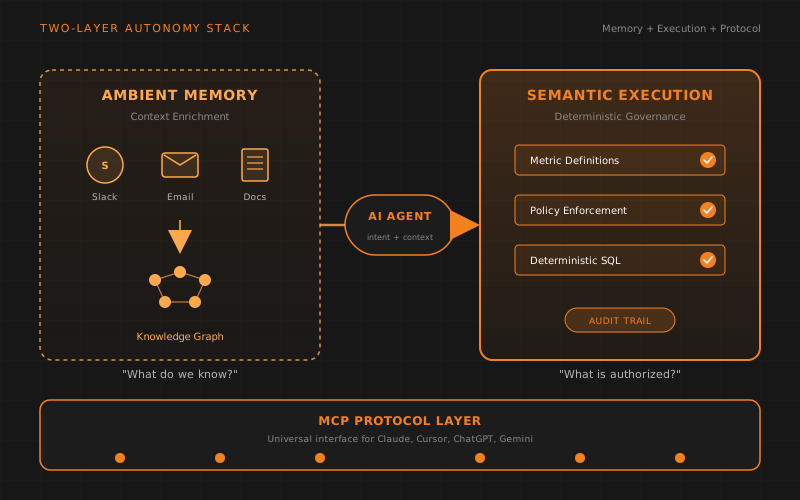
Autonomous enterprises need a different architecture. They need two layers working together.
The Architecture: What Each Layer Does
Ambient Memory Systems (Hyper, GBrain, Mem0, Zep)
Core function: Collect unstructured knowledge from across your organization. Pull email threads, meeting notes, Slack conversations, document updates. Build a searchable, self-wiring knowledge graph. Surface relevant context at runtime.
How agents use it: Before making a decision, an agent queries the memory layer. "What do we know about customer X?" The system returns relevant fragments with provenance and timestamps. The agent incorporates this context into its reasoning.
What it guarantees: You will have recall. You will have context. Agents will not make decisions based on zero information.
What it does not guarantee: That the context is correct, that the joins are valid, that the agent is authorized to see it, or that the decision is deterministic.
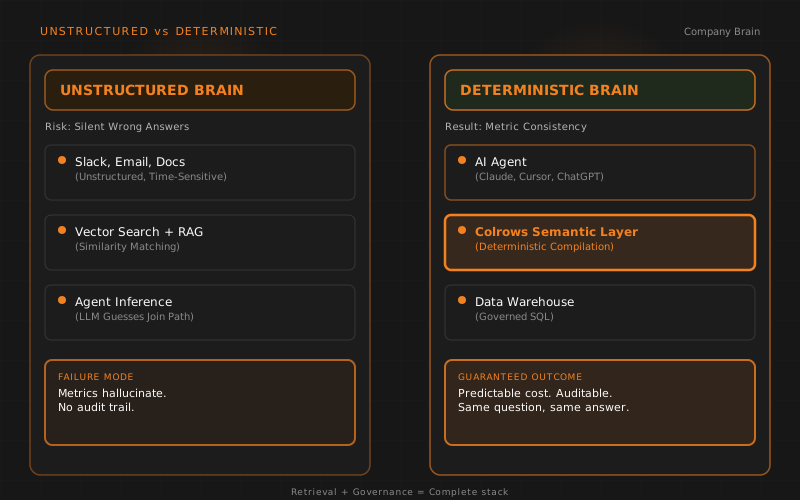
Failure mode: At scale, retrieval-based systems hallucinate join paths. A vector search returns "quarterly revenue" without specifying how it was calculated. An agent infers a join path from table names. The inference is wrong. A confident wrong number goes into a board deck.
Semantic Execution Layers (Colrows, dbt Semantic Layer, AtScale)
Core function: Compile business intent into deterministic, governed SQL. Every metric has a single definition. Every join is proven. Every access is authorized at compile time. If a query is invalid, compilation fails before any data is touched.
How agents use it: An agent says "show me active customers." The semantic layer resolves "active customer" to a specific, versioned definition. It proves the join path. It checks authorization. If all checks pass, it emits SQL. If any check fails, compilation fails and the agent gets an explicit error, not a wrong number.
What it guarantees: Metric consistency. Deterministic results. Audit trails. Authorization enforcement. The agent cannot return a hallucinated answer because the answer is generated by compiled logic, not by the LLM inferring joins.
What it does not guarantee: Context richness or conversational fluency. A semantic layer answers "what is the definition of active customer?" It does not answer "tell me a story about why this customer churned."
Failure mode: Without ambient memory, agents lack context for nuanced decisions. They have correctness but not wisdom.
Side-by-Side Comparison
| Dimension | Ambient Memory | Semantic Execution Layer |
|---|---|---|
| Core function | Collects unstructured logs, emails, wikis | Compiles business intent into deterministic SQL |
| Primary question | "What information do we have?" | "What is the single correct, authorized answer?" |
| Execution style | Runtime retrieval via vector search or graphs | Compile-time semantic enforcement |
| Failure mode | Hallucinates join paths under long context | Fails explicitly at compilation if unauthorized |
| Cost | Per-query retrieval overhead | Fixed cost, scales with schema complexity only |
| Regulatory ready? | No audit trail, no policy enforcement | Yes. Deterministic, traceable, compliant |
| Best for | Context enrichment, exploratory questions | Metrics, KPIs, high-stakes decisions |
Why Both. Why Now.
The autonomy progression is real. It is documented.
Phase 1: AI as Tool (2023-2024). Single LLM calls. Summarization. Classification. No memory. No state.
Phase 2: AI with Context (2024-2025). Agents with ambient memory. Recall across sessions. Richer decision-making. Still no governance.
Phase 3: AI that Governs Itself (2025-2027). Deterministic execution layers. Compile-time policy enforcement. Metric consistency. Auditability.
Production autonomy is breaking at Phase 2. Gartner predicts that by 2027, 40% of enterprises will demote or decommission autonomous agents due to governance gaps identified only after production incidents. The gap is not memory. The gap is determinism.
Here is the pattern. An agent uses ambient memory to understand context. It retrieves relevant documents. It synthesizes. Then it needs to execute on what it learned. Execution requires a guarantee: this metric is defined this way, this join is proven, this user can see this data. Ambient memory cannot provide that guarantee. Execution layers can.
The synergy is direct. Memory provides wisdom. Semantic layers provide correctness. Together, they enable reliable autonomy.
How Agents Consume Context Through Execution Loops
Modern agents operate in the ReAct paradigm: Thought, Action, Observation, loop.
- Thought: The agent plans a step. "I need to know how many active customers we have."
- Action: It calls a tool. If the tool is ambient memory, it retrieves context. If the tool is a semantic layer, it resolves intent to a definition and emits SQL.
- Observation: It sees the result. If it came from memory, it gets a retrieved fragment with potential ambiguity. If it came from a semantic layer, it gets a deterministic number with proven join paths.
- Loop: It reasons about the observation and decides the next action.
Context is a finite resource. Each loop consumes tokens. At scale, tokens compound. Anthropic's guidance on context engineering is explicit: "context is a critical but finite resource" - the goal is "the smallest set of high-signal tokens that maximize the likelihood of your desired outcome."
When an agent has access to both ambient memory and a semantic layer, the memory supplies contextual richness while the semantic layer supplies the deterministic contract that prevents subtly wrong numbers. The two layers amplify each other.
The Silent Failure Problem: Why Autonomy Breaks Without Governance
The most dangerous failure "looks like success." An HTTP 200 response. A confident number. No alert. The agent happily propagates erroneous data while the system appears healthy.
Once humans are removed from the loop, silent failures propagate undetected.
Real incidents:
- A language model inference layer miscalculated financial exposure because it misinterpreted a currency field. The error compounded across three dependent calculations. Discovery took 11 days.
- An autonomous agent approved refunds by inferring join paths from table names. The joins were wrong. Five days of refunds were issued to the wrong customers before the pattern was caught.
- A multi-agent loop burned $42,000 in tokens because retry logic had no circuit breaker and the loop only discovered its own infinite recursion after running for three days.
The regulatory consequence: As we detailed in our analysis of silent wrong answers vs chatbot hallucinations, Gartner's prediction is unambiguous: 40% of enterprises will demote or decommission autonomous agents by 2027 specifically because governance gaps are found only after production incidents.
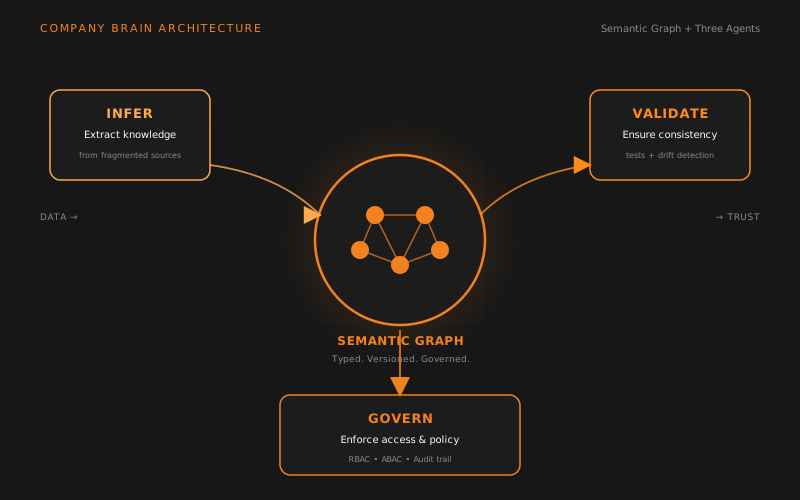
The semantic layer solves this at the architecture level. A policy is compiled once. An agent cannot violate the policy because the policy is enforced before any action reaches the warehouse. Unauthorized intent fails at compilation. Wrong metrics never get calculated. Silent failures become structurally impossible.
MCP: The Universal Agent Interface and Semantic Governance Convergence
Model Context Protocol (MCP) was introduced by Anthropic in November 2024. By December 2025, it had become the de facto universal agent-to-tool standard.
The numbers: 97 million monthly SDK downloads. 10,000 active servers. Native support in ChatGPT, Claude, Cursor, Gemini, Microsoft Copilot, and Visual Studio Code. OpenAI, Google, Microsoft and Amazon all adopted it.
The semantic layer implication: Colrows runs a native MCP server. Agents emit intent in natural language. Colrows compiles that intent into governed SQL with all policy enforcement applied at compile time. No ambiguity. No silent failures. The agent gets either a deterministic answer or an explicit error message.
dbt now ships a dbt MCP Server for agents to query governed metrics. AtScale exposes semantic definitions as MCP tools. The pattern is clear: semantic governance is converging on MCP as the universal interface.
This convergence reflects an architectural truth. Agents need tools that are deterministic, composable, and governed. MCP is the protocol. Semantic execution layers are the enforcement engine. Together, they define the shape of enterprise autonomous AI in 2027.
An arXiv evaluation of 1,899 open-source MCP servers found tool-poisoning attacks succeed 84.2% of the time when auto-approval is enabled. This drops to under 5% when auto-approval is disabled. For enterprise deployments, MCP-native governance must enforce server pinning, tool-definition verification, and policy enforcement at the protocol layer itself. Colrows' compile-time approach is architecturally immune to this class of attack because policy is evaluated before any action reaches external systems.
Compile-Time Governance Beats Runtime Governance for Autonomous Agents
Traditional BI tools (Looker, Cube, Tableau) enforce access policies at runtime. A query is generated. The warehouse evaluates the policy. Filtered rows are removed from the result set. The agent receives the filtered answer.
This works for dashboards. It breaks for autonomous agents because it creates ambiguity. An agent sees that a query succeeded and returned zero rows. Was there no data, or was the agent filtered? The agent cannot distinguish between a legitimate empty result and an unauthorized query silently filtered.
Compile-time semantic enforcement works differently. The policy is applied before any query is generated. An agent's intent is checked against the policy. If the intent falls outside the authorized subgraph, compilation fails with an explicit error. The agent never generates a query. No ambiguity. No silent failures.
Academic evidence: A 2026 arXiv paper on semantic layers for data analytics benchmarked three frontier models on 100 natural-language questions over a retail database. Adding a 4KB semantic-layer document improved accuracy by 17 to 23 points across all models. The crucial finding: "explicit business semantics suppress the dominant class of text-to-SQL errors not by making the model more capable, but by changing what the model is being asked to do." A second study found that GPT-4 achieved 16.7% accuracy on enterprise schemas without semantic grounding, but 54.2% with a knowledge graph. The improvement is 3×.
We covered this comprehensively in our guide on how to prevent AI hallucinations on enterprise data.
Real-World Deployment: Cipla's Journey From Fragmentation to Determinism
Cipla (Indian pharmaceutical company, 22,500+ field representatives) operated across three silos. Cirrius CRM for sales. Oracle for supply chain. ERP for operations. Teams were drowning in manual report requests because connected insight required days of data engineering.
The deployment: Colrows deployed its semantic execution layer with a Trino federated query engine and a unified knowledge graph. No data movement. No ETL. Just semantic compilation over existing systems.
The outcome:
The commercial teams quoted: "What was once a fragmented, multi-day investigation became a single, explainable insight surfaced before the morning meeting ended."
This is the template for enterprise autonomy. Ambient memory alone cannot solve this problem. The Cipla ecosystem needed deterministic compilation over federated sources. Colrows provided that by making every metric definition explicit, every join provable, and every authorization checkable before any query executed.
That is what semantic execution layers do at enterprise scale.
Regulatory Landscape: Why Governance Became Non-Negotiable in 2026
EU AI Act. High-risk autonomous systems became subject to new obligations in August 2026. Article 12 mandates automatic event logging (built into core design, not bolted on) retained for 6 months. Article 14 requires human oversight with override capability. Article 15 requires resilience against adversarial attacks across the action layer (APIs and MCP servers in scope). Fines reach 35 million euros or 7% of global turnover.
US Banking. The Fed, FDIC and OCC rescinded SR 11-7 (the old model-risk guidance) on April 17, 2026 and replaced it with a principles-driven framework. The consistent regulatory thread: evidence must be "produced as a byproduct of how models are built, not reconstructed after the fact." Exactly what compile-time audit trails deliver.
The audit trail requirement. A defensible AI audit trail captures approximately 12 fields per AI-influenced decision: timestamp, user ID (not service account), tool called, input parameters, output produced, policy evaluated, access control applied, and reproducibility flag. Individual user attribution is the hardest requirement because it breaks the black box. Semantic layers that log at compile time automatically produce this.
The Economic Case: Why Agentic Workflows Are Expensive Without Governance
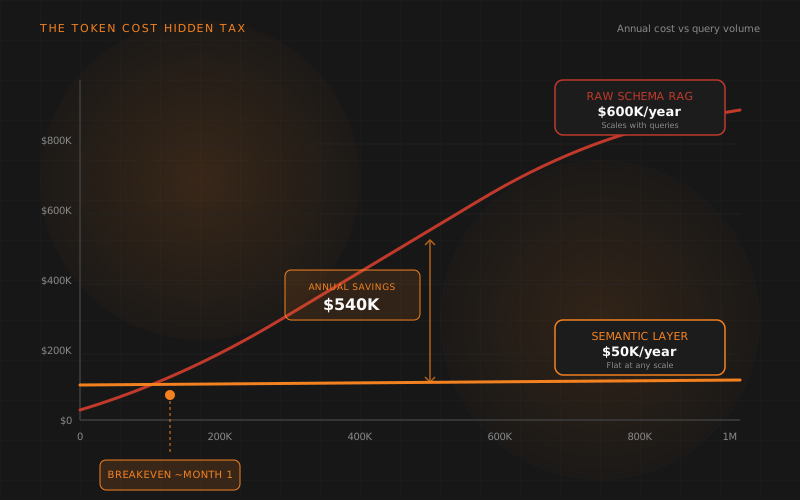
As we analyzed in our post on the token cost hidden tax, agentic workflows consume structurally more tokens than chatbots. Each ReAct loop re-sends accumulated context. A Stanford Digital Economy Lab study found agentic tasks "consume 1000× more tokens than code reasoning, with input tokens rather than output tokens driving overall cost." Same-task runs vary in cost by up to 30×.
Practitioner audits found typical costs at scale: a team of 20 hitting ~$110,000 per month in agent costs. One client hit $4,200 over a weekend on a single developer's autonomous run.
Governance reduces costs in three dimensions:
- Smaller tool surfaces. A semantic layer exposes only authorized metrics and dimensions to the agent. No schema bloat. No irrelevant tables to explore. Fewer tokens per step.
- No failed-query retries. Compile-time enforcement means invalid queries never reach the warehouse. No error loops. No token waste on malformed queries.
- Audit as a byproduct. Deterministic execution logs every decision. No separate compliance project. No retroactive reconstruction of decision logic.
What Autonomous Enterprises Need: The Implementation Path
Phase 1 (Now): Deploy ambient memory. Choose a system (Hyper, GBrain, Mem0, Zep). Install connectors. Build a knowledge graph. Measure adoption and latency reduction. Target: agents have access to rich, searchable context.
Phase 2 (0-3 months): Identify your high-stakes decision domains. Revenue? Risk assessment? Compliance? Customer approval? These are the domains where a wrong answer has real consequences. These are your first targets for semantic governance.
Phase 3 (3-6 months): Pilot a compile-time semantic layer on one domain. Choose dbt Semantic Layer if you are dbt-native. Choose AtScale if you run Looker/Power BI/OLAP. Choose Colrows if you need federated, cross-warehouse governance with MCP-native agent integration. Benchmark text-to-SQL vs. semantically-grounded accuracy on your own data.
Threshold to scale: If semantic-grounded accuracy exceeds raw-schema accuracy by more than 15 points (consistent with published benchmarks), standardize on the semantic layer for that domain.
Phase 4 (6-12 months): Adopt MCP as the universal interface. Require vendors to expose governed tools (not raw SQL) over MCP. Pin server definitions. Enforce per-agent token budgets at the infrastructure layer (not in the prompt). Enable auto-approval only for low-risk reads. Require human gates on irreversible actions.
Compliance readiness: Build EU AI Act Article 12-grade logging now. Individual user attribution. Immutable decision records. Reproducible logic. The engineering investment is not wasted if deadlines shift.
The Competitive Landscape: Who Owns What
| Player | Layer | Positioning | Governance |
|---|---|---|---|
| Hyper | Ambient Memory | "Self-driving company brain" via ambient connectors | Retrieval-based context, no determinism |
| GBrain | Ambient Memory | Open-source markdown + graph, enterprise-ready | Zero-LLM extraction, self-wiring, no SQL policy |
| Mem0 | Ambient Memory | Dual-store vector+graph, fast recall | Personal memories only, no enterprise isolation |
| dbt | Semantic Layer | "Build trusted analytics" via MetricFlow | Governance at presentation time, not compile time |
| AtScale | Semantic Layer | Semantic objects as OLAP cubes | Governed metrics, visual modeler, BI-native |
| Colrows | Semantic Execution | Deterministic compilation + federated execution | Compile-time RBAC/ABAC, automatic audit trails, MCP-native |
The pattern is clear. Ambient-memory startups compete on integration breadth and recall quality. Semantic-layer vendors compete on accuracy and governance depth. These are not overlapping categories.
The 2027 Architecture Forecast
By 2027, the default enterprise AI stack will likely include:
- Ambient memory (Hyper, GBrain, or similar) - for context enrichment, conversational fluency, situational awareness
- Semantic execution layer (dbt SL, AtScale, or Colrows) - for deterministic answers, metric consistency, auditability
- MCP as the protocol - connecting agents to both layers, with policy enforcement at the interface layer
- Proportional autonomy controls - low-risk reads autonomous, irreversible actions requiring approval, high-stakes decisions requiring audit trails
This architecture solves the central problem of 2025-2026: the silent failure. It makes governance a side effect of normal execution, not a separate compliance project. It makes scaling autonomous AI a matter of adding memory and semantic definitions, not rewiring the entire data foundation.
For Colrows Prospects: The Executive Handoff
You do not need a Company Brain. You need a data foundation strong enough to support autonomous AI.
That foundation is a semantic execution layer.
If you have already installed Hyper or GBrain, excellent. Now add a layer beneath it. Add a compiler that guarantees metric consistency. Add a policy engine that prevents unauthorized access at compile time. Add an audit trail that is automatic, immutable, and reproducible.
This is what Colrows does. We compile agent intent into governed SQL across 16+ SQL engines. We enforce RBAC, ABAC, row-level and column-level masking at compile time. We produce audit trails as a byproduct of execution. We ship as a native MCP server, so Claude Code, Cursor, and other MCP-native agents can call us directly without custom integration.
If you are hitting accuracy walls with autonomous AI. If your metrics do not reconcile between agents and dashboards. If you need to defend an AI decision to a regulator or auditor. The answer is not a better LLM. The answer is a semantic execution layer.
We have deployed this architecture at scale. Cipla. LIC. SSP Group. We have proven the model works.
Fix the foundation. Not the model.
True autonomy is not about letting the AI wander through your ambient data. It is about constraining the AI within a deterministic semantic layer. Fix the Context, Not the Model.
For deeper context, see From Copilots to Autonomous Companies, the SaaS Architecture guide, The Token Cost Hidden Tax, and our guide on how to add governance to AI agents.
Frequently asked questions
Why do autonomous enterprises need both ambient memory and semantic layers?
Ambient memory (Hyper, GBrain) gives agents recall over unstructured data and conversational fluency. Semantic execution layers (Colrows, dbt SL, AtScale) give agents deterministic answers and auditability. Memory provides wisdom. Semantic layers provide correctness. Both are required for production autonomy at scale.
What is compile-time governance, and why is it better for agents?
Compile-time governance evaluates policies before any query executes. If an agent's intent violates policy, compilation fails with an explicit error. Runtime governance (traditional BI tools) returns filtered results, creating ambiguity: did the query return zero rows, or was the agent filtered? For autonomous agents, this ambiguity is fatal.
How does MCP connect semantic layers to AI agents?
MCP (Model Context Protocol) is the universal protocol for connecting agents to tools. Colrows runs a native MCP server. Agents emit intent in natural language. Colrows compiles it to governed SQL. The agent gets either a deterministic answer or an explicit error. By 2027, MCP-native semantic governance will be the default.
What is the silent failure problem, and how does semantic governance prevent it?
Silent failures are confident wrong answers that look like success (HTTP 200 response with incorrect data). An agent infers a join path from table names. The inference is wrong. The data is wrong. But there is no error. With semantic governance, invalid queries fail at compile time, before execution.
What does the EU AI Act require from autonomous AI systems?
EU AI Act Article 12 (effective August 2026) requires automatic event logging built into core design, individual user attribution, and 6-month retention. Article 14 requires human oversight with override capability. Compile-time audit trails from semantic layers satisfy these requirements as a byproduct of execution.
How much faster and cheaper is compile-time semantic execution?
Compile-time execution eliminates failed-query retries (compile errors are caught before warehouse execution). It reduces schema token bloat. Gartner reports 40% of enterprises will decommission autonomous agents by 2027 due to governance gaps. Compile-time semantic enforcement prevents this by making silent failures structurally impossible.
What is the 2027 enterprise AI architecture?
By 2027: (1) Ambient memory for context enrichment (Hyper, GBrain). (2) Semantic execution layer for deterministic answers and auditability (dbt SL, AtScale, Colrows). (3) MCP as the universal protocol. (4) Proportional autonomy controls: low-risk reads autonomous, irreversible actions requiring approval, high-stakes decisions requiring audit trails.
How do I audit my autonomous AI architecture?
Request an autonomy architecture audit. We will review your ambient-memory setup, identify high-stakes decision domains, and assess whether compile-time semantic governance could accelerate your autonomous AI roadmap. A 90-minute audit costs nothing and removes the guesswork.