| Aspect | Wiki / RAG / Search | Company Brain (Colrows) |
|---|---|---|
| What it stores | Documents and text, or a vector index over them | Meaning: typed entities, governed relationships, and versioned definitions |
| Metric consistency | Cannot verify that your finance dashboard agrees with the doc | Every query resolves to the same governed definition |
| Joins | Cannot prove a join or guarantee two agents resolve a term the same way | Compiles through a proven join path deterministically |
| Governance | Describes policy but does not enforce it | Governed before the answer exists, correct by construction |
| Auditability | No reproducible, audited result | The same audited result whether it came from a CFO, a dashboard, or an agent |
The expensive version of the problem
Let us put numbers on fragmented knowledge, because the C-suite case lives or dies on them.
Poor data quality costs the average organization $12.9 million a year, according to Gartner. Thomas Redman, writing in MIT Sloan Management Review, estimates the cost of bad data at 15 to 25 percent of revenue for most companies. Knowledge workers spend nearly 20 percent of every week looking for internal information or tracking down colleagues who can help, per the McKinsey Global Institute's "The Social Economy" study. And inefficient decision-making squanders roughly 530,000 manager-days a year at a typical Fortune 500 company, about $250 million in wages, McKinsey found, with 61 percent of executives saying at least half their decision time is wasted.
Now layer AI on top of that mess. MIT's Project NANDA found that 95 percent of generative AI pilots delivered no measurable profit-and-loss impact. Gartner predicts more than 40 percent of agentic AI projects will be canceled by the end of 2027, citing escalating cost, unclear business value, and inadequate risk controls. Only 7 percent of enterprises say their data is fully ready for AI, in a Cloudera and Harvard Business Review study.
The pattern is consistent. The models work. The data foundation does not. You cannot automate a company whose own systems disagree about what a customer is.
Company brain, enterprise brain: the same idea
Both names describe the same thing, and teams use them interchangeably. An enterprise brain is a governed, structured model of what an organisation knows, built so people and AI agents can act on it safely.
"Company brain" spread first because Y Combinator used it in a Request for Startups. "Enterprise brain" tends to show up in procurement documents and architecture reviews. There the buyer is a CDO rather than a founder.
The vocabulary does not change the requirement. Whichever term your organisation uses, the hard part is the same. The answer has to be governed before it exists, correct by construction, and reproducible afterwards. That is the whole argument of this page.
What a company brain actually is
A company brain is a living, governed model of what your organization knows and how it works, made legible to both people and AI agents.
YC partner Tom Blomfield was specific about what it is not: "This isn't a company-wide search or a chatbot over documents. It's a living map of how a company works: how refunds get handled, how pricing exceptions are decided or how engineers respond to incidents."
That distinction matters because most products marketed as a company brain are something simpler:
- A wiki (Confluence, Notion) is a document store with a search box. It has the words "we exclude refunds from net revenue." It cannot verify that your finance dashboard agrees.
- A RAG / enterprise search layer (Glean and similar) is a vector index over text. Great for "where is the onboarding doc?" It cannot prove a join or guarantee that two agents resolve "churn risk" the same way.
- A tool registry (an MCP server collection) tells an agent what it can do. It does not tell the agent what is true about the business.
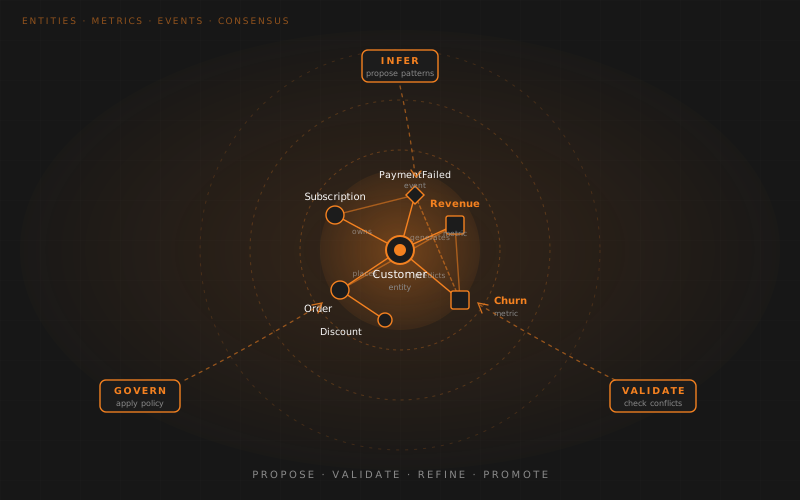
A real company brain sits underneath all three and feeds them. It captures meaning, not files: typed entities, governed relationships, versioned definitions, and the policies that constrain them.
The bridge from "expensive problem" to "architecture"
Here is the translation for the technical reader, because the business stakes above are caused by a specific architectural absence.
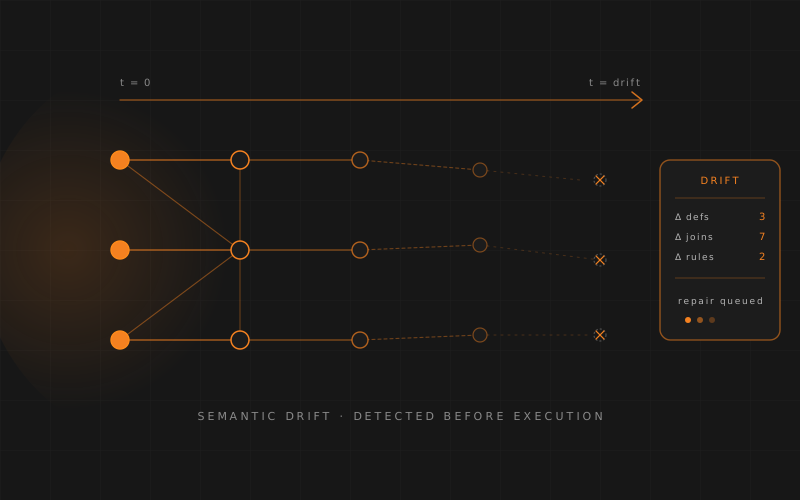
When there is no governed semantic layer, every consumer of data, every analyst, every dashboard, every agent, re-derives meaning on the fly. The agent writes its own SQL. It guesses a join. It invents a definition of "active customer" because none is enforced. That is why two agents asking the same question return two answers. The disagreement is upstream of the tools.
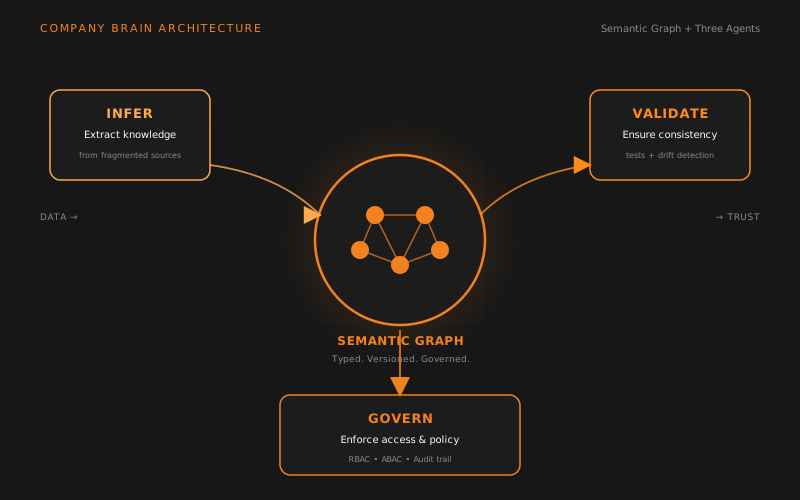
The fix is to make meaning a compile-time concern. Define each metric, entity, relationship, and policy once, in a governed, versioned graph, and force every query to compile through it. The question becomes deterministic: the same input resolves to the same governed definition, the same proven join path, and the same audited result, whether it came from a CFO, a dashboard, or an autonomous agent.
Why this makes agents trustworthy (with receipts)
This is not theory. It is measurable.
The data.world AI Lab benchmarked GPT-4 answering business questions against an enterprise SQL database. On the raw schema, zero-shot accuracy was 16.7 percent. With a knowledge graph representing the same data, accuracy tripled to 54.2 percent. On the schema-intensive questions, the kind real enterprise questions actually are, raw SQL scored 0 percent.
A 2026 dbt Labs benchmark went further. For queries covered by a well-modeled semantic layer, accuracy approaches or hits 100 percent, versus 84 to 90 percent for the best 2026 text-to-SQL models on raw tables. The reason is the part that should make a CTO sit up: "With text-to-SQL, failure looks like a plausible but incorrect answer. With the Semantic Layer, failure looks like an error message."
That is the entire game for enterprise AI. A wrong answer that looks right is the thing that ends up in a board deck, a regulatory filing, or an agent's autonomous action. A governed semantic layer converts silent wrong answers into loud, catchable errors.
What this looks like in production
Picture an autonomous renewals agent on a B2B SaaS finance team.
- It asks the company brain for the account's typed customer entity. The brain returns it with current relationships: contract terms, owner, payment history, region.
- It asks for "churn risk" under the finance-approved definition. The brain resolves the term to the versioned metric, applies the finance scope (exclude free-tier, 90-day pre-renewal window), and proves the join path through Subscription to Payment to Refund.
- The brain compiles the question into governed SQL, runs it, and returns a result with the audit trail attached.
Now a second agent, customer success, asks the same question about the same account. It hits the same brain and gets the same answer. Not because the agents coordinated, but because the brain enforced consensus at compile time. That is what "single source of truth" means when an auditor asks you to reproduce a number.
Where Colrows fits, and where it does not
Be clear about scope. A full company brain spans data, documents, process, policy, and culture. Colrows does not do all of that, and any vendor that claims to is selling you the wiki-plus-vector-index illusion YC warned about.
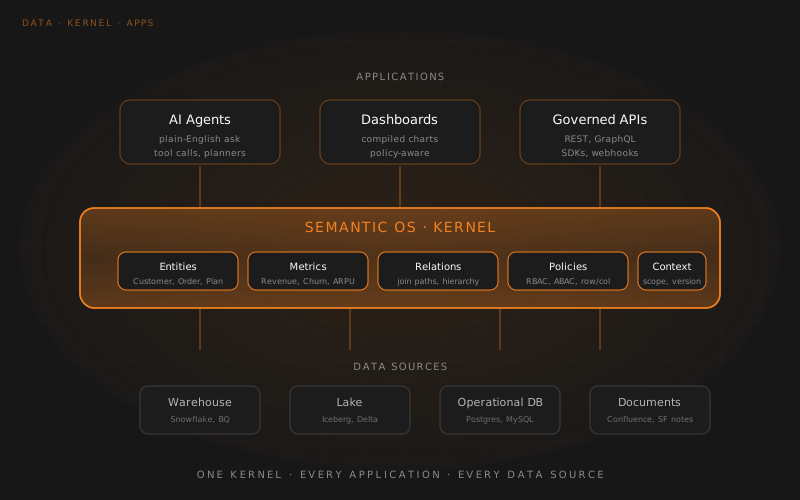
Colrows owns one pillar: the data-semantics layer. It is the deterministic semantic compiler for your data estate, the governed engine for metrics, entities, relationships, and policies. It is the foundational pillar, because it is the one that decides whether your agents and your decisions are trustworthy. The rest of the company brain builds on top of an answer everyone can trust.
Map it directly to the RFS. YC is asking for "a system that pulls knowledge out of all these fragmented sources, structures it, keeps it current, and turns it into an executable skills file for AI." Colrows is exactly that system for the data estate. The RFS goes beyond data, into process and tribal knowledge, and we are honest that those are adjacent pillars. But the data pillar is the one that fails loudest when it is missing, and the one regulators and auditors care about most.
Architecturally, Colrows is:
- Deterministic. Compile-then-execute at the warehouse edge. The brain is the path a query has to take, not a sidecar it may consult.
- Non-replicating. It reads from PostgreSQL, Snowflake, Databricks, BigQuery, Redshift and 10-plus more, plus catalogs and Confluence. No rip-and-replace, no copy of your data.
- Portable. It speaks MCP, so it is not locked to one platform's walled garden.
- Self-maintaining. Inference, validation, and governance agents keep the graph current so it does not decay into stale tribal knowledge.
- Deployable where you are regulated. Cloud, dedicated, hybrid, or on-premise, with RBAC, ABAC, and row and column security enforced at compile time, before any query touches the warehouse.
The honest competitive picture
Everyone is moving toward the company brain from a different starting point, and that is good for you. It validates the category.
- Palantir Foundry has the most opinionated ontology, semantic plus action and workflow tiers, but it is deeply embedded in Foundry.
- Databricks Unity Catalog added Business Semantics, though its foreign-key constraints are informational, not strictly enforced by the engine.
- Snowflake, dbt Labs, and Salesforce are co-driving the Open Semantic Interchange standard, v1.0 shipped January 2026, which is the right direction for interoperability.
- Microsoft Fabric IQ added ontology support with MCP endpoints.
- Glean is the at-scale enterprise-search "brain," but it is retrieval-first.
Colrows is not trying to be all of them. It owns deterministic data semantics, which most of them treat as a feature rather than the foundation. Where they win is ecosystem breadth, installed base, and adjacent capabilities. Where Colrows wins is determinism, no data movement, MCP portability, autonomous maintenance, and regulated-environment deployment. It is complementary to the broader stack, not a replacement for it.
What it costs
Colrows pricing follows the shape of the work: schema complexity plus query volume, because agents and humans both query the brain. There is a Free tier for exploration, unlimited datasources, users, and access policies, with an included compute budget, and an Enterprise tier for regulated production workloads with SSO, dedicated or on-premise deployment, and SOC 2 and HIPAA support.
The bottom line
Every enterprise will end up with a company brain in some form. The question is whether the data pillar underneath it is the governed, versioned, deterministic kind, or a stitched-together guess that produces a different number every time you ask.
YC thinks every company in the world will need one. The benchmarks show the data layer is what makes it trustworthy. And trustworthy is the only version worth deploying, because a confident wrong answer is the most expensive output your AI can produce.
The models already work; what fails is the data foundation that lets two agents answer the same question two different ways. Fix the Context, Not the Model.
If your CFO and your AI agent still calculate revenue two different ways, start there.
For where this sits in the wider category, AI knowledge management scores the five approaches on whether they only find knowledge or also govern the answer.
FAQ
What is a company brain in enterprise AI?
A company brain is a living, governed model of what an organization knows and how it operates, structured so both people and AI agents can act on it safely. YC's Summer 2026 RFS describes it as a system that pulls knowledge from fragmented sources, structures it, keeps it current, and turns it into an executable layer for AI.
Is a company brain just enterprise search or RAG?
No. Enterprise search and RAG retrieve text by similarity. A company brain captures structured meaning: typed entities, governed metric definitions, proven relationships, and enforceable policies. Retrieval can find a document; it cannot prove a join or guarantee two agents use the same definition of revenue.
What is the YC Summer 2026 Company Brain RFS?
It is Y Combinator's call (category #4, by partner Tom Blomfield) for startups building the layer that turns scattered company knowledge into something AI can act on reliably. It descends from Garry Tan's open-source "G-Brain" personal memory system, released April 2026.
How does a semantic layer improve AI agent accuracy?
Benchmarks show large gains. The data.world AI Lab measured a 3x accuracy improvement (16.7% to 54.2%) when GPT-4 answered enterprise questions through a knowledge graph instead of raw SQL. A 2026 dbt Labs benchmark found a well-modeled semantic layer approaches 100% accuracy on covered queries, and converts silent wrong answers into catchable errors.
Where does Colrows fit in a company brain?
Colrows is the data-semantics pillar: the deterministic compiler that governs metrics, entities, relationships, and policies for your data estate. It is the foundational layer for agent reliability and decision support. A full company brain also includes process, policy, and culture, which are adjacent pillars Colrows integrates with via MCP and connectors.
How is Colrows different from Palantir, Databricks, or Glean?
Palantir's ontology is powerful but embedded in Foundry. Databricks' semantic constraints are largely informational. Glean is retrieval-first. Colrows owns deterministic compilation at the warehouse edge, replicates no data, is MCP-portable, maintains its model autonomously, and deploys on-premise for regulated workloads.
What does fragmented knowledge actually cost?
Gartner puts poor data quality at $12.9 million per organization per year. Thomas Redman in MIT Sloan Management Review estimates 15 to 25 percent of revenue lost to bad data. McKinsey ties inefficient decision-making to about $250 million a year at a typical Fortune 500 company. And 95 percent of generative AI pilots showed no P&L impact, per MIT's NANDA initiative.
How does a company brain help with audit and compliance?
Because every query compiles through governed, versioned definitions with an attached audit trail, decisions become reproducible. You can show an auditor exactly which definition produced a number and when it changed, which directly reduces restatement and compliance risk.