Masking-after vs governing-before on PHI
| Requirement | Mask-after-generation tools | Governed AI analytics (Colrows) |
|---|---|---|
| PHI access | Row is read, then masked in output | Unauthorized plan cannot be generated; row is never read |
| Minimum-necessary | Enforced at display | Enforced structurally, per persona, before execution |
| Reproducibility | SQL can vary run to run | Deterministic; same question, same scope, same answer |
| Audit | Partial logs | Point-in-time reproducible audit trail per answer |
Why healthcare raises the bar
Clinical and life-sciences teams want the same self-serve analytics everyone else does, but on data where a wrong disclosure is a breach. Three requirements follow.
- Proof of non-access. The minimum-necessary standard is about what was accessed. A system that can show PHI was never read by an unauthorized query is stronger than one that redacts it after the fact. See fine-grained access control.
- Determinism. Clinical and operational reporting must reproduce. An answer that shifts run to run cannot support a decision or an audit.
- Auditability. Every answer needs lineage: which definitions, which policies, which data version. See conversational analytics for clinical data for the architecture.
Fix the Context, Not the Model. A safer model does not make PHI access provable. Defensible healthcare analytics comes from a semantic layer that shapes an allowed subgraph per persona and proves the query before it runs.
How compile-time governance supports HIPAA controls
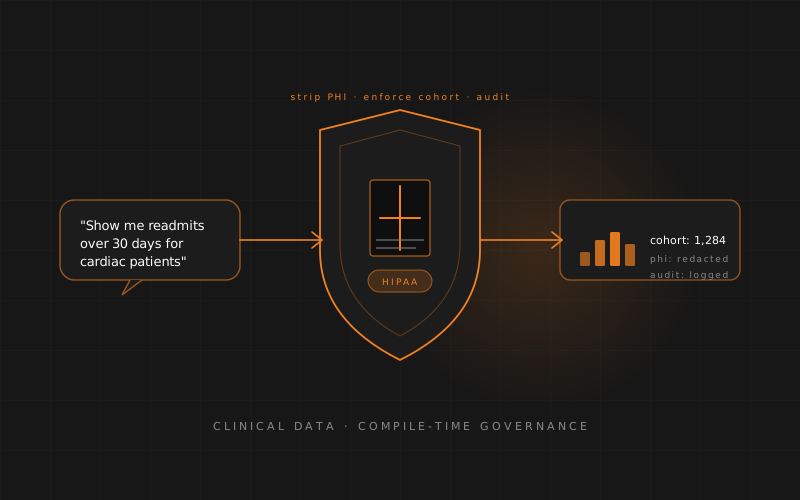
Colrows compiles agent intent through a typed semantic graph and enforces policy before any SQL runs.
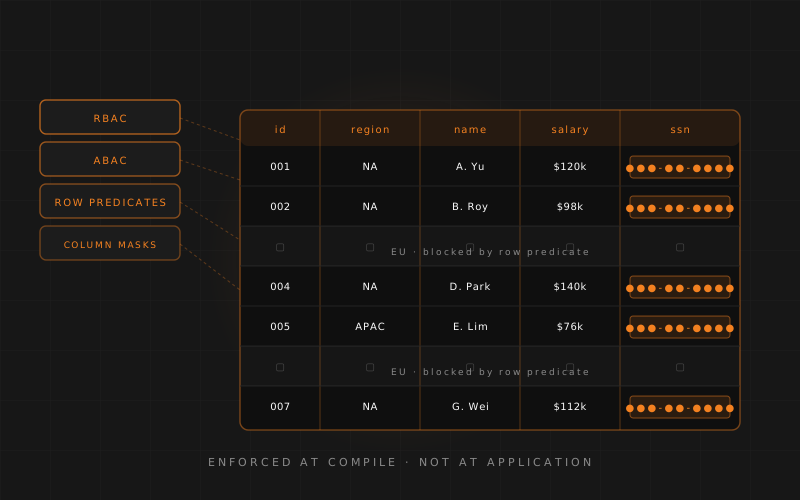
- Restricted rows never read. RBAC, ABAC, and row/column predicates are evaluated at compile time. Colrows shapes an allowed subgraph per persona, so an unauthorized plan cannot be generated, supporting the minimum-necessary principle structurally.
- Deterministic SQL. The same question in the same scope compiles to the same SQL, so clinical and operational numbers reproduce.
- Join path proof. Cross-dataset questions prove a deterministic join path or refuse with an explainable error.
- Point-in-time reproducibility. Every answer carries an audit trail tying the number to the definitions and policies in force at the time.
- Refusal over hallucination. Ambiguous requests refuse at compile time instead of guessing. See how to prevent AI hallucinations on enterprise data.
Proof from a life-sciences deployment
Governed conversational analytics is not theoretical in regulated life sciences. At Cipla, a pharmaceutical enterprise, a Colrows deployment drove 8x data adoption and a greater-than-90% reduction in decision latency while keeping access governed. The lesson for healthcare: strong governance and fast self-serve are not opposites when the governance is structural.
On vendor claims specifically, AI analytics for regulated industries explains why a HIPAA badge is not a certification.
We compare the broader set of conversational analytics tools on the same three axes.
The UAE has its own hard residency rule for health data, covered in enterprise AI in the UAE.
Frequently asked questions
What makes AI analytics HIPAA-appropriate?
Minimum-necessary access enforced before data is read, deterministic reproducible SQL, and a point-in-time reproducible audit trail. Compile-time governance can prove PHI was never accessed by an unauthorized query.
Is masking PHI in the output enough?
Often not. Masking hides PHI after it is read. Compile-time governance prevents the unauthorized plan from being generated, so restricted rows are never read.
Does Colrows guarantee HIPAA compliance?
No tool guarantees compliance alone. Colrows provides controls, compile-time governance, deterministic SQL, and auditability, that assist a covered entity or business associate as part of a complete control environment and a signed BAA.