
Why this matters now
Until recently, the consumers of enterprise data were mostly humans. Analysts wrote SQL. Executives clicked dashboards. Business teams pulled reports. Mistakes were slow, traceable, and correctable.
AI agents changed that. An LLM-based agent can issue thousands of queries an hour. Each one is generated from natural language and grounded in whatever schema the model can guess from. Definitions drift, joins are fabricated, governance is bypassed - all at machine speed. Without a semantic layer, every agent invents its own version of "revenue," "active customer," and "Q3 EU sales." No two answers match. None can be audited.
Consider a concrete scenario. Two analysts ask an AI agent the same question - "what was our Q3 revenue in EU?" - on a Monday morning. Without a semantic layer, the agent generates two slightly different SQL queries, each making different assumptions about which orders table to join, whether refunds are subtracted, and whether Q3 means calendar quarter or fiscal quarter. Both queries return numbers. Both numbers look plausible. Neither analyst notices they got different answers until a quarterly review three weeks later, when their reports disagree by 4.7 million euros. Now multiply that by every question every agent asks every hour.
A semantic layer is what turns AI agents from probabilistic guessers into systems you can put in production. It is the structural difference between "the model said so" and "the query was proven."
How a semantic layer works
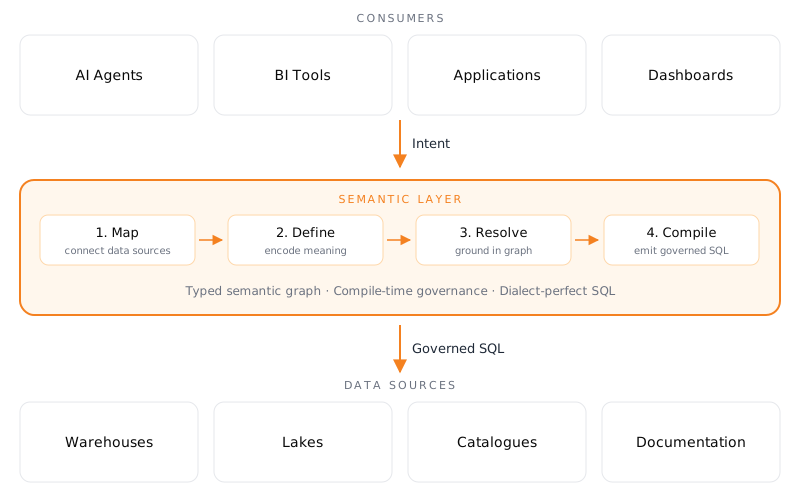
A semantic layer follows a four-step process: map, define, resolve, compile.
1. Map - connect to data sources
The layer introspects your warehouses, lakes, operational databases, and metadata catalogues. It pulls schemas, columns, foreign keys, and existing metric definitions into a single representation. Modern platforms support 16+ engines out of the box (Snowflake, Databricks, BigQuery, Redshift, Postgres, MySQL, ClickHouse, Trino, and more).
2. Define - encode business meaning
On top of the mapped structure, the layer captures what the data means - entity definitions (what is a Customer?), metric formulas (how is Revenue computed in this business?), relationships (how is Customer linked to Subscription?), and governance predicates (who can see what, under which conditions?). Modern platforms build much of this automatically, then let humans approve or correct.
3. Resolve - ground every query in the graph
When a query arrives - whether from a human, a BI tool, or an AI agent - the semantic layer resolves every term to its grounded entity in the graph. "Revenue" is not just a string; it is a resolved concept with a specific formula, a specific source, and a specific governance scope.
4. Compile - emit governed, dialect-perfect SQL
Finally, the layer compiles the resolved query into native SQL for the target engine. Governance predicates (RBAC, ABAC, row/column-level filters) are injected at compile time, before any SQL touches the warehouse. The result is deterministic: the same intent produces the same SQL, every time. The same query against Snowflake and against Databricks produces dialect-perfect SQL for each.
Why semantic layers are critical for AI agents (not just BI)
Semantic layers existed in BI tools (Looker, MicroStrategy, SAP) for two decades. So why is the category suddenly being rebuilt?
Because AI agents break every assumption a BI semantic layer was built on.
BI tools are deterministic at the front end. A user picks "Revenue" from a dropdown. The semantic layer resolves it. Done.
AI agents are stochastic. They generate text that may or may not match a real entity. They hallucinate joins. They invent column names. They confuse two metrics with similar definitions. Without a layer between the agent and the warehouse, every query is a roll of the dice.
A semantic layer for AI agents must do three things a BI semantic layer never had to:
- Compile, not retrieve. Agents do not pick from dropdowns; they generate intent in free text. The layer must compile that intent into SQL deterministically, with proven join paths and grounded entities.
- Enforce governance at compile time. RBAC, ABAC, and row/column-level filters cannot be advisory. If the agent's user does not have access to a column, the column must not appear in the generated SQL - period.
- Maintain itself. Schemas drift. Columns are renamed. New tables appear. A semantic layer that requires manual updates every time the data team ships a migration cannot keep up with AI agent volume.
This is why the category is being rebuilt. The semantic layer for the AI era is not just metric resolution. It is a semantic execution layer.
Semantic layer vs. data catalog vs. data warehouse
The three are often confused but solve different problems.
| Data warehouse | Data catalog | Semantic layer | |
|---|---|---|---|
| Primary purpose | Stores and processes data | Indexes data assets and metadata | Encodes business meaning and governance |
| Primary user | Engineers, ETL pipelines | Data stewards, governance teams | Applications, agents, dashboards |
| Executes queries | Yes - SQL native | No - documentation only | No - emits SQL to the warehouse |
| Enforces policy at compile time | No - typically advisory | No - governance is metadata, not enforcement | Yes - RBAC/ABAC injected into generated SQL |
| Maintains itself | No - DBAs maintain | No - manually curated | Modern platforms with autonomous graphs - yes |
| Output | Tables, views, query results | Searchable lineage and tags | Governed SQL, metric APIs, MCP tools |
A data warehouse without a semantic layer means every consumer rewrites the same business logic. A data catalog without a semantic layer means you can find a table but not trust what it returns. A semantic layer without a warehouse has nothing to compile against. The three compose.
How to evaluate semantic execution layers
Score each criterion 0 (absent) to 5 (best in class), then sum.
1. Graph autonomy (0-5)
Does the platform auto-build the semantic graph from your data sources, or do you hand-author every entity and relationship? Score 0 for fully manual, 3 for semi-automated, 5 for autonomous detection plus drift handling.
2. Dialect coverage (0-5)
How many SQL dialects does the compiler support natively? 1-3 dialects scores 1, 4-9 scores 3, 10+ with dialect-perfect output scores 5.
3. Compile-time governance (0-5)
Are RBAC, ABAC, and row/column-level predicates enforced at compile time, or applied as a post-query filter? Post-filter scores 1 (the data was still read). Compile-time injection scores 5 (the data was never accessed).
4. AI-agent readiness (0-5)
Can agents call the platform via HTTP, JDBC, or an MCP-style tool surface? Does the platform return proven join paths and an audit trail per query? Manual SDK scores 1; full agent surface with proofs scores 5.
5. Audit trail and reproducibility (0-5)
Can you re-run a historical query and prove it used the exact definitions in force at that moment? None scores 0, partial logging scores 2, point-in-time reproducible scores 5.
6. Multi-scope semantics (0-5)
Does the platform model meaning at multiple scopes (global, datastore, persona, user), or assume one global definition per concept? Single-scope scores 1; true multi-scope resolution scores 5.
7. Maintenance overhead (0-5)
How much engineering time is required to keep the layer current as schemas evolve? Days per migration scores 1, hours scores 3, autonomous drift handling scores 5.
Sum the seven criteria. Maximum is 35. Above 28 is enterprise-ready. Below 18 means you will end up rebuilding the layer on top of whatever you bought.
Frequently asked questions
What is the difference between a semantic layer and a metric layer?
A metric layer is a subset of a semantic layer. It captures measures - revenue, churn rate, NPS - and their formulas. A semantic layer captures everything around that: entities, relationships, governance, scopes, and resolution rules. Every metric layer can become a semantic layer by adding entity modeling and governance; not every semantic layer is just a metric layer.
Do I need a semantic layer if I use dbt?
dbt is a transformation framework. It builds models in your warehouse but does not, by default, resolve queries against business meaning at runtime, enforce governance at compile time, or expose itself to AI agents in a deterministic way. A semantic layer sits above dbt - many platforms (Colrows included) ingest existing dbt metric definitions as a starting point.
Can a semantic layer replace my data warehouse?
No. A semantic layer compiles to SQL that runs on your warehouse. The warehouse stores and executes; the semantic layer governs and translates. They are complementary, not substitutes.
How does a semantic layer prevent AI hallucinations?
Hallucinations happen when an LLM generates a column name, join, or metric definition that does not exist or is wrong. A semantic layer forces every query to resolve through a typed graph with proven join paths. If the agent's intent cannot be grounded in the graph, the query fails compilation. Agents cannot fabricate joins that the graph does not have.
Is a semantic layer the same as a data catalog?
No. A catalog indexes data assets - what tables exist, where they came from, who owns them. A semantic layer executes against meaning - it compiles queries and enforces policy. Many enterprises run both. (For more on why catalogs alone fall short in the AI era, see The Decline of Metadata Tools.)
What is a semantic graph, and how is it different from a knowledge graph?
A semantic graph is a typed graph that encodes business entities, metrics, and the relationships between them, with governance attached at the node and edge level. A knowledge graph is broader - it can describe anything (people, papers, places) using RDF/OWL primitives. Every enterprise semantic graph is a kind of typed knowledge graph specialised for business data.
What does compile-time governance actually mean?
It means RBAC, ABAC, and row/column-level predicates are injected into the generated SQL during compilation. The user's identity, role, and attributes shape the SQL before it executes. Filtered-out rows are never read, and unauthorised queries fail compilation - they cannot leak through to the warehouse.
Does a semantic layer slow down query performance?
A modern compiling semantic layer adds milliseconds at compile time and can improve runtime performance by emitting dialect-optimised SQL with proven join paths. The tradeoff to watch for is layers that act as a query proxy at runtime - those can add overhead. Compile-then-execute architectures do not.
How does a semantic layer handle schema changes?
The honest answer: badly, in older platforms. Schema drift was historically the leading reason semantic layers fell out of date. Modern platforms with autonomous semantic graphs detect changes through introspection, propose mappings, and flag definitions that need human review - while continuing to compile against the last-known-good version until the new definition is approved.
Can a semantic layer work with unstructured data like documents and PDFs?
Yes, increasingly. The mapped layer extends beyond warehouses to ingest documentation (Confluence, internal wikis, runbooks) and data catalogues. These contribute to the intent vocabulary - the language users and agents actually use - without becoming queryable tables.
Citations and further reading
The semantic layer concept has deep roots:
- The W3C's Semantic Web standards - RDF, OWL, SPARQL - defined the formal vocabulary for typed graphs of meaning.
- The 2001 article The Semantic Web by Tim Berners-Lee, James Hendler, and Ora Lassila articulated the original vision of machine-readable meaning at web scale.
- Gartner has tracked the evolution of the category through its coverage of active metadata, data fabric, and more recently AI-ready data.
For deeper Colrows-specific perspectives:
- Deterministic vs Probabilistic Text-to-SQL - the benchmark evidence for compiled semantic layers, and a seven-question buyer's framework.
- Building the Enterprise Memory Graph - the six-layer architecture of semantic consensus.
- Snowflake, Databricks & the Semantic Layer - how warehouse-native and platform-native semantic layers compare.
- The Rise of Autonomous Semantic Systems - infrastructure that learns the enterprise and updates itself.
- The Myth of Semantic Isolation in Multi-Tenant AI Systems - why meaning leaks even when data does not.
Compare Colrows directly with the platforms most commonly considered alongside it:
- Colrows vs Cube.js - hand-authored metrics API vs. semantic execution layer for AI agents.
- Colrows vs dbt Semantic Layer - metric layer above transformations vs. semantic graph above the warehouse.
- Colrows vs Looker - presentation-time BI semantic layer vs. compile-time agent execution.
- Colrows vs AtScale - OLAP-shaped semantics for BI vs. graph-shaped semantics for AI agents.
- Colrows vs ThoughtSpot - search-driven BI vs. Semantic Intelligence for autonomous AI.
Closing thought
The semantic layer is no longer optional infrastructure for the analytics team. In the AI era, it is the layer between probabilistic models and your warehouse - the difference between an agent that hallucinates and an agent you can put in production. Every query proven, every policy enforced, every answer traceable.
If you want to see what a semantic execution layer looks like in production, book a demo or start free.