Curated Genie Spaces vs a semantic execution layer
A Genie Space is a hand-curated set of tables with instructions. A semantic execution layer resolves meaning across the whole estate, proves the join path, and enforces policy at compile time before emitting governed SQL.
| Dimension | Databricks Genie (curated Spaces) | Colrows (semantic execution layer) |
|---|---|---|
| Reach | Databricks only; Unity Catalog data | 16+ warehouses, one governed graph |
| Scope per unit | Up to 30 tables per Space; best practice five or fewer | Whole estate; no per-space table cap |
| Governance | Inherited from Unity Catalog, enforced at query time | Compile-time: unauthorized plans cannot be generated |
| Determinism | LLM generation; SQL can vary run to run | Deterministic by construction; same question, same SQL |
| Curation | Hand-curated Spaces with instructions | Autonomous, continuously maintained graph |
What Databricks Genie does well
- Governance inheritance. Genie runs on Unity Catalog, so row filters and column masks defined there are enforced per user automatically. For Databricks-native teams, this is a real strength.
- Zero data movement. Genie queries your lakehouse in place. No separate semantic store to sync.
- Fast to stand up. Curate a Space, add a few tables and instructions, and business users can ask questions.
- Native to the platform. If you already run Databricks, Genie is the lowest-friction conversational layer.
Where Genie gets stretched for enterprise buyers
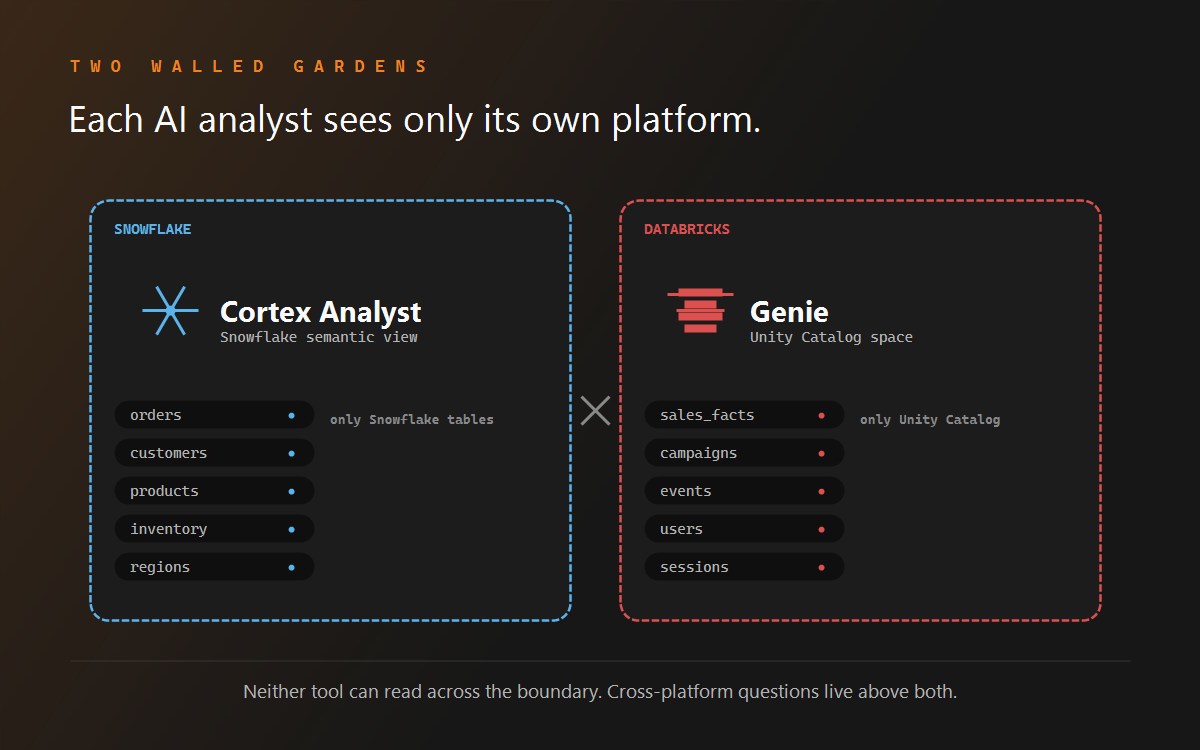
- Databricks-only. Genie sees only Databricks data in Unity Catalog. Cross-warehouse questions require ingesting other data into Databricks first.
- 30-table cap, best kept smaller. A Space supports up to 30 tables or views, and Databricks recommends aiming for five or fewer for accuracy. Large domains must be pre-joined into views or metric views.
- Governance is permission-driven, not space-bounded. Databricks documents that Genie can query tables beyond those explicitly added to a Space: access is controlled by Unity Catalog permissions, not by the Space itself, and a user can prompt for joins or edit SQL to reach other tables their role allows. Governance is inherited but configuration-dependent.
- Nondeterminism. LLM generation means the same question can produce different SQL across runs, with no native compile-time proof that a join path is valid.
- Cost is DBU-based. Genie consumes warehouse compute (DBUs), which is harder to pre-budget than a fixed per-message price.
- Throughput limits. Each workspace handles up to roughly 20 questions per minute via the UI; the API free tier is best-effort five per minute. High-concurrency agent workloads need planning.
Genie is not wrong. It is a Databricks-native conversational feature, not a multi-warehouse execution layer. For the deeper contrast, see Colrows vs Databricks Genie and Cortex Analyst vs Genie.
Fix the Context, Not the Model. Curating a tighter Genie Space helps, but the boundary is the platform. Multi-warehouse, reproducible answers come from a semantic layer that resolves meaning and proves the query before it runs.
The Databricks Genie alternatives, by job to be done
1. Colrows - for governed, multi-warehouse AI agents
Colrows is a compile-time semantic execution layer built agent-first. It compiles intent through a typed semantic graph into deterministic, dialect-perfect SQL across 16+ engines, proves join paths, and enforces RBAC, ABAC, and row/column policy before any query runs, so filtered-out rows are never read. Best fit when your estate spans more than Databricks and you need reproducibility and compile-time governance, not just inherited permissions.
2. Snowflake Cortex Analyst - for Snowflake-native teams
Cortex Analyst is Genie's closest peer on the Snowflake side: fast, warehouse-native text-to-SQL that inherits Snowflake RBAC. Same single-warehouse tradeoff, opposite platform.
3. dbt Semantic Layer (MetricFlow) - for code-first metrics
The dbt Semantic Layer defines vendor-neutral metrics in code and generates SQL for Databricks, Snowflake, BigQuery, and Redshift. Good for standardizing definitions across engines. Requires dbt Cloud; see the dbt pricing teardown.
4. Cube - for headless metric APIs
Cube serves governed metrics over SQL, REST, GraphQL, and MDX with an open-source core. Best for embedded analytics and many consumers.
5. ThoughtSpot Spotter - for search-driven self-service
ThoughtSpot Spotter brings search-token architecture and an agentic semantic layer, multi-cloud and LLM-flexible, for thousands of business users.
6. Sigma Computing - for warehouse-native spreadsheet BI
Sigma connects live to Snowflake, Databricks, BigQuery, and PostgreSQL with a spreadsheet interface and an "Ask Sigma" agent that respects warehouse roles and row-level security. Good for governed, spreadsheet-style exploration.
Cost snapshot (2026, USD)
Point-in-time figures. Genie cost is DBU-based. Verify against vendors before committing.
| Platform | Entry | Model |
|---|---|---|
| Databricks Genie | Included with Databricks; consumes SQL warehouse DBUs | Consumption (DBU); pro or serverless SQL warehouse required |
| Cortex Analyst | Separate "AI Credit" currency since Apr 2026: $2.00/credit global, $2.20 regional | ~67 credits per 1,000 messages (about $134-$147) + warehouse compute |
| dbt Cloud / Semantic Layer | Developer free; Starter $100/user/mo | Seats + usage; SL requires dbt Cloud |
| Colrows | Free POC | Custom annual (priced on questions asked) |
Which alternative fits you
- You are Databricks-only and want fast self-serve BI: stay with Genie; it is the lowest-friction path.
- You are Snowflake-native: Cortex Analyst.
- Your estate spans two or more warehouses, or you are regulated and need proof of non-access and reproducibility: evaluate Colrows. This is where curated single-platform Spaces structurally fall short.
- You want search-driven BI for thousands of users: ThoughtSpot Spotter.
Genie Agents reached beta in 2026 and add multi-step reasoning. Agentic BI tools scores that move against the rest of the field.
Genie sits inside a wider field of conversational analytics tools, scored here on governance and determinism.
Frequently asked questions
What is the table limit in a Databricks Genie Space?
A Genie Space supports up to 30 tables or views (raised from 25 in 2026). Databricks best practice recommends aiming for five or fewer tables per space for accuracy.
Is Databricks Genie multi-warehouse?
No. Genie works only against Databricks data registered in Unity Catalog. Cross-warehouse questions require bringing that data into Databricks first.
Does Genie enforce governance per user?
Genie inherits Unity Catalog governance: row filters and column masks are enforced per user automatically. Note that access is controlled by Unity Catalog permissions, not by the Genie Space itself, so a user can prompt for joins or edit SQL to query tables beyond those added to the space if their permissions allow.
What is the best Databricks Genie alternative for AI agents?
For governed, multi-warehouse AI agents needing deterministic SQL and compile-time governance, Colrows is the closest agent-native alternative. For Snowflake-native teams, Cortex Analyst; for code-first metrics, dbt Semantic Layer.