Native Databricks AI vs a semantic execution layer on Databricks
| Dimension | Native Databricks AI (Genie / Metric Views) | Colrows on Databricks |
|---|---|---|
| Reach | Databricks data in Unity Catalog only | Databricks plus 16+ other engines, one graph |
| Governance | Unity Catalog permissions, applied at query time | Compile-time RBAC + ABAC + row/column predicates, before execution |
| Determinism | LLM generation; SQL can vary run to run | Deterministic; same question, same scope, same SQL |
| Scope per unit | Curated Genie Space, up to 30 tables | Whole estate; no per-space table cap |
| Model upkeep | Hand-curated Spaces and instructions | Autonomous, continuously maintained graph |
Why put a semantic layer in front of Databricks
Unity Catalog is a real governance strength, and Genie rides on it well. But agent workloads push on three things the native path handles less cleanly.
- Reproducibility. Nondeterministic generation means the same question can produce different SQL. Agents that feed decisions need the same answer every time.
- Governance before access. Unity Catalog enforces row filters and column masks per user, but a permitted user can still prompt for joins or edit SQL to reach tables beyond a Space. Compile-time shaping prevents the plan from being generated at all.
- Reach. A real question often spans the lakehouse plus a warehouse or an operational store. A Databricks-only layer cannot see them.
The accuracy claims deserve care too. Genie reports strong internal scores, and Snowflake reports strong internal scores for Cortex Analyst. The two numbers come from different internal benchmarks with different baselines, and neither is independently verified. See Cortex Analyst vs Genie for why the headline percentages are not comparable.
Your options for a semantic layer on Databricks
The choices split into two groups. One group is native to Databricks. The other group is third-party and, in some cases, multi-warehouse. Many older comparison pages predate the native general availability of April 2026, so their framing is stale. Freshness is the edge here.
| Option | Native or third-party | What it gives you |
|---|---|---|
| Unity Catalog Business Semantics / Metric Views | Native | Measures and dimensions in YAML, consumed via the MEASURE() function. GA 2 April 2026 in DBR 16.4, and open-sourced. Databricks-only, requires Unity Catalog. |
| dbt Semantic Layer (MetricFlow) | Third-party | Metrics defined once and queried across warehouses, including Databricks and Snowflake. The broadly multi-warehouse standalone option. |
| Stardog / Timbr | Third-party | A knowledge-graph or ontology model over your tables, for richer relationships and reasoning. |
| AtScale | Third-party | An OLAP-style semantic layer with aggregate acceleration for BI. |
| Colrows (semantic execution layer) | Third-party | Compiles deterministic, dialect-perfect SQL with compile-time governance across 16+ engines, from an autonomous graph. |
Native Metric Views and Genie are a good fit for Databricks-native self-serve. The dbt, Cube, and AtScale comparison covers the BI-first tools. For a full decision matrix across all of these, read the semantic layer buyer's guide.
Why native isn't enough for multi-warehouse
Metric Views are strong inside Databricks, and they have clear limits outside it. Three of those limits matter most for agents that span an estate.
- Databricks-only. Metric Views cannot be queried from Snowflake or BigQuery, and they require Unity Catalog. A metric defined here does not travel to another engine.
- Composition limits. The MEASURE() function cannot be nested inside another aggregate, so an expression like SUM(MEASURE(...)) is unsupported. Some metric shapes need a workaround.
- Per-space caps. A Genie space allows up to 30 tables, and Databricks recommends 5 or fewer. Large estates do not fit one space.
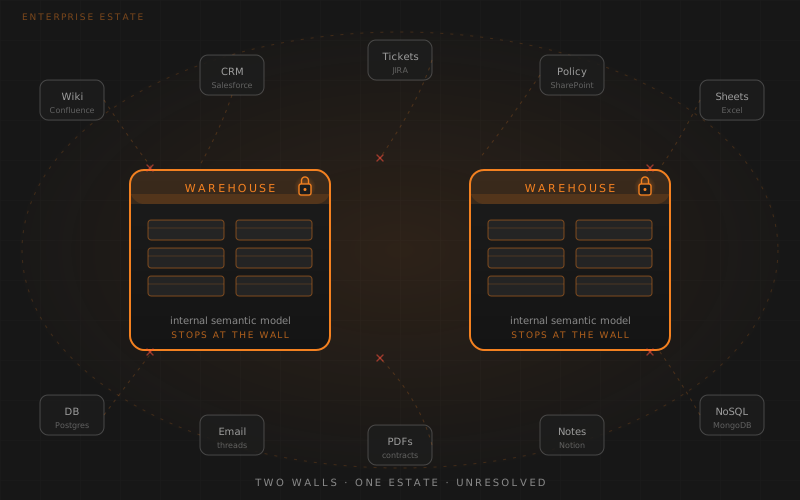
Real estates rarely live in one platform. A single business question can touch Databricks, Snowflake, Postgres, Salesforce, and Confluence in the same breath. A Databricks-only layer cannot see the other systems, so the join never resolves. For the platform-level view, see Snowflake vs Databricks semantic layer.
Fix the Context, Not the Model. A well-governed semantic layer that understands business context creates more reliable AI-driven analytics than fine-tuning the model itself.
How Colrows works on Databricks
- Dialect-perfect Databricks SQL. The compile-then-execute pipeline resolves intent against a typed graph and emits SQL tuned to Databricks, and to 16+ other engines from the same graph.
- Governance inherited and extended. Colrows respects Unity Catalog and adds compile-time RBAC, ABAC, and row/column predicates, so unauthorized plans cannot be generated and filtered rows are never read.
- Join path proof. Cross-dataset questions either prove a deterministic join path or fail at compile time with an explainable error.
- Autonomous maintenance. The graph rebuilds as your Unity Catalog schemas change, instead of hand-curating Spaces as the estate drifts.
- Audit and reproducibility. Every answer is point-in-time reproducible and carries an audit trail.
The runtime follows one path: intent, then context resolution, then constrained planning, then governed execution. That order is what makes the SQL deterministic and the governance provable before a row is read. See the product docs for how the graph is built and versioned.
When Databricks is not the whole estate
Few enterprises keep everything in one platform. A semantic execution layer lets an agent ask one governed question that resolves across Databricks and your other systems, deterministically. That is the structural advantage a lakehouse-only tool cannot match. The same graph also serves a governed semantic layer for Snowflake, so one definition of a metric holds across both platforms. See RAG vs semantic layer for why retrieval alone does not close the gap.
A portability standard is also emerging. The Open Semantic Interchange (OSI) shipped its v1.0 spec on 27 January 2026, and it entered the Apache Incubator as Apache Ossie in June 2026. More than 50 organizations back it. But participation is not the same as shipped native support, which is still partial today. Treat portability as a direction, not a solved problem. If you want to compare approaches side by side, the Colrows comparison hub lays out the options.
Frequently asked questions
What is a semantic layer for Databricks?
A semantic layer for Databricks is a governed model of your business metrics, dimensions, and join paths that sits above Unity Catalog. It gives dashboards, notebooks, and AI agents one consistent definition of each metric. A semantic execution layer goes further. It compiles each question into deterministic, dialect-perfect Databricks SQL and proves the join path before the query runs.
Does Databricks have a native semantic layer?
Yes. Unity Catalog Business Semantics, also called Metric Views, reached general availability on 2 April 2026 in DBR 16.4, and Databricks open-sourced the core. Metric Views define measures and dimensions in YAML and are consumed by dashboards, Genie, and external BI tools through the MEASURE() function. They are Databricks-only and require Unity Catalog.
Metric Views vs Timbr vs AtScale on Databricks?
Metric Views are the native, Databricks-only option and govern through Unity Catalog. Timbr and Stardog add a knowledge-graph or ontology model over your tables. AtScale adds an OLAP-style semantic layer with aggregate acceleration. Colrows adds a semantic execution layer that compiles deterministic SQL with compile-time governance across 16+ engines. See the semantic layer buyer's guide for the full matrix.
dbt semantic layer with Databricks?
Yes. The dbt Semantic Layer, built on MetricFlow, defines metrics once and queries them across multiple warehouses, including Databricks and Snowflake. It is the broadly multi-warehouse standalone option. It defines metrics, but it does not add compile-time governance or prove the join path the way a semantic execution layer does.
Can one semantic layer span Databricks and Snowflake?
Native Metric Views cannot. They cannot be queried from Snowflake or BigQuery. The dbt Semantic Layer and a semantic execution layer like Colrows can define metrics once and resolve them across Databricks, Snowflake, and other engines from one graph. Colrows also adds compile-time governance and deterministic SQL per engine.