Native Snowflake AI vs a semantic execution layer on Snowflake
| Dimension | Native Snowflake AI (Cortex Analyst / Semantic Views) | Colrows on Snowflake |
|---|---|---|
| Reach | Snowflake data only | Snowflake plus 16+ other engines, one graph |
| Governance | Inherited RBAC, applied when SQL executes | Compile-time RBAC + ABAC + row/column predicates, before execution |
| Determinism | LLM generation; SQL can vary run to run | Deterministic; same question, same scope, same SQL |
| Join safety | Uses relationships you define; no inference | Join path proof; ambiguity fails at compile time |
| Model upkeep | Hand-authored semantic model (YAML), capped in size | Autonomous, continuously maintained graph |
Why put a semantic layer in front of Snowflake
Snowflake is an excellent warehouse. That is exactly why the semantic problem shows up: the moment an AI agent asks a question, something has to turn "revenue by region last quarter" into correct, governed SQL. Native tools do this well inside Snowflake, but agents raise the bar on three things.
- Reproducibility. An agent that returns a slightly different number each run is not usable for a board report or a regulator. You need the same question to compile to the same SQL.
- Governance before access. Masking output is not the same as never reading the row. Regulated teams need to prove non-access, not just redaction.
- Reach. The question that matters often spans Snowflake plus a CRM, a lakehouse, or a Postgres system. A Snowflake-only layer cannot see them.
Your options for a semantic layer on Snowflake
The choices split into two groups. There is Snowflake's native semantic layer, and there is a third-party semantic layer on Snowflake. Both compile a business question into SQL. They differ on reach, governance, and who maintains the model.
| Option | Type | Reach | Notes |
|---|---|---|---|
| Snowflake Semantic Views | Native | Snowflake only | Schema objects. Standard SQL querying went GA on 2 March 2026. Feed Cortex Analyst. |
| dbt Semantic Layer (MetricFlow) | Third-party | Multi-warehouse | Metrics defined once, queried across warehouses. The main standalone multi-warehouse option. |
| AtScale | Third-party | Multi-warehouse | OLAP-style semantic layer with live query pushdown to Snowflake. |
| Cube | Third-party | Multi-warehouse | Headless BI with an API-first metrics model. |
| Colrows | Semantic execution layer | Snowflake plus 16+ engines | Compiles deterministic, governed SQL. Compile-time governance and join path proof. |
A shortlist between the third-party tools starts here: dbt Semantic Layer vs Cube vs AtScale. If you are still deciding what a semantic layer should do for agents, the semantic layer buyers guide 2026 maps the field.
The native options and where they stop
Cortex Analyst is a strong, fast, warehouse-native text-to-SQL service. Semantic views give it governed structure. But it is Snowflake-only, it governs at execution against physical tables, LLM generation is nondeterministic, and the semantic model is a hand-authored YAML artifact with a size ceiling. Those are reasonable tradeoffs for Snowflake-native self-serve. They become real gaps when the consumer is an autonomous agent and the estate is bigger than Snowflake. For the platform comparison, see Snowflake vs Databricks semantic layer.
Why native is not enough for multi-warehouse
Semantic Views are schema objects that live inside Snowflake. That is their strength and their limit. They cannot be queried from Databricks or BigQuery, and Snowflake does not support cross-account replication for them. A view scoped to one account stays in that account.
Size caps matter too. Snowflake recommends fewer than 10 tables per Semantic View for reliable results. When a view feeds Cortex Analyst, it must fit a 1 MB, roughly 32K-token, budget. Large models get trimmed or split, which pushes the modeling work back onto your team.
Real estates are wider than one warehouse. A single question can touch Snowflake, Postgres, Salesforce, and Confluence at once. A Snowflake-native layer cannot see those systems. A semantic execution layer resolves the same question across all of them from one semantic graph, with governance held constant.
Fix the Context, Not the Model. A well-governed semantic layer that understands business context creates more reliable AI-driven analytics than fine-tuning the model itself.
How Colrows works on Snowflake
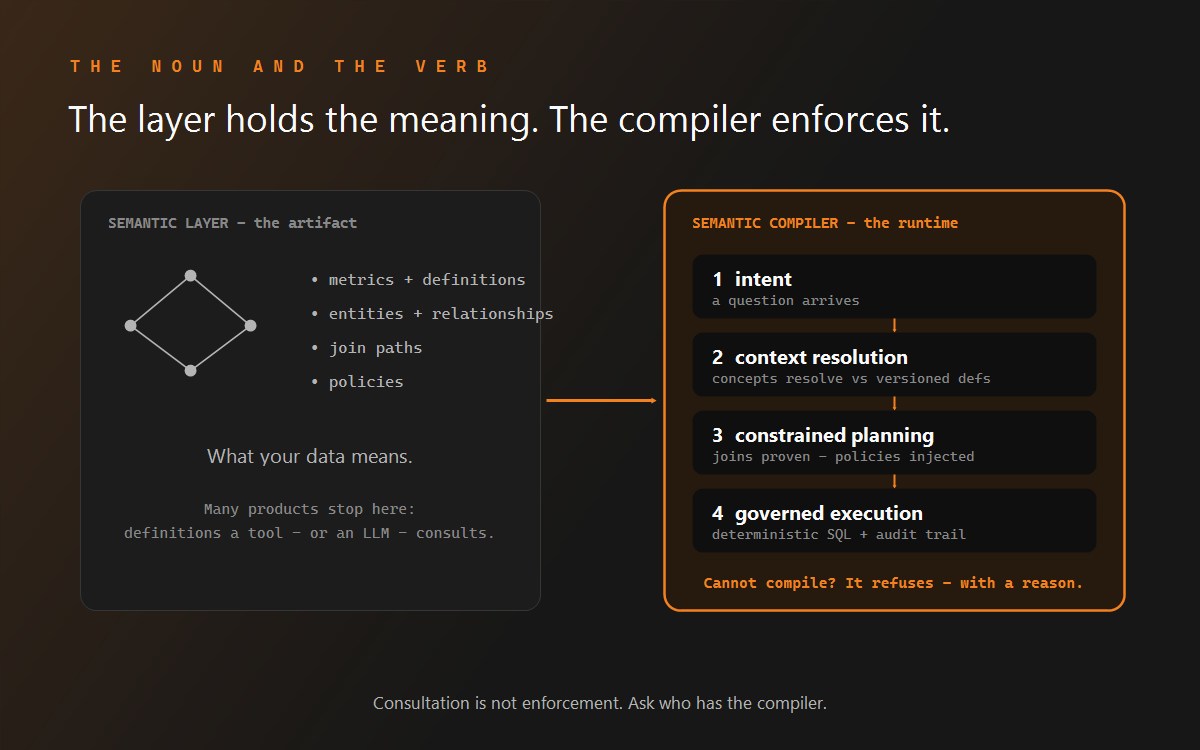
Colrows sits above the warehouse and below the prompt. It compiles agent intent through a typed semantic graph and emits governed SQL for Snowflake.
- Dialect-perfect Snowflake SQL. The compile-then-execute pipeline parses intent to an AST, resolves it against the graph, and emits SQL tuned to Snowflake's dialect. It also targets 16+ other engines from the same graph.
- Governance inherited and extended. Colrows respects Snowflake RBAC and adds compile-time RBAC, ABAC, and row/column predicates. Unauthorized plans cannot be generated, so filtered rows are never read, not just masked.
- Join path proof. When a question spans datasets, Colrows proves a deterministic join path exists or fails at compile time with an explainable error, instead of guessing a join.
- Autonomous maintenance. The graph rebuilds as your Snowflake schemas change, so you are not hand-editing a YAML model as the estate drifts.
- Audit and reproducibility. Every answer carries an audit trail and is point-in-time reproducible, which is what regulated Snowflake shops actually need.
When Snowflake is not the whole estate
Most enterprises do not keep everything in one warehouse. A semantic execution layer lets an agent ask one question that resolves across Snowflake and your other systems, with the same governance and determinism. That is the structural advantage a Snowflake-only tool cannot match. See RAG vs semantic layer for why retrieval alone does not close this gap.
What the native path costs in 2026
Snowflake changed how AI is billed. Since 1 April 2026, AI features run on a separate "AI Credit" currency. The rate is $2.00 per AI Credit on global routing and $2.20 on regional routing. Cortex Analyst uses about 6.7 credits per 100 messages, so a busy agent workload has a running meter you can model in advance.
The naming also moved. At Summit 2026, Snowflake Intelligence (rebranded Snowflake CoWork at Summit 2026) took a new name. The searchable term is still Snowflake Intelligence, so both labels point to the same product. A cost and governance comparison against Databricks sits in Cortex Analyst vs Genie, and further picks are in Cortex Analyst alternatives.
Portability: watch OSI, do not bank on it yet
The Open Semantic Interchange (OSI) is the industry attempt at a vendor-neutral metric format. The v1.0 spec shipped in January 2026, and the project entered the Apache Incubator as "Apache Ossie" in June 2026. Snowflake, dbt Labs, Salesforce, and others back it.
Do not read that as portability solved. Native support is still partial across engines, and joining a standards body is not the same as shipping it in production. Treat OSI as a signal to track, not a guarantee you can move a model between warehouses today. If cross-engine reach is a firm requirement now, a semantic execution layer gives it without waiting for the standard to land. Compare the field in the dbt vs Cube vs AtScale review, or see how Colrows fits on the comparison hub.
Frequently asked questions
What is a semantic layer in Snowflake?
A semantic layer maps business terms like revenue, region, and active customer to the tables, joins, and metrics behind them. In Snowflake it lets a person or an AI agent ask a question in plain language and get correct SQL, without hand-writing joins each time.
Does Snowflake have a native semantic layer?
Yes. Snowflake Semantic Views are the native semantic layer. They are schema objects that store tables, relationships, facts, dimensions, and metrics, and their standard SQL querying went GA on 2 March 2026. Cortex Analyst uses them for text-to-SQL.
Semantic Views vs dbt vs AtScale on Snowflake?
Semantic Views are native but Snowflake-only. dbt Semantic Layer and AtScale are third-party and work across warehouses. Native is simplest inside one account. A third-party or semantic execution layer wins when the estate spans more than Snowflake or needs compile-time governance.
How do I build a semantic layer for Snowflake?
You can author Semantic Views by hand, generate them with Semantic View Autopilot, or adopt a semantic execution layer that builds and maintains the graph for you. Colrows compiles a typed semantic graph and keeps it current as your Snowflake schemas change.
Can one semantic layer span Snowflake and Databricks?
Not with native tools, which are engine-locked. A semantic execution layer like Colrows resolves one question across Snowflake, Databricks, and 16+ engines from a single graph, with the same governance and deterministic SQL on each.