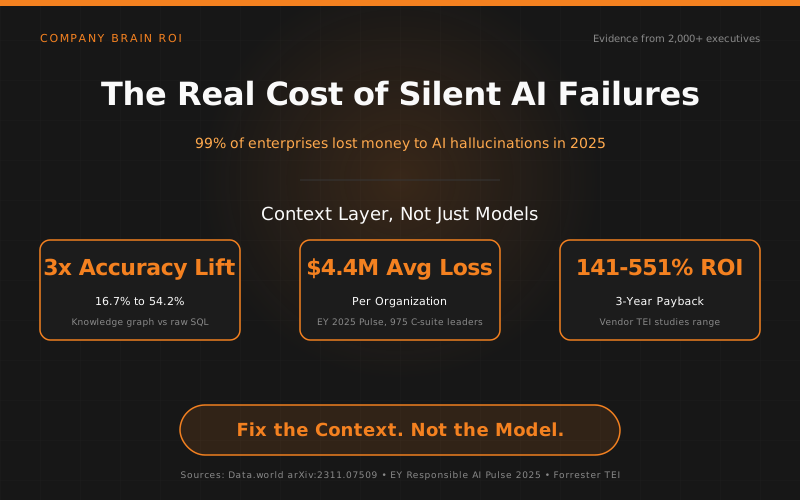
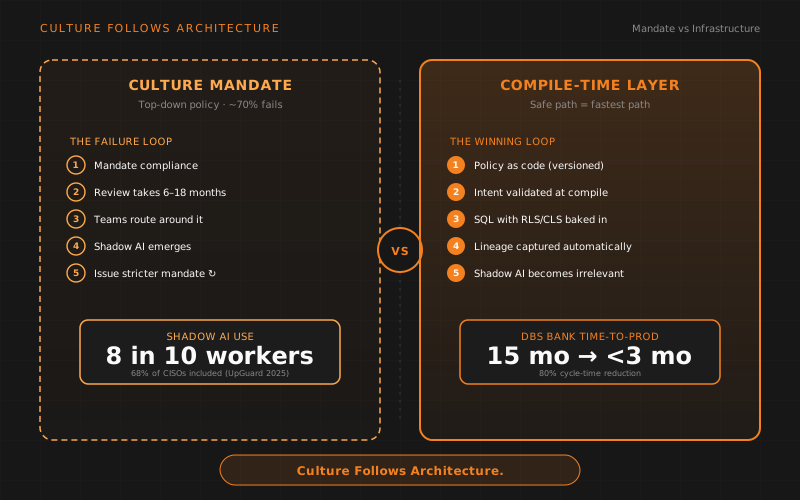
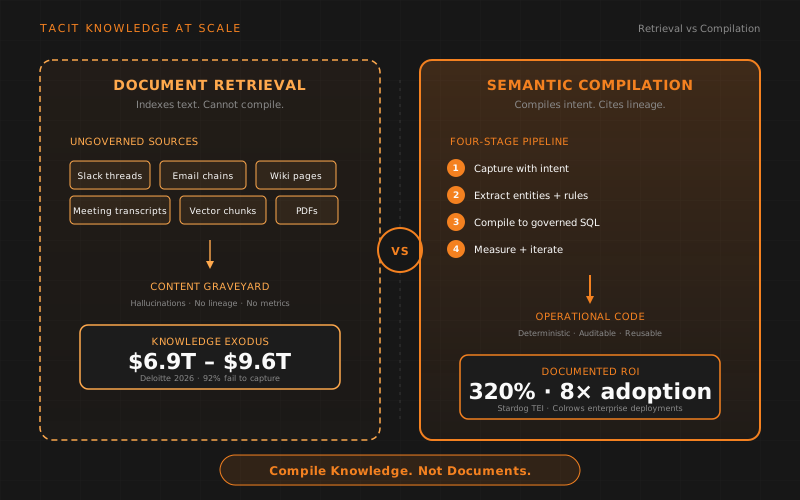
Short answer: Company brain prerequisites come in a fixed order. First, executive sponsorship with a named accountable owner and success metrics defined before approval. Second, data governance built on a semantic contract, a versioned definition of your metrics and business rules, enforced at compile time. Third, master data and data quality good enough for your priority use cases. Budget 12-18 months for these foundations, and ship a narrow lighthouse use case within 60-90 days.
AI Readiness: The Architectural Decision
Readiness is not a checklist. It is an architectural state. The difference between the 5% who succeed and the 95% who fail comes down to three prerequisites: semantic consistency, compile-time governance, and autonomous schema feedback.
| Maturity Factor | Traditional Data Stack | AI-Ready Infrastructure |
|---|---|---|
| Logic Consistency | Tribal knowledge. "Revenue" calculated differently in three tools. | Centralized semantic graph. Single definition. Enforced everywhere. |
| Governance | Runtime, reactive. Policies applied after query execution. | Compile-time, deterministic. Access control built into the semantic layer. |
| Data Flow | Static, manual. Schema changes require documentation updates. | Autonomous, self-healing. Drift detection and adaptation built-in. |
| Agent Readiness | Prototype only. Hallucination risk at scale. | Production-grade. Deterministic results. Enterprise audit trails. |
TL;DR
- Readiness is use-case-specific, not absolute. You do not need a complete data catalog. You need the right data for your first use case to be discoverable, trustworthy, and governed.
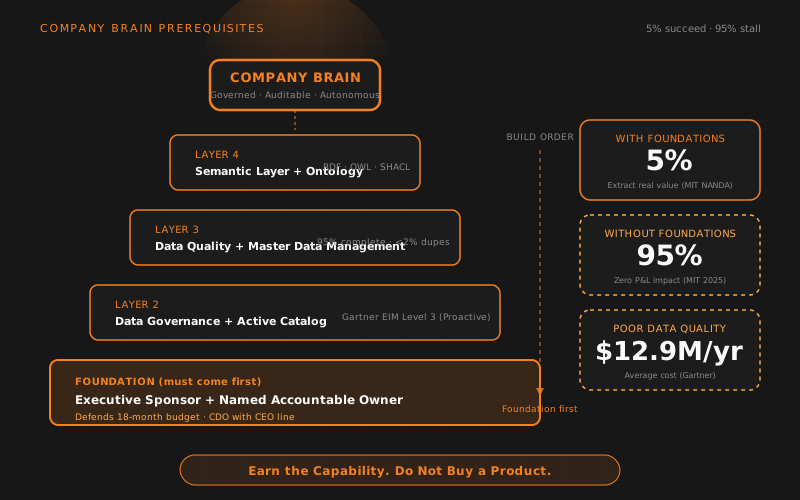
- Three prerequisites are non-negotiable and must come first: (1) executive sponsorship with a named accountable owner, (2) data governance with a semantic contract and compile-time enforcement, (3) master data and data quality good enough for your priority use cases.
- Budget 12-18 months to reach operational foundations but start a narrow lighthouse use case in parallel within 60-90 days. Sequence matters more than speed. The ones that prove one metric work fund the next ten.
The Cost of Skipping Foundations Is Quantified and Large
Gartner estimates poor data quality costs the average organization $12.9 million per year, based on 154 reference customers in its 2020 Magic Quadrant for Data Quality Solutions. MIT Sloan and Cork University research puts revenue loss at 15-25% annually. The AI-readiness gap is now a board-level risk. Gartner predicts that through 2026, organizations will abandon 60% of AI projects unsupported by AI-ready data, noting that 63% of organizations lack or are unsure of the right data-management practices.
The "1x10x100 rule" explains the urgency. Fixing a data error at entry costs roughly 1x. After it propagates: 10x. Once it reaches a decision or end-user: 100x. Most enterprises have already paid the 100x bill several times over without realizing it.
The Three Pillars of AI Readiness
Pillar 1: The Semantic Contract
You must have an auditable way to define business metrics. If "Revenue" is calculated differently in three tools, you are not ready for AI.
This is the foundation. A semantic contract is a versioned, governed definition of the metrics, entities, and business rules that matter to your organization. It lives in a semantic graph, not in spreadsheets or BI tool proprietary formats. Every query references the contract. Every agent understands it. Every downstream system complies with it.
Without a semantic contract, governance remains tribal. The SaaS Architecture page shows how compile-time semantic binding enforces the contract before the warehouse ever sees the query.
Pillar 2: The Governance Perimeter
You must enforce access control before query execution. Runtime security is a failure point for autonomous agents.
Governance failure is a people problem, not a tech problem. Practitioner consensus puts it at roughly 80% people/culture and 20% technology. Programs collapse when ownership is unclear.
Reach Gartner EIM Level 3 on Priority Domains. The practical prerequisite for a Company Brain is reaching Level 3 (Proactive) on your priority domains: defined governance policies, named owners, and cross-functional collaboration. Reaching Level 3 from a low base typically takes 12-18 months.
Stand Up an Active-Metadata Catalog. You do not need a complete catalog first, but you need active metadata management: continuous, automated metadata collection covering the data feeding your first use cases. Options include Collibra, Alation, Informatica, Atlan, DataHub, AWS Glue, Google Dataplex. The choice is less important than the discipline of populating it.
Assign Ownership By Decision, Not By Title. Separate business stewardship (defining and fixing data in the source system) from IT enablement (tooling, profiling, lineage). The business owns the definitions. IT owns the plumbing. The CDO arbitrates.
Pillar 3: The Schema Feedback Loop
You must have a mechanism to detect schema drift automatically. Static documentation is not an infrastructure.
This is the cipher key. When "Supplier ABC Ltd" in procurement is "ABC Limited" in ERP and "ABC Corp" in finance, an AI agent does not reject the bad data. It hallucinates connections. Master Data Management on critical entities (customer, product, supplier) is what makes governance enforceable.
Define Quality Across Six Standard Dimensions. Accuracy, completeness, consistency, timeliness, uniqueness, validity. Set measurable thresholds per critical domain rather than chasing a universal number. A commonly used baseline target is 95% completeness and under 2% duplicates for priority datasets.
Start MDM on One or Two Domains. Master data management is the execution layer that makes governance enforceable. Start with 1-2 business-critical domains (customer, product, or supplier). Assign ownership to business leaders. Embed validation into source-system workflows so bad data cannot enter.
Readiness is not about the volume of your data. It is about the determinism of your context. Fix the Context, Not the Model.
A well-governed semantic layer that understands business context creates more reliable AI-driven analytics than fine-tuning the model itself. Compile-time governance. Deterministic results.
Executive Sponsorship: The Highest Impact
This is the highest-impact single factor. The successful 5% in MIT's study sustained sponsorship through the life of the initiative, defined success metrics before approval, and treated AI as business transformation rather than an IT project.
What good looks like:
- A named primary sponsor who authorizes the change and is accountable for benefits
- A CDO or equivalent with budget authority who reports directly to the CEO
- Success metrics defined before approval, tied to a business KPI a CFO already tracks
- Budget committed for 18 months minimum, with a credible defense against the 12-month re-org cycle
Gartner predicts that by 2027, 80% of data and analytics governance initiatives will fail due to a lack of a real or manufactured crisis. Governance programs collapse when sponsorship goes thin.
What Are the Company Brain Prerequisites, in Priority Order?
| Priority | Item | Why it comes here |
|---|---|---|
| Critical 1 | Executive sponsorship + named accountable owner + success metrics defined before approval | Without sponsorship, the next budget cycle kills the program |
| Critical 2 | One prioritized lighthouse use case tied to a business KPI | Proves the pattern. Funds the next domain |
| Critical 3 | Semantic contract + data governance ownership model on priority domains | Substrate for everything that follows |
| Critical 4 | Data quality + MDM on 1-2 critical entities to required thresholds | Cipher key. Without it, hallucinations are inevitable |
| Important 5 | Semantic layer + minimal viable ontology for the lighthouse domain | Compiles intent into governed SQL |
| Important 6 | Lineage/provenance + access control (RBAC then ABAC) + audit | Required for GDPR, EU AI Act, SOX |
| Important 7 | Cloud/lakehouse modernization and API integration for priority sources | Scale enabler. Hybrid is fine if cloud is impractical |
| Build over time | Enterprise-wide catalog completeness, advanced analytics, agentic capabilities, semantic stewardship at scale | Earned, not bought |
Buy-and-Partner Beats Build-Alone
MIT NANDA's data is unambiguous: purchasing AI tools from specialized vendors and building partnerships succeed about 67% of the time. Internal builds succeed only one-third as often.
The reason is that build-alone teams underestimate the metadata, lineage, MDM, and ontology work required. They build the model. They forget the substrate. The vendor option is not "buy the AI." It is "buy the infrastructure that lets your team own the definitions and the business rules without rebuilding the plumbing."
The Technical Infrastructure Prerequisites
Once the foundations are in place, the technical layer becomes tractable:
- Modernized data warehouse / lake / lakehouse integrating priority source systems. Cloud-native is the default for scalability. Hybrid is common and fine.
- Active metadata + column-level lineage and provenance tracking. Prerequisite for both GDPR Article 30 compliance and AI trust.
- API-first integration architecture. The enterprise-knowledge-graph breakeven is typically 10-15 heterogeneous data sources. Below approximately 8 sources, a lightweight ETL/dashboard layer is usually the better choice.
- Semantic layer + ontology. Connective tissue. Compiles business intent into deterministic SQL. See what is a semantic compiler for the architectural distinction.
- Security and access control. RBAC for coarse-grained, ABAC for fine-grained Zero-Trust. Permission checks must be built into retrieval, not just the UI.
- Audit / compliance. Audit trails, PII auto-detection, lineage-based tag propagation. Increasingly required under GDPR, CCPA, and the EU AI Act.
Run access control, metric definitions, and policy at compile time, not at presentation time. The agent never sees data it should not see. Audit trails are a byproduct of execution, not a separate compliance project. This is what makes a semantic execution layer the production-ready choice for enterprise AI.
Industry Benchmarks: What the Foundations Pay Off Looks Like
Stardog's Forrester TEI (December 2021): 320% ROI, $9.86M total benefits over 3 years. 75-95% time savings on primary data tasks. Analytics applications completed 2-3x faster. Named customers include BNY Mellon, Bosch, NASA, Boehringer Ingelheim.
AstraZeneca BIKG (bioRxiv, 2021): Biological Insights Knowledge Graph built on ontology normalization and multi-source integration. Demonstrates ontology-first design as a prerequisite. Results are methodological (link prediction, target ID) rather than purely financial.
Siemens supply-chain KG (Neo4j): Modeled 16,910 tier-1, 43,759 tier-2, and 49,775 tier-3 suppliers. Quote from the team: "Most enterprises have the data. Few have the context."
JPMorgan Chase data mesh (AWS, 2021): Federated data products and enterprise catalog across 450+ petabytes serving 6,500+ applications. The pattern: "make data easy to share across the organization, while maintaining appropriate control over it."
Common Failure Modes (Avoid These)
- Unclear ownership. "Everyone is responsible" means nobody owns the fix when a definition drifts.
- Manual unscalable processes. Curating metadata in spreadsheets does not survive contact with 50+ tables.
- Governance treated as a one-time IT project. Maturity is continuous. Reassess every six months for the first two years.
- No early win within the first budget cycle. Without a lighthouse, sponsorship erodes.
- Scaling before foundations exist. Expanding to domain five when domain one still has unowned definitions multiplies the rework.
- Over-engineered ontologies. Minimal viable ontology beats elegant abstraction. Teams pursuing enterprise knowledge graphs without preconditions typically abandon implementations within 18 months.
Recommendations: The Sequencing That Works
First 30 days. Establish accountability
Name an executive sponsor and a single accountable data owner (CDO or equivalent reporting high). Run a data governance maturity assessment. Define success metrics now.
Threshold to proceed: a sponsor who will defend the budget for 18 months and a documented business KPI.
Days 30-90. Pick one lighthouse use case and prove value
Choose high-impact, low-complexity. Assess data readiness for that use case only. Deliver a visible result in 60-90 days.
Threshold: if you cannot identify trustworthy, governed data for the use case, fix that before building.
Months 3-9. Build the core
Stand up a catalog with active metadata, MDM on 1-2 domains, data-quality monitoring with thresholds tied to KPIs, and a minimal viable ontology and semantic layer for the lighthouse domain. Reach governance Level 3 on priority domains.
Threshold: priority-domain data meets your defined quality bar and "customer / product / supplier" has one agreed definition.
Months 9-24. Scale deliberately
Expand to the next highest-priority domain using lessons learned. Add ABAC and fine-grained access, full lineage, and audit and compliance. Buy-and-partner rather than build-alone for the platform layer.
Threshold to keep scaling: each domain shows measurable adoption and business impact before the next begins.
Always. Measure business impact, not vanity metrics
Track time saved, costs avoided, and revenue unlocked. Not "assets tagged." Reassess maturity every 6 months for the first two years.
Caveats
- Several quantified claims originate from vendors (Stardog, Atlan, Informatica, Acceldata) or vendor-commissioned analyst studies (Forrester TEI). Treat as directional, not guaranteed.
- The Gartner $12.9M figure derives from 154 self-reporting large enterprises already shopping for data-quality tools. It overstates the absolute cost for smaller organizations.
- "Company brain" is not a standardized industry term. We treat it as an enterprise knowledge graph plus semantic execution layer, which is the closest well-documented analog.
The Bottom Line
A Company Brain is not a tool you procure. It is a capability you earn through executive sponsorship, a semantic contract that defines business intent, data governance that enforces it, and a semantic execution layer that compiles it into deterministic SQL.
The 5% that win do not have better models. They have a CDO with budget authority, one disputed metric resolved into a single definition, one domain mastered to 95% completeness, and one lighthouse use case that proved the pattern before the second was funded.
The sequence is the strategy. Readiness is not about volume. It is about determinism.
For deeper context, see The ROI of a Company Brain, The Culture of Transparency, and Self-Serve Analytics: What It Means for Your Team.
Next Steps
If you are evaluating whether your organization is ready to build a Company Brain, the first move is not a vendor demo. It is a governance maturity assessment and a candid conversation about sponsorship.
Colrows works with enterprises that have the foundations in place and need the compile-time semantic layer that turns them into operational code. We also work with teams that are still building the foundations and want a partner who can sequence the work without selling shelfware.
Book a technical architecture review to assess your readiness for deterministic AI. First conversation is free. First governance audit takes a week. First mastered domain ships within 30 days.
Frequently asked questions
What are the prerequisites for building a Company Brain?
Three prerequisites are non-negotiable: executive sponsorship with a named accountable owner, data governance with a semantic contract and compile-time enforcement, and master data and data quality good enough for your priority use cases. Sequence matters more than speed.
Why do 95% of enterprise AI pilots fail?
MIT NANDA's 2025 study found 95% of organizations extract zero return from AI pilots. The 5% that succeeded had deterministic foundations: semantic consistency, compile-time governance, and autonomous schema feedback.
What is a semantic contract?
A semantic contract is a versioned, governed definition of the metrics, entities, and business rules that matter to your organization. It lives in a semantic graph, not in spreadsheets or BI tool proprietary formats. Every query references it and every agent understands it.
How long does it take to become AI-ready?
Budget 12-18 months to reach operational foundations, but start a narrow lighthouse use case in parallel within 60-90 days. Reaching Gartner EIM Level 3 on priority domains from a low base typically takes 12-18 months.
What does poor data quality cost an enterprise?
Gartner estimates poor data quality costs the average organization $12.9 million per year, and MIT Sloan and Cork University research puts revenue loss at 15-25% annually. The 1x10x100 rule compounds it: an error costs 1x to fix at entry, 10x after it propagates, and 100x once it reaches a decision.
Should we build or buy Company Brain infrastructure?
Buy-and-partner. MIT NANDA's data shows purchasing AI tools from specialized vendors and building partnerships succeeds about 67% of the time, while internal builds succeed only one-third as often. Build-alone teams underestimate the metadata, lineage, MDM, and ontology work required.