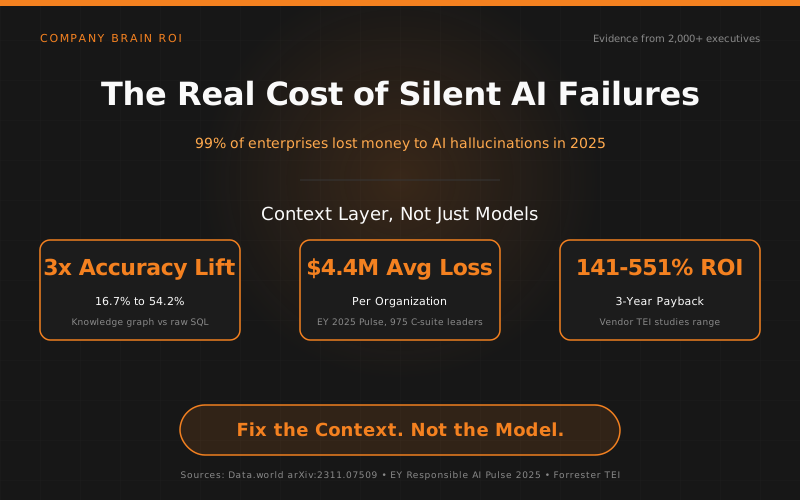
Short answer: Company brain ROI comes mostly from fixing the context layer under the model. Vendor-commissioned studies report three-year ROI of 141% to 551% for governed semantic layers. The strongest independent evidence is a peer-reviewed benchmark: GPT-4 answered enterprise financial questions with 16.7% accuracy on raw SQL and 54.2% through a knowledge graph, a 3x lift. Skipping that layer is costly too: EY found an average $4.4 million loss per company affected by AI errors.
TL;DR
- The real bottleneck for enterprise AI ROI is not model intelligence. It is the absence of a governed semantic layer underneath the model. Gartner reports only 20% of AI initiatives hit positive ROI. The top performers invest up to 4x more in data foundations than in AI tools.
- The accuracy lift from a semantic layer is peer-reviewed and substantial. GPT-4 accuracy on enterprise financial questions: 16.7% on raw SQL, 54.2% via knowledge graph. A 3x lift. On the hardest queries, raw SQL scored 0%.
- The cost of getting it wrong is measurable. 99% of organizations reported financial losses from AI errors in 2025. The average loss per affected company: $4.4 million. The companies winning AI ROI did not buy better models. They fixed their context layer first.
The Hard Truth About Enterprise AI
Your organization bought a large language model. Your data team deployed it. Your CFO is asking why nothing changed.
This is not a model problem. It is a context problem.
The real bottleneck for enterprise AI ROI is not model intelligence. It is the absence of a governed semantic layer underneath the model. Gartner's 2025 data reveals the hard numbers. Only 20% of AI initiatives hit positive ROI. Among the top performers, one pattern dominates: they invest up to four times more in data foundations than in AI tools themselves.
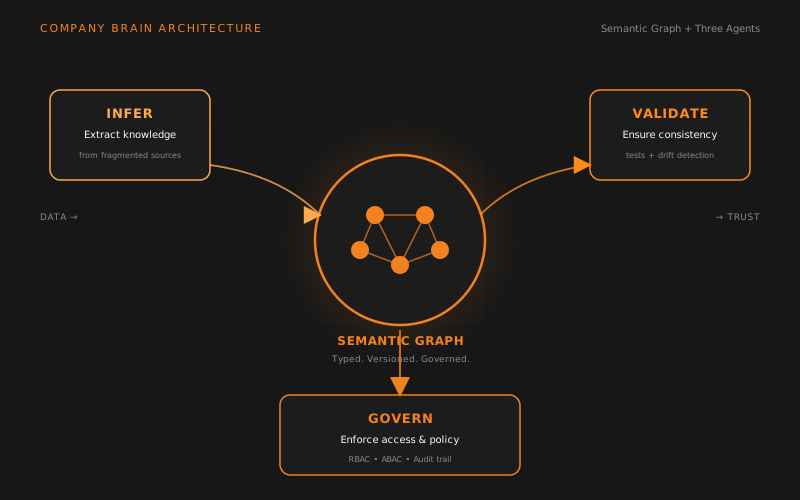
This is where the "Company Brain" lives. Not as a document-search tool. Not as a vector database bolted onto Slack. A Company Brain is an autonomous semantic layer that transforms raw warehouse complexity into reliable, deterministic, auditable execution. We covered the architectural pattern in detail in Company Brain for Enterprise AI: Why the Data Layer Decides Everything.
Organizations that have built one are seeing the difference. Three-year ROI ranging from 141% to 551%. Time-to-insight compressed from weeks to hours. Hallucination-induced financial losses effectively eliminated.
But here is what separates success from failure: the ones that work are not buying a better chatbot. They are fixing their context layer first.
Why Context Matters More Than Models
The Accuracy Lift is Real (And Peer-Reviewed)
Raw language models querying your database directly hit a wall. Data.world's peer-reviewed benchmark (Sequeda, Allemang & Jacob; November 2023) found GPT-4 answering enterprise financial questions at 16.7% accuracy when pointed at raw SQL. Same questions, same data, routed through a knowledge graph instead: 54.2% accuracy.
The lift is 3x.
For high-complexity queries (cross-metric revenue, period-over-period with grain validation, regulatory compliance dashboards), raw SQL scored 0%. A structured semantic layer enabled accurate, explainable answers on the same questions.
This is not vendor marketing. This is arXiv-published, peer-reviewed computer science. We unpacked the full benchmark methodology in The Text-to-SQL Accuracy Cliff: 91% on Benchmarks, 21% in Production.
The Cost of Getting It Wrong is Massive
EY's 2025 Responsible AI Pulse surveyed 975 C-suite leaders across 21 countries. The results are sobering.
99% of organizations reported financial losses linked to AI-related errors. 64% experienced losses exceeding $1 million. The average: $4.4 million per affected company.
What caused those losses? Hallucinations. Silent failures. Wrong numbers that looked plausible enough to move capital.
One documented case: Deloitte issued a government report containing fabricated citations, generated by GPT-4. The audit trail was clear. The refund: ~AU$440,000 (~$290K USD). Another: Air Canada's chatbot invented a bereavement-refund policy that the airline was legally held liable for.
These are not edge cases anymore. They are baseline enterprise risk.
The Verification Overhead Kills Productivity
Forrester's analysis puts the annual cost of AI-output verification at roughly 4.3 hours per employee, per week. For a 30-person data team, that is $426,000 per year spent on pure overhead: checking whether the numbers are right.
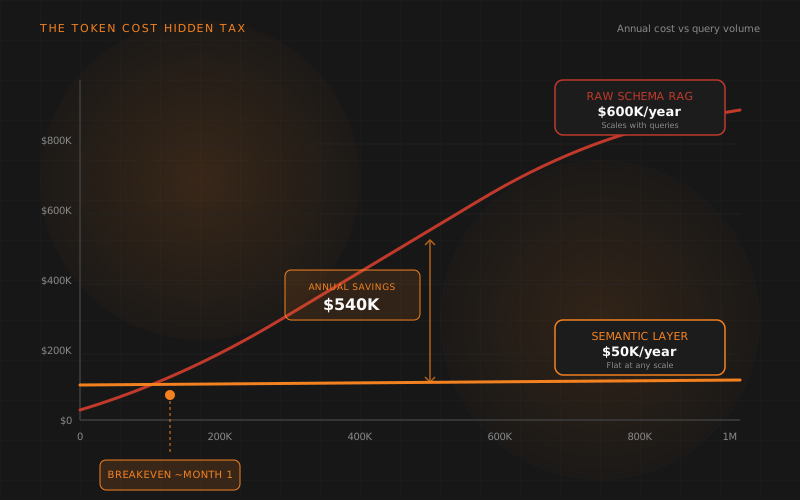
A governed semantic layer does not eliminate verification. It reduces it and makes it visible. Ambiguous queries fail loudly at compile time instead of silently returning wrong answers. This is the same mechanism we analyzed in The Token Cost Hidden Tax: governance reduces cost by eliminating failed-query retries.
The Competitive Landscape: Who Does What
| Solution Type | What It Does | Core Economic Limitation |
|---|---|---|
| Enterprise Search / RAG (e.g., Glean) | Retrieves text documents. Useful for onboarding friction, finding tribal knowledge. 141% three-year ROI reported. | Retrieves text only. Cannot resolve structured warehouse metrics or enforce governance. Hallucination risk remains high on complex analytical queries. |
| Traditional BI Layers (e.g., Looker, Tableau, Power BI) | Centralizes metric definitions and dashboards. Ships proprietary modeling layers (LookML, DAX). | Logic hardcoded into presentation tools. Traps context away from AI agents. Cannot serve external applications or autonomous systems. Replicates definitions across tools. |
| Vector Databases (e.g., Pinecone, Weaviate, pgvector) | Manages embeddings and similarity search at scale. Fast retrieval. | Pure vector retrieval by similarity. Does not provide governed meaning or enforce query constraints. No compile-time verification. Silent hallucinations on out-of-distribution queries. |
| dbt / Cube Semantic Layers | Defines metrics once in version-controlled YAML. Serves definitions to BI and agents. | Covers meaning only. No enforcement, no compile-time checking, no behavioral policy. Requires downstream tools to implement governance. |
| Autonomous Semantic Layer (Colrows) | Compiles agent intent into governed SQL at compile time. Typed semantic graph. No execution without verified context. Near 100% accuracy on covered queries. | Requires upfront schema mapping and structured definition alignment. Pays dividends within weeks. No verification tax. No hallucinations on deterministic execution path. |
The pattern is clear. Enterprise search tools retrieve text. BI layers centralize dashboards. Vector databases search embeddings. But none of them enforce meaning or guarantee correctness. None of them convert silent wrong answers into caught errors.
An autonomous semantic layer solves for that one critical gap. We compared this trade-off in depth in RAG vs Semantic Layer: Architecture, Cost, and When You Need Both.
The Danger of Silent Hallucinations
Here is where architecture shapes business outcomes.
Raw text-to-SQL applications fail quietly. A model guesses at your schema. It generates a plausible query. The database executes it. The numbers come back wrong. Nobody knows.
An autonomous semantic layer changes the entire failure mode. The system does not execute ambiguous queries. It does not guess. If a query cannot be resolved against your verified schema, execution halts at compile time. The system throws an explicit error. The error surfaces. The human catches it before the wrong number reaches a board report or a customer.
Text-to-SQL failure: Plausible but incorrect answer propagates to decision-makers.
Semantic Layer failure: Error message caught by the system, logged, traced, fixed.
The second is operationally expensive. The first is financially catastrophic.
This is why the most successful AI deployments do not start by buying a better model. They start by fixing context. We laid out the seven-layer governance pattern in our guide on how to add governance to AI agents.
Fix the Context. Not the Model.
What Is the ROI of a Company Brain? Vendor Studies and What They Mean
The ROI figures below come from vendor-commissioned analyst studies. Treat them as directional, not as independent guarantees. But the pattern across multiple vendors is consistent: a governed semantic layer compounds value over time.
| Study | Solution | ROI | Timeline | Key Benefit | Source Quality |
|---|---|---|---|---|---|
| Forrester TEI | Glean | 141% | 3 years | 36 hours faster onboarding per new hire. Payback under 6 months. | Vendor-commissioned; composite org of 10K employees. |
| UserEvidence | Strategy Mosaic Semantic Layer | 551% | N/A | $3.4M average net gain. Two-month payback. 80% increase in metric consistency. | Vendor-commissioned. |
| Forrester TEI | Microsoft 365 Copilot | 116% | 3 years | $19.7M NPV across 16 decision-makers. | Vendor-commissioned. |
| Forrester TEI | WRITER | 333% | 3 years | Labor efficiencies up 200%. Review times cut 85%. | Vendor-commissioned. |
| Data.world Benchmark | Knowledge Graph vs. Raw SQL | 3x accuracy lift | N/A | GPT-4 accuracy: 16.7% on raw SQL, 54.2% via knowledge graph. | Peer-reviewed academic research. arXiv:2311.07509. |
Important caveat: All vendor figures are based on composite, hypothetical organizations. They should frame your analysis, not determine your budget. The strongest independent signal is the academic accuracy benchmark: knowledge graphs materially improve LLM question-answering.
What Executives Are Actually Saying
Forget vendor hype. Here is what the C-suite is telling researchers right now.
On Data Trust (RGP CFO Survey, 2026): Only 10% of CFOs fully trust their enterprise data. 86% say legacy systems limit AI readiness. 35% cite data trust as the number-one barrier to AI ROI.
On AI Failures (EY 2025 Pulse, 975 leaders): 99% experienced AI-related financial losses. 64% above $1 million. Average damage: $4.4M per organization.
On Decision Authority (OneStream, 350+ finance/IT execs): Nearly half made major business decisions on faulty data in the past year. 79% say they could support large-scale AI. Yet 61% second-guess their data monthly. 11% daily. See our analysis in Why BI Metrics Do Not Match Across Dashboards.
On Project Success Rates (MIT GenAI Divide, 150 interviews + 350-person survey): 95% of enterprise GenAI pilots delivered zero measurable P&L impact. Only 5% reached rapid revenue acceleration. Purchased solutions succeeded 67% of the time. Internal builds succeeded 33% of the time. The root cause: tools that do not retain feedback, adapt to context, or improve over time.
One quote encapsulates the moment: "If I can't find it on Glean, then it doesn't exist." What they meant was: If the context layer is broken, the AI cannot work.
How to Calculate Your Own ROI
Do not start with a model. Start with your most contested metric.
Pick one KPI that your organization disagrees about constantly. Revenue per customer. Cost per acquisition. Days sales outstanding. Something your CFO, your product team, and your data team define differently.
Build a governed semantic definition of that metric. Make it explicit. Make it versioned. Make it testable.
Now route an AI agent against it. Measure accuracy against your verified source of truth. Benchmark the time it takes to verify results.
This is your POV baseline. Do this in 4 to 6 weeks.
The organizations seeing 300%+ ROI did this first. They did not buy an enterprise search tool. They did not spin up a new vector database. They fixed the context layer.
Once you have one metric working at >85% accuracy, the scaling economics follow. Each additional metric compounds the value without adding verification overhead.
Four Metrics to Track
If you decide to invest in a semantic layer, these are the four metrics that actually change the business case:
1. AI Answer Accuracy. Baseline: Run 20 to 30 fixed, high-value business questions against your current setup. Log accuracy. Then add a semantic layer. Rerun the same questions. Target improvement: from <50% to >85%. Achievable final state: >95% on covered queries.
2. Verification Time Per Employee. Baseline: 4.3 hours per week (Forrester figure). Measure your own: how many hours do your analysts spend confirming AI output before trusting it? Track this weekly. A semantic layer should cut this by 60% to 80% within the first month.
3. Time-to-Insight. Track days from business request to live, trusted dashboard. Baseline varies wildly (5 days to 8 weeks depending on org size). A good semantic layer compresses this 50% by eliminating back-and-forth on metric definitions.
4. Cost Per AI Failure. Log every hallucination that makes it to a decision-maker. Attach a cost. Some are $0 (caught in review). Some are $50K (bad forecast). Some are $500K (wrong pricing decision). A semantic layer that catches 90% of errors before execution saves the difference.
The Threshold That Should Change Everything
If fewer than 20% of your AI initiatives meet their KPIs right now, your problem is not the model. It is the context.
Stop buying more models. Redirect that spend to a governed semantic layer.
If your CFO and your AI agent calculate revenue differently, that is your starting point. Fix that one definition before anything else. It will unlock three others.
If a customer-facing application can make binding commitments (like Air Canada's chatbot), then a governed layer is not optional. It is a legal requirement.
Getting Started: What Success Looks Like
The companies seeing results share a pattern:
- They start narrow. One schema. One metric. One business process.
- They buy or partner instead of building internally. (MIT data: 2x success rate for purchased solutions vs. internal builds.) See The Build vs Buy Decision for Enterprise Semantic Layers.
- They measure accuracy before and after on their own data, not vendor benchmarks.
- They compress verification by eliminating ambiguity at compile time, not by trusting the model more.
- They treat the semantic layer as IP. Version it. Defend it. Build on it.
Within 8 weeks, they have a POV that moves the needle.
The Bottom Line
Your CFO is not asking for better models. They are asking: Will this number be right? Will it stay right? Can I explain it to the board?
An autonomous semantic layer answers all three questions. Not through better AI. Through better architecture.
The ROI is measurable. The timeline is weeks, not quarters. The failure mode shifts from silent hallucinations to caught errors.
Test this on your most complex transactional schema. See how many hours it saves your team. See how many wrong answers it catches before they reach a decision-maker.
That is the real ROI of a Company Brain.
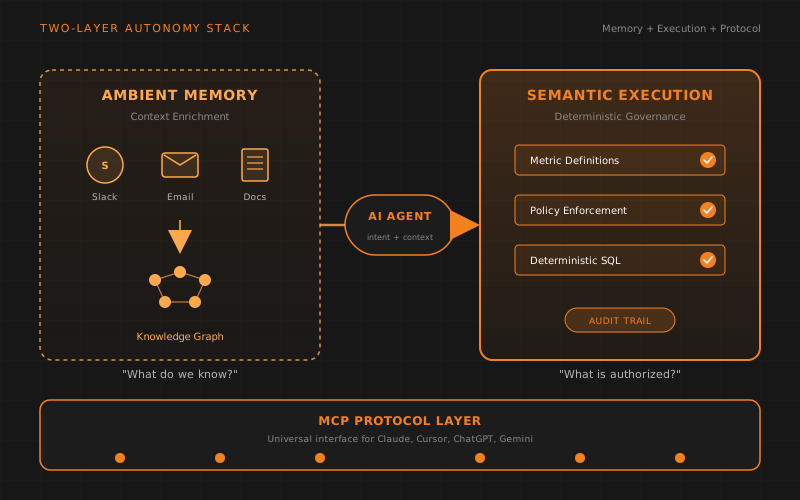
For deeper context, see From Ambient Memory to Deterministic Autonomy, YC's Company Brain RFS, and What Is a Semantic Compiler? Deterministic SQL for AI.
Next Steps
If your organization runs on a complex warehouse, if your teams define metrics differently, if your AI agents are hallucinating on the data they should trust most, reach out.
Colrows turns your database schema into a deterministic semantic execution layer. No token creep. No verification tax. We absorb the cost of compile-time accuracy so you do not have to.
We specialize in mapping complex, multi-table transactional schemas into typed semantic graphs that your AI can execute against with 95%+ accuracy.
Your first conversation is free. Your first schema mapping takes a week. Your first metrics live within 30 days.
Frequently asked questions
What is the ROI of a Company Brain?
Vendor TEI studies report three-year ROI ranging from 141% to 551% for governed semantic layers. The strongest independent signal is the peer-reviewed accuracy benchmark: knowledge graphs improve LLM question-answering accuracy by 3x (from 16.7% to 54.2% in Data.world's arXiv:2311.07509 study).
Why do semantic layers improve accuracy?
A semantic layer compiles agent intent into governed SQL at compile time. The model never sees raw warehouse complexity. It works with typed, versioned business definitions instead. This eliminates the dominant class of text-to-SQL errors: hallucinated join paths and misinterpreted metrics.
What is the cost of AI hallucinations?
EY's 2025 Responsible AI Pulse survey of 975 C-suite leaders found that 99% of organizations reported financial losses from AI errors. 64% reported losses exceeding $1 million. The average loss per affected company: $4.4 million.
What is a silent hallucination?
A silent hallucination is a plausible but incorrect answer that propagates to decision-makers without any error signal. Raw text-to-SQL systems guess at schemas and return wrong numbers that look right. A semantic layer halts ambiguous queries at compile time, converting silent failures into caught errors.
How much time does AI verification cost?
Forrester estimates approximately 4.3 hours per employee per week is spent verifying AI output. For a 30-person data team, that is $426,000 annually in pure overhead. A governed semantic layer reduces this by 60-80% within the first month by eliminating ambiguity at compile time.
How do I calculate Company Brain ROI for my organization?
Pick one high-value, contested metric your CFO, product, and data teams define differently. Build a governed semantic definition. Run 20-30 fixed business questions through your current setup and measure accuracy. Then route them through the semantic layer. The accuracy delta and verification time savings give you your baseline ROI in 4-6 weeks.
What is the difference between Glean and a semantic layer?
Glean retrieves text documents from Slack, email, and wikis. It is useful for onboarding and tribal knowledge. A semantic layer compiles business intent into governed SQL over structured warehouse data. They solve different problems. Glean reduces administrative friction. A semantic layer prevents silent financial errors.
Why do most AI initiatives fail to deliver ROI?
Gartner reports only 20% of AI initiatives hit positive ROI. MIT's GenAI Divide study found 95% of enterprise GenAI pilots delivered zero measurable P&L impact. The root cause is consistent: the context layer is broken. Organizations buy better models when they should fix their data foundation first.