Short answer: Tacit knowledge capture now costs little: conversational AI interviews, automated meeting transcription and passive tool-shadowing record what experts never wrote down. The hard part is making it usable. Raw transcripts dumped into a vector store become an unsearchable content graveyard. Capture with intent, extract metric definitions, join paths and business rules with AI tagging plus human review, then compile them into a governed semantic layer so questions resolve to auditable SQL.
TL;DR
- Capture is no longer the constraint. Conversational AI interviews, automated transcription, and passive tool-shadowing have collapsed the cost of capturing what was previously undocumented. The recurring failure mode is that captured material becomes an unsearchable content graveyard. Storage inflation, duplication, and govern-less transcription feeds are the new tax.
- Document retrieval treats expertise as static text. Vector chunks, GraphRAG, and enterprise search work for historical lookup (find the past ticket that solved a similar problem). They collapse when a live agent must resolve a metric definition or validate a join against your warehouse. The result is hallucination, not insight.
- Semantic compilation converts tacit knowledge into deterministic, executable code. Metric definitions, join paths, and decision rules become structured metadata. Natural-language intent compiles directly into governed SQL with audit trails. Stardog modeled 320% ROI; Colrows enterprise deployments report 8x adoption increase; LinkedIn's peer-reviewed GraphRAG cut median issue resolution by 28.6%. The pattern is consistent: when knowledge becomes operational code, accuracy and speed both improve.
| Attribute | Tribal/Tacit Knowledge | Colrows Semantic Graph |
|---|---|---|
| Logic Storage | Employee memory / Spreadsheets | Centralized Semantic Graph |
| Governance | None (High risk of error) | Compile-time / Deterministic |
| Consistency | Low / Variable | High / Guaranteed |
| Scaling | Human-bottlenecked | Automated / Compiler-driven |
| AI Agent Fit | Low (Hallucination risk) | Native / Production-Ready |
The Real Crisis Is Not Capture
Tacit knowledge (the intuitive, experience-based expertise that lives in people's heads) makes up roughly 90% of an organization's total knowledge. That number is directional rather than precisely measured, but the pattern is clear across every operational interview, postmortem, and onboarding cycle. The expert knows which join path matches the metric. The expert knows why the pricing exception was made in Q3. The expert knows the edge case that triggers the exception path. None of it is written down.
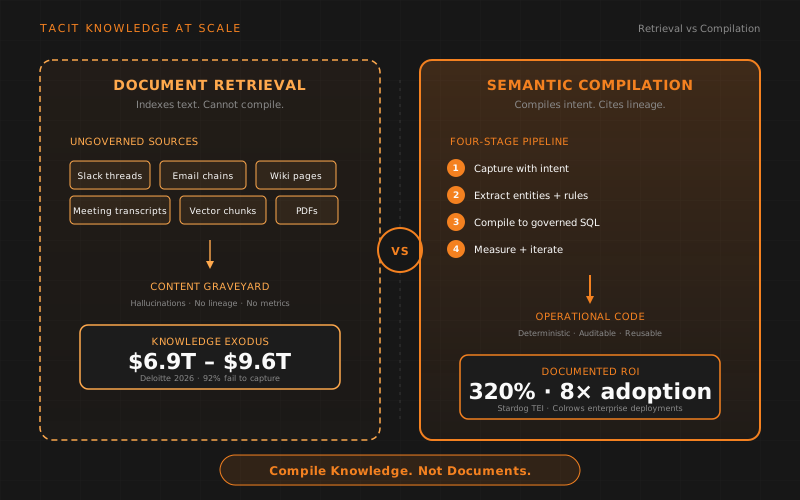
The demographic catalyst is now quantified. Deloitte Insights' June 2026 report "The $9 Trillion Knowledge Exodus" projects $6.9 to $9.6 trillion in lost output as more than 30 million Americans turn 65 within four years. 92% of surveyed organizations still fail to consistently capture knowledge from soon-to-be retirees. 85% of C-suite leaders view the knowledge exodus as moderate-to-mission-critical. Deloitte's Human Capital Trends separately ranked knowledge management a top-three issue while only 9% of organizations felt ready to address it.
And yet the supply of raw captured data has never been higher. Conversational AI interviews, automated meeting transcription (Glean, Sana, Read AI, Fellow), video-based capture (Panopto), and passive tool-shadowing now record knowledge that never used to be written down. The context buried in a six-month-old Slack thread. The decision made in a meeting nobody minuted. The infrastructure cost of capture has collapsed.
This is the trap. Capturing more text does not produce more usable knowledge. It produces an unsearchable content graveyard. Storage inflation. Data duplication. Compliance risk from govern-less transcription feeds. The metaphor we used in The Token Cost Hidden Tax applies here too: dumping raw context into an LLM at query time was the wrong answer for analytics. Dumping raw transcripts into a vector store is the wrong answer for knowledge.
Why Document Retrieval Fails the Analytical Warehouse
Traditional knowledge management indexes and retrieves text. Vector search finds similar chunks. GraphRAG grounds language models in historical text corpora. All of these work for one job: historical lookup. A customer-service rep finding an old ticket that solved a similar problem. An onboarding engineer searching for the wiki page someone half-wrote.
They collapse when a live AI agent or analyst needs to resolve a business metric, join warehouse tables, or apply governance rules. When an agent queries "show me our top customers by profit contribution," a document-search system may find similar historical queries or past analyst reports. But it cannot reliably:
- Parse the current definition of "profit contribution" in your GL schema
- Resolve the correct join path between customers, transactions, and margin tables
- Handle the nuance that "contribution" means gross margin for some product lines and operating margin for others
- Filter out test data
- Apply role-based access controls to the result set
The Tribal Trap
Relying on analysts to "explain" metrics to an AI creates a continuous loop of error. The system must re-parse the explanation, infer the SQL, and guess the join every time. Three points of failure stacked.
The Extraction Mandate
Colrows enables you to map that tacit knowledge directly into the semantic layer. We turn "what the analyst thinks" into "how the compiler resolves the query." Business logic becomes operational code instead of tribal lore.
Hallucination happens when the system guesses or invents answers. It proposes a join that does not exist. It uses an outdated definition. It conflates two metrics with similar names. In a contact-center ticket lookup, this is annoying. In a CFO generating quarterly reports or a board-level decision, it is a business risk. We covered the cost in detail in The ROI of a Company Brain: EY's 2025 Responsible AI Pulse found 99% of organizations suffered AI-related financial losses, with $4.4M average damage per affected company.
The structural reason is simple. Document retrieval treats expertise as static text. The semantic content of "profit contribution is gross margin minus operating costs for SKUs in the consumer line" gets indexed as a similar-string lookup. The next time an agent asks about contribution, retrieval may surface that chunk, but the LLM still has to re-parse it, infer the SQL, and guess the join. Three points of failure stacked.
The Knowledge Infrastructure Matrix
| Knowledge Strategy | Primary Documented Return | Core Infrastructure Limitation |
|---|---|---|
| Unstructured Chat Capture (Glean, Slack scraping) | Reduces per-ticket investigation time by 5 to 10 minutes. Zillow saved 1,500+ hours per month and shortened onboarding ~20%. | Indexes text chunks by similarity only. Cannot resolve or govern structured warehouse metrics. No deterministic join path validation. |
| Document-Based GraphRAG (LinkedIn Customer Service, SIGIR '24) | Reduces median per-issue resolution time by 28.6% (7 hours to 5 hours). Improved retrieval MRR by 77.6%. Peer-reviewed. | Optimized for historical text-ticket lookups. Fails on live transactional schemas and current business logic. Cannot validate current metric definitions. |
| Autonomous Semantic Compilation (Colrows) | Near 100% query accuracy on covered queries. 8x acceleration in self-service data adoption. Forrester TEI modeled 320% ROI for adjacent graph platforms. | Requires structured metadata onboarding and definition alignment up front. Pays back within one fiscal quarter at typical enterprise scale. |
The pattern is clear. Text retrieval is sufficient when you are querying historical text. It fails when you are querying live data with business definitions attached. We mapped this trade-off across more vendors in RAG vs Semantic Layer: Architecture, Cost, and When You Need Both.
Semantic Compilation: From Transcript to Operational Code
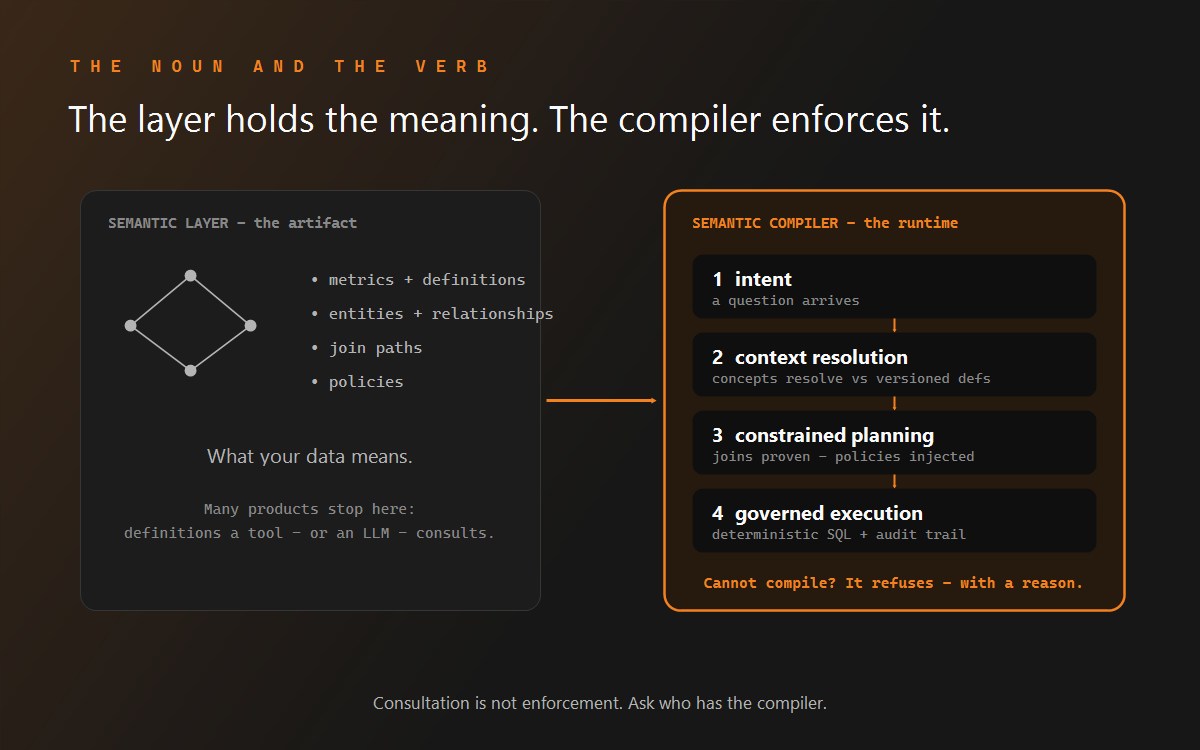
A semantic layer bridges the gap between natural-language intent and analytical data stores. It intercepts business questions, resolves them against an authoritative knowledge graph, and compiles them directly into governed SQL. Metadata governance is embedded in the compilation pipeline. Hallucinated queries are blocked at compile time. Tacit knowledge about business rules, metric definitions, and decision logic becomes operational truth, not archived text.
The mechanism is the same one we described in What Is a Semantic Compiler? Deterministic SQL for AI: parse intent, resolve against a typed semantic graph, validate references, emit dialect-perfect SQL. If a definition is missing or a join cannot be proven, compilation fails loudly. No silent wrong answers reach the board deck.
Do not leave your logic trapped in tribal lore. Codify it into a deterministic graph. Fix the Context, Not the Model. When knowledge is compiled instead of indexed, hallucination risk drops, compliance becomes measurable, and business logic becomes auditable infrastructure instead of archived text.
Document retrieval: Index text, surface similar chunks at query time, let the LLM re-infer SQL. Three points of failure stacked.
Semantic compilation: Compile tacit knowledge into typed metadata up front. Intent resolves against governed definitions. SQL is deterministic. Audit trail is automatic.
Fix the Context. Not the Model.
How Tacit Knowledge Becomes Operational Code: A Four-Stage Model
Stage 1. Capture What Matters
Deploy conversational AI interviews with retiring experts, video-based walkthroughs of complex processes, and automated transcription of decision-critical meetings. The output is structured narrative: decision criteria, edge cases, metric definitions, join logic. Do not dump raw transcripts into a vector store. Tag and synthesize as you capture. The same trap we documented in our analysis of YC's Company Brain RFS applies here: ambient retrieval is necessary but not sufficient.
Stage 2. Extract and Structure
Run LLM-based auto-tagging and entity extraction against captured content. Identify metric definitions, business rules, join paths, and assumptions. Feed these into your semantic graph (ontology plus knowledge base). Treat this as a collaborative curation step, not a set-and-forget automation. Human review is required for accuracy. Manual-only curation breaks at scale; pure-automation pipelines drift. The hybrid pattern (AI extracts, human reviews, machine validates) delivers the accuracy of manual curation at the speed of automation.
Stage 3. Compile and Govern
Connect the semantic layer to your data warehouse. When an analyst or agent asks a business question, the system resolves intent against the semantic graph, validates all references, and compiles directly into SQL. Embed role-based access, data residency rules, and audit logging in the compilation pipeline. Every query carries a "sources cited" audit trail showing which metadata definitions were applied. The compile-time governance pattern is detailed in our guide on how to add governance to AI agents.
Stage 4. Measure and Iterate
Track query accuracy, user adoption, and time-to-insight. Monitor the hallucination rate (% of queries that return factually correct results without user correction). If accuracy dips, the semantic layer has a gap. Fix it at the metadata level, not by retraining the LLM. Update metric definitions, add new join paths, or refine business rules. The cycle is fast because the fix is structural, not statistical.
Why Manual Curation Fails (And Why That Matters)
Traditional knowledge bases require humans to manually create and maintain documentation. An arXiv case study of a national space research center found failure knowledge scattered across GitLab, merge requests, and meeting notes, with wikis underused. The quote from a senior engineer was direct: "I don't think we document it anywhere to be honest." Academic work on taxonomy construction confirms that manual curation "faces significant challenges in scalability, cost, and consistency" against exponential data growth.
The semantic layer solves the scalability problem. LLM-based auto-tagging converts captured content into structured metadata at scale. Ontologies and knowledge graphs formalize business concepts and relationships so they can be reused, validated, and evolved. The hybrid human-in-the-loop approach delivers accuracy at the speed of automation. The drift-detection pattern is covered in Agents That Maintain Your Data Systems.
The Economic Buyer Case
For CFOs: Knowledge-compilation platforms reduce the cost of compliance and audit. Every query is logged with lineage and governance stamps. No more spreadsheet audits or manual traceability efforts. ROI typically hits within one fiscal quarter.
For CDOs: A governed semantic layer breaks silos. Finance, operations, and marketing all work from the same definitions of "customer," "revenue," and "pipeline." No more conflicting reports from different data teams. The pattern is exactly the failure mode we documented in Why BI Metrics Do Not Match Across Dashboards.
For CTOs: Deterministic query compilation means AI agents are debuggable and auditable. When a recommendation fails, you can inspect the code path and see exactly which metric definition or join logic caused the error. This is not possible with a black-box LLM reading unstructured text.
Detailed Business Impact
Unstructured capture systems. Glean's customer Confluent reduced per-ticket investigation time by 5 to 10 minutes (vendor case study). Zillow reported saving 1,500+ hours per month and approximately 20% shorter onboarding. These are real wins for contact-center and operational support use cases. The architectural limitation is clear: if you are querying historical Slack and email, text search is sufficient. If you need to resolve a metric definition or validate a join against live transactional data, these systems cannot help.
GraphRAG on historical text. LinkedIn's peer-reviewed deployment (Xu et al., SIGIR '24, arXiv:2404.17723) reduced median per-issue resolution time by 28.6% (from 7 hours to 5 hours) and improved retrieval MRR by 77.6%. This is a strong result for text-based QA and the most credible evidence in the document-retrieval column because it is peer-reviewed and from a real production deployment. The architectural limitation: the system is optimized for "given this corpus of historical issues, find the relevant one." It cannot resolve current business definitions or validate joins against live schemas.
Semantic compilation. Stardog's Forrester TEI (December 2021) modeled a knowledge graph platform at 320% ROI and total benefits of over $9.86 million over three years, with data scientists and engineers seeing 75% to 95% time savings and analytics projects completed two to three times faster. Microsoft 365 Copilot (Forrester TEI) accelerates onboarding up to 25% (saving 11 days per new hire). These are vendor-commissioned models, so treat the maximums with appropriate caution. The structural advantage of a semantic layer is measurable: when metadata is governed and query compilation is deterministic, speed and accuracy both improve.
Governance, Provenance, and Auditability
When knowledge is locked in transcripts and Slack threads, compliance is manual and error-prone. When knowledge is compiled into a structured semantic layer, audit trails are automatic.
Requirements under GDPR, HIPAA, CCPA, and the EU AI Act all demand traceability. If an AI system recommends denying a loan application, regulators demand a paper trail showing which data, which rules, and which assumptions drove the decision. A document-retrieval system has no such trail. A semantic-compilation platform logs every metadata reference, every join, and every governance rule applied. Compliance becomes data-driven instead of narrative-driven. We unpacked the regulatory implications in detail in Security and Privacy in a Company Brain.
Practical Implementation
Stage 1. Audit and Baseline (0 to 90 days)
Identify critical roles and retirement risks. Map where tacit knowledge actually lives. Baseline the metrics finance already tracks: onboarding ramp days, repeat-question volume, rework costs, search time, ticket investigation time. If more than 20% of critical roles are single points of knowledge, or if onboarding exceeds 45 to 60 days, the business case is clear.
Stage 2. Capture with Intention (3 to 9 months)
Deploy automated capture in the flow of work. Conversational AI interviews with at-risk experts. Video walkthroughs and legacy interviews. Passive indexing of critical systems (not a full Slack dump, but structured access to decision threads). Prioritize one or two high-value domains rather than boiling the ocean. Enable self-serve analytics as an outcome. Benchmark: measure a drop in repeat questions and a first onboarding-time improvement within two quarters.
Stage 3. Structure with a Semantic Layer (6 to 18 months)
Layer a knowledge graph + ontology + LLM auto-tagging over captured content. Ensure it is searchable, governed, and directly connected to your data warehouse. Use W3C standards (RDF, OWL, SHACL) to avoid vendor lock-in. Insist that query compilation is deterministic and fully auditable. See SaaS Architecture for the technical graph structure. If AI-assistant answers cannot cite provenance or fail in high-stakes domains, the semantic layer is the fix, not a bigger model.
Stage 4. Govern and Prove ROI (continuous)
Embed provenance, version control, retention policies, and permission-aware access from day one. Compliance is far cheaper designed-in than bolted-on. Track hard ROI via impact-chaining. Expand investment once onboarding ramp falls 20% or more and rework declines. Pause and redesign if adoption stalls below 50%, since adoption determines returns, not deployment.
Caveats
- The "90% of knowledge is tacit" figure is widely cited but not empirically established. IDC's own analysts note no universal measurement exists. Treat it as directional, not precise.
- Several headline ROI figures (Microsoft 365 Copilot, Stardog) come from vendor-commissioned Forrester TEI studies using composite organizations and "up to" maximums. Credible directionally but not audited single-customer results.
- LinkedIn's GraphRAG result (28.6% reduction, from 7 to 5 hours) is the strongest evidence here because it is peer-reviewed and from a real production deployment.
- Data-silo and search-time macro figures trace to inconsistent or aging methodologies. Cite as illustrative, not authoritative.
The Bottom Line
Stop archiving ungoverned text logs. The capture tools are commoditized. The constraint is no longer "can we record what the expert knew?" It is "can we compile what they knew into governed, executable infrastructure?"
When knowledge is compiled instead of indexed, hallucination risk drops, compliance becomes measurable, AI agents become debuggable, and the institutional memory that walks out the door at retirement gets preserved as operational code instead of dead text.
Document retrieval is necessary for historical lookup. Semantic compilation is necessary for analytical execution. Pick the right tool for the job and stop confusing the two.
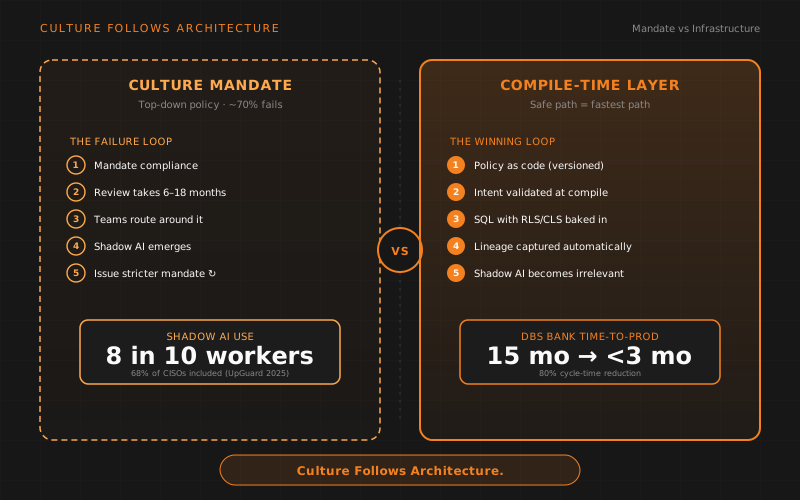
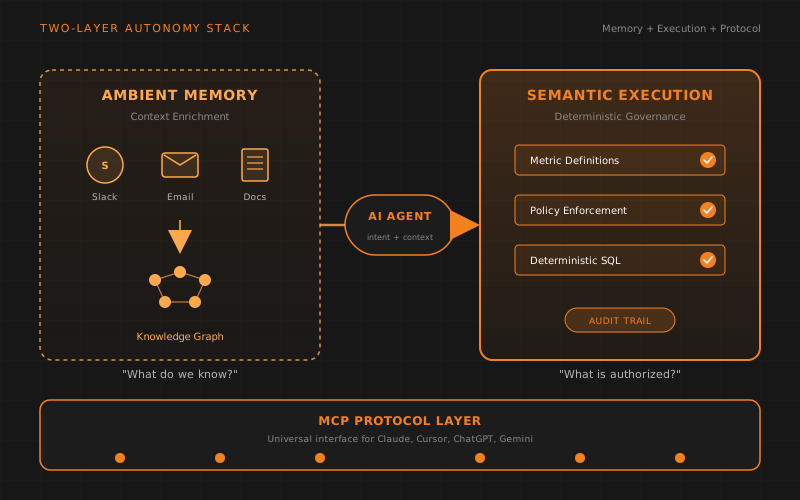
For deeper context, see The Culture of Transparency: Why Architecture Solves What Mandates Cannot, From Ambient Memory to Deterministic Autonomy, and From Metric Stores to Knowledge Machines.
Next Steps
If your organization is sitting on ungoverned transcripts and worried about the knowledge walking out the door at retirement, the fix is not a bigger vector store. It is semantic compilation.
Colrows turns your team's tacit logic into deterministic, executable data infrastructure. We map captured expertise into governed metadata, compile intent into auditable SQL, and produce lineage as a byproduct of every query.
Your first knowledge audit is free. Your first metric definition takes a week. Your first compiled semantic domain ships within 30 days.
Capturing knowledge is half the job; governing what an agent may do with it is the other half, covered in AI knowledge management.
Frequently asked questions
What is tacit knowledge and why does it matter for enterprise AI?
Tacit knowledge is the intuitive, experience-based expertise that lives in people's heads: how a senior analyst knows which join path matches a metric, why a pricing exception was made, which edge cases trigger an exception path. Industry estimates put tacit knowledge at roughly 90% of an organization's total knowledge (directional). When it walks out the door at retirement, AI agents trying to operate on its absence hallucinate. Deloitte's June 2026 report projects $6.9T to $9.6T in lost output as 30M+ Americans turn 65 within four years.
Why does document retrieval fail for enterprise analytics?
Document retrieval (vector search, GraphRAG, enterprise search) indexes text chunks by similarity. This works for historical lookup (find the past ticket that solved a similar problem). It fails when a live agent must resolve a metric definition, validate a join path against a current schema, or apply role-based access controls. Vector chunks have no metric definitions, no governance, no audit trail.
What is semantic compilation?
Semantic compilation is the process of converting tacit business knowledge (metric definitions, join logic, decision rules, edge cases) into executable, governed metadata that compiles natural-language intent directly into deterministic SQL. The system resolves intent against a typed semantic graph, validates references, and emits dialect-perfect SQL with audit trails. If a definition is missing, compilation fails loudly instead of hallucinating quietly.
How does a semantic layer prevent AI hallucinations?
Hallucinations occur when an agent guesses join paths, invents metric definitions, or conflates similar-sounding metrics. A semantic layer makes definitions, joins, and governance rules explicit and machine-readable. When the agent compiles a query, every reference must resolve against the metadata layer. Undefined metrics or invalid joins cause compilation to fail explicitly. No silent wrong answers reach the board deck.
What ROI do organizations see from semantic compilation?
Stardog's Forrester TEI (December 2021) modeled 320% ROI and $9.86M three-year benefits with 75-95% time savings for data scientists. LinkedIn's peer-reviewed GraphRAG deployment cut median issue resolution from 7 hours to 5 hours (28.6% reduction). Colrows enterprise deployments report 8x increase in data adoption and near-100% accuracy on covered queries. Vendor TEI numbers should be treated as directional. LinkedIn's number is the strongest signal because it is peer-reviewed and production-deployed.
What is the difference between GraphRAG and a semantic layer?
GraphRAG indexes a corpus of documents into a knowledge graph and grounds LLM responses against that graph. It excels at historical question-answering over text. A semantic layer compiles intent into governed SQL against a live transactional warehouse. GraphRAG cannot resolve current metric definitions or validate joins against live schemas. The two are complementary: GraphRAG for unstructured retrieval, semantic layers for analytical execution.
How do I capture tacit knowledge from retiring experts?
Use a four-stage model: (1) Capture with intent (conversational AI interviews, video walkthroughs, automated meeting transcription); (2) Extract entities, metric definitions, join paths, and business rules using LLM-based auto-tagging with human review; (3) Compile into the semantic layer connected to your warehouse; (4) Measure accuracy, adoption, and time-to-insight, then iterate at the metadata level. Skip step 2 and you create a content graveyard.
Does a semantic layer help with GDPR and EU AI Act compliance?
Yes. Compliance under GDPR, HIPAA, CCPA, and the EU AI Act requires traceability: which data, which rules, which assumptions drove a decision. Document retrieval systems have no such trail. A semantic-compilation platform logs every metadata reference, every join, and every governance rule applied as a byproduct of compilation. Audit trails are automatic and tamper-evident, not bolted on after the fact.