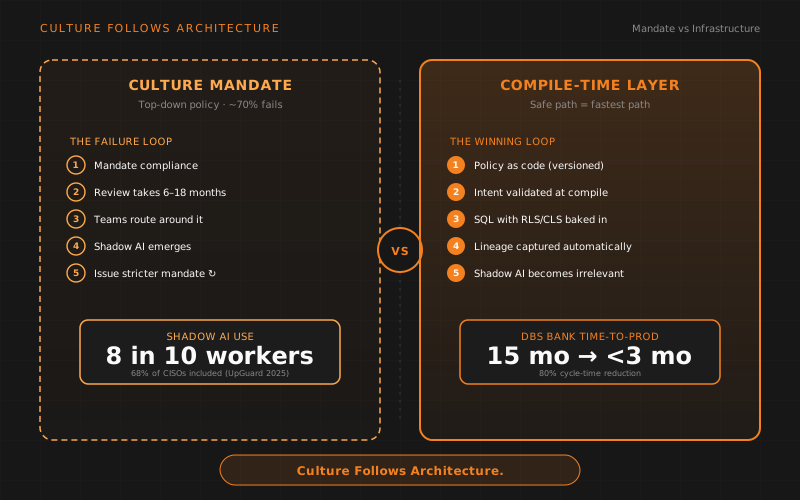
Short answer: A culture of transparency comes from infrastructure that makes the governed path the fastest path. Mandates alone produce workarounds: when compliance takes 6 to 18 months, 8 in 10 employees use unauthorized AI tools. Compile-time governance validates intent before SQL is generated and records versioned definitions, lineage and audit trails automatically. DBS Bank cut AI time-to-market from 15 months to under 3 while scaling from about 600 to 1,500+ models in production.
| Dimension | Opaque AI Stack | Transparent AI (Compile-Time) |
|---|---|---|
| Query logic | Black-box text-to-SQL | Deterministic, auditable SQL |
| Governance | Presentation-time (post-read) | Compile-time (pre-query) |
| Audit trail | Manual, log-dependent | Automatic, point-in-time reproducible |
| Version control | None (schema drift undetected) | Versioned semantic graph |
| Agent readiness | Bypasses all controls | All query paths governed |
TL;DR
- Shadow AI is not a culture problem. It is an infrastructure signal. 8 in 10 employees and 68% of security leaders (including CISOs) use unauthorized AI tools because the compliant path is too slow. Mandating discipline produces workarounds. Redesigning the substrate makes safe behavior automatic.
- Presentation-time governance fails the agent era. Traditional BI layers (Looker, Tableau, dbt) apply security after data is retrieved. Agents that query APIs directly bypass it entirely. Compile-time governance validates intent before SQL is generated. The model never sees unauthorized data.
- The proof case is DBS Bank: governance compressed time-to-production from 15 months to under 3, scaled from ~600 models (2022) to 1,500+ (2025), and grew AI economic value from SGD 180M to SGD 1B+. Governance did not slow this. It enabled it. Culture follows architecture.
The Real Problem Is Not Resistance. It Is Infrastructure.
Your organization tried to enforce AI governance. You issued a policy. You mandated compliance reviews. You asked teams to document model behavior and query lineage.
Nothing changed. The policy was ignored. Employees built shadow AI. Production systems grew undocumented. The compliance team fell further behind.
You assumed the problem was culture. Your engineers were moving too fast. They resisted accountability. They valued speed over stewardship.
But the real problem was architecture.
When compliance takes 6 to 18 months and moves a pilot from lab to production, employees do not follow the rules. They route around them. UpGuard's 2025 State of Shadow AI found 8 in 10 employees use unauthorized AI tools. More striking: 68% of security leaders, including CISOs, admit to using unsanctioned AI in their own workflows.
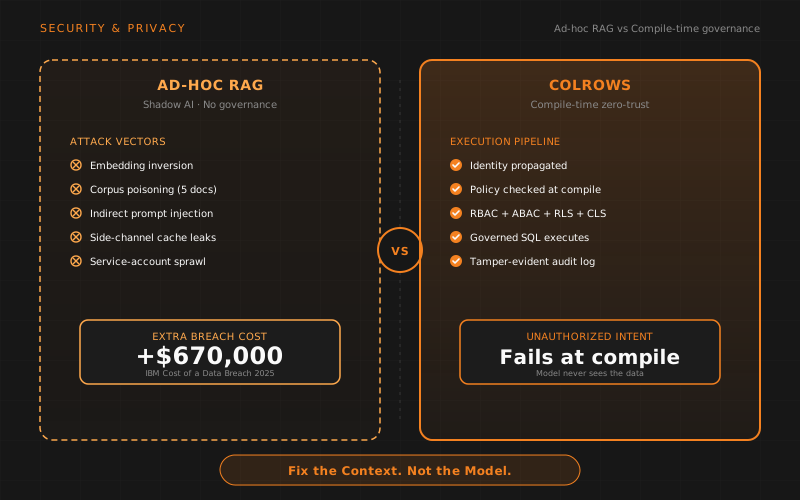
This is not rebellion. It is operational necessity. We unpacked the breach economics of this in Security and Privacy in a Company Brain.
A traditional semantic layer enforces governance at presentation time. An engineer submits a query via API. The application checks permissions. If the user lacks authorization, the result set is masked. But the masking happens after data is retrieved. The model has already "seen" it. For autonomous agents querying via MCP or direct API calls that bypass dashboards, this design completely fails.
Colrows changes the paradigm. It enforces governance at compile time. When an agent requests data, the system verifies intent, validates schema constraints, and applies access control rules before generating SQL. If the request violates policy, the system throws an explicit error during compilation. The model never sees the data.
The secure path becomes the fastest path.
Culture follows architecture, not the reverse.
The Governance Gap: Where Shadow AI Wins
The Cost of Slow Compliance
The empirical record is stark. About two-thirds of organizations report they either lack or are unsure they have the right data management and governance practices for AI. The Cloud Security Alliance found only roughly one quarter of organizations have comprehensive AI security governance in place. Gartner's 2024 survey of data management leaders found 63% either lack governance or are unsure. Board oversight is rising but shallow: only 27% of boards have formally added AI governance to a committee charter.
The specific complaint from teams doing the work is consistent: compliance takes too long.
ModelOp's 2025 AI Governance Benchmark surveyed 100 senior AI/data leaders. The results:
This is not a perception problem. It is a process problem.
The Shadow AI Response
When the compliant path is slower than the non-compliant path, employees choose the non-compliant path.
UpGuard's November 2025 State of Shadow AI surveyed 542 security leaders and 1,020 employees. The findings:
- 8 in 10 employees use unauthorized AI tools
- 68% of security leaders, including CISOs, admit to incorporating unsanctioned AI into daily workflows
- 45% of workers find workarounds to access blocked applications
- 48% of employees say they would continue using AI tools even if their employer explicitly banned them
Bans do not work because they do not address the root cause. The compliant tool is too slow or too hard to use.
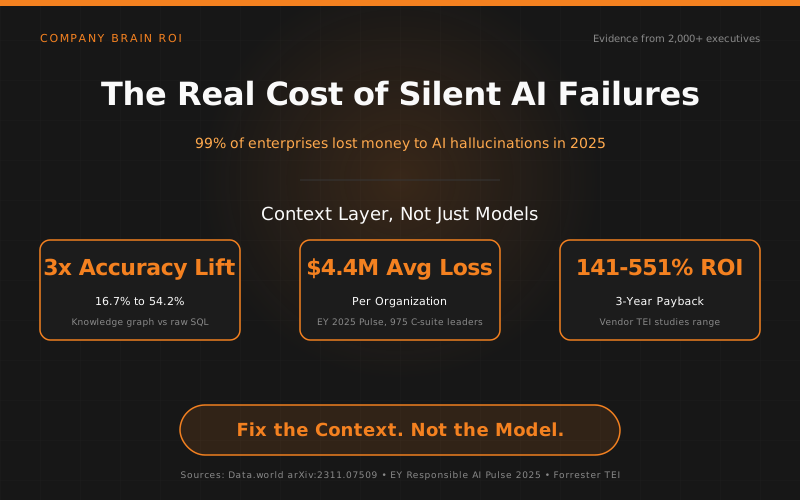
IBM's 2025 Cost of a Data Breach Report found shadow AI involved in 20% of breaches. More damning: organizations with high levels of shadow AI saw breaches that added USD 670,000 to the average breach cost compared to those with low or no shadow AI. We covered the full breakdown in The ROI of a Company Brain.
The pattern is clear. Governance-by-mandate produces shadow AI. Shadow AI produces breach risk. Breach risk becomes financial and reputational liability.
The lever is not culture change. It is infrastructure redesign.
How Presentation-Time Governance Fails the Agent Era
The Architecture Problem
Traditional semantic layers and BI platforms enforce governance at presentation time. This worked when humans ran queries through dashboards. It fails completely in the agent era.
Consider the flow:
- Presentation-time model (traditional BI): User submits query via dashboard, application layer checks permissions, results are masked if authorization fails, user sees filtered output.
- Compile-time model (Colrows): Agent submits intent via MCP, semantic layer verifies schema, identity, and policy, SQL is generated with constraints baked in, if authorization fails, execution halts before any data is read.
The difference is subtle and catastrophic. In presentation-time governance, the data is retrieved and filtered afterward. Masking happens at the UI layer. For autonomous agents querying data warehouse APIs directly, this design breaks completely.
Why? Because agents do not operate through dashboards. They query the warehouse directly. They call REST APIs. They use MCP protocol connectors. They invoke SQL directly. At every one of these access points, presentation-time governance is bypassed.
The agent retrieves raw schema. The agent faces full token complexity. The agent's context window explodes. The model struggles with semantic disambiguation. It hallucinates metrics. It invents joins. Wrong answers get cached. Trust collapses. The economic side of this is detailed in The Token Cost Hidden Tax.
For a CDAO trying to deploy agentic analytics at scale, this is not a culture problem. It is an architecture problem.
The Colrows Approach
Colrows enforces governance at compile time. This means the system verifies authorization and constraints before the query is generated, not after results are returned.
The flow:
- Agent submits intent: "Show me Q4 revenue by customer segment, filtered to accounts over $1M ARR"
- Colrows parses intent and resolves against the semantic graph
- Colrows checks: Is this agent authorized? Is the user authorized? Are the requested dimensions and metrics in scope?
- If policy checks pass, Colrows generates SQL with row-level and column-level security baked in
- The query runs against the warehouse
- Results returned with full lineage and audit trail
If any policy check fails, the system does not generate a query at all. It throws an explicit error. The error is logged. The error is traceable. No data is read. The model never hallucinates.
This is the core difference: governance integrated into the compiler, not bolted onto the presentation layer. We described the underlying mechanism in What Is a Semantic Compiler? Deterministic SQL for AI.
Presentation-time governance: Data is retrieved, then filtered. Masking happens after. Agents bypass it via direct API.
Compile-time governance: Intent is validated before any query is generated. If unauthorized, compilation fails. Data is never accessed.
Fix the Context. Not the Model.
Why Shadow AI Is a Tell, Not a Flaw
The widespread use of unsanctioned AI tools is not evidence that employees are undisciplined. It is evidence that the compliant path is too slow or too hard.
This is a critical reframe. Treating shadow AI as a security or compliance problem produces bans and mandates that fail 70% of the time (per organizational-change research). Treating it as an infrastructure signal produces redesigns that work.
The UpGuard finding that 68% of security leaders use shadow AI is especially telling. CISOs are trained to think risk-first. They understand compliance. They have more authority to follow rules than most employees. Yet they use unauthorized tools. This is not a behavioral or cultural problem. It is a functional gap in the authorized infrastructure.
The McKinsey/MIT research on AI adoption puts this precisely: organizations where senior leadership actively shapes AI governance achieve significantly greater business value than those delegating it to technical teams alone, but only if the infrastructure supports fast, governed deployment. Without a fast compile-time governance layer, leadership mandates translate into longer timelines and more workarounds.
The Behavioral Patterns: Mapping Resistance to Infrastructure Gaps
| Observed Resistance Tell | Core Behavioral Root Cause | The Infrastructure Fix |
|---|---|---|
| Shadow AI Workarounds. 8 in 10 workers use unauthorized AI tools. 68% of security leaders admit to unsanctioned use. | Official data paths are too slow. Compliance takes 6-18 months. Employees choose speed over policy. | Colrows Unified Surface: A single, governed semantic entry point that connects any agent via MCP. Compile-time governance eliminates the trade-off. |
| The Velocity Tax Mandate. Teams spend 6-18 months moving an AI pilot to production due to manual compliance review. | Slow intake-to-production timelines create the perception that governance equals velocity tax. | Compile-Time Enforcement: RBAC and ABAC verified instantly during compilation. No manual review loop. DBS Bank: 15 months to under 3 months. |
| Explainability Debt. Opaque text-to-SQL logic compounds silently. Wrong answers look right until they appear in board decks. | Text-to-SQL and RAG cannot explain reasoning. Lineage is missing. Policy context invisible. | Deterministic SQL Generation: Colrows compiles intent into transparent, auditable SQL. Every join explicit. Every answer carries lineage. |
| Control-Loss Resistance. Engineers fear central governance will strip autonomy. They distrust centralized policy. | Legacy semantic layers feel like top-down mandates. Ownership and accountability unclear. | Federated Ownership: Core definitions remain authoritative. Teams own edge semantics. Autonomy preserved. Interoperability enabled. |
| The "Too Hard" Block. Explainability frameworks require data scientists to document models post-hoc. | Governance layers ask engineers to add documentation on top of building models. Feels like extra work. | Native Observability: Colrows generates audit trails, lineage, and documentation as a byproduct of compilation. No extra steps. |
Why Culture Change Fails Without Architecture Change
The organizational-change research is consistent: roughly 70% of transformation programs underperform or fail outright. The primary reason is not lack of commitment or poor communication. It is misalignment between the intended change and the underlying incentive structure.
McKinsey's research on agile transformations found that when an organization tried to shift from "waterfall" to "agile" without changing how teams were measured, bonused, and promoted, the transformation collapsed. Engineers optimized for the metrics that still mattered. The agile framework became cosmetic. Actual behavior did not change.
The same dynamic applies to AI governance. If you mandate that teams document models, implement lineage, and follow compliance processes, but you measure and promote teams by features shipped per quarter, the mandate loses.
Gartner's 2026 prediction is direct: by 2027, 80% of data and analytics governance initiatives will fail due to lack of a real or manufactured crisis. This means governance programs collapse in the absence of a felt, urgent business priority. Why? Because without a crisis, the default incentive structure reasserts itself. Shipping features is rewarded. Governance is overhead.
The solution is not a stronger mandate. It is an architecture where the governed path is the fastest path. Where compliance is not a velocity tax but a velocity enabler. Where documentation and lineage happen automatically as byproducts of normal work.
Colrows enables this by making governance a compile-time property of the semantic layer. When an engineer uses the layer, governance is automatic. They do not have to choose between speed and security. The architecture enforces both. The 7-layer pattern is detailed in our guide on how to add governance to AI agents.
Culture follows architecture.
The Business Case: Why Transparency Scales AI Faster, Not Slower
The counterintuitive finding from successful AI organizations is that transparency accelerates deployment, not slows it.
DBS Bank: The Proof Case
In 2018, DBS established a PURE framework (Purposeful, Unsurprising, Respectful, Explainable) for all AI use cases. It built a cross-functional Responsible AI Council with mandatory employee e-learning. It operationalized a governed data platform and AI protocol registry.
This is not correlation. This is causation. Governance reduced cycle time by 80% because it eliminated rework. Models built to explainability standards failed less often. Documented lineage meant fewer integration surprises. Policy-by-default meant fewer post-deployment compliance violations that triggered restarts.
The economic impact was proportional. DBS scaled from ~600 models (2022) to over 1,500 models (2025). Annual economic value from AI grew from SGD 180M (2022) to SGD 1B+ (2025).
Governance did not slow this. It enabled it.
Morgan Stanley: Trust at Scale
Morgan Stanley's Wealth Management GenAI Assistant reinforces this. The assistant did not ship fast and ask forgiveness. It implemented rigorous evaluation frameworks to test every use case before deployment. Advisors graded responses for accuracy. Independent second-line teams validated every update before it went live.
The result: over 98% of advisor teams actively use the assistant. Document access jumped from 20% to 80%. Adoption is near-universal because trust is high.
Speed and safety do not trade off when the underlying architecture is sound. They reinforce each other.
How Compile-Time Governance Makes Safety the Default
The Mechanics
Traditional governance layers operate as guards at the entrance to production. "Does this model meet compliance criteria? Yes or no. Deploy or reject."
Colrows operates as a compiler that makes unsafe execution impossible. It does not ask permission at the gate. It makes the safe path the only path.
Here is how:
- Policy as code (versioned in Git). RBAC rules, ABAC conditions, and access policies are stored as versioned code. They are reviewed via pull request. They can be rolled back. They are tested.
- Intent validation at parse time. When an agent submits a request, Colrows does not generate a query first and then check authorization. It validates the intent against policy before generating anything. If the intent violates policy, parsing fails. Error thrown.
- Deterministic SQL generation. Once intent passes policy checks, Colrows generates SQL with security baked in. Row-level filters are in the WHERE clause. Column-level masking is in the SELECT. No data is retrieved that the user should not see.
- Full lineage capture. Every decision is logged. Which user requested what. Which policies applied. Which rows were accessed. Which joins were taken. All captured automatically and made queryable for audit, debugging, or reproducibility. See How to Govern AI Agents That Query Enterprise Data for the full pattern.
- Short-lived agent tokens. Non-human agents get time-bound, minimally-privileged tokens. If a token is compromised, it expires in minutes. Damage is bounded.
Compare this to presentation-time governance: policy stored in multiple places, intent interpreted at query time without pre-validation, SQL generated first and security checked afterward, lineage manual or missing, agents running as permanent service accounts. The first approach makes safe behavior automatic. The second requires discipline. Discipline fails under pressure.
Why This Matters for Agents
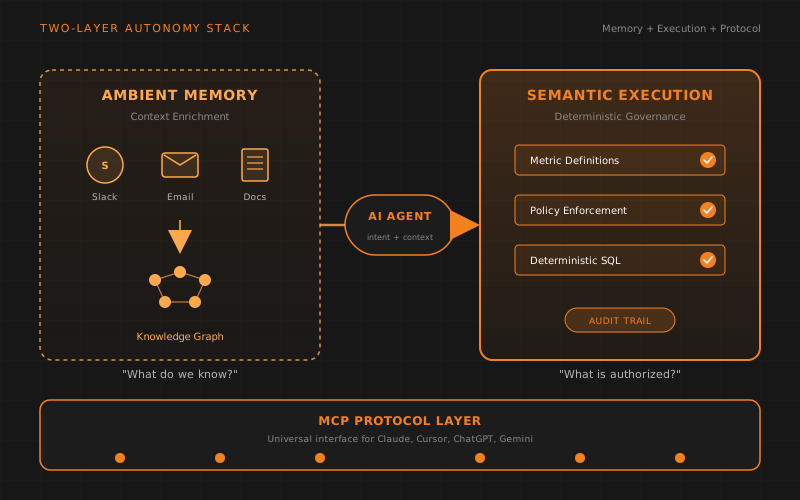
An autonomous agent operating in a presentation-time governance environment faces a fundamental problem: it must interpret the raw schema, reason about joins, and guess at semantics before any security policy can be applied. This explodes context, token costs, and hallucination risk. The same dynamic is examined in From Ambient Memory to Deterministic Autonomy.
An agent operating in a compile-time governance environment works against a versioned semantic graph where every metric and entity is defined, every join is pre-validated, and every permission boundary is explicit. The agent's task shrinks to intent interpretation, not semantic inference.
For a CDAO deploying agents at scale, this is the difference between a system that requires constant tuning and one that works reliably.
The Three-Phase Roadmap: From Mandate to Architecture
Phase 1: Establish the Substrate (0-3 months)
Stand up a governed semantic layer that can be the source of truth for all AI and analytics queries. Start with one domain (e.g., financial metrics) and cover 5-10 disputed definitions.
Threshold: The governed layer must do at least 80% of what employees need, or shadow AI persists.
Run a shadow-AI discovery sweep (network, SaaS, identity logs, browser history). Do not punish; frame findings as channeling opportunities. Present the option: "You use these tools because our official tools were too slow. We are fixing that."
Align pricing to scale without penalty. If your pricing is per-seat, agents are a cost multiplier. Colrows' schema-complexity plus query-volume model scales agents as a feature, not a financial burden.
Phase 2: Make Governance Invisible (3-9 months)
Automate lineage capture, model registries, and policy enforcement. If governance still takes 6+ months or more than 40% of engineers call it "too slow," re-engineer the process before enforcing wider use.
Mandate pre-deployment evaluation (the Morgan Stanley model) for high-risk use cases. Independent second-line validation required. But make validation fast: 1-2 weeks, not 6 months.
Decouple OKR attainment from compensation. Add governance and assurance KPIs (documentation coverage, lineage completeness) to "done." Make transparency a craft, not overhead.
Phase 3: Federate and Scale (9-24 months)
Allow domains to own semantic definitions while ensuring they conform to core enterprise policies. Promote successful edge definitions back to the core. This preserves autonomy while enabling interoperability and prevents the "too centralized" backlash.
Fund change management at roughly 2x the build cost (per McKinsey frontrunner research). Identify super-users. Publicize adoption metrics and transparency wins.
Tie governance to a business outcome (a near-miss postmortem, a compliance audit, a competitor incident) to avoid Gartner's 80%-failure trap. Manufactured crises work.
Thresholds and Decision Points
- If adoption of the governed tool plateaus below ~70% of target users, the default is not yet easier than alternatives. Re-engineer the developer experience.
- If governed time-to-production does not improve relative to ad-hoc paths, the layer is adding friction rather than removing it. Audit the review loop.
- If a serious governance incident occurs despite controls, treat it as the "manufactured crisis" to accelerate, not retreat from, the program.
Why This Matters Now: The Agent Adoption Curve
The reason this conversation is urgent is timing. Gartner predicts over 40% of agentic AI projects will be canceled by end of 2027 due to escalating costs, unclear value, or inadequate risk controls. Gartner also predicts that by 2027, 40% of enterprises will demote or decommission autonomous agents because governance gaps are discovered only after production incidents.
This is the choice point. Organizations deploying agents without a compile-time governance layer are building a brittle system that will fail spectacularly. Organizations deploying agents through a governed semantic layer can scale safely and economically. We mapped the broader landscape in YC's Company Brain RFS.
The architectural choice made now determines whether your agentic AI roadmap is an accelerant or an anchor.
Transparency Codified Into the Stack
Colrows does not rely on culture to produce transparency. It compiles it in.
The semantic graph is versioned. Every change to a metric definition, access policy, or entity relationship is attributed, timestamped, and reversible. This is not a changelog. It is a point-in-time reproducible record of what your organization meant by "revenue" on any given date.
Every compiled query generates a structural audit trace: which user requested what, which policies applied, which join paths were proven, and the exact SQL that was executed. This trace is deterministic. Run the same intent against the same graph version and you get the same SQL. No ambiguity. No drift.
Row-level security and column-level masking are not applied after the query runs. They are compiled into the WHERE and SELECT clauses before the query is generated. The warehouse never reads unauthorized data. The audit log never records a masking event because masking was never needed.
This is what "culture of transparency" means when it is codified: every output is traceable to its source, every access decision is logged, and every metric definition is version-controlled. We described the underlying authorization model in Data Authorization: Why Security Fails in the Semantic Layer and the technical implementation in Data Access Control.
The Bottom Line
The real problem is not your culture. It is not your people. It is not your processes.
It is infrastructure.
When governance takes 6-18 months, employees route around it. When compliance happens at presentation time, agents bypass it. When policies are scattered across multiple tools, they become inconsistent and unenforceable.
Colrows consolidates governance into a single compile-time layer. It makes safety automatic. It removes the false choice between speed and security. It turns shadow AI from a workaround into an irrelevance.
The path to a transparent, governed, trustworthy AI organization is not a cultural mandate. It is a technical redesign.
For deeper context, see Security and Privacy in a Company Brain, The ROI of a Company Brain, and Governance as Code vs Governance as Semantics.
Frequently Asked Questions
How does a semantic layer improve AI transparency?
A semantic layer sits between users (and agents) and the data warehouse. It stores metric definitions, entity relationships, and access policies in a versioned graph. When a query is compiled, the layer generates deterministic SQL with explicit joins, logged filters, and full lineage. Every output carries a structural trace back to its source definitions. Transparency is not an add-on. It is a byproduct of compilation.
What does auditable AI mean for BFSI compliance?
For BFSI organizations under RBI, SARFAESI, SOC2, or HIPAA requirements, "auditable" means every query is point-in-time reproducible. Run the same intent against the same graph version and you get the same SQL. The audit trail records which user, which policies, which data, and why. Regulators can replay any past query and verify exactly what definitions were in force. No log reconstruction. No after-the-fact interpretation.
Why is compile-time governance better for enterprise security than BI-layer controls?
BI-layer controls (Looker access filters, Tableau RLS) apply security after the warehouse has already read and returned the data. Any agent, API client, or SQL runner that bypasses the BI tool sees all rows. Compile-time governance validates intent before SQL is generated. If the intent violates policy, compilation fails. No query runs. No data is read. The warehouse never sees the unauthorized request. This is the only model that works when autonomous agents query data directly.
Next Steps
If your organization is scaling agents and compliance is your bottleneck, the solution is not better training or stricter policies. It is architecture.
Stop fighting human behavior with corporate mandates. Deploy a governed semantic layer that makes compliance automatic.
Colrows specializes in autonomous semantic execution for complex transactional schemas. We turn your data complexity into a compile-time advantage. We eliminate the choice between speed and governance.
Your first schema audit is free. Your first compile-time enforcement takes one week. Your first agent deployment with full audit trails and policy-by-default takes 30 days.