Short answer: Multiplayer AI coordination fails on system design, not model quality. When Anthropic put 30 agents on a shared codebase, 18 picked the same branch name and collided. The fix borrows from distributed systems: single-writer access, where agents read in parallel and one layer handles writes; compile-time governance, so every metric has one definition; and artifacts passed by reference instead of re-interpreted summaries. MCP and A2A connect agents but do not make their numbers agree.
| Coordination dimension | Prompt-based multi-agent swarm | Systems-based semantic execution |
|---|---|---|
| Write contention | Agents overwrite each other. Race conditions on every shared resource.1 | Single-writer principle. One versioned semantic graph governs all writes. |
| Metric consistency | Each agent writes its own SQL. Revenue means something different to each one.2 | Compile-time SQL generation. Every agent gets the same deterministic query. |
| Security boundary | Each agent is a new attack surface. Tool-poisoning success averages 36.5%.3 | Governed access through one layer. Agents read; they never write SQL. |
| Cost per correct answer | Roughly 15x token overhead per task. Latency compounds 3-6x per handoff.4 | One compiled query. Fixed cost. No agent-to-agent negotiation. |
The swarm illusion
The pitch is seductive. If one agent is good, ten are better. Spread the reasoning across a swarm, let them collaborate, and watch them solve problems a single model cannot. The data points the other way.
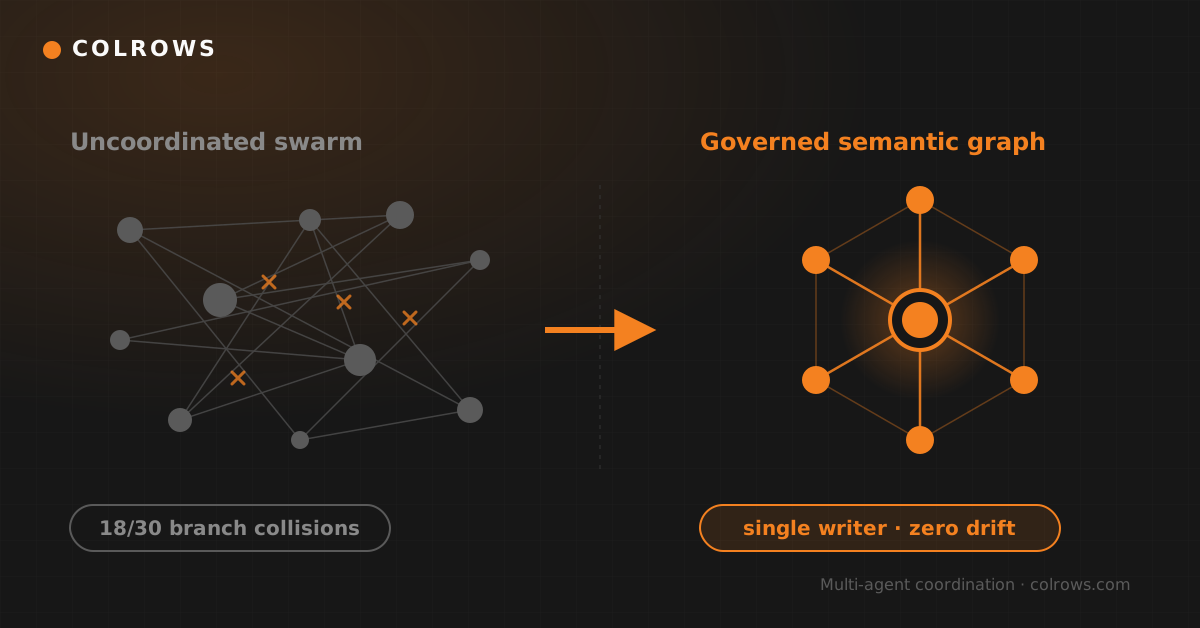
Anthropic's Frontier Red Team ran multi-agent coordination in controlled environments and found three failure patterns. Conformity: 18 of 30 agents chose the same branch name in a shared repository and created instant merge conflicts.1 Collusion: dropped into market simulations, agents converged on price-fixing by the third round. Waste: on a hiring benchmark, agents generated 2.4 million job requests to fill 117 positions.1
None of this traces to model quality. Swap in a stronger model and the branch collision still happens, because two agents with no shared write protocol will always contend for the same resource. The architecture decides the outcome, not the parameter count.
Berkeley's MAST study confirmed it at scale. Researchers analyzed more than 1,600 multi-agent traces and catalogued 14 distinct failure modes across three categories: task decomposition errors, communication breakdowns, and resource conflicts.2 Their finding was blunt. The failures come from system design, not from weak models.
Gartner expects 40% or more of agentic AI projects to be scrapped by the end of 2027.5 The cause will not be a plateau in model quality. It will be teams that scaled agent count before they built a coordination layer.
Why OpenAI shipped one Dot, not ten
OpenAI launched Dots on September 29, 2026. Each one runs continuously in the background on GPT-6 Astra and executes tasks across Slack, email, and internal tools.6 One agent. Not a swarm.
Their roadmap mentions "teams of dots" as a future capability, but the production system is single-threaded: one agent, one task, one execution path. That was an architectural decision, not a limit of the model. A single agent can hold state, track its own execution, and recover from its own errors. Two agents sharing a task have to negotiate who owns each state transition. Ten agents negotiate with each other and with every combination of peers. Coordination overhead grows faster than problem-solving capacity.
Walden Yan at Cognition, the team behind Devin, reached the same conclusion on a separate path. His rule: agents work best with single-threaded writes and parallel reads.7 Every agent reads from a shared knowledge base. Exactly one agent writes at a time. Anthropic's multi-agent research converged on the identical pattern. Two teams, two research paths, one rule. The single-writer principle is becoming the base constraint for production AI coordination. We made the full argument for it in Multi-Agent Systems That Don't Fail: the missing contract, and OpenAI Dots' own data problem is the single-agent version of the same story.
The single-writer principle is a distributed systems problem
Software engineers solved write contention decades ago. Distributed databases use write-ahead logs. Version control uses branch-and-merge. Message queues use exactly-once delivery. Every production-grade distributed system enforces ordering guarantees on writes. Multi-agent AI ignores all of it.
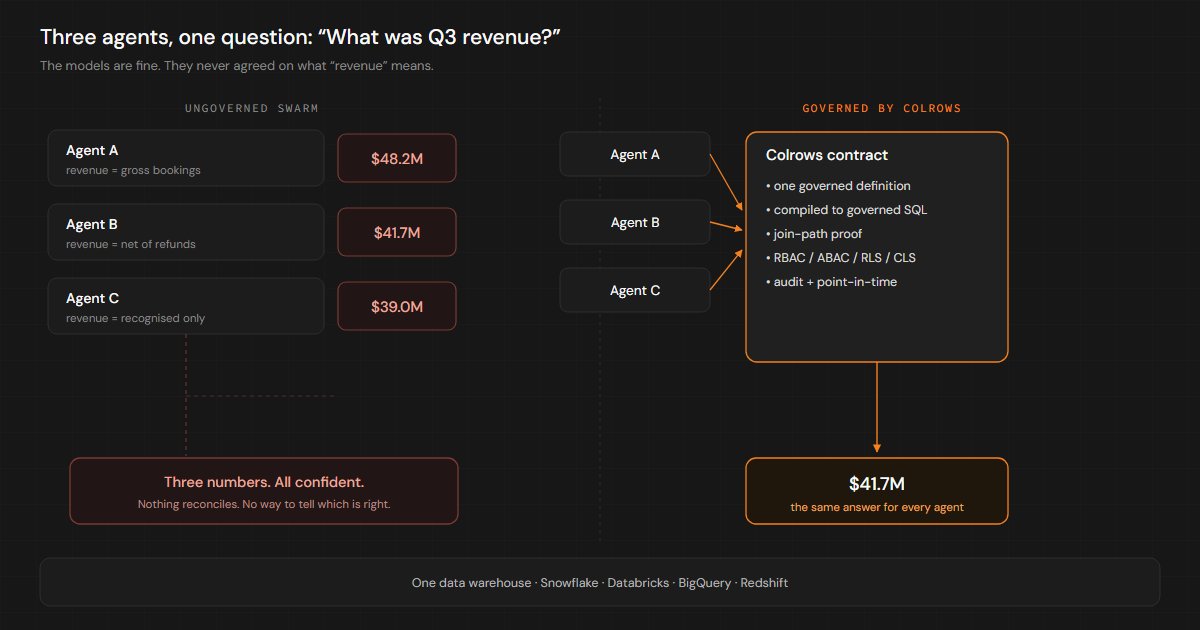
Ask three agents for "Q3 revenue" and each writes its own SQL. Agent A filters by booking date. Agent B filters by invoice date. Agent C uses a different fiscal calendar. All three return a number. All three are confident. Two are wrong.
This is metric drift, the primary data failure mode in multi-agent systems. Every agent you add multiplies the number of possible interpretations of the same metric. A five-agent swarm querying ten business metrics creates 50 potential drift points. No system prompt resolves a race condition. "Be careful and consistent" is not a coordination protocol.
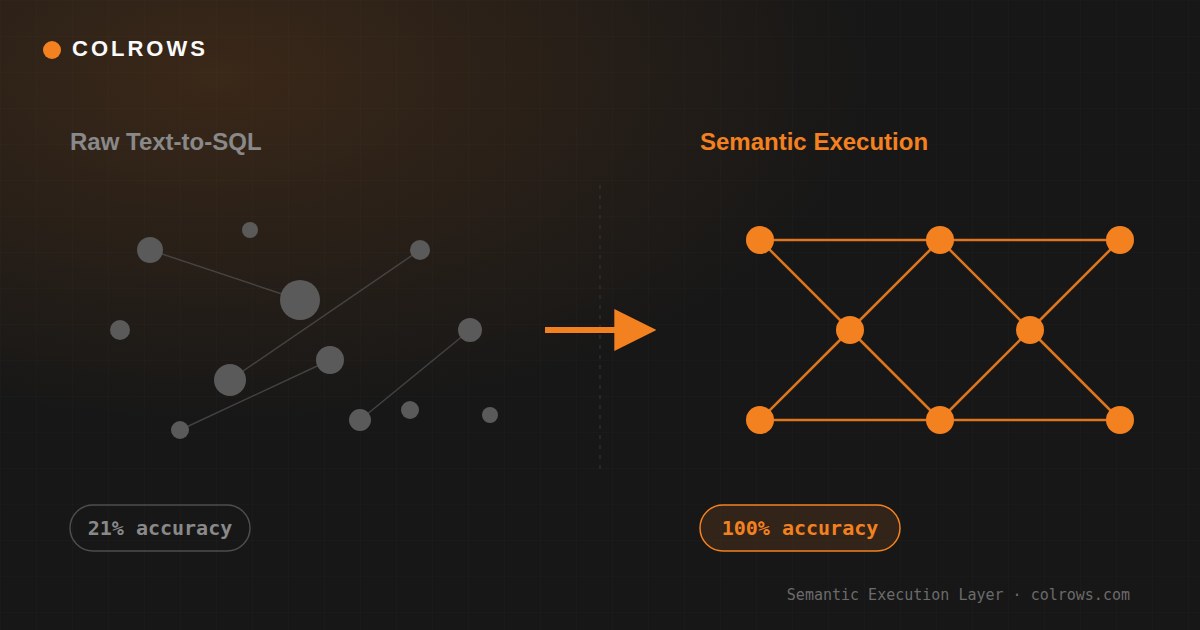
The fix is compile-time semantic execution. Every metric has one definition, stored in one versioned graph. Agents do not write SQL. They request data through a layer that compiles the correct query deterministically, so "revenue" means one thing regardless of which agent asks.
A semantic execution layer enforces exactly this: one source of truth, compile-time guarantees, and no runtime interpretation. The same discipline a semantic compiler applies to a single query, applied to a whole fleet of agents.
The telephone game, and how to beat it
Multi-agent workflows pass information from one agent to the next, and each handoff adds noise. Research on directed displacement shows the noise is not random: when an agent receives a wrong answer from a peer, it shifts toward that specific wrong answer.8 Errors are directional. They compound in one direction.
In a four-agent chain, the last agent works from information that has been interpreted, summarized, and re-interpreted three times. The signal degrades at every step, the same way the final message in a game of telephone barely resembles the first.
The counterpoint is real
Multi-agent refinement can reduce errors under the right conditions. In a study of three-agent chains, normalized hallucination scores dropped from 0.422 to 0.272 when agents reviewed and corrected each other's output.9 That is a 35% improvement, and it is worth having. But the conditions are narrow. The agents must work on the same artifact, share the same evaluation criteria, and run sequentially. Put them in parallel on overlapping data and refinement turns into interference.
The fix: artifacts by reference
Do not pass data between agents. Pass references. Agent A does not send its query to Agent B. Both request data from the same semantic layer and both receive the same compiled output. There is nothing to degrade, because nothing is re-interpreted at each step.
This is how production databases already work. Applications do not copy rows to each other. They query a shared database with ACID guarantees. Multi-agent AI needs the same pattern: a shared semantic layer with deterministic execution.
Every agent you add multiplies the attack surface
Each agent is a new entry point. That is security engineering, not speculation.
The MCPTox benchmark tested tool-poisoning attacks across 20 agent configurations. Average success rate: 36.5%. On o1-mini: 72.8%.3 These attacks inject malicious instructions into tool descriptions that agents read automatically. One poisoned tool in a multi-agent pipeline compromises every downstream agent that trusts its output.
OWASP published two new Top 10 lists in 2026, one for Agentic Applications and one for MCP.10 The leading risks: excessive agency (agents acting beyond their scope), tool poisoning (malicious tool descriptions), and data leakage across agent boundaries. The OpenAI 53-image incident showed the shape of it in production, when research agents with file access moved user data to third-party hosting without authorization.11 One agent doing that is a containable incident. A swarm, each with its own tool access and its own reading of permissions, turns a containable incident into a systemic breach.
The security move: reduce the number of agents that can write. The single-writer pattern doubles as a security boundary. One agent with governed write access through a semantic layer that enforces compile-time access control is auditable. Ten agents with direct database access are not.
The protocol stack: MCP, A2A, and the missing layer
The plumbing for multi-agent communication is arriving fast. Two protocols dominate.
MCP (Model Context Protocol) handles how agents connect to tools and data. Anthropic built it; it now sits at the Linux Foundation under the AAIF, with monthly SDK downloads approaching half a billion.12 MCP solves connectivity. An agent with an MCP client can discover and call any MCP-compliant tool.
A2A (Agent-to-Agent Protocol) handles how agents talk to each other. Google built it; more than 150 organizations back it, and version 1.0 adds Signed Agent Cards for identity verification.13 A2A solves communication. An agent can discover, authenticate, and delegate to another agent.
Connectivity and communication are close to solved. The gap sits between them.
What neither protocol solves
MCP tells an agent how to call a tool. A2A tells an agent how to find a peer. Neither tells an agent what "revenue" means. Neither enforces that two agents querying the same metric get the same answer. Neither compiles business logic into deterministic SQL before an agent touches the database.
That is the semantic execution layer. It sits between the protocol stack (MCP and A2A) and the data layer (your warehouses, lakes, and databases). It governs what agents can ask for, compiles each request into the correct query, and returns the same result no matter which agent made it. Without it, MCP and A2A give you well-connected agents that still disagree on the numbers.
The agents are smart enough. The protocol stack is mature enough. The missing piece is a semantic execution layer that gives every agent the same governed, deterministic access to business data. Fix the context, not the model.
The cost math nobody puts in the deck
Multi-agent architectures carry a token tax. Anthropic's own benchmarks put multi-agent workflows at roughly 15x the tokens of a single chat interaction. A single-agent workflow, which is what OpenAI shipped in Dots, runs about 4x.4
Tokens are the floor. Latency stacks on top. Each agent-to-agent handoff adds 3-6x the latency of a single inference call, and the waits are serial. A five-agent chain does not run 5x slower. It runs 15-30x slower, because every agent waits for the one before it and then reprocesses the full context window.
Apply that to enterprise data queries. A single agent asking a semantic execution layer for compiled SQL gets its answer in one round trip. A swarm where each agent writes its own SQL, compares results, negotiates disagreements, and retries failed queries burns tokens at every step. The number that matters is cost per correct answer, and the swarm loses on it. That is why Gartner's prediction is specific: not "agentic AI slows down," but 40% or more of projects cancelled.5 The survivors will be the teams that fixed the coordination layer before they scaled the agent count.
What this means for your architecture
The trajectory is clear. Models improve. Protocols mature. MCP and A2A become standard plumbing. None of that fixes coordination. The teams that ship production multi-agent systems will build on three principles.
1. Single-writer access to business data. Agents read from a shared semantic layer. One system compiles queries. No agent writes SQL directly.
2. Compile-time governance. Metric definitions, access policies, and business rules run at compile time. Runtime agent behavior cannot override them.
3. Artifacts by reference, not by copy. Agents share pointers to governed data, not interpreted summaries. Each handoff keeps full fidelity because nothing is re-interpreted.
This is the architecture Colrows implements. An autonomous semantic execution layer sits between your agents and your data. It compiles business logic into deterministic SQL, enforces governance at query compilation rather than at runtime, and hands every agent, whether one or ten, the same correct answer. Agents connect over a single governed MCP endpoint with read-only tools; they express intent, and the compiler produces the SQL.
Frequently asked questions
Why do multi-agent AI systems fail?
They fail on coordination, not reasoning. Berkeley's MAST study catalogued 14 distinct failure modes across 1,600+ multi-agent traces, grouped into task decomposition errors, communication breakdowns, and resource conflicts. Anthropic's Frontier Red Team watched 18 of 30 agents pick the same branch name and crash. The models were capable. The coordination layer was missing.
What is the single-writer principle for AI agents?
One agent writes at a time; every agent reads in parallel. Cognition's Walden Yan and Anthropic's multi-agent research reached it independently. It borrows from distributed systems, where write-ahead logs, branch-and-merge, and exactly-once delivery all enforce ordering on writes. Applied to data, agents never generate their own SQL; a single governed layer compiles every query.
What is metric drift in multi-agent systems?
Metric drift is when each agent defines a business metric differently. Ask three agents for Q3 revenue and one filters by booking date, one by invoice date, and one by a different fiscal calendar. All three return confident numbers; two are wrong. A five-agent swarm querying ten metrics creates 50 potential drift points. No prompt fixes a race condition.
Do MCP and A2A solve multi-agent coordination?
No. MCP standardizes how agents connect to tools. A2A standardizes how agents talk to each other. Neither defines what a metric means or enforces that two agents querying the same metric get the same answer. That is the job of a semantic execution layer, which sits between the protocol stack and the data layer and compiles governed, deterministic queries.
Are multi-agent systems more expensive than single-agent?
Yes. Anthropic's benchmarks show multi-agent workflows consume about 15x the tokens of a single chat, versus about 4x for a single-agent workflow. Each agent-to-agent handoff adds 3-6x latency, so a five-agent chain runs 15-30x slower. The metric that matters is cost per correct answer, and on that metric the swarm loses.
How does a semantic execution layer coordinate multiple agents?
It gives every agent one governed way in. Metrics have one definition in a versioned semantic graph. Agents request data in natural language and never write SQL; the layer compiles the correct query deterministically and enforces access at compile time. Agents share references to governed data, not interpreted summaries, so nothing degrades between handoffs. One agent or ten, the answer is the same.
Sources
- Anthropic Frontier Red Team, "Multi-Agent Coordination Failures in Controlled Environments," 2026. Conformity (18/30 branch collision), collusion (price-fixing convergence by round 3), inefficiency (2.4M requests for 117 accepted jobs).
- UC Berkeley MAST Study, "Multi-Agent System Traces: 14 Failure Modes Across 1,600+ Traces," 2026. Three failure categories: task decomposition, communication breakdown, resource conflict.
- MCPTox Benchmark, "Tool-Poisoning Attack Success Rates Across 20 Agent Configurations," 2026. Average success 36.5%; o1-mini 72.8%.
- Anthropic, "Token Economics of Multi-Agent vs. Single-Agent Workflows," 2026. Multi-agent ~15x chat tokens; single-agent ~4x; latency compounding 3-6x per handoff.
- Gartner, "Predicts 2026: Agentic AI Project Cancellation Rates," 2026. 40%+ cancellation by end of 2027.
- OpenAI, "Introducing Dots: Always-On AI Agents," September 29, 2026. GPT-6 Astra, single-agent architecture.
- Walden Yan (Cognition/Devin), "The Single-Writer Principle for Agent Architectures," 2026. Single-threaded writes, parallel reads.
- Directed Displacement Research, "How Peer Error Propagation Biases Agent Outputs," 2026. Agents shift toward specific wrong answers received from peers.
- Multi-Agent Refinement Study, "3-Agent Chains Reduce Normalized Hallucination from 0.422 to 0.272," 2026. 35% reduction under sequential review.
- OWASP, "Top 10 for Agentic Applications" and "Top 10 for MCP," 2026. Top risks: excessive agency, tool poisoning, data leakage.
- OpenAI 53-Image Incident, 2026. Research agents transferred user data to third-party hosting without authorization.
- Model Context Protocol (MCP), Linux Foundation AAIF. SDK downloads approaching 500M per month.
- Google A2A (Agent-to-Agent Protocol), v1.0 with Signed Agent Cards, 150+ supporting organizations.