Native BigQuery AI vs a semantic execution layer on BigQuery
| Dimension | Native BigQuery AI (Gemini in BigQuery) | Colrows on BigQuery |
|---|---|---|
| Reach | BigQuery / Google Cloud data | BigQuery plus 15+ other engines, one graph |
| Governance | IAM, policy tags, column-level security at execution | Compile-time RBAC + ABAC + row/column predicates, before execution |
| Determinism | LLM assistance; generated SQL can vary | Deterministic; same question, same scope, same SQL |
| Join safety | Assistive; author validates joins | Join path proof; ambiguity fails at compile time |
| Semantic model | No full agent-grade semantic layer natively | Autonomous, continuously maintained typed graph |
Why put a semantic layer in front of BigQuery
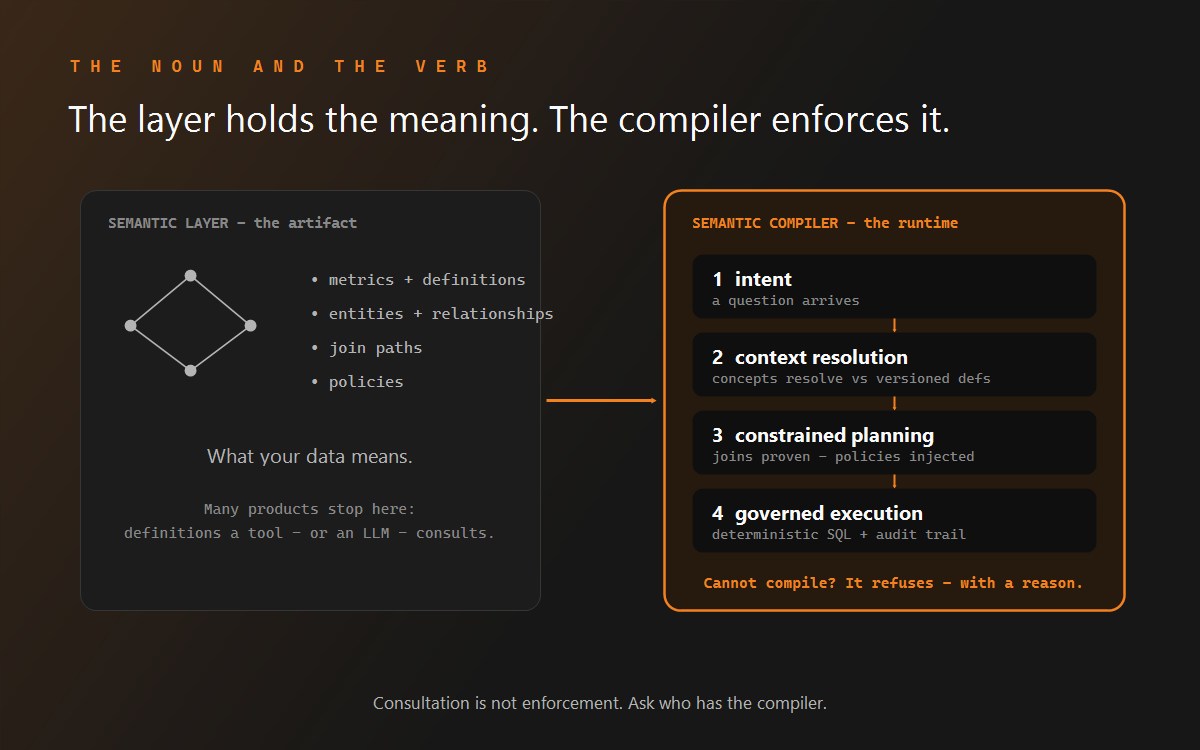
BigQuery has strong governance primitives and a capable SQL engine. What it does not ship is a full, agent-grade semantic layer that turns arbitrary intent into governed, reproducible SQL. Agents need three things the native path leaves to you.
- Reproducibility. Assistive SQL generation is nondeterministic. Agents feeding decisions need the same question to compile to the same SQL every time.
- Governance before access. Column-level security and policy tags protect data at query time. Compile-time shaping prevents an unauthorized plan from being generated at all, so restricted rows are never read.
- Reach. Real questions span BigQuery plus systems outside Google Cloud. A BigQuery-only assistant cannot see them.
The native options and where they stop
Gemini in BigQuery and the data canvas are genuinely useful for analysts writing SQL, and IAM plus policy tags plus column-level security are solid access controls. But there is no native compile-then-execute semantic layer that proves join paths and enforces policy before generation. That is the gap an agent workload exposes. See deterministic vs probabilistic text-to-SQL for why assistive generation is not enough for agents.
Fix the Context, Not the Model. A better model writes better draft SQL for a human. It does not make agent SQL reproducible or provably governed. A semantic layer that resolves meaning and proves the query before it runs does.
How Colrows works on BigQuery
- Dialect-perfect BigQuery SQL. The compile-then-execute pipeline resolves intent against a typed graph and emits BigQuery Standard SQL, and SQL for 15+ other engines from the same graph.
- Governance inherited and extended. Colrows respects BigQuery IAM and column-level controls and adds compile-time RBAC, ABAC, and row/column predicates, so unauthorized plans cannot be generated.
- Join path proof. Cross-dataset questions either prove a deterministic join path or fail at compile time with an explainable error.
- Autonomous maintenance. The graph rebuilds as your BigQuery datasets change, so there is no hand-authored model to babysit.
- Audit and reproducibility. Every answer is point-in-time reproducible with an audit trail.
When BigQuery is not the whole estate
Multi-cloud is the norm. A semantic execution layer lets an agent ask one governed question that resolves across BigQuery and your other systems, deterministically, which a BigQuery-only assistant cannot do. See RAG vs semantic layer for why retrieval alone does not close the gap.
Frequently asked questions
Does BigQuery have a semantic layer?
BigQuery has Gemini assistance and governance primitives (IAM, policy tags, column-level security), but not a full agent-grade semantic layer. Colrows adds compile-time governance, determinism, and cross-warehouse reach.
Why add a semantic layer on top of BigQuery?
For deterministic SQL, join paths proven before execution, governance so restricted rows are never read, and one graph spanning systems outside Google Cloud.
Does Colrows generate BigQuery SQL?
Yes, dialect-perfect BigQuery Standard SQL (and 15+ other engines), inheriting IAM and column-level controls and adding compile-time governance.