
BFSI is where AI meets the hardest evidentiary bar in the enterprise. Supervisors now expect institutions to explain how an automated system reached a decision, to reconstruct that decision months later, and to prove that no one saw data they were not entitled to see. Retrieval and post-hoc guardrails cannot clear that bar, because both reason over the data first and check afterward.
Data AI agents for BFSI, where a wrong answer is a compliance event.
Banks and financial institutions cannot deploy an AI agent that might read the wrong row or invent a number. Colrows compiles governance into the query, so every answer is deterministic, auditable, and traceable to the rules in force when it ran.
01 · The pressure
The regulators moved. The tooling did not.
RBI FREE-AI
Explainability and accountability
India's framework for responsible AI in finance expects decisions to be explainable and accountable, not emitted by an opaque model.
SARFAESI & DRT
Recovery and evaluation logic
NPA evaluation and asset recovery run on statute and precedent. The rules have to be modeled, not approximated by a language model.
BCBS 239
Risk-data aggregation
Risk data must be accurate, complete, and traceable to source. One inconsistent metric definition across systems is a finding.
EU AI Act · MiFID II
Reconstruction on demand
Where they apply, high-risk-system and recordkeeping rules require an institution to reconstruct what a system did, and when.
02 · The architecture
Governance before the query, not guardrails after it.
Colrows sits above your warehouses and databases as a semantic execution layer. It compiles every question, from a person or an agent, into governed SQL: RBAC, ABAC, and row and column predicates are injected before the plan runs, the join path is proven, and a point-in-time audit record is written.
The consequence for a bank is specific. A forbidden account is never read, because the compiler cannot reason over data the identity is not entitled to. A metric means one thing across risk, finance, and the front office, because it is defined once in the graph. And an answer given today can be reproduced next year with the exact definitions and permissions that were in force.
This is what lets a regulated institution put agents into production at all: the enforcement point sits where the agent cannot bypass it.
Guardrail vs. compile-time
| Filters output after the model reads | Enforces access before SQL runs |
| Bypassable by prompt | Structural; not reachable by the agent |
| Metric varies by team | Defined once, consistent everywhere |
| Log review to reconstruct | Point-in-time reproducible by design |
03 · Proof
A confidential ARC, NPA evaluation in hours.
An asset reconstruction company ran retail NPA evaluation over months, with legal, technical, field, and executive judgment living apart. Colrows modeled RBI SARFAESI and DRT logic into the graph and built a governed evaluation workflow, so every bid rationale now ships traceable to regulation, precedent, and the account itself.
>95%
Reduction in evaluation cycle time (months → hours)
100%
Regulatory coverage - RBI SARFAESI & DRT modeled
100%
Auditable reasoning trail behind every bid rationale
More on governed AI for finance.
AI Analytics for Banking: Why BFSI Needs Governed, Auditable, Deterministic AI
In banking, a wrong answer is a compliance event. Proof from a >95% faster NPA deployment.
Read more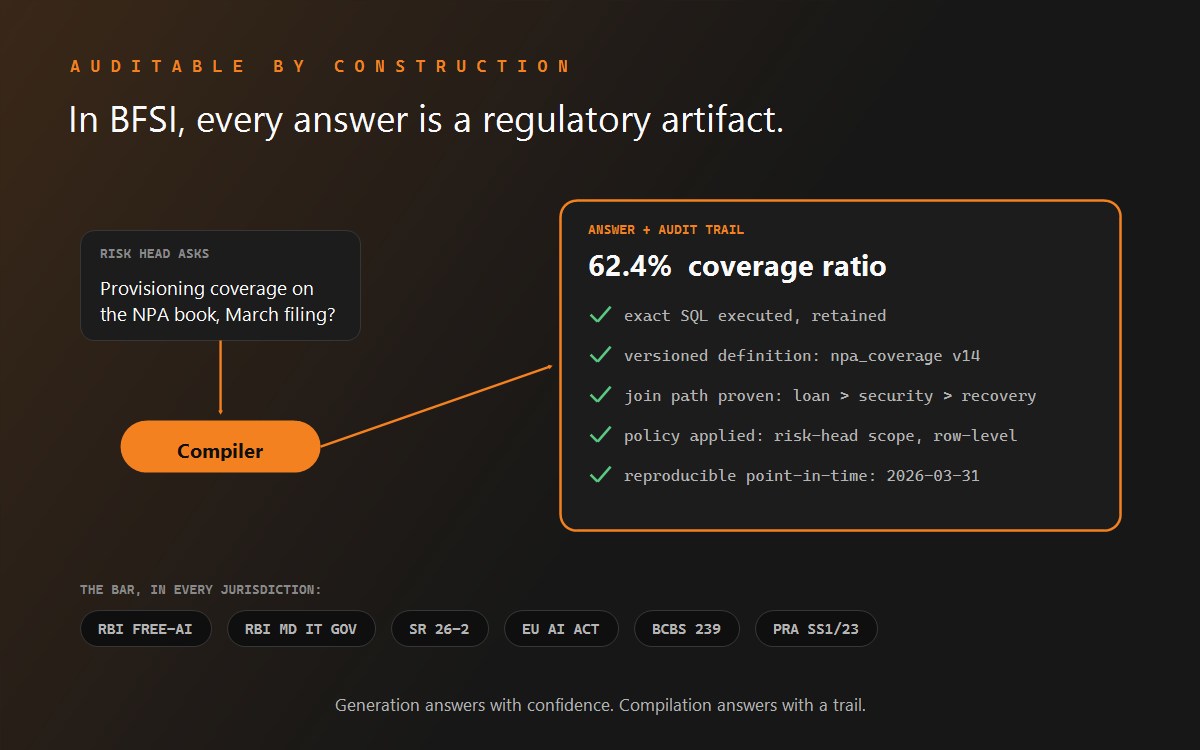
Engineering Auditable SQL for BFSI Conversational Analytics
What RBI FREE-AI, SR 26-2, the EU AI Act, and BCBS 239 require - and the architecture that clears the bar.
Read more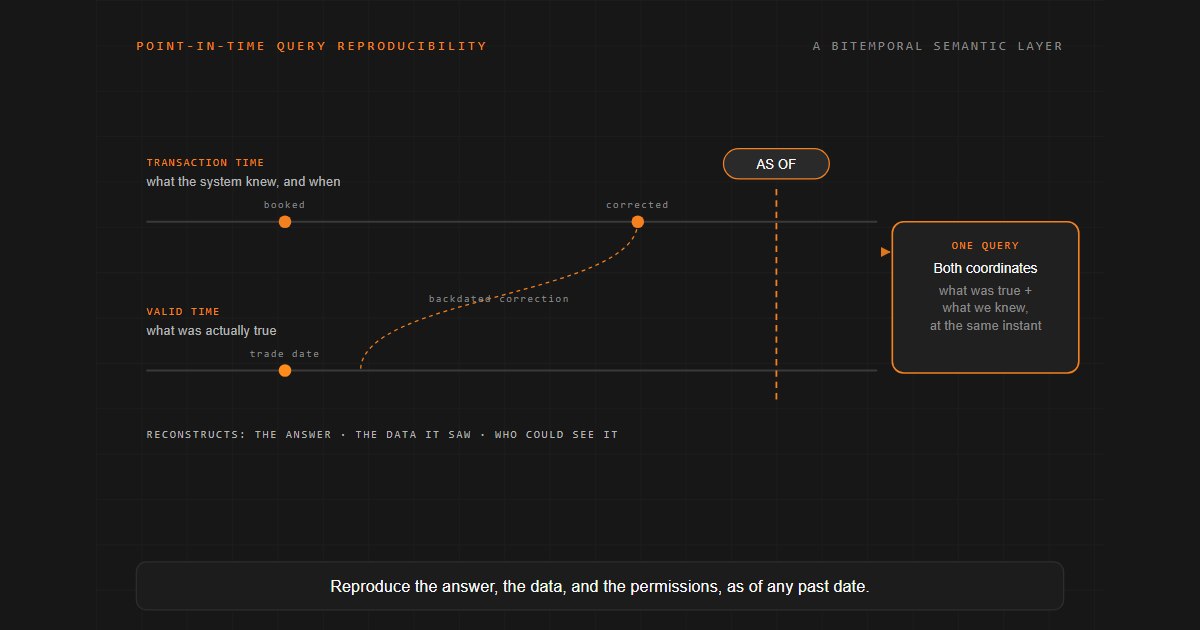
Point-in-Time Query Reproducibility: The Audit Gap Costing Banks Billions
SEC recordkeeping penalties passed $2 billion and MiFID II gives 72 hours to reconstruct a trade.
Read moreQuestions from data leaders in BFSI.
Why can't a bank just add guardrails to an AI agent?
A guardrail runs after the model has already reasoned over the data, so it can be bypassed and it cannot prove what was seen. Colrows enforces RBAC, ABAC, and row and column predicates at compile time, before the SQL runs, so a forbidden record is never read in the first place and every answer carries the rules that were in force.
Which regulations does a BFSI deployment account for?
Engagements model the rules that apply to the workload. For Indian BFSI that has included RBI SARFAESI and DRT logic for NPA evaluation; the framework also maps to RBI FREE-AI guidance, BCBS 239 risk-data principles, and the EU AI Act where those apply. The point is that the regulatory logic is modeled into the semantic graph, not left to the model to infer.
Can we reproduce an answer for an audit months later?
Yes. Every answer is point-in-time reproducible. The audit trail captures the graph version, the identity context, the resolved entities, and the proven join path, so a compliance team can re-run a historical query with the exact definitions and permissions that were in force at that moment.
Put a governed agent in front of your data.
Scope a fixed-scope deployment against your own systems, with the regulatory logic modeled in.